
What this guide answers
- How long should a presentation night run?
Juniors: 90 minutes, absolute maximum two hours, afternoon slot, awards before food loses the room less than the reverse.
- What awards should a junior team give out?
A participation medal for every player, presented individually by their own coach with a sentence about them; one or two performance awards (best & fairest, most improved); one character award (team spirit or coaches'…
- How do we keep presentation night speeches short?
Structure and enforcement: a run sheet with times against every item, a one-minute-per-award brief delivered to every presenter beforehand, a five-minute hard cap on the president's wrap (put the season detail in the…
- Should we charge for presentation night tickets?
For senior nights, yes — a ticket that covers catering keeps the night roughly cost-neutral and, bluntly, ticketed attendees show up.
South Africa edition. This guide is written for volunteer-run clubs in South Africa. Where rules differ — grants, tax, incorporation, safeguarding — follow the South Africa-specific pointers below or check with your national body.
Presentation night is the one event where the whole club is in the same room feeling good about itself — and the event most likely to run ninety minutes over, lose the under-10s to a sugar meltdown before their trophies, and leave the volunteer who organised it swearing "never again". The difference between the two outcomes isn't budget or venue. It's a run sheet, a realistic award list, and about six weeks of unglamorous planning.
This guide is the full playbook: the countdown, the budget, the award categories (including the ones that matter more than best-and-fairest), a minute-by-minute run sheet you can steal, and the traps that sink trophy nights every single year.
Decide the shape of the night
The first planning decision is the only strategic one: one night or two? If your club spans juniors and seniors, seriously consider splitting. The formats want different venues, different running times and different levels of formality, and welding them together is how you get eight-year-olds waiting through senior speeches at 9pm.
In practice that means a junior prize-giving on a Sunday afternoon (90 minutes, a braai, done by four) and a senior awards evening proper — dinner, bar, speeches.
Then set the parameters that drive everything else:
- Date: within two or three weeks of the season ending, while the feeling is still warm. Check against association finals, school holidays and grand finals in other codes your families follow. Lock it early — ideally it's been on the club calendar since pre-season, because you put it there during season planning.
- Venue: clubrooms (cheap, ours, BYO everything) vs function room (catered, licensed, costs real money). Book the moment the date is set.
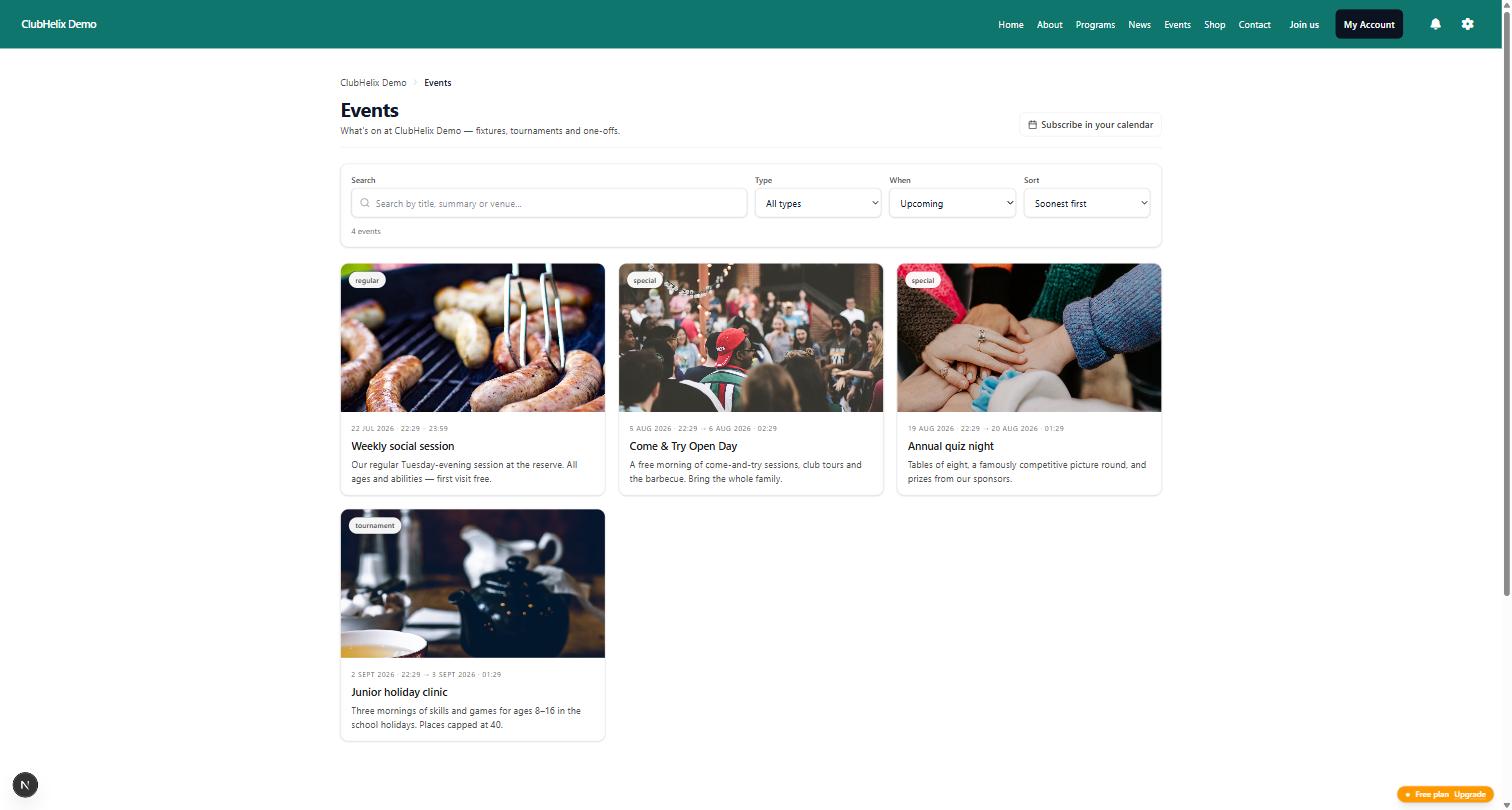
- Ticketing: even free events should be ticketed for a headcount — catering and seating both depend on it. Publish the night as a proper event with RSVP or paid tickets on your club website, and you get numbers, dietary requirements and payment handled in one pass instead of a spreadsheet and a shoebox of cash.

The six-week countdown
- 6 weeks out — confirm date, venue, format and budget (table below). Announce the date to members. Nominate an MC — the single biggest determinant of the night's energy. You want your warmest confident talker, not necessarily the president.
- 5 weeks out — open ticket sales/RSVPs. Confirm award categories with coaches (they need time to think, or you'll get names chosen in the car park). Order trophies now: engravers are the bottleneck of trophy season, and five weeks is the comfortable margin.
- 4 weeks out — book catering (or roster the club kitchen), plan the bar, invite special guests: sponsors, life members, the council rep who approved your lights grant. Sponsors handed a moment on stage renew; sponsors forgotten don't.
- 3 weeks out — collect award winners from coaches (in confidence), start the season slideshow (call for photos club-wide — this is also your best RSVP-reminder excuse), draft the run sheet.
- 2 weeks out — chase RSVPs with a "sales close Friday" push. Confirm final numbers with the caterer. Write scripts for the MC: every award, every name, phonetically checked — a butchered name on stage is remembered for years.
- 1 week out — trophies collected and checked against the winners list (engraving errors surface now, not on the night). Print the run sheet. Confirm AV: microphone, speakers, screen for the slideshow, and a backup for each.
- Day before — room setup, trophies laid out in run-sheet order (this matters more than any other logistics detail), AV tested in the actual room with the actual laptop.
The budget table
Realistic numbers for a community club senior night, ~120 attendees, function-room format. Scale to taste; the ratios are the useful part.
| Item | Typical cost | Notes |
|---|---|---|
| Venue hire | $0–$800 | $0 if clubrooms — the strongest argument for them |
| Catering | $25–$55/head | Buffet beats plated for cost and pace |
| Trophies & engraving | $8–$20 each | Perpetual trophy engraving adds ~$15/line |
| AV (mic, speakers, screen) | $0–$400 | Often free with the venue — confirm, don't assume |
| Decorations & printing | $100–$300 | Club colours, table runners, printed programs |
| MC / entertainment | $0–$500 | A club personality for free beats a hired stranger |
| Photographer | $0–$300 | A parent with a good camera + a shot list works |
| Contingency | 10% | Something always comes up |
Fund it honestly: ticket price typically covers catering; the club (or a night sponsor — "Awards presented by [local business]" is an easy sell) covers trophies and extras. Decide upfront whether the night is a fundraiser, cost-neutral, or a club gift to members — all three are legitimate, but mixing them mid-planning is how budgets blow out.
Award categories: beyond best-and-fairest
Every club has its performance awards. The clubs whose nights people love are generous with recognition awards too — they cost a trophy each and they're the ones families talk about on the way home.
Performance awards (per team):
- Best & Fairest (plus runner-up)
- Coaches' Award — the player who did everything asked, in the coach's words
- Most Improved — often the loudest cheer of the night
Character and contribution awards (per team or club-wide):
- Team Spirit / Best Clubperson (junior and senior editions)
- Volunteer of the Year — presented early and prominently, not as an afterthought
- Rising Star (best first-season player)
- Coach's/Manager's thank-you — every junior coach and manager named on stage
- Milestones — 50/100/150 games, life memberships, retirements. These are the emotional peaks of the night; schedule them deliberately.
Fun awards (juniors especially, one per team max):
- Golden Boot / Golden Arm / most goals-runs-tries
- Best Celebration, Muddiest Player, Best Team Photo Face
- The "Sat-Nav Award" for the family who drove furthest all season
Two rules keep award lists healthy. First, every junior gets something — a participation medal per player, handed over by their own coach with eye contact and a sentence, means every family goes home with a moment. Second, cap the categories: more than four or five awards per team turns the night into a conveyor belt and devalues all of them.
The run sheet
The run sheet is the night's constitution: one page, timed to the minute, taped next to the trophy table and in the MC's hand. Steal this senior-night version (juniors: compress to 90 minutes, awards before food, done by late afternoon):
| Time | Item | Who |
|---|---|---|
| 6:30 | Doors, drinks, season slideshow looping | Bar crew, AV |
| 7:00 | Welcome, acknowledgements, sponsor thank-yous | MC |
| 7:10 | President's season wrap — five minutes, hard cap | President |
| 7:15 | Dinner served; slideshow continues | Caterer |
| 7:50 | Awards block 1 — junior-adjacent & lower grades | MC + coaches |
| 8:20 | Milestones & life memberships | President |
| 8:35 | Volunteer of the Year | MC |
| 8:45 | Dessert / raffle draw | MC |
| 9:00 | Awards block 2 — senior grades, club champion | MC + coaches |
| 9:30 | Closing thanks, next-season teaser ("registrations open [date]") | President |
| 9:35 | Music up, bar open, dance floor | Everyone |
Run-sheet craft, learned the hard way:
- Trophies laid out in run-sheet order with a runner handing them to the presenter. Every on-stage rummage costs thirty seconds and all momentum.
- Speeches have caps and the MC enforces them. Brief every presenter: one minute per award — say why, name the winner, shake hands, photo, next.
- Photograph systematically: a designated photographer, a fixed photo spot with the club banner behind, every winner. These photos are your website news post, your social content, and your sponsorship deck for the next pre-season.
- Alternate the emotional register: fun award → serious award → milestone → fun. Forty identical presentations in a row flatlines any room.
The traps that sink trophy nights
- The night runs long. Cause: uncapped speeches and too many awards. Cure: the run sheet, an empowered MC, and category discipline.
- A name is mispronounced or misspelled on a trophy. Cure: winners list checked against engraving at one-week-out, phonetic notes in the MC script.
- The AV fails. Cure: test in the room the day before; have the slideshow on two devices; know where the venue's spare mic lives.
- Nobody RSVPs until the last minute. Cure: real ticketing with a published cutoff, early-bird pricing if paid, and a "caterer needs numbers Friday" push that names the actual constraint.
- The organiser does everything. Cure: presentation night is a sub-committee of four (MC/program, catering/venue, trophies/awards, tickets/comms), not a person. Write the roles down — then hand the file to next year's four, along with the debrief notes you'll capture in the end-of-season report.
Frequently asked questions
How long should a presentation night run?
Juniors: 90 minutes, absolute maximum two hours, afternoon slot, awards before food loses the room less than the reverse. Seniors: three hours of program (7:00–9:30-ish) then social time — the awards themselves should never exceed about 90 minutes of stage time in total. If your award count won't fit, cut categories or split junior and senior nights; don't stretch the night.
What awards should a junior team give out?
A participation medal for every player, presented individually by their own coach with a sentence about them; one or two performance awards (best & fairest, most improved); one character award (team spirit or coaches' award); and at most one fun award. The sentence from the coach matters more than the trophy — it's the part the child remembers. Avoid ranking-style awards proliferating in young age groups; the fun and character awards carry the night.
How do we keep presentation night speeches short?
Structure and enforcement: a run sheet with times against every item, a one-minute-per-award brief delivered to every presenter beforehand, a five-minute hard cap on the president's wrap (put the season detail in the written report instead), and an MC with explicit committee backing to move things along. The single best trick: schedule the item after each speech on the run sheet — a speaker with a visible successor wraps up.
Should we charge for presentation night tickets?
For senior nights, yes — a ticket that covers catering keeps the night roughly cost-neutral and, bluntly, ticketed attendees show up. For junior afternoons, free or gold-coin entry with a sausage sizzle is the norm, but still take RSVPs so you can cater and seat properly. Either way, run it through your club's online event system so numbers, payments and dietary notes arrive without a volunteer decoding a group chat.
ClubHelix handles the boring half of trophy night — an events page with RSVPs and paid tickets on your club website, headcounts and payments reconciled automatically, and every attendee already in your member database. Start free and have next season's whole calendar, presentation night included, online in an afternoon.


