
What this guide answers
- How do you run a photo competition in a camera club?
Publish the sections, grades, file specification and deadline for the whole season in advance.
- How should photo competitions be judged?
Most clubs use an external judge who marks each image and comments briefly, with awards receiving longer discussion.
- Who owns the copyright in club competition images?
The photographer does. A club should never claim ownership.
- What should a camera club charge for membership?
Enough to cover hall hire, judge costs, affiliation, insurance and the website, with a small surplus for exhibitions and equipment.
- How do you keep beginners in a camera club?
Grade the competitions so beginners are not marked against experienced exhibitors, offer a pre-deadline image review with a mentor, pair every new member with a buddy for their first few months, and run short practical…
Canada edition. This guide is written for volunteer-run clubs in Canada. Where rules differ — grants, tax, incorporation, safeguarding — follow the Canada-specific pointers below or check with your national body.
Ask a camera club member why they turn up on a Tuesday and they will tell you it is for the company, the outings, the tips about lenses. Watch what actually happens and you will see something narrower and more powerful. Twice a month, a person who would otherwise photograph nothing has a deadline, and a fortnight later a stranger with some standing tells them, in front of the room, what is working in their picture and what is not.
That is the product. A camera club sells a deadline, honest feedback and somewhere to show the work — and everything that goes wrong in a camera club goes wrong in one of those three places. Rules that are ambiguous produce arguments instead of pictures. A judge who was not briefed produces a bruising night that costs you four members. A club website that shows nothing but a logo and a meeting address produces no new members at all.
This guide is for the committee of a community camera club or photographic society, new or long-established. It covers a competition system that survives contact with a hundred entries, entry handling that does not eat somebody's weekend, judging and scoring that helps rather than deflates, an outings and workshop program with a mentoring culture underneath it, and the exhibition, image-rights and online-display decisions that decide whether members are proud to be associated with the club.
Build the competition system first
Everything else in a camera club orbits the competition calendar, so design it deliberately. Three decisions do most of the work.
Sections — what people enter into
| Section type | Typical division | Why clubs run it |
|---|---|---|
| Open | Anything goes | The baseline — nobody is ever locked out |
| Set subject | A theme announced six to twelve months ahead | Forces work outside a comfort zone, creates conversation |
| Monochrome | Greyscale and toned images only | Different craft, rewards different members |
| Nature or wildlife | Strict rules on staging and manipulation | Serious discipline with genuine standards attached |
| Photojournalism or documentary | Minimal editing, story required | The section that most needs written rules |
| Creative or altered reality | Composites and heavy manipulation encouraged | Gives the digital artists their own room |
| Physical prints, mounted to a stated size | The section that most improves people, and the one clubs drop first | |
| Audio-visual or sequence | A set of images or a short slideshow | Suits members who think in narrative |
Two or three sections per competition night is plenty. Running eight sections means each gets four minutes of judging and nobody learns anything.
Grades — so beginners are not judged against exhibitors
Grade members rather than throwing everyone in together. A simple, common structure is three grades with published promotion rules: a member is promoted when they win a set number of awards in a season, and can request a move up at any time. Publish the promotion rule and apply it mechanically. The moment promotion becomes a committee judgement call, it becomes a grievance.
The rules that must be written down
Ambiguity is where camera clubs get ugly. Put every one of these in a rules document that lives on the club website, dated, with a version number:
- Authorship. The entrant must have made the image. Every element in a composite must be the entrant's own capture unless the section explicitly permits otherwise.
- Capture window. Most clubs allow images made within the last two to four years. Say which.
- Re-entry. Whether an image that has previously scored or been awarded in your club can be entered again, and after how long. Whether a near-identical variant counts as the same image.
- Editing limits per section. Nature and documentary sections need explicit limits — what cloning, adding or removing is permitted, and what is not.
- Generative and computational tools. Decide the club's position, write it down and apply it per section rather than club-wide. Most clubs land on something like: generative fill and synthetic elements are not permitted in open, nature or documentary sections, and are permitted in a creative section provided the base capture is the entrant's own. Whatever you choose, requiring entrants to keep the original raw file and produce it on request is the enforceable part.
- Titles. A character limit, and a rule that the title must not identify the entrant.
- Anonymity. Entries are judged without the maker's name visible. This matters more than any other single rule.
- Late entries. Whether the deadline is real. Make it real.
Review the rules once a year, at a set meeting, with proposed changes circulated a fortnight beforehand. Changing rules mid-season is how committees lose the room.
Handling entries without losing a weekend
The entries officer is the most quietly heroic role in a camera club, and the job is almost entirely avoidable pain caused by inconsistent files.
Publish a single specification and hold to it:
| Setting | Typical club specification |
|---|---|
| File type | JPEG |
| Dimensions | A stated maximum width and height in pixels, longest edge fixed |
| Colour space | sRGB, embedded |
| File size | Under a stated cap, so a night of entries fits on a laptop |
| Filename | A strict pattern — grade, section, sequence, title |
| Print mounts | A stated board size and thickness, label on the back top-left |
| Deadline | A fixed day and time, published for the whole season at once |
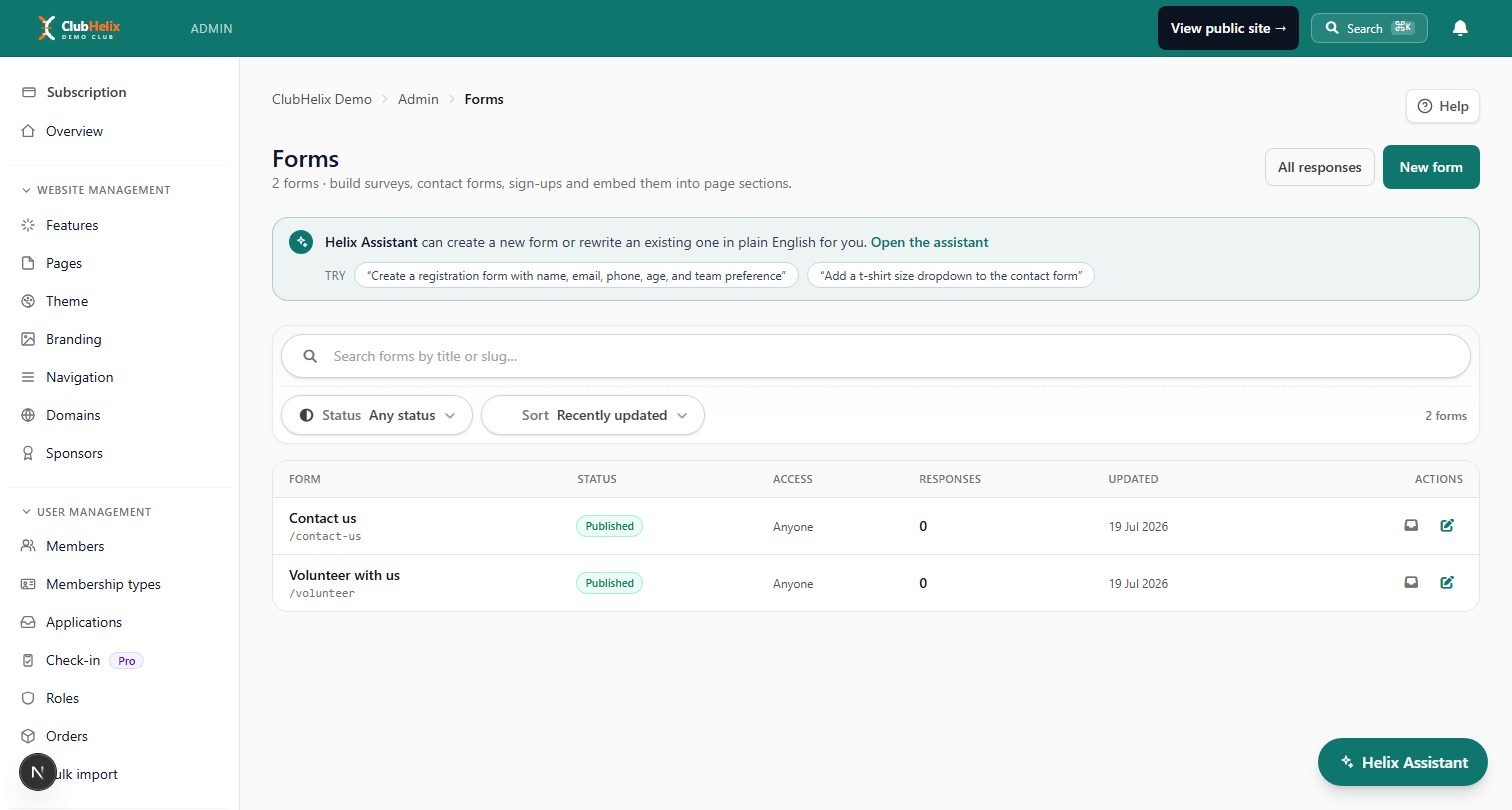
Then collect the entries with a form rather than by email. Email entries mean chasing attachments, resizing other people's files at 11pm and a folder full of images called DSC_0492.jpg. An online entry form with the fields you actually need — grade, section, title, the file, and a tick to confirm the rules — gives the entries officer one tidy list and gives the entrant a confirmation they can point to. ClubHelix forms and surveys handles exactly this shape of collection, and the same tool runs your set-subject suggestions ballot and end-of-season feedback.
A workable weekly rhythm for the entries officer: entries close Wednesday night, files checked and renamed to anonymous sequence numbers on Thursday, the anonymised set goes to the judge on Friday, the judge returns scores the following Wednesday, and the results are published the morning after judging night. Anonymising before the judge ever sees a name is not optional if you want people to trust the result.

Judging and scoring that helps rather than deflates
A judging night is a public act of criticism in front of a member's peers. Done well it is the single most valuable hour in club photography. Done badly it ends a hobby.
Choose a judging model on purpose
| Model | How it works | Strength | Weakness |
|---|---|---|---|
| Single external judge | One accredited or experienced judge marks and comments | Consistent voice, real authority | One person's taste dominates the night |
| Panel of three | Three judges score independently, marks combined | Smooths out taste, fairer at the top | Harder to book, slower, less commentary |
| Rotating internal judging | Members judge other grades' work | Cheap, builds judging skill in-house | Awkward, and taste bias is obvious to everyone |
| Peer scoring | Everyone present scores every image | Engaging, no booking required | Popularity contest, thin feedback |
| Portfolio review night | No scores at all — structured discussion of each image | The most useful format for improving | Feels unrewarding to competitive members |
Most healthy clubs mix them: external judges for the main competitions, one internal night per season to develop judges, and at least one no-score review night a year, which is often where the real teaching happens.
Scoring scales, and the tie problem
Two common approaches. A numeric scale — commonly out of ten, sometimes fifteen — gives you a season aggregate for a points trophy and a clear ranking. An award-tier system — accepted, merit, honour — avoids arguments about whether an image is a seven or an eight and travels better between judges. Numeric scales need a stated tie-break rule, published in advance, or your season aggregate will end in a dispute. The standard is the higher number of top awards, then the higher single score, then a shared placing.
Brief your judge. Every time.
Most bad judging nights are briefing failures rather than judge failures. Send this, a fortnight out:
Thank you for judging on [date]. The club runs three grades and two sections — [details]. There are [n] images in total, anonymised. We are asking for a mark out of ten and roughly forty-five seconds of comment per image, with two or three minutes on each award. Our members are mostly [beginner-to-intermediate / experienced], and we specifically value comments that name one concrete thing the maker could change. Please avoid comments on equipment. Our nature section rules are attached — cloning of any element is not permitted in that section. Please return marks by [date] using the attached sheet. Parking is [details], we start at [time], and the club pays [fee or travel arrangement].
What makes commentary useful
The habit worth teaching every judge and every internal reviewer is a three-part comment: name what the image is trying to do, name the strongest thing in it, then name one specific change. Not three changes, one. Specific means "the horizon sits exactly halfway and the sky is the more interesting half", not "consider your composition".
Two things to head off before they hurt the club. First, brief judges away from equipment commentary — it teaches nothing and makes newer members feel poor. Second, protect the low scorers. A member who receives a five in silence in front of forty people will not return. Some clubs publish only awards on the night and release full marks privately afterwards, which is a small change that keeps people in the room.
Outings, workshops and the mentoring culture
Competitions produce images. Outings and workshops produce photographers, and they are what a member joins for in their first three months, long before they care about a points trophy.
An outings program with a shape
Plan the year around light and access rather than around dates. A workable annual pattern for a club that meets fortnightly:
| Outing type | What it teaches | Frequency |
|---|---|---|
| Golden-hour landscape | Planning, filters, patience | Quarterly |
| Night and astro | Long exposure, focus in the dark, safety | Twice a year |
| Street and market | Nerve, consent, working fast | Quarterly |
| Studio or lighting | Control, modifiers, working with a model | Twice a year |
| Macro and close-up | Depth of field, stacking, patience again | Twice a year |
| Wildlife or bird hide | Field craft, long lens technique, ethics | Twice a year |
| Architecture at blue hour | Perspective correction, mixed lighting | Annually |
| Sports or motion | Panning, tracking, shutter discipline | Annually |
Run each outing with a named leader, a published meeting point and finish time, a stated difficulty and walking distance, and an honest line about what gear is genuinely needed. Sort out access before you publish — reserves, private land, industrial sites, markets and many public gardens have permit or permission requirements for group photography, and turning up with fifteen tripods without asking is how clubs get banned from a location permanently.
Take a headcount. Not for bureaucracy — for the walk back in the dark. Publish outings as events on the club site with RSVPs, and the leader knows who is expected, who is car-sharing and whose emergency contact they hold.
Workshops that people actually attend
Short, practical and repeated beats long, comprehensive and annual. A rolling program of one-hour workshops before the main meeting works well: camera basics for absolute beginners, exposure and metering, one editing session per tool the club actually uses, printing and soft proofing, mounting and matting for print competitions, and a "prepare your competition entry" clinic a fortnight before each deadline. That last one lifts overall standard more than any other single intervention.
Mentoring, made deliberate
The culture that keeps members past year one is not accidental. Three things make it real:
- A buddy for every new member for their first three months — someone who greets them, sits with them on judging night and explains what just happened.
- A pre-entry review offer. Any member can send an image to a nominated mentor before the deadline and get one honest opinion. Half of the sting of a low score is not knowing it was coming.
- A first-year rule for the committee. Every new member gets asked, personally, to come on one outing. Not a general invitation — a specific ask, for a specific date.
Ask members what they want from the program rather than guessing; how to run a member survey has a workable structure for a short annual one.
Exhibitions and showing the work
An exhibition is the single best recruitment tool a camera club has, because it puts the work in front of people who have never thought about joining a club.
Venues that reliably say yes: libraries, community and arts centres, council foyers, hospital and university corridors, cafes and wine bars, garden centres, and the foyer of a theatre. Corridor and cafe venues are free, low-effort and low-security. A proper gallery slot is a bigger commitment with better results.
Budget lines to plan for, in rough order of size:
| Line item | Notes |
|---|---|
| Printing and mounting | The largest cost — decide whether the club or the maker pays |
| Framing | Standardise on one frame size and colour and the show looks twice as good |
| Hanging system | Ask the venue what is permitted before you buy anything with a nail in it |
| Labels and signage | Title, maker, and a one-line caption — printed identically, not handwritten |
| Opening event | Drinks, a short speech, and the club's join form on the table |
| Insurance | Ask your insurer whether members' works on display off-site are covered |
| Invigilation | Volunteer roster if the venue requires a presence |
Two practical rules. Standardise mounts and frames across the whole show, even if the images vary wildly — inconsistent framing is what makes a community exhibition look amateur. And decide the sales question in advance: whether works are for sale, what commission (if any) the venue or the club takes, who handles the money and who arranges delivery. Write it into the exhibition terms every exhibitor signs.
Image rights, credit and consent
This is the area where clubs are most casual and most exposed, and it is easily fixed with one clear clause and one clear habit.
Copyright stays with the maker. The club never owns members' images. What the club needs is a licence — permission to use the image for specific purposes. Put a plain-language version in your membership terms, something like:
By entering an image in a club competition, you grant the club a non-exclusive, royalty-free licence to reproduce that image for club purposes — on the club website and social channels, in club newsletters, in club exhibitions and in entries to interclub competitions — always with your name displayed as the maker. You keep copyright and every other right. You may withdraw an image from club use at any time by asking the secretary in writing.
Credit every image, everywhere. Name on the website, name on the label, name in the newsletter. It costs nothing and it is the currency members actually care about.
Third-party competitions and sponsor "opportunities" deserve a hard look. Some external competitions and brand promotions ask entrants to grant broad, perpetual, transferable licences. Read the terms before the club promotes anything to its members, and tell members plainly what they would be granting.
Photographing people. Consent norms and privacy law differ by place and by context, and the rules for photographing children are stricter everywhere. As general information — get a written model release for anything you plan to exhibit, publish or enter, be conservative with images of children and always deal with a parent or guardian, and remember that a location's permission is separate from a person's consent. Check the specifics with your national photographic body or the relevant privacy regulator rather than relying on what someone at the club heard.
Drones. Flying for club outings is subject to your national aviation regulator's rules, plus whatever the landowner permits. Confirm both before an outing includes a drone.
In Canada, clubs usually affiliate to the national association, which runs competitions, a judging program and a distinctions pathway, and many also join a provincial or regional grouping for interclub work. Federal and provincial privacy law applies to how the club handles members' personal information, and commercial use of an identifiable person generally requires consent, with stricter expectations in some provinces. Written releases are the simplest way to stay comfortable, and bilingual labelling is worth the effort in officially bilingual areas.
Membership, money and the club night
Camera club costs are modest and predictable: hall hire, judge fees or travel, affiliation, insurance, competition software or storage, exhibition costs and the website. Income is subscriptions, occasional workshop fees, exhibition sales commission and the odd sponsor.
Two habits are worth adopting. Offer a first-year rate or a free trial night, because the barrier to walking into a room of people with expensive cameras is higher than committees remember. And bill annually online rather than collecting cash at the door — online membership and self-registration means the treasurer stops chasing and the entries officer always knows who is a current member.
Two practical scheduling notes for a club in the northern half of the world. The club season conventionally runs from early autumn to late spring, with the competition calendar closing before the light evenings arrive and attendance drops — use the summer for outings, exhibitions and workshops rather than trying to hold judging nights nobody comes to. Golden hour is generous around the equinoxes and brutally short in midwinter, so plan landscape outings accordingly and keep a bad-weather indoor alternative for every winter date.
Showing the work online — and why the club site is the exhibition that never comes down
A camera club with no online gallery is invisible. Social feeds crop the work, compress it, bury it a week later and give the platform the audience. A club website does the opposite: full-width images, the maker's name attached, a permanent link, and search engines that send strangers to it for years.
What a good camera club site carries: the current season's competition results with the awarded images, a gallery per outing, the rules document, the set subjects for the next twelve months, the workshop program, and a genuinely clear "how to join and what happens on a Tuesday" page. Keep image dimensions sensible for the web, keep the maker's name in the caption, and think about whether you want full-resolution files available for download — most clubs display a web-sized version and keep the originals with the maker.
For the practical side of getting good pictures of the club itself — meetings, outings, the exhibition opening — how to take good club photos is worth passing to whoever holds the camera at social events, and free images for club websites covers the licensing traps when you need a photo the club did not make.
Putting the season on one site
The recurring jobs in a camera club are all list-shaped: collect entries against a deadline, publish results and awarded images, take names for outings, sign people up for workshops, renew subscriptions and email the club when the set subject changes. Doing that across a spreadsheet, an inbox and a social group is why entries officers burn out. ClubHelix puts them in one place — forms and surveys for competition entries and the set-subject ballot, events for outings and workshops with a headcount, the canvas page editor for galleries and results pages that show the work at a decent size, and a members list that tells you at a glance who is financial and which grade they are in.
There is a free tier that comfortably covers a club of this size, honest pricing if you outgrow it, and no advertising wrapped around your members' pictures. If your current site is a page somebody built in 2014 and nobody has the password for, set up a new club site — a season page, a results gallery and a working entry form is an evening's work, and the hobby and interest clubs page shows the wider picture.
Frequently asked questions
How do you run a photo competition in a camera club?
Publish the sections, grades, file specification and deadline for the whole season in advance. Collect entries through an online form, anonymise them before the judge sees them, brief the judge in writing, and publish results and awarded images within a day of judging night. The two things that most affect fairness are anonymity and a published tie-break rule, and the two things that most affect goodwill are how gently low scores are handled and whether the rules changed mid-season.
How should photo competitions be judged?
Most clubs use an external judge who marks each image and comments briefly, with awards receiving longer discussion. Panels of three smooth out individual taste but are harder to book. Whichever you use, brief the judge on your grades, sections and rules, ask for one concrete, specific suggestion per image, and steer them away from commenting on equipment. A no-score portfolio review night once a season is often the most useful evening of the year.
Who owns the copyright in club competition images?
The photographer does. A club should never claim ownership. What the club needs is a written, non-exclusive licence to use entered images for club purposes — the website, newsletters, exhibitions and interclub entries — always credited to the maker, and revocable on request. Put that clause in the membership terms so every member has agreed to it before they enter.
What should a camera club charge for membership?
Enough to cover hall hire, judge costs, affiliation, insurance and the website, with a small surplus for exhibitions and equipment. Most clubs charge an annual subscription, offer a discounted first year or a free trial night, and reduce rates for students and concession holders. Publishing what the subscription pays for removes almost all resistance to a rise when one is needed.
How do you keep beginners in a camera club?
Grade the competitions so beginners are not marked against experienced exhibitors, offer a pre-deadline image review with a mentor, pair every new member with a buddy for their first few months, and run short practical workshops before the main meeting. Ask new members personally to come on one specific outing rather than issuing a general invitation. Most people who leave a camera club decide to in their first three months.
Keep reading — how to run a film society covers the licensing and season-programming side of a screen-based club, and how to run a birdwatching club tackles outings, access permissions and beginner-friendly field trips in depth.

