
What this guide answers
- Do you need a qualification to coach parkour?
There is no single answer across markets, and in several the venue and the insurer set the bar rather than a governing body.
- How do you run a parkour club safely without an indoor venue?
Grade every session by tier, keep the first weeks at knee height, drill landing and rolling every single session, and walk the site before anyone trains on it.
- What should a parkour waiver include?
Participant and guardian details, medical conditions and emergency contacts, a plain-language description of the actual risks, agreement to club rules including the tier system, and a separate opt-in for photography.
- How do you get permission to train in public space?
Ask in writing, early, and low on the ladder. Name your club, your session times, your group size, your insurance and your coach's qualification, and commit to off-peak times, no marks, no litter and leaving when asked.
- At what age can children start parkour?
Coached programs commonly start around six or seven with heavily bounded, ground-level movement, and the useful question is not age but supervision ratio and progression discipline.
New Zealand edition. This guide is written for volunteer-run clubs in New Zealand. Where rules differ — grants, tax, incorporation, safeguarding — follow the New Zealand-specific pointers below or check with your national body.
A set of low walls behind a library, a coach in a club shirt, fourteen teenagers doing quiet landings onto a strip of grass, and a security guard walking towards you with a question. How that conversation goes decides more about your club's next two years than any drill you teach that morning.
That is the honest reframe for parkour. The movement side is the part you already know: you can teach a precision jump, you can build a warm-up, you can spot a cat leap. What turns that into a club is legitimacy — a coach with a qualification, a session plan with graded progressions, a waiver on file, a written relationship with whoever owns the ground you train on, and a parent who can explain to another parent what their kid actually does on Saturday. Every one of those is administrative work, and none of it is why you started.
This guide is for the person building that scaffolding: coaching progressions and risk-graded session design, training in public space and the permissions and perception that come with it, and the waiver, minors and parent-expectation layer that lets you take under-eighteens seriously. It assumes you are volunteer-run, short on money, and doing this because the alternative is watching the sport happen without any adults in the room.
What a parkour club is actually selling
Parents do not enrol a twelve-year-old in parkour because they want them jumping between rooftops. They enrol them because their kid is already climbing on everything and they would rather that happened with a coach present. Coaches at established clubs know this and lean into it: what you sell is graded progression and supervision, and the movement is how you deliver it.
That framing changes how you describe yourself everywhere — on your website, in the letter to a landowner, in the first conversation with a parent. Three lines do most of the work:
- We teach how to land before we teach how to jump. Landing mechanics, rolls and controlled descent are in every session, at every level.
- Height and difficulty are earned, not chosen. Members work within a published tier, and a tier moves when the coach says the technique holds, not when the member feels brave.
- We train where we have permission to train, and we leave it as we found it. No rooftops, no private property, no locations where someone has asked us not to be.
Put those three lines on your homepage and repeat them at the start of every taster session. They defuse most of the objections you will ever get, and they are also, conveniently, a good club.
Coaching, qualifications and ratios
The single largest jump in credibility a parkour club can make is having a qualified, insured coach whose credential you can name in writing. It matters to parents, to insurers, to venues and to whoever is deciding whether your group is allowed back next month.
Whatever pathway you use, track it. Keep a register of every coach with their qualification, the expiry dates of their first aid and CPR certificates, and their background screening status, set to remind you before anything lapses — a coach with an expired certificate is a coach you cannot roster. Accreditation tracking does this against the member record.
Ratios are the other coaching decision people skip. A working starting point for community sessions, to be adjusted for the group and the site:
| Group | Coach to participant | Notes |
|---|---|---|
| Under 8 | 1 to 6 | Second adult present at all times, tightly bounded training area |
| 8 to 12 | 1 to 8 | Assistant coach for any session using height or apparatus |
| 13 to 17 | 1 to 10 | Second adult on site, especially in public space |
| Adults | 1 to 12 | Tighten for beginners, technical rail work or an unfamiliar spot |
Add one rule on top: a session in public space always has two adults, regardless of ratio, because one of them may have to leave with an injured participant while the session continues.
Coach qualification for parkour in New Zealand is not standardised the way it is in older sports. Most clubs combine gymnastics or fitness coaching accreditation with a current first aid certificate and whatever parkour-specific coach course they can access. Ask your insurer what they will accept before you build a pathway, and talk to your regional sports trust about recognition and facility access.
Designing a risk-graded session
Parkour injuries in coached settings are rarely caused by the spectacular movement. They are caused by an athlete attempting something one grade above where their landing mechanics are, usually late in the session, usually with a phone pointed at them. A tier system fixes almost all of that, because it converts "are you feeling it?" into "have you passed this?".
| Tier | Ground rules | Skills introduced | Height and drops |
|---|---|---|---|
| Foundation | Everything at knee height or below | Quiet landings, forward roll, precision jump on ground line | Step-downs only, soft surface |
| Developing | Waist-height obstacles, matted or grassed landings | Safety vault, step vault, low rail balance, cat hang | Controlled descents, drops no higher than hip |
| Consolidating | Obstacles to chest height, coach walks the line | Kong and dash over a box, swing-through, tic-tac | Drops to shoulder height on a tested surface |
| Advanced | Technical work with a spotter, never on first rep | Rail precisions, cat leaps, running lines | Documented margins, coach veto on any new drop |
Two rules make the table real rather than decorative. First, a tier moves on evidence — three clean repetitions at the current height, on two different sessions, observed by a coach. Second, nothing new gets attempted in the last fifteen minutes of a session, when legs are tired and attention is thin. Write both into your coaching policy and let coaches point at them instead of arguing.
The session shape that keeps people safe and interested
A ninety-minute session that works across ages and tiers:
| Minutes | Block | What happens |
|---|---|---|
| 0-10 | Mobility and prep | Wrists, ankles, shoulders, hips — parkour loads all four hard |
| 10-20 | Conditioning | Quadrupedal movement, hangs, squats, core |
| 20-30 | Landing and rolling | Every session, every level, no exceptions |
| 30-55 | Skill block | One movement family, drilled at tier-appropriate height |
| 55-75 | Applied line | A short route linking the skill into movement |
| 75-85 | Game or challenge | Tag, follow-the-leader, add-a-move — this is why teenagers return |
| 85-90 | Cool-down and review | One thing learned, one thing to work on |
Walking the spot before anyone trains on it
Whether you are in a hired gym or on a set of public walls, the coach arrives early and walks the site. Check landing surfaces for glass, gravel, drainage and softness. Push on capstones and rails to find the loose ones. Look for spikes, bollards and anything at head height on a run-out. Identify the exit route and where an ambulance could reach you. Then veto one or two obstacles for the day and say so in the briefing — a coach who has already removed something from the menu is a coach the group takes seriously.

Training in public space
This is the part no other club sport has to solve. Your training venue is a plaza, a park, a car park stairwell or a bit of civic landscaping, and you are sharing it with people who did not consent to your session. Handle it well and you get years of quiet use. Handle it badly and you get a sign, a fence, or a rubberised surface installed specifically to stop you.
Work up the permission ladder in order, and stop when you get a yes in writing:
- Informal use. Small groups, off-peak, in genuinely public space. Fine for adult training, not enough for coached junior sessions you charge for.
- A written notice to the landowner. A short letter that names your club, your session times and your coach's qualifications. Often the only thing anyone ever asks for.
- A permit or licence for organised activity. Common where the space is a managed park or reserve, and usually cheap or free for community groups.
- A hire agreement. A formal booking of a plaza, a school yard or a car park outside hours, with an agreed fee and insurance evidence.
- An indoor venue. A gymnastics club, a leisure centre hall or a warehouse space you fit out. The expensive answer, and the one that makes wet-weather and junior programs possible.
The letter that unlocks most of this is short. Who you are and how long you have existed. What a session looks like, in plain words. When and where you want to train, and how many people. Your insurance cover and your coach's qualification. And the commitments — you will avoid peak pedestrian times, cap group size, leave no marks or litter, stop immediately if asked, and give one named contact with a phone number.
The perception playbook
- Look like a club. Matching shirts and a small banner change the read from "a gang of kids" to "an organised group" faster than any explanation.
- Introduce yourself to the guard or the ranger before the session, not during it. Give them your name and number. People who have met you defend you.
- Cap group size at a spot and split rather than swarm. Twenty bodies on a plaza reads as an occupation regardless of behaviour.
- Protect the surfaces. No chalk on rails, no scuffing painted metal, nothing with a memorial plaque on it, nothing that is somebody's shopfront.
- Pick up litter that is not yours. It costs three minutes and buys enormous goodwill.
- Publish your schedule publicly. A group with a timetable on a website is legible. A group that materialises at random is a nuisance to be reported.
- Leave when asked, immediately and politely. Argue by email the next day, with a named contact and a written proposal — never on the ground in front of your juniors.
Ask the local council first. Parks, recreation or open space teams handle organised activity in public reserves, and many run a low-cost permit for regular community sessions. Councils that have already built a skate park or an outdoor fitness area are the easiest to talk to, because they have made this decision before.
Waivers, minors and parent expectations
Parkour attracts scrutiny that gymnastics does not, for reasons that are mostly about footage rather than injury rates. Your paperwork and your parent communication have to be better than the sport average, not equal to it.
What a participation agreement should capture. Participant name and date of birth. Parent or guardian details and signature for anyone under eighteen. Relevant medical conditions, medications and previous injuries. Emergency contact. A plain-language acknowledgement of the actual risks — falls, sprains, impact injuries, uneven and hard surfaces, shared public space. Agreement to the club rules, especially that members do not attempt movements above their tier and follow coach instruction. A separate, optional consent for photography and video. And a version number, so you know which text each member signed.
As general information — a waiver records informed consent and the health information you need in an emergency. It is not a shield that removes your duty of care, its weight varies by jurisdiction, and the position is different again for minors, who generally cannot sign away their own rights. Have your document reviewed by someone qualified in your area, re-sign it annually, and store the signed versions where a coach can retrieve one from a phone. Digital waivers signed at enrolment beat a folder of paper that lives in the boot of a coach's car.
The pre-first-session email
Send this before a junior's first session, not after. It prevents about eighty percent of the misunderstandings clubs actually have.
- What we do. A ninety-minute coached session — mobility, conditioning, landing practice, one skill, a game. Nobody jumps off anything on day one.
- What we do not do. No rooftops. No private property. No filming as the point of the session. No progression by dare.
- What to bring. Trainers with grip, comfortable clothes, water, and a jumper for the cool-down.
- Where to be, and when. Drop-off point, collection point, and who to speak to if you are late.
- Watching. Parents are welcome to stay for the first session, and there is a parents' spot away from the training area.
- Photos. How we handle them, and how to opt out with no questions asked.
Filming deserves its own policy, because it is genuinely part of the culture. The rule that works: one nominated filmer per session, footage goes to the club account only, coaches carry the no-photo list, and clips are reviewed before anything is posted. It protects the kids whose families said no, and it stops the session drifting into a shoot.
Membership, terms and the money shape
Parkour clubs run on two revenue models and most end up with both.
| Model | Best for | Watch out for |
|---|---|---|
| Casual drop-in | Adult sessions, jams, school holidays | Unpredictable income, harder to plan coach rosters |
| Term enrolment | Junior programs, skill progression, retention | Refund pressure when families miss weeks |
| Annual membership | Insurance, voting rights, club identity | Needs a renewal reminder process or it quietly lapses |
Term enrolment is what turns a group into a program: eight or ten weeks, a fixed cohort, a coach who can plan progression because the same faces come back. Take enrolments online with a cap per class and the waiver built into the sign-up — programs and term enrolment handles the waitlist and the payments, which is the part that eats a volunteer's evenings. For the wider structure, how to start a junior program is worth reading alongside this.
Your costs are mostly fixed: coach payments, venue hire, insurance, mats and portable apparatus, first aid supplies and kit. The coach line decides everything else — a club that pays coaches properly keeps them, and a club that keeps coaches builds progression.
Indoor time in New Zealand usually means hiring a gymnastics club floor or a council-owned hall by the hour. Community hire rates through councils are often well below commercial rates, so ask before you book anything privately, and price a term block to cover venue and coach with a margin for equipment.
Plan the year around the weather, not the calendar. The hottest months push sessions to early morning and late afternoon, and hard surfaces in full sun are a genuine burn and grip risk, so shaded or indoor alternatives matter more in midsummer than in winter. Cold, wet mornings are the smaller problem — a wet rail is simply a no-training day, and members accept that when the rule is published in advance.
Jams, gradings and keeping teenagers past sixteen
Parkour does not need a league to hold people, but it does need milestones. Two work particularly well.
Internal gradings. Publish the tier criteria, assess twice a year, and hand out something physical — a wristband, a patch, a certificate with the coach's signature. Members who can see the next rung stay on the ladder.
Club jams. A jam is a half-day open session at one spot with coaches present, structured loosely around a few challenges and finishing with food. Run it as a proper event with registration and waivers rather than a group chat message, and invite the local skate, climbing and gymnastics communities — cross-pollination is how small movement clubs survive. Sports club risk management covers the plan you should have behind it, and log anything that goes wrong through incident reporting so your register reflects reality rather than only the injuries that needed an ambulance.
The teenage retention problem is real: members who arrive at eleven and get good by fifteen often leave at seventeen with nowhere to go. Give them somewhere — an assistant coach pathway, a filming and social media role, a jam to organise. The clubs that keep their sixteen-year-olds are the clubs that hand them responsibility before they ask for it.
Putting the paperwork somewhere it cannot get lost
Almost everything above produces a record — a signed waiver, a coach's qualification with an expiry date, a term enrolment with a payment, a photo consent, an incident on a Saturday morning. Kept in a phone, a folder and three inboxes, those records fail exactly when you need them. Kept on your own club site, they are one search away: waivers signed at enrolment and versioned, coach accreditations with expiry reminders, term enrolment with class caps and online payment, and an incident register your coaches can add to from the spot.
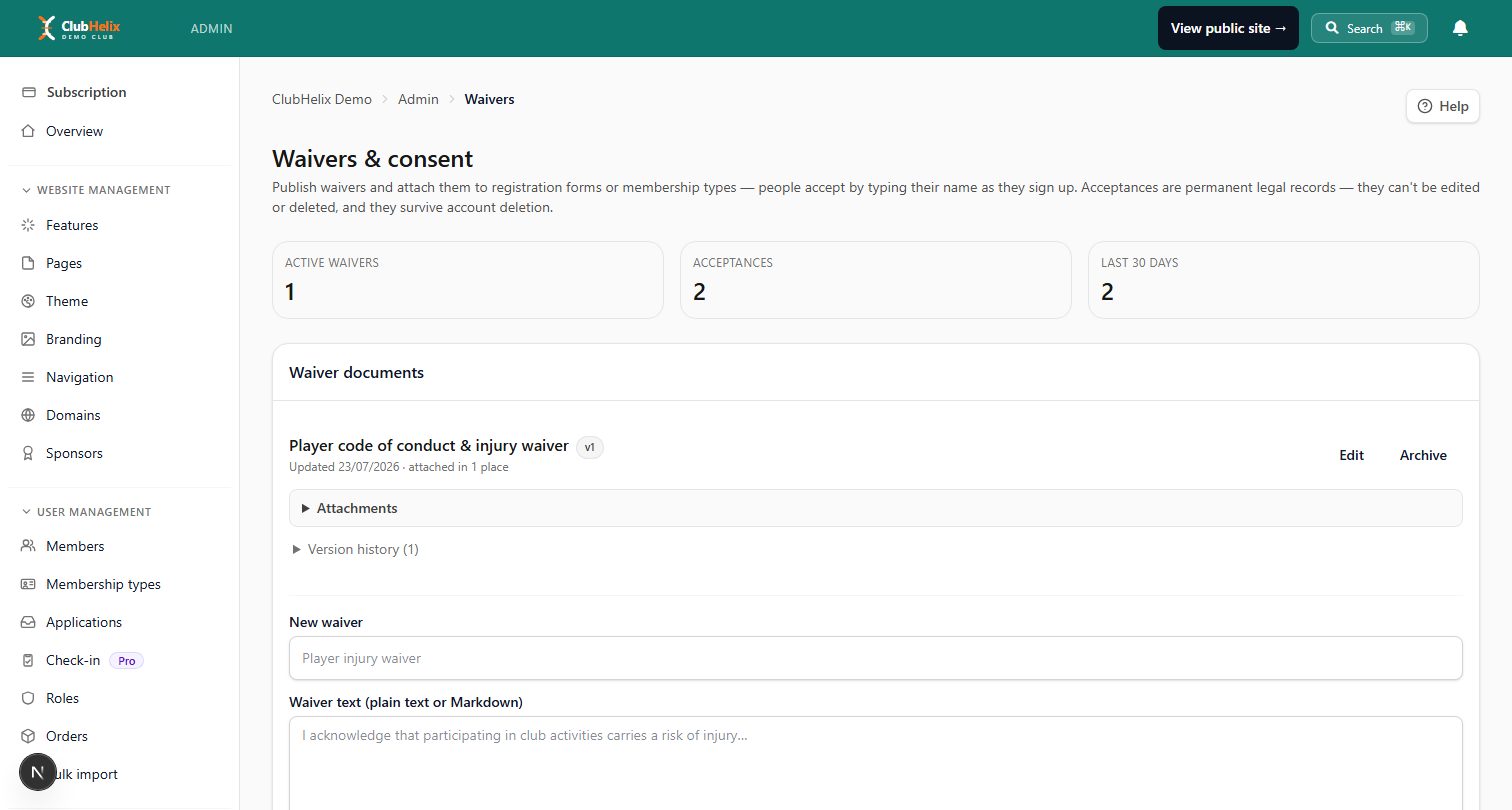
ClubHelix gives a young club a professional website, an online enrolment flow and the whole records layer in one place — free to start, with straightforward pricing when you outgrow it, and built for volunteer committees rather than for professional sport. If you are currently answering enrolment questions in a chat thread at 11pm, set your club up online and get that evening back.
Frequently asked questions
Do you need a qualification to coach parkour?
There is no single answer across markets, and in several the venue and the insurer set the bar rather than a governing body. What is consistent is that a recognised coaching qualification, current first aid and CPR, and background screening for anyone working with minors are what parents, insurers and facility operators expect to see. Track the expiry dates as carefully as the certificates.
How do you run a parkour club safely without an indoor venue?
Grade every session by tier, keep the first weeks at knee height, drill landing and rolling every single session, and walk the site before anyone trains on it. Cap group size, keep two adults present, and veto obstacles that are wet, loose or badly surfaced. The clubs with the best safety records are the ones with the most boring first eight weeks.
What should a parkour waiver include?
Participant and guardian details, medical conditions and emergency contacts, a plain-language description of the actual risks, agreement to club rules including the tier system, and a separate opt-in for photography. Treat it as a consent and information record rather than legal protection, re-sign it annually, and have the wording reviewed by someone qualified where you operate.
How do you get permission to train in public space?
Ask in writing, early, and low on the ladder. Name your club, your session times, your group size, your insurance and your coach's qualification, and commit to off-peak times, no marks, no litter and leaving when asked. Most decision-makers say yes to an organised group with a contact number and refuse an anonymous one.
At what age can children start parkour?
Coached programs commonly start around six or seven with heavily bounded, ground-level movement, and the useful question is not age but supervision ratio and progression discipline. Younger cohorts need tighter ratios, a second adult, shorter blocks and far more game-based work than technical drilling.
Keep reading — how to run a climbing club for another sport built on graded progression, and sports club risk management for the framework behind your session policies.


