
What this guide answers
- What does a model railway club committee actually need to manage?
Three things at once — the building, the layouts and the exhibition.
- How do you stop a club layout from never being finished?
Give it a written charter before the first baseboard is cut — purpose, scale, era, footprint, budget, named lead and deputy, milestones, and an explicit definition of what finished means.
- How far ahead should a club plan its exhibition?
Book the venue about twelve months ahead, invite guest layouts and traders around nine months out, open publicity and advance ticket sales three to four months out, and publish the volunteer roster early enough that…
- Should a model railway club sell exhibition tickets online?
It helps in three ways — a shorter queue on the morning, real numbers to plan catering and staffing against, and a record of who came that you can tell about next year.
- How should a club handle members' own models and tools?
Assume nothing is covered until you have checked. Keep an asset register of club-owned equipment for insurance, tell members plainly whether the club's policy extends to their personal locomotives and stock stored on…
UK edition. This guide is written for volunteer-run clubs in the UK. Where rules differ — grants, tax, incorporation, safeguarding — follow the UK-specific pointers below or check with your national body.
A model railway club is three organisations sharing one set of keys. It is a tenant, responsible for a building it usually does not own. It is a long-running engineering project, where the layout in the main room was started by people who have since died and will be finished by people who have not yet joined. And once a year it is an events business, putting on an exhibition that has to take enough money at the door to cover twelve months of rent.
Those three jobs pull in different directions, and most club dramas trace back to one of them being funded by another. The exhibition committee wants the layout portable; the layout builders want it permanent. The treasurer wants the doors open more often; the members who hold keys want the building quiet on a Tuesday. Getting the balance right is the actual work of the committee.
There is a local wrinkle too. OO dominates in the United Kingdom, with strong N and O followings and a finescale minority working to tighter standards on the same nominal gauge — which means two members can build lovely modules that will not run each other's stock. Add the busiest exhibition circuit anywhere, where layouts travel to shows most weekends of the season, and portability stops being a preference and becomes the club's business model. Write your standards down early.
This guide is for the committee of a model railway or railway modellers club: the people who hold the lease, run the working bees, referee the layout arguments and put on the show. It covers clubroom tenure, keys and safety, module standards and project governance, the shared-tool problem, and a full countdown to an exhibition that funds the year.
The clubrooms — lease, keys and the working-bee roster
Your building is the club. Lose it and you have a mailing list and a lot of baseboards in members' garages. Yet plenty of clubs cannot lay hands on their own lease, and the person who negotiated it retired in 2009.
Start by getting the tenure documented and re-read once a year at committee. The questions that matter are boring and expensive:
- Who is the landlord, and who is the named tenant — the club, or an individual member?
- How long does the agreement run, when does it renew, and what notice can either side give?
- Who pays for the roof, the wiring, the heating and the floor?
- What are you allowed to alter? Fixed benches and wall-mounted layouts are alterations.
- Who else uses the building, and what happens to your layout when they do?
- What insurance does the landlord require, and what does yours cover — building, contents, members' own models, public liability?
That last point deserves a committee conversation of its own. A club room holds a serious amount of members' personal locomotives and stock — often more, in total value, than everything the club itself owns — and most of it sits there uninsured on the assumption that "the club's policy covers it". Confirm what is actually covered, tell members plainly what is not, and put it in the welcome pack.
Keys, access and who can be in the building alone
Keys are the quiet governance issue in every hobby club with premises. Too few and the building is only open when one person is free; too many and nobody knows who was last in when the heater was left on.
| Access level | Who holds it | Conditions |
|---|---|---|
| Full keyholder | Committee, layout leads, safety officer | Signed keyholder agreement, on the register, alarm code |
| Session keyholder | Members who run a regular night | Opens for a rostered session only |
| Escorted access | New members, visitors, contractors | Never alone in the building |
| No access | Members under a defined age, guests | Attend during staffed opening hours |
Keep a keyholder register with dates issued and returned, and reconcile it every year at the annual general meeting. Add a simple opening-and-closing checklist on the door — soldering irons off at the wall, layout power down, heaters off, windows latched, alarm set, lights, lock — because the one time it matters is the one time somebody was in a hurry.
Decide your lone-working position explicitly. Many clubs allow experienced keyholders to work alone but require them to message the club's chat when they arrive and when they leave, and ban solo use of the table saw, the ladder and anything involving a hot iron above head height. That is a sensible baseline, but check what your insurer and landlord expect rather than assuming.
The working-bee roster
Clubrooms need maintenance the hobby does not romanticise: painting, gutter clearing, vacuuming under baseboards, rewiring, replacing the sagging shelf that holds forty locomotives. Run scheduled working bees rather than emergency ones — two or three a year, dated twelve months ahead, each with a published task list so members can pick something they can actually do. A member who cannot climb a ladder can sort the timber offcuts, laminate the signage or cook lunch, and asking them to do exactly that is how you get them there. Our guide on how to organise a working bee covers the run sheet in more detail.

Layout projects that actually get finished
The characteristic failure of a model railway club is not a layout that is badly built. It is a layout that is 70 per cent built, has been 70 per cent built for six years, and cannot be exhibited, dismantled or finished because three people disagree about the track plan and one of them owns the baseboards.
The fix is project governance that would look familiar in any workplace, scaled down until it fits on one page. Before any new layout starts, the committee agrees a short project charter:
- Purpose — exhibition layout, clubroom permanent layout, or training and test track
- Scale, gauge and era — decided once, in writing
- Owner — the club owns the layout and everything screwed to it, full stop
- Project lead and deputy — named, with the deputy expected to take over eventually
- Footprint and weight — maximum module size, weight one person can lift, transport vehicle it must fit
- Budget and funding source — with a stop-work threshold above which the committee must approve
- Milestones — baseboards, track laid, wired and tested, scenic base, detail, first public running
- Definition of done — what "finished enough to exhibit" means
The ownership line prevents the single most damaging club argument there is: a member leaves, or dies, and the family arrives to collect what they believe is his layout. Settle it at the start, in writing, and say so kindly in the welcome pack.
Module standards
If your club builds modular layouts — and most do now, because modules let ten members build at home and bring the results together — then the standard is the club's most important technical document. It does not need to be elaborate. It needs to be unambiguous and enforced.
| Standard | Why it matters |
|---|---|
| Module length and depth | Fits the transport, the trestles and the exhibition floor plan |
| Rail height above floor | Two modules built to different heights need a ramp nobody wants |
| End plate profile and alignment | How modules physically join and stay joined |
| Track centres and radius at the ends | Determines what stock can run through |
| Electrical bus, connector type and polarity | One wrong plug shorts a whole layout |
| Control system and addressing | Avoids duplicate decoder addresses on show day |
| Legs, trestles and levelling | Uneven halls are the norm, not the exception |
| Backscene height and colour | Keeps a modular layout looking like one layout |
| Maximum weight per module | One person, one lift, no injuries |
Publish the standard where members can find it without asking, version it with a date, and require the project lead to sign off a module against the standard before it is accepted into a layout. A ten-minute check at the bench saves a two-hour rebuild in a hall at seven in the morning.
Tools, consumables and the shared-stuff problem
Clubs accumulate tools the way layouts accumulate wagons. Somewhere in your building there is a good airbrush that nobody can find, a soldering station that has not worked since the Christmas party, and four half-empty tins of the same ballast.
Three habits keep it civil. Keep an asset register — what the club owns, what it cost, when it was bought, its serial number, and where it lives — which doubles as your insurance schedule and takes an afternoon to build once. The club equipment register template is a reasonable starting point. Second, mark club property and log borrowing, even informally: a signed-out board on the wall beats a dozen "has anyone seen…" messages. Third, run consumables as a small club shop rather than a free-for-all — track, wire, ballast, paint and adhesives bought in bulk and sold to members at cost plus a little. It saves members money, keeps stock on hand, and quietly funds the exhibition float.
Safety belongs in this section rather than in an appendix, because the hazards in a model railway club room are real if unspectacular: soldering fumes, resin and solvent vapours, dust from cutting foam and timber, power tools used by people who are tired, and ladders. Ventilate the soldering bench, keep the datasheets for anything with a warning label, provide eye protection where people cut and grind, and log incidents and near misses so patterns become visible.
Electrical safety in a club building is worth taking seriously. Portable appliance testing of the club's transformers, soldering stations and heaters, residual-current protection on the sockets members use, and a firm rule that only a qualified electrician touches fixed wiring are the practical baseline. Your landlord or insurer may require documented evidence of testing, so keep the certificates in the club's files.
Running the exhibition
For most clubs the annual exhibition is the whole financial year in one weekend. It is also the club's public face, its recruitment channel and, done badly, the reason four committee members resign in the same month. Treat it as a project with a countdown.
| When | What |
|---|---|
| 12 months out | Venue booked and paid; dates confirmed and clear of competing shows |
| 9 months out | Invitations to guest layouts; trader offers sent; budget approved |
| 6 months out | Floor plan drafted; layouts and traders confirmed with what each needs |
| 4 months out | Publicity opens — website page live, listings submitted, posters designed |
| 3 months out | Advance tickets on sale; volunteer roster published for sign-up |
| 8 weeks out | Insurance, safety plan and any council or venue paperwork finalised |
| 4 weeks out | Catering ordered; float and card readers arranged; signage printed |
| 1 week out | Final roster and set-up plan sent to every volunteer and exhibitor |
| Set-up day | Floor marked out, power run, layouts in, safety walk-through |
| Show days | Door, floats, breaks, and one named person on the radio who makes decisions |
| 2 weeks after | Payments out, thank-yous sent, wash-up meeting, venue rebooked |
Guest layouts are the heart of the show and the biggest cost line. Agree in writing what the club pays — typically travel, accommodation and meals rather than a fee — and get it in an exhibitor letter that also states arrival window, space allocated, power provided, table depth and whether the layout must run continuously or can be operated to a timetable. Traders want the same clarity: frontage in metres, tables provided or not, load-in access, and whether they are being charged a flat stand fee or a percentage.
Ticketing decides your queue. Selling advance tickets online does three useful things: it smooths the door on Saturday morning, it gives you a real number to plan catering and staffing against, and it puts an email address in your club's records for next year's publicity. Keep cash at the door as well — a proportion of your visitors will always prefer it — but do not make card payment the awkward option.
Then there is the roster, which is where exhibitions actually fail. Break the weekend into two-hour shifts and specific posts — door and tickets, raffle table, second-hand stall, catering, roving float and break relief, layout stewarding — and let members sign up for named slots themselves rather than being rung up individually. Publish the roster where everyone can see the gaps, and the gaps fill faster than you expect. Aim to have every volunteer working no more than half the day, because the ones who work the whole weekend do not come back next year.
Run a second-hand stall if you possibly can. Members clear out, the public finds a bargain, the club takes a commission, and it is often the second biggest income line after the door.
Members, subs and the atmosphere in the room
Model railway clubs have a demographic reality worth naming: the membership skews older and male, and the clubs that stay healthy are the ones that deliberately do something about it. That is not a diversity slogan, it is succession planning — every skill in the room needs to exist in at least two heads.
A few practical moves. Run at least one session a month that a complete beginner can attend and understand, and say so in the listing. Have a written expectation of behaviour, so the member who dominates the running night has something to be measured against. Make the room welcoming to visitors who arrive alone by having a named greeter on club nights. Offer a family or junior category with clear supervision rules, and check what youth-safeguarding requirements apply to your club — those vary by jurisdiction and by any funding you accept, so confirm with the relevant authority rather than assuming a hobby club is exempt.
Set subs to cover the fixed costs — rent, utilities, insurance, website — and let the exhibition fund the capital projects. That way a wet exhibition weekend costs you a project, not the lease.
| Income | Expenditure |
|---|---|
| Member subscriptions | Rent, rates and utilities |
| Exhibition door and stands | Insurance |
| Second-hand stall commission | Exhibition venue hire and exhibitor costs |
| Consumables sold to members | Layout materials and track |
| Clubroom hire to other groups | Tools, benches and building maintenance |
| Raffles and social nights | Website, publicity and printing |
If your building sits empty for most of the week, hiring it out to another group is often the easiest income the club will ever find — see how to hire out your clubrooms for how to price and manage it without creating a second job for the secretary.
Keeping the clubrooms and the exhibition on one system
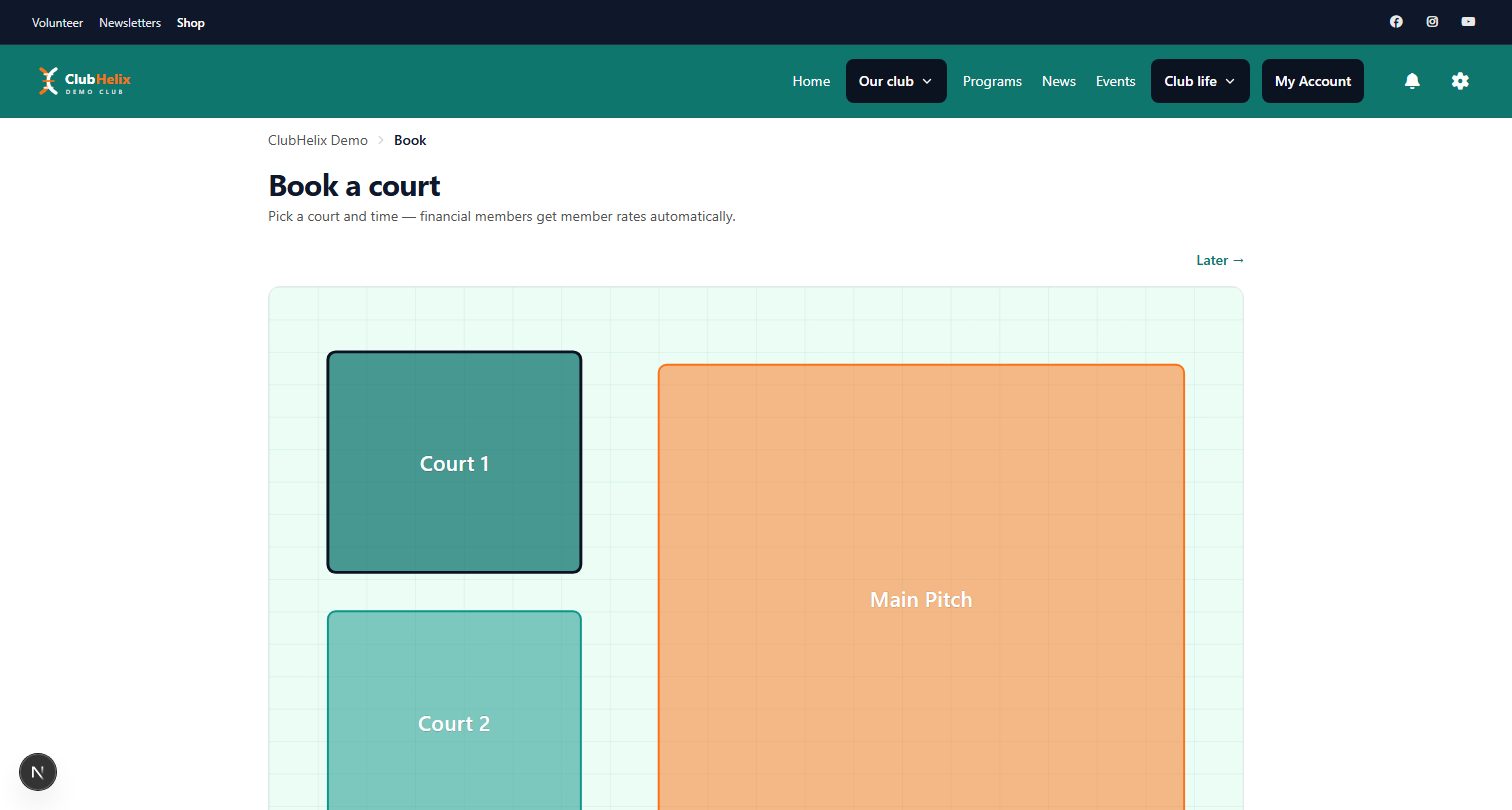
Most of the admin above is booking, rostering and selling. ClubHelix handles all three on your club's own website — room and facility booking so members can see which nights the main room is taken and other groups can book the hall, events and ticketing for exhibition tickets and members' nights with numbers you can plan against, volunteer rostering so exhibition shifts fill themselves instead of being chased by phone, and a club shop for consumables, badges and second-hand sales.
You get a proper public website out of it too, which for a club whose main recruitment happens once a year at an exhibition is not a small thing. There is a free tier to start on, the pricing is published up front, and a committee member with an afternoon can set your club up and have the exhibition page live before the posters are printed.
Frequently asked questions
What does a model railway club committee actually need to manage?
Three things at once — the building, the layouts and the exhibition. In practice that means a documented lease and keyholder register, a written module standard and project charter for each layout, an asset register for shared tools, and a countdown plan with a volunteer roster for the show. Most club disputes come from one of those three being informal.
How do you stop a club layout from never being finished?
Give it a written charter before the first baseboard is cut — purpose, scale, era, footprint, budget, named lead and deputy, milestones, and an explicit definition of what finished means. State that the club owns the layout. Review progress against the milestones at committee, and be willing to declare a stalled project complete at a lesser scope rather than letting it occupy the room indefinitely.
How far ahead should a club plan its exhibition?
Book the venue about twelve months ahead, invite guest layouts and traders around nine months out, open publicity and advance ticket sales three to four months out, and publish the volunteer roster early enough that members can sign up rather than be chased. The wash-up meeting within a fortnight of the show is what makes next year's edition easier.
Should a model railway club sell exhibition tickets online?
It helps in three ways — a shorter queue on the morning, real numbers to plan catering and staffing against, and a record of who came that you can tell about next year. Keep accepting cash at the door as well, since a share of visitors will always prefer it, and make sure the online option is genuinely quick on a phone.
How should a club handle members' own models and tools?
Assume nothing is covered until you have checked. Keep an asset register of club-owned equipment for insurance, tell members plainly whether the club's policy extends to their personal locomotives and stock stored on site, and record who has borrowed what. Also settle ownership of layouts in writing at the start of each project, so it is never in question later.
Keep reading — how to organise a working bee for the maintenance days that keep the building standing, and how to hire out your clubrooms for turning an empty Tuesday into income.


