
What this guide answers
- What age do you have to be to join a masters sports club?
It depends on the sport and the governing body. Many masters competitions begin at 35, several open at 30, and a few use 40 as the entry point, with five-year age bands running upwards from there.
- How do masters age groups work?
Competition is usually divided into five-year bands, and the rule that assigns a member to a band varies by sport — some use age on the day of competition, others fix the band by age at the end of the competition year…
- Should a masters club require a medical certificate?
Most clubs do not, and there are good reasons for that. A mandatory certificate creates a barrier for exactly the people a masters club wants to reach, and it does not shift clinical judgement onto the club.
- How do masters clubs keep members for decades?
By having a proposition that survives the end of competition.
- What should a masters club put on its website?
Age bands and the rule that assigns them, the club record list with its full history, permanently archived results, the training timetable, the social calendar, the two renewal payments a member is responsible for, and…
New Zealand edition. This guide is written for volunteer-run clubs in New Zealand. Where rules differ — grants, tax, incorporation, safeguarding — follow the New Zealand-specific pointers below or check with your national body.
The extraordinary thing about a masters club is the length of the relationship. A junior club has a member for eight years and a senior club might get twelve. A masters club can have somebody from 35 to 85 — half a century of subscriptions, committee terms, championship trips, prizegivings and, eventually, a name read out at the AGM. Almost nothing else in community sport works on that timescale.
That long horizon is also the trap. Because members stay, committees stop noticing that they have stopped recruiting. Because the age groups are familiar, nobody writes down how they work until an entry gets rejected. And because everyone is an adult, health screening gets treated as somebody else's problem right up until the morning it is not.
This guide is for the committee of a masters or veterans club in any sport — athletics, swimming, rowing, hockey, football, cycling, netball, lawn bowls — whether you are a standalone club or a masters section inside a larger one. It covers the three things that decide whether the club is still here in twenty years: getting age groups, records and results right; handling health, injury and graded participation like grown-ups; and treating the social program as the retention engine it genuinely is.
The two clubs inside every masters club
Almost every masters committee eventually discovers it is running two clubs that share a name and a bank account.
The first is the competitive club. These members plan their year around championships, know their age band to the month, care intensely about a personal best set fourteen years ago, and will travel interstate or overseas to compete. They are visible, vocal, and usually the ones on committee.
The second is the participation club. These members came back to sport in their forties because their knees or their doctor or their kids suggested it. They may never enter a championship. They come for the training session, the coffee afterwards, and the fact that somebody notices when they miss two weeks. They are usually the larger group and almost always the quieter one.
Both are legitimate, and clubs get into trouble when they design everything for the first group and then wonder why the second group churns. The practical fix is simple and structural: every offering the club makes should have an obvious entry point for someone who is not going to compete. A training session that is also a social session. A championship day with a non-competitive event on the program. A results page that celebrates a first finish as well as a fastest time.
| The club is doing this well when | The warning sign is |
|---|---|
| New members are named and welcomed at their first session | New members are handed a training program and left alone |
| Non-competing members appear in the newsletter | Every photo is a podium |
| Committee includes at least one person who does not compete | Every committee decision is framed around championships |
| There is a way to stay a member during an injury year | Injured members simply do not renew |
Age groups, records and results
Masters members care about age groups with an intensity that surprises people arriving from open-age sport, and they are right to. The age band is what makes a fair contest possible across a fifty-year span, and it is also the thing that gives a 62-year-old something to aim at that a 32-year-old cannot take from them.
Most masters sport runs in five-year bands. The detail that trips up clubs is not the bands themselves, but the rule that decides which band you are in.
| Rule | How it works | Where it usually applies |
|---|---|---|
| Age on the day of competition | Your band is set by your age on the day you compete | Track, road and field events |
| Age at 31 December of the season | Your band is fixed for the whole competition year | Many pool and team sports |
| Aggregate age for relays and crews | The team's band is set by the total age of its members | Relays, crews, pairs |
| Youngest member sets the band | The team competes in the band of its youngest athlete | Some team and squad formats |
Whichever rule your governing body uses, publish it on your own site in plain language and put a worked example beside it. Every masters club has an annual conversation with a member who has entered the wrong band because a birthday landed awkwardly, and a one-paragraph explanation on your website ends that conversation permanently.
Records that hold up
A club record is only worth having if it can be defended, which means the ratification process needs to exist before the record is set, not after. Build a short standing checklist and give it to whoever runs your club competition.
- The performance was achieved in a competition your club recognises for records, and that list of recognised competitions is written down.
- The timing or measurement method is recorded, including whether it was electronic or hand-held.
- Any conditions your sport requires — wind reading, course measurement, pool length, equipment specification — are captured on the day.
- Two named officials or witnesses are recorded, not "everyone saw it".
- The athlete's age band on the day is recorded alongside the performance.
- A claim form is lodged within a stated deadline, and the records officer signs it off at the next committee meeting.
Then publish the record list in full, by event and by band, and keep the superseded performances visible underneath. Masters clubs are custodians of a long history, and members genuinely read back through it. A record page that shows the whole lineage is worth more to your membership than a page showing only the current holder.
Results are a retention feature, not a formality
In open-age sport results are news for a week. In masters sport they are a personal archive that a member returns to for thirty years, because their own history against their own bands is the point of the whole exercise.
That has three practical consequences. Publish results permanently on your own site rather than only in a newsletter or a chat thread that scrolls away. Make each member's results findable by name, not just by event. And record the age band alongside every result, so a performance still makes sense to someone reading it a decade later. Running your own competitions, fixtures and results on your own site — rather than relying entirely on whatever your governing body publishes for its own championships — is what makes that archive yours to keep.

Age-grading is worth explaining on the same page. Most masters sports have a scoring system that converts a performance into a percentage against the recognised standard for that age and event, which lets a 70-year-old and a 40-year-old compare their efforts meaningfully. Clubs that run an age-graded club championship alongside the straight results almost always find it becomes the trophy people actually want, because it is the only one where the whole club is genuinely in the same race.
Age-group structures, record ratification and championship entry here run through your regional masters association and the national body above it. Confirm the record conditions with your association before publishing a club record list — the club's rules should sit inside the national ones rather than beside them, or you will end up defending a performance that the national body does not recognise.
Health, injury and graded participation
This is the section masters committees most want to skip and least can afford to. Adults between 35 and 85 arrive with a genuinely wide range of health backgrounds, and the club's job is neither to screen them medically nor to ignore the question.
The workable position is that the club asks, records, and points outward. Ask a short set of questions at registration and again at annual renewal. Record the answers securely and restrict who can see them. And point every member at their own doctor for anything the club is not qualified to judge, which is essentially everything clinical.
A reasonable registration health section covers: an emergency contact, any condition the club should know about in an emergency, current medication that matters in an emergency, and a plain statement that the member has considered their own fitness to participate and will talk to their doctor if anything changes. That is general information, not a clearance protocol, and it should be worded that way. Nobody at the club is signing anyone off as fit.
Encourage new and returning members to have a conversation with their GP before they start, particularly anyone coming back after several years away or after a cardiac, respiratory or joint issue. Some clubs include a line in the welcome email suggesting exactly that. Keep the framing as encouragement rather than a requirement — a mandatory medical certificate creates a barrier for the very people you are trying to bring back, and it does not transfer clinical judgement to the club.
Have an emergency plan and rehearse it once a year. Where is the nearest defibrillator, who is calling emergency services, who meets the ambulance at the gate, who has the emergency contact list on their phone, and who calls the family. Write it on one page, laminate it, and put it where the first aid kit lives. This is the least glamorous document your club will ever produce and the one you will be most grateful for.
Graded participation keeps injured members members
The single biggest cause of a masters member disappearing is an injury that turns into a year off that turns into a lapsed subscription. Build the ladder back in advance and name it, so a member has somewhere obvious to go rather than simply stopping.
| Grade | What it means in practice | What the club provides |
|---|---|---|
| Full competition | Championships, club competition, full training | Entries, selection, coaching |
| Modified competition | Competing in a reduced program or a lower-load event | A published alternative event at every club competition |
| Training only | Full training, no competition this season | No pressure to enter anything, still in the group |
| Rehabilitation | Modified session, alternative activity, shorter duration | A named contact who checks in monthly |
| Social membership | Not training at all this year, still part of the club | Newsletter, events, an obvious route back |
The rehabilitation grade is the one that matters most and the one clubs almost never formalise. A member who is out for six months needs a reason to stay connected, and a monthly two-minute call from a named person is the cheapest retention intervention any club has available. Our guide on how to retain club members goes further on the mechanics of noticing before somebody has gone.
The social program is the retention engine
Masters clubs that survive for decades are almost never the ones with the best results. They are the ones where the social calendar is treated as core business, planned a year ahead, and given a budget and a portfolio holder rather than being left to whoever remembers.
The reason is straightforward. The competitive reason to belong fades — everyone slows down, and eventually everyone stops entering. The social reason to belong does not fade, and for many members it strengthens as the rest of their life changes. A club that has only a competitive proposition loses people at exactly the point when they need it most.
| When | What | Why it works |
|---|---|---|
| Season opening | Welcome session plus a shared meal, new members named | Sets the tone that turning up matters more than performing |
| Monthly | A fixed social slot after one training session | Habit beats invitation — same night, same place, every month |
| Mid-season | A club championship day with a non-competitive event | Gives the participation half of the club a reason to be there |
| Championship trip | Group travel and shared accommodation to a major meet | The single strongest bonding event most masters clubs have |
| Off-season | A non-sport activity — walk, ride, dinner, quiz | Keeps contact through the months nobody trains |
| Season close | Presentation night with age-group awards and long-service | Recognition across bands, not just overall winners |
Two design rules make the difference. Recognise across bands rather than only overall, because an overall award in a masters club is essentially an award for being the youngest person there. And recognise longevity explicitly — ten, twenty and thirty years of membership deserve naming, and life membership criteria that are written down stop the award becoming a popularity contest. Our guide to running a presentation night has the run sheet.
Bereavement is part of this, and clubs that pretend otherwise handle it badly when it comes. Decide in advance how the club marks the death of a member — a notice, a minute's silence, a named trophy, a page in the club history. Members who have been in the club for thirty years have earned that, and how you handle it is watched closely by everyone else.
Committee, fees and the thirty-year member
A masters committee has a specific failure mode. Members have time, expertise and goodwill, so the same six capable people do everything — and then all reach the same life stage at once. Term limits feel unnecessary right up to the year they would have saved you. Write succession into the annual cycle instead: every role has a named deputy, every portfolio has a one-page handover document, and the AGM names the deputy publicly so it is real.
On fees, the long relationship changes the maths. A member who joins at 38 and stays until 78 pays more into the club than any junior family ever will, and the decisions that keep them are unglamorous. Offer a leave-of-absence or non-competing category so an injured or travelling member can stay on the books cheaply rather than lapsing. Make renewal a single link rather than a form and a bank transfer. And keep a small number of categories, because a masters club with eleven fee tiers has created a treasurer's problem, not a member benefit.
Whatever your currency, publish the club subscription and the separate governing-body registration side by side on the same page, with the renewal dates for both. Members routinely pay one and assume it covered the other, then find out at a championship entry deadline. Add competition entry fees as a third clearly labelled line. This one page removes more administrative friction than any other change a masters committee can make in an afternoon.
Recruiting is really two separate jobs, and clubs that run one campaign for both get poor results. Reaching a 35-year-old means being visible where people leaving open-age sport already are — club nights, local competition, the parents standing on the sideline at their child's game — and the message is that competition does not have to stop. Reaching a 65-year-old means word of mouth, community groups and health services, and the message is that turning up alone is normal and someone will be waiting at the door. Write both, run both, and measure them separately in your membership reports.
Running four decades of membership from one place
The administrative shape of a masters club is unusual — long tenures, annual renewals that must not be missed, health and emergency details that need to be current and private, results that need to live forever, and a social calendar that carries as much weight as the competition one. ClubHelix covers exactly that shape: online registration and renewals with the health and emergency fields you choose, competitions and results published permanently on your own site, and events with RSVPs so the social program is booked and counted rather than guessed.
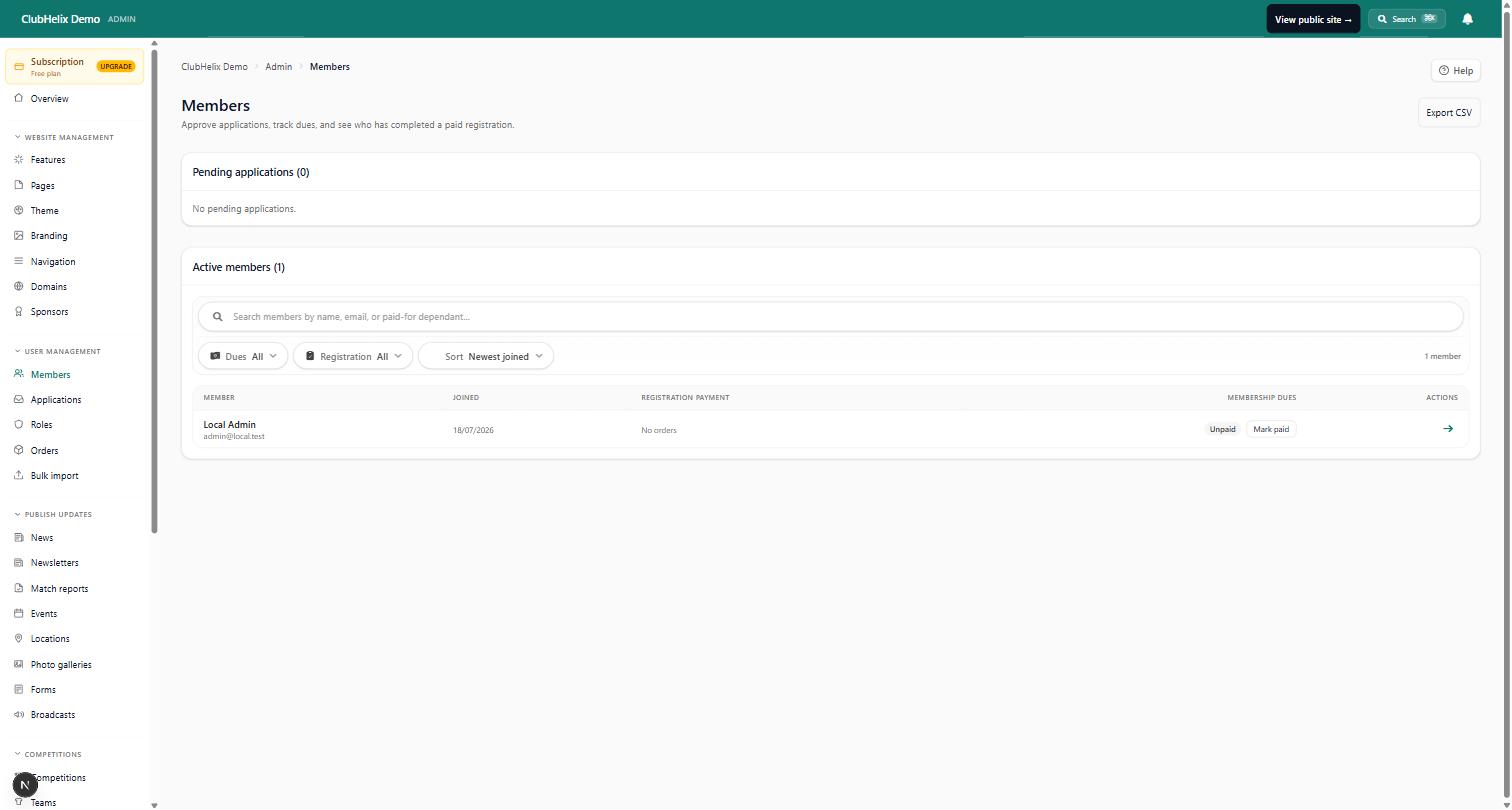
If your club currently runs on a spreadsheet that only one person can open, this is a weekend's work to fix. The free tier is enough to get a real club site live with a members list and a renewal link, pricing is published up front with no negotiation, and you can set your club up and have the next round of renewals going out from your own domain instead of somebody's personal email.
Frequently asked questions
What age do you have to be to join a masters sports club?
It depends on the sport and the governing body. Many masters competitions begin at 35, several open at 30, and a few use 40 as the entry point, with five-year age bands running upwards from there. Check the entry age with the body your club affiliates to, and publish it clearly on your own site because it is the most common question a masters club is asked.
How do masters age groups work?
Competition is usually divided into five-year bands, and the rule that assigns a member to a band varies by sport — some use age on the day of competition, others fix the band by age at the end of the competition year, and team events often use aggregate or youngest-member rules. Publish the rule your sport uses in plain language with a worked example beside it.
Should a masters club require a medical certificate?
Most clubs do not, and there are good reasons for that. A mandatory certificate creates a barrier for exactly the people a masters club wants to reach, and it does not shift clinical judgement onto the club. The common approach is to collect emergency contacts and any condition relevant in an emergency, encourage members to speak with their own doctor, and follow whatever your insurer and governing body actually require.
How do masters clubs keep members for decades?
By having a proposition that survives the end of competition. That means a social program with a budget and a calendar, a membership category that lets an injured or travelling member stay connected cheaply, recognition for longevity as well as for winning, and someone who notices when a regular stops turning up. Results alone will not hold a member into their seventies.
What should a masters club put on its website?
Age bands and the rule that assigns them, the club record list with its full history, permanently archived results, the training timetable, the social calendar, the two renewal payments a member is responsible for, and a clear description of what happens on somebody's first night. That last one converts more enquiries than anything else on the list.
Keep reading — how to retain club members for the noticing systems, and how to run an athletics club if your masters section sits inside a wider club.


