
What this guide answers
- How much mat space does a judo club need?
Enough for the work you actually do. Static drills need roughly six to nine square metres per pair, while randori needs closer to eighteen to twenty-five because thrown bodies travel.
- How often should a judo club run gradings?
Three or four kyu gradings a year suits most clubs. That is frequent enough that a consistent student progresses at a visible rate, and spaced enough that time-in-grade and mat-hour requirements mean something.
- What records does a judo club have to keep?
At minimum, per student — current grade and promotion date, attendance and mat hours, syllabus items signed off, licence number and expiry, medical information and emergency contacts.
- How do you track coach accreditations and screening expiry?
Keep one list with every credential, its holder, its issuer and its expiry date, and set a reminder well ahead of each renewal.
- Does a small judo club need a website?
Yes, and mostly for three audiences — parents checking class times and fees, students checking grading dates and syllabus requirements, and complete beginners deciding whether to walk in.
USA edition. This guide is written for volunteer-run clubs in the United States. Where rules differ — grants, tax, incorporation, safeguarding — follow the USA-specific pointers below or check with your national body.
A judo club is measured in square metres. How many juniors you can safely take, whether you can run randori or only static drills, whether you can host a contest, whether two classes can overlap on a busy night — every one of those questions resolves to the same arithmetic: how much mat you have down, and how many bodies are moving on it.
The second measurement is licences. Judo is a throwing sport with a formal grading system, and almost everything the club does officially — grading a student, entering a contest, having a coach on the mat unsupervised, refereeing — depends on a credential someone holds and a date on which it expires. A club with brilliant coaching and a disorganised credentials folder will eventually have a session it cannot legally run.
This guide is for the committee, the senior coach and whoever ended up as club secretary. It covers mat area and hall hire, session structure that fits the space you actually have, grading cycles and syllabus tracking, the coach and referee accreditation register, and contest-day admin. Figures used below are illustrative examples for planning, not standards — your national body's rules always win.
Mat maths — the number that caps your club
Start with the space, because it sets everything downstream. Two rules of thumb are worth internalising:
- A pair doing static work — uchikomi, gripping practice, ne-waza turnovers — needs roughly six to nine square metres.
- A pair doing randori or full throws needs far more, in the order of eighteen to twenty-five square metres, because a thrown body travels and an uncontrolled fall needs somewhere to land.
That difference is why a hall that comfortably holds a class of twenty-four in uchikomi lines will only support four or five simultaneous randori pairs. Work it out once and write it on the wall.
| Mat area laid | Static drills (pairs) | Randori (pairs) | Realistic junior class | Realistic senior class |
|---|---|---|---|---|
| 50 sq m | 6-8 | 2 | 14-16 | 10-12 |
| 100 sq m | 12-16 | 4-5 | 24-28 | 18-22 |
| 150 sq m | 18-24 | 6-8 | 32-36 | 26-30 |
| 200 sq m | 24-32 | 8-10 | 40+ | 34-40 |
Those class figures are a planning starting point, not a standard — supervision ratios and any minimum mat requirements are set by your national body, so confirm yours and use the stricter number wherever they differ.
Two further practical notes. First, mat area is not the same as floor area — leave a clear border so nobody lands on a skirting board, and never lay mats up to a wall with fixtures on it. Second, capacity is a coaching-supervision number as much as a spatial one; a class of thirty juniors on 150 square metres is legal and unteachable at the same time.
Tatami, jigsaw and the pack-down problem
Most community clubs use interlocking jigsaw mats, typically one metre square and forty millimetres thick, because they are affordable and stackable. Traditional tatami give a better throwing surface and last longer, but they are heavier and generally want a permanent home. Whichever you have, the operational question is the same: how long does it take to lay and lift, and who is doing it?
- Time it honestly. A hundred jigsaw tiles takes two people about fifteen minutes each way. That is half an hour of a ninety-minute booking gone, every session, forever.
- Buy the trolley before you buy more mats. Stacked mats carried by hand get dropped, chipped and eventually binned.
- Tape the perimeter, not the joins. Perimeter tape stops creep; taping every join makes pack-down miserable and shortens mat life.
- Number the tiles and keep a laying plan. New volunteers can then set up correctly without a senior coach standing over them.
- Store them flat and dry. Mats stored on edge in a damp cupboard deform, and deformed mats never quite lock again.

Hall hire when you do not have a home dojo
Very few community judo clubs own their building. Most hire a school gym, community centre or scout hall by the block, and the hire agreement quietly determines the club's whole shape.
Negotiate these five points before you sign anything:
- Storage on site, lockable. Without it you are carting mats in a trailer, and the club dies the day the trailer owner moves away.
- Set-up and pack-down time inside the booking, not either side of it. Ask for the extra thirty minutes explicitly.
- Floor protection expectations in writing. Halls with sprung timber floors will worry about your mats; agree the answer before a caretaker raises it mid-season.
- Grading and contest dates booked with the weekly sessions. These are the dates you advertise months ahead and cannot move.
- Notice periods both ways. School lettings get reclaimed for exams and productions. Know how much warning you get.
As a rough planning figure, community or school gym rental commonly falls somewhere between $30 and $90 an hour, with recreation-department facilities often cheaper for registered nonprofits. Multiply by the hours you actually need including set-up, then by weeks in the year — that annual number, not the hourly rate, is what your fee structure has to cover.
Session structure that fits your mat
A judo session has a fixed skeleton, and the value of writing it down is that any coach can run the club's session in the club's style when the senior coach is away.
| Segment | Junior (60 min) | Senior (90 min) | Purpose |
|---|---|---|---|
| Line-up and bow-in | 3 min | 3 min | Attendance taken here, every time |
| Warm-up and movement | 10 min | 12 min | Gets bodies ready for falling |
| Ukemi (breakfalls) | 8 min | 5 min | Never skipped, at any grade |
| Technique teaching | 12 min | 20 min | One throw or hold, taught in stages |
| Uchikomi and nage-komi | 10 min | 15 min | Repetition — low space cost |
| Ne-waza | 8 min | 15 min | Groundwork uses less mat per pair |
| Randori | 5 min | 15 min | Space-hungry — rotate in waves |
| Wind-down and bow-out | 4 min | 5 min | Announcements land here, not at the door |
Two structural tricks make a small mat behave like a big one. Wave randori runs half the class while the other half sits at the edge as timekeepers and coaches, swapping every two minutes. And ne-waza first on crowded nights lets you take a larger class than your randori capacity allows, because groundwork pairs need roughly a third of the space.
Take attendance at the bow-in, not from memory afterwards. It matters more in judo than most sports because mat hours feed directly into grading eligibility, and a class roll reconstructed in March is worthless when a student asks in April whether they qualify.
Grading cycles, syllabus tracking and certificates
Gradings are the spine of the judo year. Most clubs run three or four kyu gradings a year, timed so that a student who trains consistently can progress at a rate that feels earned rather than automatic.
The administrative load is real, because eligibility in judo is usually a combination of several things at once:
- Time in grade — a minimum period since the last promotion.
- Mat hours — a minimum number of sessions attended since then.
- Syllabus — the throws, holds, turnovers and terminology for that grade, demonstrated on a compliant partner.
- Contest or line-up performance — many national syllabi introduce this at the senior kyu grades, and the exact requirement varies. Check yours rather than assuming.
- A current licence or registration with the national body, which is usually what makes the grade recognised outside your own club.
Tracking eligibility without a shoebox of paper
Keep one record per student, not one record per grading. What has to live on it:
| Field | Why it matters |
|---|---|
| Current grade + date | Drives time-in-grade eligibility for the next one |
| Mat hours since | Counted from attendance, not estimated |
| Syllabus checklist | Which techniques have been signed off, and by whom |
| Contest record | Where the syllabus requires it |
| Licence number | Plus its expiry date |
| Medical and consent | Conditions the coach must know about before randori |
| Guardian contact | For every junior, kept current rather than captured once at joining |
The syllabus checklist is the part clubs most often keep in a coach's head. Write it out per grade — o-goshi, ippon seoi-nage, osoto-gari, kesa-gatame and the rest, in whatever order your syllabus sets — and sign items off progressively across the term. Gradings then become a confirmation of what coaches already know, not a stressful audit.
Belts, certificates and the register
Order belts and certificates before the grading, based on the nominated list, and accept that you will occasionally have a spare. Ordering afterwards means a four-week gap between a child earning a belt and receiving it, which is exactly the wrong lesson to teach about effort and reward.
A grading day run sheet that works:
- Nominations close ten days out, online, with the fee paid at nomination.
- Coach reviews eligibility against the records and confirms the list.
- Belts, certificates and the examiner's paperwork ordered on the same day.
- Mats laid an hour early, warm-up run by a senior student.
- Grading run in grade order, lowest first, so nervous juniors go home earliest.
- Results recorded against member records that afternoon, not that month.
- Promotions submitted to the national register within whatever window your body specifies.
- A photo and a short news post naming everyone promoted, published within two days.
The accreditation register
This is the register that keeps the club legal, and it should be as boring and as current as a fire log. Every credential in judo has an issuer, a renewal cycle and a consequence for lapsing.
| Credential | Held by | Watch for |
|---|---|---|
| Coaching qualification / level | Anyone leading a session | Level determines what they may supervise unaccompanied |
| First aid certification | At least one person per session | Renewal is typically on a fixed multi-year cycle |
| Safeguarding screening | Everyone working with juniors | Renewal dates vary by scheme — track each individually |
| Safeguarding training | Coaches and committee | Often separate from the screening check itself |
| Referee licence | Contest officials | Levels determine which events they may officiate |
| National body membership | Coaches, students, the club | Usually annual, and usually what carries the insurance |
| Insurance certificate | The club | Confirm what it covers for randori, contests and gradings |
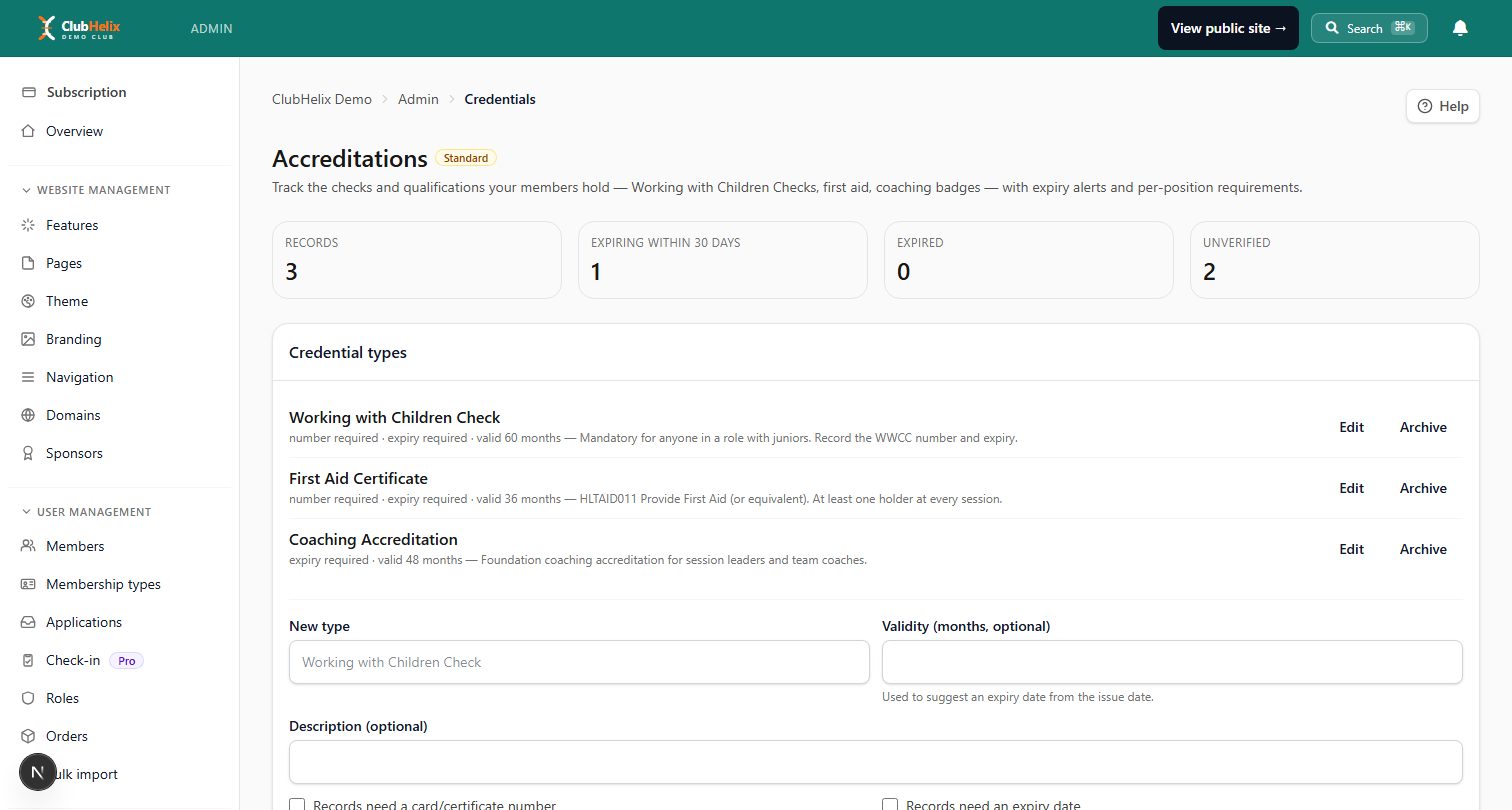
Run the register on a single list with expiry dates and an alert ahead of each one, and adopt a hard rule the committee will not bend: a lapsed safeguarding check means a stand-down from junior sessions until it is renewed. That rule is uncomfortable exactly once. ClubHelix's accreditations tracking does this job — credentials, expiry dates, reminders and who is currently clear to be on the mat.
In the United States the screening baseline is a background check plus abuse-prevention training for every coach and volunteer working with minors, which your national organisation and insurer will both require. More than one national body recognises grades, so confirm which register your promotions are recorded with before your first grading.
Treat all of the above as general information rather than legal advice. Where your national body's rules or the relevant authority's requirements differ from anything here, theirs are the ones that apply.
Contest calendar and weigh-in admin
Even a club with no competitive ambitions should enter something, because contest experience is what separates a student who can perform a throw from one who can land it on a resisting opponent.
The admin has a predictable shape:
- Publish the year's target events early, with your own internal entry deadline a week before the real one.
- Collect entries as a single form — name, licence number, grade, weight category, guardian consent for juniors, and who is driving.
- Declare weight honestly. A junior asked to make a category they are not comfortably inside is a welfare problem, not a tactical one. Enter them where they train.
- Take a club kit bag — spare belts, a red backing patch if your event needs one, tape, a first-aid kit and every entered student's licence details on one sheet.
- Have a licensed referee attend where your event expects clubs to contribute one. Building your own referees is a long game with a short payback.
The competitive calendar generally follows the school year — a fall build-up, a winter block of tournaments and a spring peak, with a lighter summer that many clubs use for camps and open mats. Line gradings up with the semester rhythm so students grade while they are still training regularly.
Fees, and what they have to cover
Judo club money is simple to describe and easy to get wrong. Weekly hall hire leaves the account regardless of who turns up; income arrives in bursts at enrolment and grading.
A structure that holds up:
| Charge | Frequency | Covers |
|---|---|---|
| Annual club fee | Yearly | Insurance levy, national body registration, admin |
| Term or block fee | Termly | Hall hire and coaching for that block |
| Casual mat fee | Per session | Visitors and irregular attenders only |
| Grading fee | Per grading | Examiner costs, belt and certificate |
| Contest entry | Per event | Passed through at cost |
Charge the term fee rather than a per-session mat fee wherever you can. Per-session pricing feels friendly and quietly destroys the club's cash flow, because the weeks when attendance dips are exactly the weeks your hire bill does not. Take payment online at enrolment so the treasurer is reconciling a report rather than a tin — term enrolment with capacities and waitlists does that, and pairs well with a digital waiver signed once at joining rather than a paper form re-collected every year.
For the wider question of how much to charge, our guide on how much club membership should cost walks through the arithmetic. If your club also runs other arts from the same hall, how to run a martial arts club covers the shared ground.
Keeping the whole club in one place
The admin above is not complicated, but it is relentless: attendance every session, mat hours per student, syllabus sign-offs, grading nominations and fees, licence expiry, screening renewals, hall bookings and the weekly "training is on" message. ClubHelix keeps all of it on your own club website — accreditations tracking for the credentials register with expiry reminders, programs and enrolment for term fees and class capacities, and facility booking if you hire your mat space out to other groups between sessions. Judo sits under our martial arts club management software page, which covers gradings, classes and the credentials register in one view.
Start on the free tier and grow into it, with pricing published openly and no negotiation required to find out what you would pay. You can set up your club site in an evening, and have your next grading taking nominations online by the weekend.
Frequently asked questions
How much mat space does a judo club need?
Enough for the work you actually do. Static drills need roughly six to nine square metres per pair, while randori needs closer to eighteen to twenty-five because thrown bodies travel. A hundred square metres supports a junior class of around twenty-four in drills but only four or five simultaneous randori pairs, so plan classes around the randori number.
How often should a judo club run gradings?
Three or four kyu gradings a year suits most clubs. That is frequent enough that a consistent student progresses at a visible rate, and spaced enough that time-in-grade and mat-hour requirements mean something. Publish the dates for the whole year in advance so students and families can plan around them.
What records does a judo club have to keep?
At minimum, per student — current grade and promotion date, attendance and mat hours, syllabus items signed off, licence number and expiry, medical information and emergency contacts. For coaches and officials, keep qualifications, first aid, safeguarding screening and referee licences with their renewal dates on a single register.
How do you track coach accreditations and screening expiry?
Keep one list with every credential, its holder, its issuer and its expiry date, and set a reminder well ahead of each renewal. Agree in advance that anyone whose safeguarding check has lapsed stands down from junior sessions until it is renewed — the rule is only awkward the first time it is applied.
Does a small judo club need a website?
Yes, and mostly for three audiences — parents checking class times and fees, students checking grading dates and syllabus requirements, and complete beginners deciding whether to walk in. A club site that publishes the timetable, takes enrolments and payments, and lists the grading calendar answers all three without a coach replying to messages at 10pm.
Keep reading — how to run a karate club and how to start a junior program.

