
What this guide answers
- How do you start a handball club from nothing?
Begin with one weekly session at a fixed time and venue that anyone can attend in ordinary sports gear, and protect it above everything else — a session that never gets cancelled builds trust faster than any promotion.
- How do handball clubs get court time?
By making the venue manager's decision easy. Send one email that includes your insurance certificate, a written resin and floor-care policy, named session supervisors, and a request for a full season block rather than…
- How do you recruit referees for a small sport?
From inside the club, one person at a time. Injured players, retired players, parents and senior juniors are the natural pool.
- Are school programs worth the effort for a small club?
They are usually the only junior pipeline available, because children do not encounter the sport casually.
- Does a small club really need its own website?
Yes, and arguably more than a big one does. The handful of people searching for the sport in your area each month are your highest-intent recruits, and venues and schools will look you up before agreeing to anything.
USA edition. This guide is written for volunteer-run clubs in the United States. Where rules differ — grants, tax, incorporation, safeguarding — follow the USA-specific pointers below or check with your national body.
Every conversation your club has begins with an explanation. You ring a stadium about court hire and the manager pictures the game played against a wall. You email a school and the sport teacher assumes you mean something they saw at an Olympics once. You put a flyer in a shopping centre and half the people who read it think it is a typing error. Running a handball club in a market where the sport is a curiosity means you are not competing with other clubs for players — you are competing with the fact that most people do not know the game exists.
That changes the shape of the job. In a big code, the committee's work is processing demand: registrations arrive, teams form, the association runs the fixture. In a minority sport, the committee's work is manufacturing demand, and almost all of it flows through three bottlenecks. You need court time in venues that have no reason to prioritise you. You need a junior pipeline, which in practice means schools, because there is no backyard version of this sport feeding children into your club. And you need referees, because a competition without officials is just training with scoreboards.
This guide is for the six people trying to build that from a standing start, or trying to keep it alive after the founder moved cities. It covers the honest sequencing of a new club, how to win a court booking, how to run school programs that actually convert, how to grow and keep a referee pool, and how to make the club findable by the small number of people already searching for it.
The honest sequencing of a minority-sport club
The most common way these clubs fail is doing everything at once — announcing a league before there is a referee, or recruiting juniors before there is a screened coach to receive them. Build in order, and give each stage a year.
| Stage | What exists | What you are building next | The trap |
|---|---|---|---|
| 1 | One weekly session, mixed ability, borrowed goals | A reliable court booking and a second coach | Cancelling sessions — nothing kills a new club faster |
| 2 | Two sessions, a small senior squad | A first school program and a club referee | Taking on fixtures you cannot officiate |
| 3 | Juniors training, a referee or two | A social competition or a festival day | Running a league with four teams and no depth |
| 4 | Juniors, seniors, a home venue | A committee that is not three people | Founder burnout at exactly this point |
Two habits protect all of it. Keep the entry point permanently open — a session anyone can turn up to in ordinary sports gear, every week, at the same time and place. And write down what you do, because in a club this size, a single departure can take the only copy of the coaching plan, the venue contact and the equipment list with it.
Most clubs join the national governing body, which sanctions the club league structure, runs national championships and administers the coaching and officiating certifications. Clubs typically incorporate as a nonprofit at state level, and school districts and municipal recreation departments will generally require both that incorporation and a certificate of insurance before granting gym time.
Getting court time when the venue has never heard of you
Indoor court time is a seller's market. Basketball, netball, futsal and volleyball are already queued at the desk, they book in blocks, and they pay on time. You arrive as an unknown quantity asking for a court that is bigger than most halls have.
Venue managers are not being difficult when they hesitate. They are worried about five specific things, and a club that answers all five in one email gets taken seriously.
| What the venue manager worries about | What to put in front of them |
|---|---|
| Damage to the floor and walls | Your resin policy in writing, plus goal handling and storage arrangements |
| Insurance | A current certificate of currency from your affiliation, attached to the email |
| Payment | An offer to pay the block up front, or by direct debit, with a named treasurer |
| Behaviour and supervision | Named session supervisors, a code of conduct, screened coaches for junior sessions |
| Whether you will still be there | A twelve-month booking request rather than casual weekly hire |
Resin deserves its own paragraph, because it is the single most common reason a venue says no. Many halls ban adhesive resin outright and have had bad experiences with residue on floors and walls. Decide your position before you ask: either play resin-free at community level and say so explicitly in your first email, or nominate a resin type the venue approves and commit in writing to cleaning after every session. Turning up with a tub of resin at a venue that has not agreed to it will cost you the booking and the relationship.
Court size is the second obstacle. A full court is considerably larger than the basketball or netball court most halls are built around, so many community clubs never play full size at home. That is fine — reduced-court and small-sided formats are legitimate, they suit smaller squads, and they are how nearly every junior program in the world starts. Mark your lines with removable tape, photograph the layout so setup is repeatable, and keep the tape roll in the gear bag.
The economics of a timeslot
Work the maths in hall-hours rather than guessing. A two-hour weekly slot across a twenty-week season is forty hall-hours. If you have twenty-four registered players, each one is carrying under two hall-hours of hire across the whole season — that is the number to put in front of your own members when they ask why fees exist, and it is usually much smaller than they fear.
Then go hunting for the cheap hours. Off-peak weekday slots, late evenings, school holiday periods and venues out of the immediate centre are all substantially cheaper, and a new club has the flexibility to take them. Ask for a discount in exchange for a full-season commitment, ask whether an off-peak rate exists and whether community or junior rates apply, and ask what happens to the fee if the venue cancels on you.
The usual venues are school district gyms hired out of hours, municipal recreation centres, community colleges and university recreation facilities. Permits are typically issued in seasonal rounds with a certificate of insurance required up front, and resident or non-profit rates are common — ask which category your club falls into before you accept the first quote.

Schools: the only junior pipeline you actually have
Children do not stumble into this sport. Nobody plays it in the street, it is rarely on television where you live, and no parent wakes up planning to enrol their child in it. Schools are the pipeline, and a club that treats school programs as its core business rather than as outreach will grow while others stall.
The offer that works is small and concrete. Approach the sport or physical education staff with a fully specified package: a six-week in-class or after-school unit, delivered by your coach, with all equipment supplied, aligned to whatever the school is already trying to achieve. Ask for nothing except the hall and the timetable slot in year one.
| Week | Session focus | What the students take away |
|---|---|---|
| 1 | Catching, passing, moving with the ball | Everyone scores in the first session |
| 2 | The three-step rule and the dribble | The rule that makes the game feel different |
| 3 | Shooting and the goal area | Jump shots — the moment they get hooked |
| 4 | Defence, blocking and safe contact | Confidence in a physical but controlled game |
| 5 | Goalkeeping and small-sided games | A role for every body type |
| 6 | Class tournament with student referees | A finish, a photo, and a flyer that goes home |
Then build the bridge, because this is exactly where school programs leak. A six-week unit that ends with applause and no next step converts almost nobody. Finish week six with a dated invitation to a free come-and-try session at your venue, in the following fortnight, with a joining link and a price on it. Follow up with the school a week later and ask them to send the reminder. Our guides on running a come-and-try day and increasing junior participation cover the conversion mechanics in more depth.
Other things that make school partnerships durable: give the teacher a lesson plan they can run themselves after you leave, leave a set of soft balls with the school, invite the class to a senior fixture, and put a named contact and a photo release process in place before you take a single picture. Then run a term-based program at your own venue for the students who come across, so there is somewhere for them to land — programs and term enrolment exists precisely for that shape of thing.
Background screening requirements for coaches and volunteers vary by state, by school district and by governing body, and federal athlete-safety training obligations may also apply. Treat this as general information, and confirm exactly what is required with both your national governing body and the district before your first session in a school.
Referees: the constraint that decides how big your season can be
Everything else scales faster than officials. You can add a training night with a coach and a booking; you cannot add a fixture round without someone to referee it. The referee pool is the hard ceiling on the competition you can run, so treat it as a standing committee job.
Recruit from inside first. The people most likely to referee are players who are injured, players who have stopped playing, parents who have watched forty games, and senior juniors who want a role and some income. Ask them individually — a general appeal to the whole club produces nothing.
| Stage | What they do | What the club owes them |
|---|---|---|
| Whistle-holder | Referees club training games and scratch matches | A rules session, a whistle and someone alongside them |
| Club referee | Junior and social fixtures | An entry-level accreditation course, paid by the club |
| Appointed referee | Senior league fixtures under association appointment | Support with travel, kit, and a mentor |
| Referee coach | Develops and assesses others | Recognition, and a say in how appointments are made |
Six practices keep referees in the game:
- Never send anyone out alone in their first season. Pair a new referee with an experienced one, even when the game only needs one.
- Pay or reimburse the same night, not four weeks later, and publish the rate so nobody has to ask.
- Debrief within forty-eight hours — two things that went well, one to work on. Silence after a hard game is what makes people quit.
- Enforce your abuse policy at the first incident, not the third. A club that lets a coach shout at a seventeen-year-old official will lose that official and every one who hears about it.
- Roster fairly and in advance, so nobody discovers on Thursday that they are officiating on Saturday.
- Buy the kit. A shirt, a whistle, cards and a watch cost very little and change how someone sees the role.
Publish appointments where everyone can see them and record who officiated what. Match officials management handles the appointments, availability and the record; keeping it visible also makes it obvious when the same two people are carrying the whole season.
Squads, training and the competition you can realistically field
A full-sided game needs a squad in the teens, which is more than many new clubs have. Rather than waiting for numbers, design the competition around the numbers you have.
- Small-sided and reduced-court formats let you run competitive games with eight to ten players a side and are far more forgiving of an uneven skill spread.
- A festival day — four clubs, one venue, short games, one day — is easier to staff, easier to referee and easier to sell than a weekly league, and it is how most regional handball scenes actually started.
- Cross-club training with the nearest club, alternating venues, gives both squads a real opposition without either committing to a fixture list.
- Mixed and social grades open the sport to adults who will never play at league level but will pay subs and turn up every week.
- Beach handball in the warmer months keeps members engaged, needs no hall hire and is unusually good at recruiting curious passers-by.
Keep the training session itself welcoming to first-timers, because in a minority sport there is a beginner in the room almost every week. A predictable structure — warm-up, one skill, one game concept, small-sided game, cool-down — lets a newcomer join at any point without derailing the session. Team management with squad lists, availability and attendance takes the guesswork out of who is actually turning up, which matters far more when your margin is four players rather than forty.
Fees, break-even and the money shape
The finances of a small indoor club are simple and unforgiving: hall hire is most of your cost base, it is fixed, and it does not care how many people show up.
| Cost line | Behaviour |
|---|---|
| Hall hire | Fixed per booked hour — your dominant cost |
| Affiliation and insurance | Fixed per club, sometimes per player |
| Equipment | Lumpy — goals and balls up front, then slow replacement |
| Referee payments | Variable with fixtures |
| Coaching and courses | Occasional, and worth budgeting for deliberately |
Two rules keep a small club solvent. First, set fees from the booking, not from what feels polite: total your committed hall hours for the season, add affiliation and a modest equipment allowance, divide by a conservative membership estimate, and that is your floor. Second, take money at the point of joining. Pay-at-the-door casual fees are the standard model in new clubs and they are also why the treasurer ends the season out of pocket — a season membership paid online, with a casual rate that is deliberately more expensive per session, moves people onto the plan you can actually budget against.
Offer a discounted rate for students and juniors through a published code rather than negotiating case by case, and keep a quiet hardship provision. In a club this small, one player lost over a fee is a measurable percentage of your membership.
Set the number from your own facility permit costs and publish the breakdown — gym rental, affiliation, insurance, equipment. Where the club runs both a fall and a winter season, price them separately rather than as one annual figure, since players who join mid-year should not have to buy a season they missed.
The handful of people already searching for you
Somewhere in your city, a small number of people search for this sport by name every month. Some played it at school overseas, some watched it during a major championship, some have just moved. That is a tiny audience — and it is the highest-intent audience your club will ever have. If they find a page with training times, a venue address, a price and a join button, you gain a member. If they find a dormant social page from three years ago, you lose one you never knew about.
So build the page that answers exactly what those people ask: what the sport is in two sentences, where and when you train, what to bring, what it costs, whether beginners are welcome, and who to contact. Put the venue on a map. Say clearly which version of handball you play, because the name confusion sends people to the wrong club constantly. Keep a news post or an event on the page each month, so it is obviously alive.
The same page does double duty with schools and venues, both of which will look you up before agreeing to anything. A site with a published code of conduct, an insurance statement and a photo of last week's session is a far easier yes than an email address with no history behind it.
Making a small club look like a real one
None of the work above is hard, but there is a lot of it and it lands on very few people: memberships and renewals, session attendance, school program enrolments, referee appointments, fixtures for the festival day, fees and the hall-hire budget. ClubHelix pulls that into one place with a club website you control — team management for squads, availability and attendance, programs and term enrolment for school and junior courses, match officials for referee appointments, and online registration with payments so subs arrive without anyone chasing a transfer.
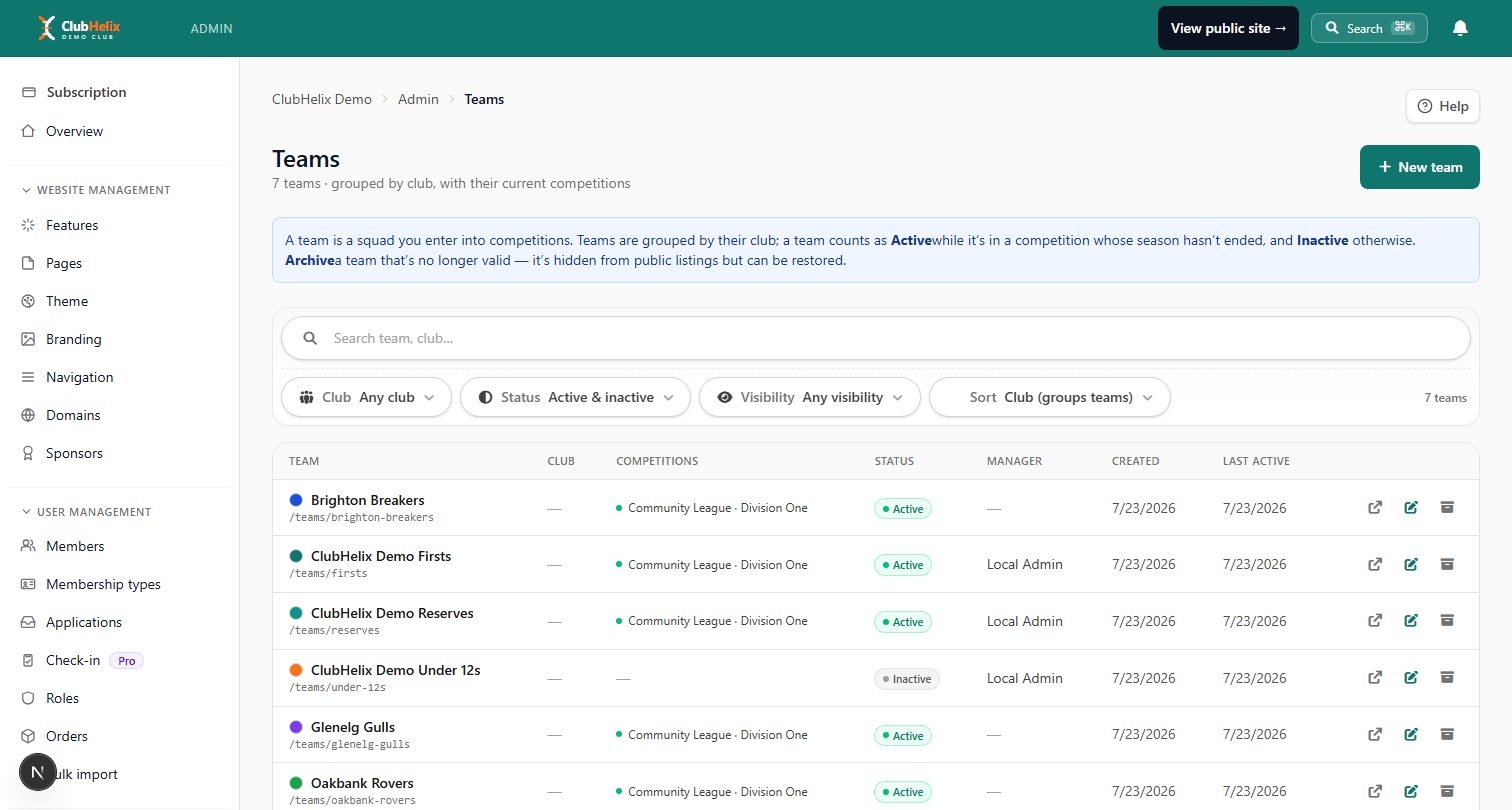
Begin on the free tier while the club is six people and a booking, and step up only when the numbers justify it — the pricing page sets out exactly what changes at each step, so a small club is never quoted a big-club figure. Create your club site in an evening, which is about the time you would otherwise spend rebuilding the registration spreadsheet after the next handover, and school enrolments, referee appointments and subs stop living in three different inboxes.
Frequently asked questions
How do you start a handball club from nothing?
Begin with one weekly session at a fixed time and venue that anyone can attend in ordinary sports gear, and protect it above everything else — a session that never gets cancelled builds trust faster than any promotion. From there add a second coach, then a school program, then referees, then a competition. Trying to launch a league before you have officials is the most common way new clubs collapse.
How do handball clubs get court time?
By making the venue manager's decision easy. Send one email that includes your insurance certificate, a written resin and floor-care policy, named session supervisors, and a request for a full season block rather than casual weekly hire — and ask for off-peak slots, which are cheaper and far more likely to be available to a new club.
How do you recruit referees for a small sport?
From inside the club, one person at a time. Injured players, retired players, parents and senior juniors are the natural pool. Pay for their accreditation course, pair them with an experienced official for their whole first season, reimburse them on the night, and act on abuse immediately. Referee numbers, not player numbers, usually cap how much competition a small club can run.
Are school programs worth the effort for a small club?
They are usually the only junior pipeline available, because children do not encounter the sport casually. The programs that work are fully specified — six weeks, your coach, your equipment, no cost to the school — and they finish with a dated invitation to a free session at your venue. Without that bridge, a school program produces goodwill and no members.
Does a small club really need its own website?
Yes, and arguably more than a big one does. The handful of people searching for the sport in your area each month are your highest-intent recruits, and venues and schools will look you up before agreeing to anything. A current site with training times, prices, policies and a join button converts both audiences.
Keep reading: how to run a futsal club for the indoor-court economics in more depth, and how to run a basketball club for the stadium-hire relationship from the other side.


