
What this guide answers
- What software does a gymnastics club need?
At minimum: online class enrolment with capacities and waitlists, membership registration with payments, attendance rolls, and a public website showing the timetable with live availability.
- How do gymnastics club waitlists work?
Families join a waitlist for a full class (or an age group), recording the child's age and preferred days.
- What coach-to-gymnast ratios do gymnastics clubs use?
Ratios are set by governing-body guidelines and insurance conditions and vary by age and program — preschool classes require far tighter ratios than school-age recreational classes.
- How much does gymnastics club membership cost?
Most clubs charge an annual registration (covering governing-body levies and insurance) plus term fees per class stream, with competitive squads paying more for additional training hours.
Ireland edition. This guide is written for volunteer-run clubs in Ireland. Where rules differ — grants, tax, incorporation, safeguarding — follow the Ireland-specific pointers below or check with your national body.
Gymnastics clubs run on a model most sporting committees never encounter: dozens of small classes, strict coach-to-gymnast ratios, term-by-term enrolment, waitlists that never empty, and a building full of expensive equipment that has to be maintained, moved and insured. It's closer to running a school than running a football club — and the admin load shows it.
The upside is demand. Gymnastics consistently has more families wanting places than clubs can supply, so the constraint is rarely marketing — it's capacity, coaching and organisation. This guide covers how to run a gymnastics club so those three things don't depend on one exhausted volunteer: structure and affiliation, the class and term model, coach ratios and accreditation, equipment, gymnastics class enrolment, and the club website that ties it together.
Structure, affiliation and the committee
Most community gymnastics clubs affiliate with the sport's national governing body, usually through its regional arm. Affiliation brings the levels framework your classes are built around, coach and judge accreditation pathways, insurance arrangements, and entry to sanctioned competitions. Registration fees for the governing body are usually collected per gymnast per year — build them into your fee structure explicitly so parents can see what's club fee and what's levy.
Community clubs typically run as volunteer-committee not-for-profits; many larger clubs employ a paid head coach or administrator once class volume justifies it. However you structure it, separate governance from coaching: the committee owns finances, venue, compliance and strategy; the head coach owns program, ratios and coach development. Our guide to committee roles and responsibilities covers the standard officer roles.
Because virtually all your members are children, child-safe standards aren't a side topic — they're the operating environment. Verified safeguarding checks for every coach and program volunteer, two-adult supervision norms, clear photography policies and a child-safe code of conduct are baseline.
In Ireland, clubs affiliate with the national gymnastics governing body, and larger clubs often structure as a company limited by guarantee through the CRO (cro.ie), with sports-body tax exemption available via Revenue (revenue.ie). Anyone coaching or regularly working with children must be Garda vetted, and governing-body safeguarding courses are standard for coaches and the club's children's officer.
This is general information, not legal advice — check current requirements with your governing body and local regulators.
The class and term model
Gymnastics runs on classes, not teams. A typical club timetable spans recreational streams (parent-and-me, preschool movement classes, school-age recreational levels) and competitive streams (development squads and levels squads training multiple sessions a week). Each class has a day, a time, a coach, a ratio — and therefore a hard capacity.
That capacity is why gymnastics class enrolment is the admin heart of the club. The model that works:
- Enrol by term, per class. Families book a specific class for the school term (or session block, where that's the local rhythm). Re-enrolment for the next term opens to existing families first (a fortnight's priority window), then to the waitlist.
- Cap every class at its ratio-derived capacity and never hand-wave it. Overfull classes are a safety issue, not a scheduling issue.
- Run waitlists properly. Record the child's age and preferred days, offer places in order, and give each offer an expiry so places don't sit reserved for a family that's moved on.
- Take payment at enrolment. A place isn't held until it's paid for. Instalment options soften the term-fee lump for families without wrecking your cash flow.
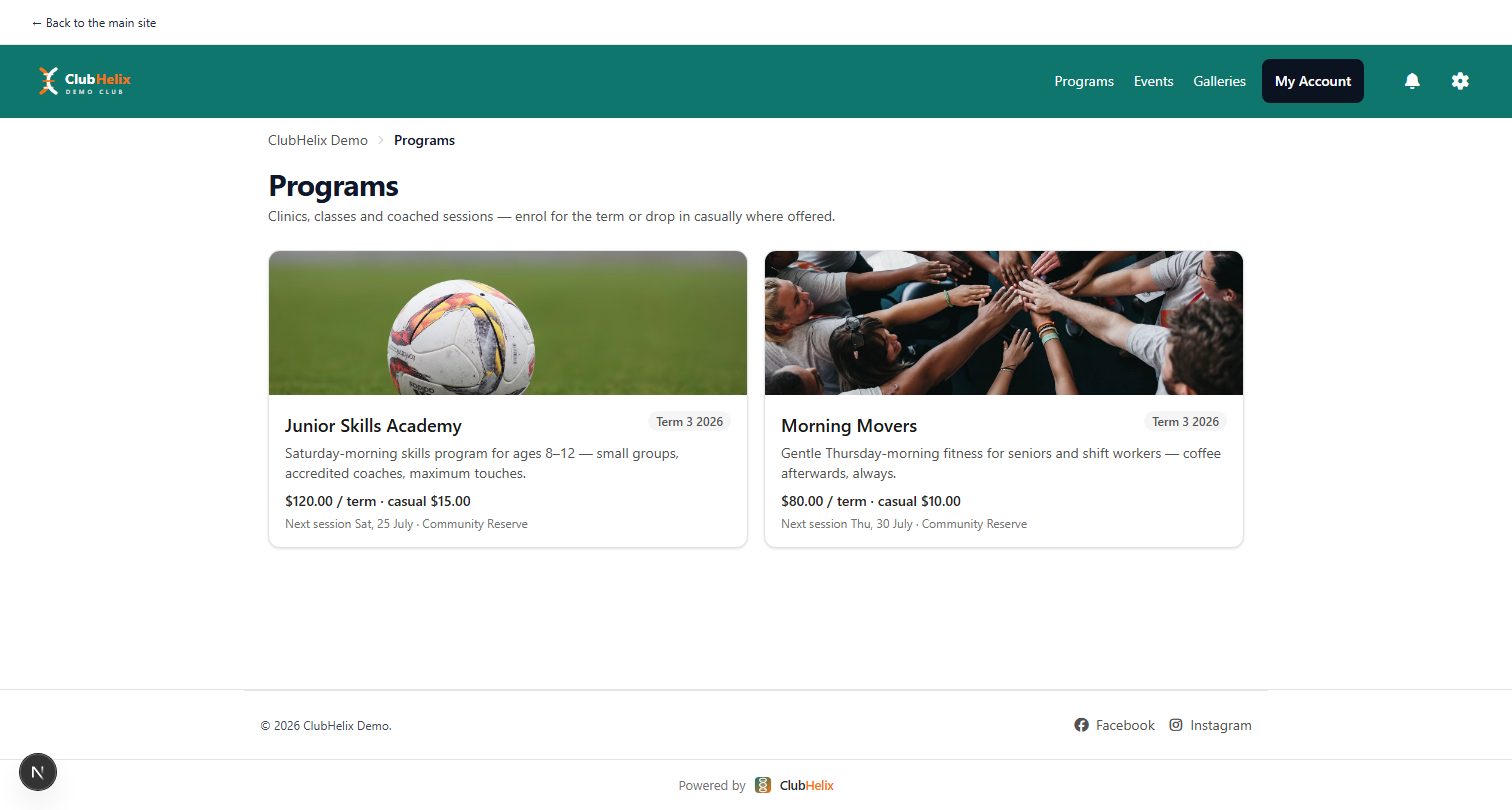
Doing this on paper and spreadsheets consumes an entire volunteer. Gymnastics club management software should let parents browse the timetable, see live availability, enrol and pay online, and join a waitlist when a class is full — ClubHelix's programs and term enrolment does exactly this, with online registration handling the membership and governing-body levy layer underneath.
Coach ratios, accreditation and development
Coach-to-gymnast ratios are set by your governing body's guidelines and your insurance conditions, varying by age and program level — preschool programs run much tighter ratios than school-age recreational classes. Two operational consequences follow. First, your timetable is really a coaching roster: every class needs its accredited coaches rostered, with a plan for sick days (a class without its ratio doesn't run). Second, your growth ceiling is coach supply, not demand.
That makes coach development the committee's most important investment. The standard pipeline is home-grown: senior gymnasts become junior coaches, the club funds their accreditation courses and first-aid certificates, and they're mentored by experienced staff. Pay for accreditation upfront and recover it through a service commitment rather than asking teenagers to fund their own quals.
Track it all deliberately — accreditation levels, first aid, safeguarding-check expiry dates — because a lapsed credential can void insurance cover for a class. ClubHelix's accreditation tracking keeps expiry dates against each coach and warns you before anything lapses. Attendance matters too: rolls marked each class via attendance tracking are your evidence of ratios and your early-warning system for families drifting away.
Equipment and the venue
Gymnastics equipment is the biggest capital question a club faces. Bars, beams, vault tables, spring floors, trampolines, foam pits and matting cost serious money, and the venue question is tangled up with it: a shared hall means setting up and packing down every session (and equipment that wears faster), while a dedicated space means a lease the club must sustain.
Practical rules that serve committees well:
| Decision | Guidance |
|---|---|
| Buying equipment | Buy to your program's level, not aspiration — recreational classes don't need competition apparatus |
| Second-hand | Excellent for matting frames and bars; be cautious with anything sprung or safety-critical |
| Maintenance | Scheduled inspections logged in writing; cables, springs and matting checked on a calendar, not on failure |
| Replacement fund | A line in every annual budget — matting has a lifespan, and "we'll fundraise when it fails" is not a plan |
| Grants | Equipment and facility grants are gymnastics clubs' best friend — see the funding notes below |
On funding: national sports capital grant rounds and local authority grants regularly fund club equipment, and your local sports partnership (via Sport Ireland — sportireland.ie) is the best first conversation about what's currently open.
Log equipment faults the moment a coach spots them, and quarantine faulty apparatus visibly. An incident reporting process that coaches actually use — quick, on a phone, that night — protects gymnasts and the club alike.

Competitions, displays and the club year
For competitive squads, the year is a calendar of sanctioned competitions run under the governing body's levels system — entries, judges' fees, leotards, music and travel all coordinated by the club. Communicate the season calendar to squad families as early as possible; competition weekends are family logistics events.
For the recreational majority, the highlight is the end-of-year display: every class performs, families pack the venue, and gymnasts get their moment. Treat it as your flagship event — ticketing, a program, presentation of certificates — and as your best retention tool, because a child who performed at the display re-enrols for the new year. Manage tickets and RSVPs through your events system rather than an external ticketing site, and follow the display with re-enrolment opening while enthusiasm is at its peak.
Your gymnastics club website
Almost every new family finds a gymnastics club the same way: a search, a look at the website, a decision within minutes. Your gymnastics club website has one job — convert that interest into an enrolment or a waitlist entry. Lead with the timetable and live class availability, fees stated plainly, photos of your actual gym, your coaching credentials and child-safe commitments, and an enrol-now button that works on a phone.
ClubHelix's gymnastics club management software combines the website with class and term enrolment, waitlists, registration and payments, attendance, accreditation tracking and family messaging — one system instead of five, with a free tier to start (see pricing). Committees usually get a site live in an evening. If you are still weighing up the options, our comparison of gymnastics club software sets out the main kinds side by side.
Frequently asked questions
What software does a gymnastics club need?
At minimum: online class enrolment with capacities and waitlists, membership registration with payments, attendance rolls, and a public website showing the timetable with live availability. Clubs outgrow spreadsheets faster in gymnastics than in almost any sport because of class volume and ratio caps.
How do gymnastics club waitlists work?
Families join a waitlist for a full class (or an age group), recording the child's age and preferred days. When a place opens, it's offered in order with an expiry on each offer, and existing families usually get a priority window at re-enrolment before waitlisted families are offered remaining places.
What coach-to-gymnast ratios do gymnastics clubs use?
Ratios are set by governing-body guidelines and insurance conditions and vary by age and program — preschool classes require far tighter ratios than school-age recreational classes. Treat published ratios as hard class capacities and roster accredited coaches accordingly.
How much does gymnastics club membership cost?
Most clubs charge an annual registration (covering governing-body levies and insurance) plus term fees per class stream, with competitive squads paying more for additional training hours. Instalment plans help families manage the term-fee lump without hurting club cash flow.

