
What this guide answers
- How much does it cost to run a gridiron club?
The big line items are league affiliation and insurance, the club gear pool (helmets and pads plus annual reconditioning), ground hire and field marking, and travel in leagues that span long distances.
- How many players do we need for a gridiron team?
Games are eleven-a-side but platoon football means you want 30–45 registered players so offence, defence and special teams aren't the same exhausted dozen.
- Do new players need to buy their own helmet and pads?
Most clubs loan club-owned helmets and shoulder pads to first-year players, usually against a bond, so trying the sport costs little.
- When is the gridiron season?
It varies by league — some play through winter, while others run spring or summer seasons to fit around ground availability and the dominant local codes.
Ireland edition. This guide is written for volunteer-run clubs in Ireland. Where rules differ — grants, tax, incorporation, safeguarding — follow the Ireland-specific pointers below or check with your national body.
American football in Ireland is a sport run almost entirely by true believers. There's no century-old clubhouse, no ground marked for you, and most of your new players have never worn a helmet — they found the club through a mate, a social clip, or years of late-night NFL. That makes running the club a different job from running a rugby or GAA club: you're not just administering a season, you're building the sport's local infrastructure from scratch, every year.
It's absolutely doable — clubs prove it every season — but the margins are thinner and the equipment stakes higher than in almost any other club sport. This guide covers the whole operation: affiliation and season shape, the gear pool that makes or breaks a club, recruiting players from zero, converting a field, the volunteer crew a game needs, registration and waivers, money, and the online presence that brings the next wave of rookies in.
Affiliation and the shape of a gridiron season
The club game here runs through leagues organised under a national governing body, with divisions arranged by standard and geography. Affiliation enters your team in the competition, provides the insurance layer a collision sport cannot operate without, and sets the rules on player registration and transfers.
Because the leagues are small and volunteer-run, your club will likely deal with the competition directly and often — league meetings are genuinely where the sport's decisions get made, so send a committee member to every one.
Season timing varies by league — some play through winter, others run spring or summer seasons to avoid competing with the dominant local codes for grounds and players. Whatever your league's window, the cycle is familiar: an off-season of recruitment, gear reconditioning and fundraising; pre-season training camps and fitness testing; a home-and-away season of eight to twelve games; then finals. Many clubs also run flag — the non-contact version — as a summer program, an entry pathway and a women's and juniors offering in one.
The gear pool: helmets, pads and the club budget
Equipment is gridiron's defining management problem. A player needs a certified helmet, shoulder pads, girdle and pants, cleats and a mouthguard — a serious outlay of kit before anyone snaps a ball. No new player will buy all that to try a sport they've never played, so successful clubs run a gear pool: club-owned helmets and shoulder pads loaned to rookies for their first season or two.
Manage the pool like the asset register it is:
| Task | Why it matters |
|---|---|
| Asset register with sizes and serial numbers | You cannot fit players or chase returns without it |
| Helmet certification and reconditioning cycle | Helmets have service lives and recertification requirements — track dates, retire what fails |
| Bond or hire fee on loaned gear | A modest bond transforms return rates at season's end |
| Fitting days before pre-season | Badly fitted helmets and pads are a safety issue, not a comfort issue |
| Winter storage | Dry, ventilated, vermin-proof — pads rot in a wet container |
Budget gear as a permanent annual line item — replacement helmets, reconditioning, and growth stock for the players you're about to recruit.
Small community-sport grants are worth chasing every year — your local sports partnership and local authority grant rounds are the first stops, with Sport Ireland (sportireland.ie) mapping the wider funding landscape.
Recruiting players who have never played
Almost every rookie here is an adult convert. That flips the usual club growth playbook: instead of a junior pathway feeding seniors, you're marketing directly to 18–35-year-olds — NFL fans, ex-rugby players, gym-goers who want a team sport that rewards size and speed.
What works, season after season:
- Come-and-try days with loaner gear on hand, so a curious visitor hits pads on day one — the hook is visceral. Our come-and-try day guide covers the format.
- Flag programs as a no-contact, no-gear entry ramp that converts a percentage into tackle players.
- Position-based pitches — gridiron genuinely has a spot for every body type, and saying so out loud recruits people other sports turned away.
- Film and socials — game footage cut into short clips out-recruits any poster. Roster a filmer like any other volunteer.
Retention then depends on coaching rookies properly: a structured rookie school teaching stance, tackling technique and rules before full-contact scrimmage keeps new players safe and keeps them coming back. See our guide on growing club membership for the wider funnel.
Fields, chains and the match-day crew
Very few clubs have a dedicated gridiron field, so home games start with a conversion job: marking a 100-yard field with five-yard lines and hash marks on a hired rugby or football ground, and rigging goalposts — portable uprights or adapters on existing posts. Line marking a gridiron field takes hours the first time and a template thereafter; document the process so it survives volunteer turnover.
The game itself needs a crew most sports don't: a chain crew of three working the down-and-distance markers on the sideline, a down-box operator, timekeepers for the game clock, stats volunteers, and qualified first-aid or sports-trainer coverage appropriate to a collision sport.
Add the canteen or barbecue crew and a home game needs ten-plus volunteers before kickoff — roster them by name, every week; a crew cooking for the sideline crowd is as central to game day here as in any club sport.

Registration, waivers and fees
Gridiron squads are big — platoon football means 30–45 registered players is a healthy roster, and every one of them must be registered with the league and insured before contact training starts, not before round one. Because it's a collision sport, your league and insurer will require signed acknowledgements of risk and medical declarations; chasing paper waivers across a 40-man roster is exactly the admin that breaks volunteer clubs.
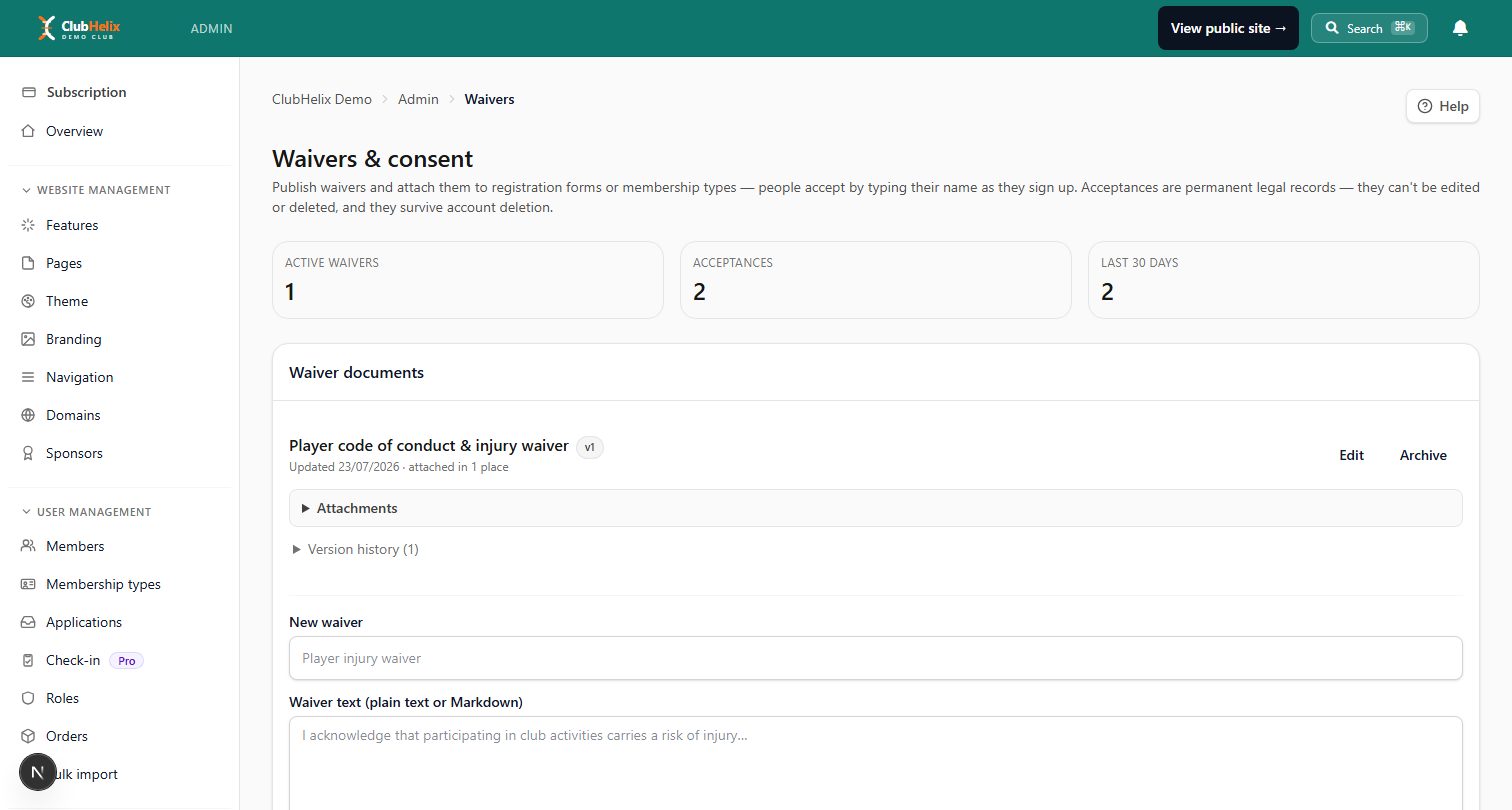
Do it digitally: with ClubHelix, online registration takes fees at sign-up (instalments help — gridiron fees run higher than most sports once insurance and gear are in), and digital waivers get signed in the same flow and stored against the member, so the registrar can see at a glance who is cleared for contact. Fee transparency matters even more in an expensive sport: publish what the registration covers, what the gear bond is, and what flag players pay versus tackle players.
Insurance itself is a board-level topic — confirm exactly what your league's policy covers, what the club must arrange itself, and what evidence of cover your ground owner requires.
Money: fees, canteen, merch and sponsors
A gridiron club's budget is fee-heavy by necessity, but the gap-closers are the same as any club: the food trade at home games, sponsorship, and events. Two levers work unusually well in this sport. First, merchandise — gridiron's aesthetic sells, and supporters who never attend a game will buy the hoodie; an online club shop turns that into year-round revenue. Second, imports and coaching clinics — clubs with an experienced import player or coach can run paid skills clinics that fund the program while raising its standard.
Sponsorship pitches land best on the sport's novelty: a local business gets to be the name behind the town's American football team, with helmet decals, field signage and social reach in the package. Invoice annually, deliver visibly, renew early.
Your gridiron club website and finding the next rookie
Every gridiron club's growth problem is discoverability — the sport's future players don't know the club exists. An American football club website that ranks when someone searches "gridiron near me" or "american football club" in your city is genuinely a recruitment machine: it explains the sport for beginners, shows the season calendar, takes registrations, waivers and payments in one flow, and links the film that sells the game.
ClubHelix builds that site and the club engine behind it — registration, team management for big platoon rosters, waivers, shop, comms and a members' app, with a free tier to start (pricing). See the gridiron club management software page for how clubs set it up, or get your club online before your next come-and-try day.
Frequently asked questions
How much does it cost to run a gridiron club?
The big line items are league affiliation and insurance, the club gear pool (helmets and pads plus annual reconditioning), ground hire and field marking, and travel in leagues that span long distances. Player fees carry more of the load than in most sports, topped up by game-day food trade, merchandise and sponsorship.
How many players do we need for a gridiron team?
Games are eleven-a-side but platoon football means you want 30–45 registered players so offence, defence and special teams aren't the same exhausted dozen. Smaller clubs survive with fewer by two-way playing, but recruitment should never stop.
Do new players need to buy their own helmet and pads?
Most clubs loan club-owned helmets and shoulder pads to first-year players, usually against a bond, so trying the sport costs little. Committed players typically buy their own gear from their second season, and the club keeps the pool for the next intake of rookies.
When is the gridiron season?
It varies by league — some play through winter, while others run spring or summer seasons to fit around ground availability and the dominant local codes. Check your league's calendar, and expect pre-season training to start two to three months before round one.

