
What this guide answers
- How do fishing club competitions usually work?
Most clubs run monthly comps with species categories and a season-long pointscore, scored either at a weigh-in or by measure-and-release photos on a brag mat.
- Do fishing club members need a fishing licence?
Licence requirements vary between jurisdictions — some waters require a general recreational licence, others don't, and rules change.
- What is a measure-and-release comp?
Instead of keeping fish for a weigh-in, anglers photograph each fish on an official measuring mat with a club token in shot, and the photo is scored on length.
- How does a fishing club handle safety on comp days?
With a short standard briefing before lines-in, a log of who's fishing and where, a call-in procedure with a firm close-of-day check, and one designated safety officer who ticks every name off before the weigh-in wraps…
South Africa edition. This guide is written for volunteer-run clubs in South Africa. Where rules differ — grants, tax, incorporation, safeguarding — follow the South Africa-specific pointers below or check with your national body.
A fishing club runs on two calendars at once — the club's comp calendar, and the one the fish keep. Tides, seasons, closures and weather decide half your program for you, which is exactly why the human half needs to be organised: members who know when the next comp is, a weigh-in that runs to time, safety briefings that actually happen, and a committee that isn't reinventing the trailer-parking plan every second month.
Whether you're an estuary club weighing bream off the brag mat, a game-fishing club running tag-and-release points, or a freshwater club chasing trout openings, the mechanics of good fishing club management are the same. This guide covers the lot — comps, weigh-ins, safety, licences, money and the fishing club website that ties it together.
Set up the club and the committee
Most established fishing clubs adopt a formal legal structure — sensible once you're handling comp fees, trailer-boat insurance questions and maybe a lease on a clubhouse or weigh station. If you're still an informal crew, a written constitution, a club bank account with two signatories and basic liability cover are the first steps; your national registrar of societies or nonprofit regulator sets out the formal options from there.
Fishing clubs have a couple of committee roles beyond the standard president–secretary–treasurer trio that are worth filling deliberately:
| Role | What they own |
|---|---|
| Comp secretary | The comp calendar, entry lists, results, pointscore across the season |
| Weighmaster | Scales, brag mat, the weigh-in itself, verifying eligible catches |
| Safety officer | Briefings, comms plan, boat check requirements, call-in procedures |
| Social secretary | The post-weigh-in barbecue, presentation night, family days |
The weighmaster and safety officer roles carry real responsibility on comp days, so pick people who'll be there at 6am and again at the 2pm weigh-in, and give each a documented procedure rather than folklore. If those jobs keep landing on the same two people, our guide on how to recruit club volunteers has practical fixes.
Many clubs also affiliate with a national or regional angling body, which brings sanctioned comps, record claims, interclub events and often insurance arrangements — weigh up what your members actually use before paying per-head affiliation on the whole roster.
Fishing club competitions and the weigh-in
Comps are the engine of the club. A well-run season usually mixes formats so every kind of member gets their event:
- Monthly pointscore comps — the bread and butter. Species categories (bream, flathead, whiting, or your local equivalents), senior/junior/ladies divisions where numbers support them, and a season-long pointscore that keeps people coming back after a lean month.
- Measure-and-release comps — increasingly the default for many species. Photo-on-brag-mat scoring (fish on the mat, mouth closed, tail natural, club token in shot) means fish swim away and results still stand up. Publish exactly what a valid photo looks like — it saves every weigh-in argument.
- Feature comps — the annual open, an interclub challenge, a species-specific classic. These are your sponsor showcases and your recruiting events.
- Social sessions — wharf nights for juniors, a chartered deep-sea trip, a fly-tying evening in winter.
Make the rules boringly clear. Entry cutoffs, fishing boundaries, start and lines-down times, eligible species and minimum lengths, whether bait or lure only, and exactly when and where the weigh-in closes. A latecomer at 2:05pm with a bag of fish is a fight you only need once before you learn to write "scales close at 2:00pm sharp" in bold.
Run the weigh-in to a routine. Set up scales and mat before anyone arrives, check and record calibration, one recorder writing while the weighmaster weighs, results totalled and read out before the barbecue is finished. Announcing the winners while everyone's still there, sausage in hand, is worth more to club culture than any newsletter.
Keeping the season pointscore in a spreadsheet on one member's laptop is how clubs lose their history. Running the comp calendar online instead — an event page with paid entry for each outing and a news post for the weigh-in — puts the calendar, the entries, the results and the season pointscore where every member can see them, and the comp secretary's handover becomes a login, not a shoebox.
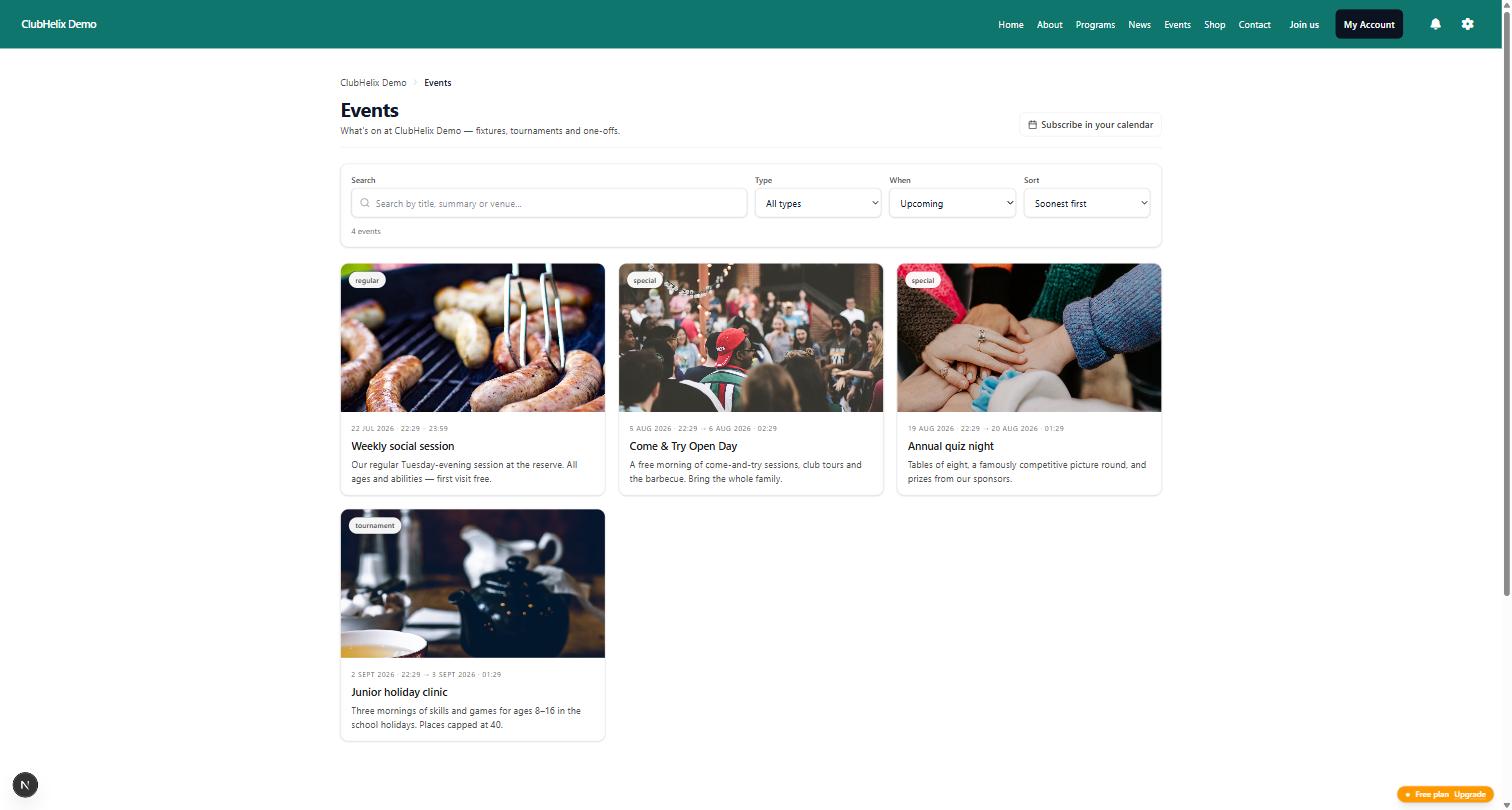
Publishing every comp as an event with RSVPs also solves the perennial "how many boats are coming?" problem — you know numbers before the briefing, not after.
Safety briefings and being organised on the water
Fishing clubs put members on rock ledges, in tinnies and offshore — so safety is a program, not a poster.
Brief before every comp. Two minutes, same structure every time: weather and sea state, boundaries for today, bar-crossing or rock-access warnings, the call-in procedure, lines-down and weigh-in times, and who the safety officer is. Recording attendance at the briefing — a checklist on a phone via RSVP and attendance tracking is enough — means you know who's on the water and who's accounted for at close.
Have a comms plan. A designated radio channel or group thread, a log of which boats launched, and a firm "call in by" time. The safety officer's job at day's end is simple: every name checked off.
Match requirements to the water. Life-jacket rules, boat safety equipment and licensing for skippers are regulated by your local maritime or boating authority and vary by jurisdiction — build your club minimums from the official requirements rather than habit. General risk planning for clubs is covered in our sports club risk management guide.
Weather calls. Decide in advance who can postpone or call off a comp, and how members find out. A wet-weather-style comms plan — one announcement, pushed to everyone, by a set time — beats forty individual text messages at 5am.
Licences, bag limits and doing it by the book
Recreational fishing is regulated jurisdiction by jurisdiction, and the club's job is to point members at the current rules, not to restate them. Fishing licence requirements, bag and size limits, closed seasons and protected zones all differ between places and change over time. Make it standing practice that comp rules defer to the current regulations — "all fish subject to current limits" — and link the official fisheries authority for your waters from the club website so members check the source, not a forwarded PDF.
Marine recreational angling requires a national recreational fishing permit, while freshwater rules are set provincially; both change over time. Link the official pages (via gov.za) from the club site so members always check the current rules. This is general information, not legal advice — check the current requirements with the official bodies.
A club that's visibly on the right side of the rules also finds doors open: fisheries officers who'll come and speak at a club night, habitat-restoration grants, and a good name with the local community.
Membership, money and the social glue
Keep joining simple. A family membership category matters more in fishing than most sports — the club that makes it easy for kids to fish the junior pointscore is the club that still exists in twenty years. Take memberships and renewals through online registration so the roster, payments and emergency contacts stay current without the secretary retyping forms at the kitchen table.
Typical income mix. Annual subs, comp entry fees, raffle and barbecue takings, sponsorship from the local tackle shop and marine dealer, and the annual open comp. Sponsors in fishing are wonderfully natural fits — tackle vouchers make better prizes than trophies, and the shop gets its logo in front of exactly its customers. Our guide to how to get sponsors for a sports club applies almost word for word.
Don't skip the social program. The post-weigh-in barbecue is the club's real AGM — it's where new members get folded in and where volunteers get recruited. Budget for it, roster it, and never let the comp end without it.

Your fishing club website and communications
Fishing clubs generate more time-critical information than almost any other club — comp postponements, tide-driven start changes, boundary changes, results. That makes the fishing club website and the comms behind it genuinely operational, not just a shopfront.
A good setup looks like this: a public website with the comp calendar, club rules, results and a join page, so prospective members can find you and see the club is alive; email broadcasts for the monthly newsletter and comp announcements, sent from the club's own address; and event pages with RSVPs so the comp secretary knows numbers early. Clubs that live on a members-only social media page are invisible to the next generation of members — searching "fishing club near me" finds websites, not private groups.
ClubHelix's fishing club management software bundles the lot — website, memberships and payments, comp entries and published results with the season pointscore, events with RSVPs, and club email — built for volunteer committees, with a free tier to get started (see pricing). Water-based clubs run on the same rhythms; our guide on how to run a sailing club shows the same pattern from the regatta side.
Frequently asked questions
How do fishing club competitions usually work?
Most clubs run monthly comps with species categories and a season-long pointscore, scored either at a weigh-in or by measure-and-release photos on a brag mat. Clear written rules on boundaries, times, eligible species and scoring keep results uncontroversial.
Do fishing club members need a fishing licence?
Licence requirements vary between jurisdictions — some waters require a general recreational licence, others don't, and rules change. Clubs should link the official fisheries authority for their waters and make comp rules defer to current regulations rather than restating them.
What is a measure-and-release comp?
Instead of keeping fish for a weigh-in, anglers photograph each fish on an official measuring mat with a club token in shot, and the photo is scored on length. It lets comps run catch-and-release while keeping results verifiable.
How does a fishing club handle safety on comp days?
With a short standard briefing before lines-in, a log of who's fishing and where, a call-in procedure with a firm close-of-day check, and one designated safety officer who ticks every name off before the weigh-in wraps up.


