
What this guide answers
- How long should a fencing beginners course be?
Six to eight weekly sessions is the sweet spot. It is long enough for a complete novice to fence a proper refereed bout and short enough that people commit to the whole thing up front.
- How much fencing kit does a club need to start?
Enough electric sets to run the strips your venue actually supports, plus one full non-electric set per beginner on your largest course.
- How do you keep track of club fencing equipment?
Number every item, keep a loan register showing who has what and when it is due back, and grade condition rather than recording pass or fail.
- How often should a fencing club run internal competitions?
Monthly is the rhythm most clubs can sustain. A two-hour pool night with a running club rating gives every member several competitive bouts without travel, creates referees, and gives newer fencers a result sheet with…
- Does a small fencing club need its own website?
Yes, mostly because of the beginner course. People searching for a course want dates, a price and a button, and if they cannot find those in under a minute they go and do something else.
UK edition. This guide is written for volunteer-run clubs in the UK. Where rules differ — grants, tax, incorporation, safeguarding — follow the UK-specific pointers below or check with your national body.
A fencing club's year has a shape you can set your watch by. The beginner course opens, twelve people pay for six weeks, by week four there are nine, and by the following season three of them are still fencing — one of whom will be on the committee within two years. Membership, coaching income, competition depth and your volunteer pool are all downstream of that one funnel.
That makes fencing unusual among community sports. Most clubs recruit at the gate: turn up, you already know roughly how the game works and you already own boots. Nobody arrives knowing how to hold a weapon, and almost nobody owns a mask. The club has to teach the sport before it can sell membership, and it has to lend the kit before it can teach. Every other admin problem a fencing club has — the armoury, the venue hire, the competition calendar — is really a consequence of that.
This guide is for the committee and coaching group of a community fencing club. It covers designing a beginner course that fills and converts, running an armoury that survives contact with beginners, giving every member a bout through in-club competition and a club ratings list, and getting people to opens without the entry admin swallowing a coach's week. Numbers used below are illustrative examples, not benchmarks — swap in your own.
The beginner course is your entire intake
Treat the course as a product, not an outreach activity. Products have fixed dates, a price, a cap and a defined outcome. Outreach activities drift, run at a loss and quietly stop happening when the volunteer who ran them moves house.
Five design rules that hold up across club sizes:
- Fixed length, fixed dates, paid in full up front. A six-week course paid at booking has a completion rate that a pay-as-you-go drop-in never matches. People finish what they have already paid for.
- One weapon, not three. Beginners cannot evaluate foil against sabre in week one, and trying to teach all three halves your coaching ratio. Teach the weapon your club is deepest in, and let graduates cross over later.
- A real bout by week two. The single biggest predictor of whether someone comes back is whether they have felt what scoring a hit is like. Footwork drills alone lose people.
- One coach or experienced helper per four to six beginners. Below that ratio the course becomes a queue.
- Kit provided and included in the price. Never ask a beginner to buy anything before they have decided they like the sport.
A six-week course that converts
| Session | On the strip | What they leave with |
|---|---|---|
| 1 | Safety brief, kit issue, on-guard, advance and retreat | Their kit set and the club's rules |
| 2 | Lunge, target, short refereed bouts to three hits | The feeling of scoring |
| 3 | Parry and riposte, distance and timing | A regular training partner |
| 4 | Electric kit — body wires, spools, the scoring box | Understanding of what the gear does |
| 5 | Pool night with the club's improvers | A first result sheet with their name |
| 6 | Graduation bouts, members invited, membership offered | The joining link and a club shirt |
Session five is the one clubs skip and shouldn't. Mixing the course into a normal club night before it ends removes the cliff at the end — graduates already know three members by name, which is the actual reason people stay.
For a rough sense of pricing, a six-week beginner course with kit provided commonly lands somewhere between £50 and £120, with juniors at the lower end. Many clubs bundle the beginner licence or first-year membership into the course fee so graduates are already registered on day one.
Fill it by running the course on a schedule people can plan around, not whenever a coach has a spare evening. Publish all four intakes for the year at once, take bookings online with a waitlist, and send a reminder the week before each start. If you also run a taster night, treat it purely as a feeder into the next course — our guide on how to run a come and try day covers the mechanics.
Turning graduates into members
The conversion moment is not graduation night. It is the three weeks after it, and it fails quietly.
| Checkpoint | When | What has to happen |
|---|---|---|
| The offer | Session 5 | Price, start date and what membership includes, said out loud |
| The join | Session 6 | A link that works on a phone, not a form to print |
| The first night | Week 7 | Someone greets them by name and pairs them for the warm-up |
| The first bout | Week 8 | They fence someone who is not from their course |
| The first entry | Weeks 9-12 | They are entered into an in-club competition, whether they ask or not |
Give the offer a deadline that means something — a discounted first term for graduates who join before the next course starts, for example. That is not a sales trick; it is the difference between deciding now and deciding never. A short survey to everyone who did the course but didn't join is worth running once a year, and the answers are usually about times and cost rather than the sport.
New members should be able to join, pay and sign the club's risk acknowledgement from their phone the same evening. Chasing a bank transfer for three weeks is how a converted beginner becomes an unconverted one.
The armoury — kit that survives beginners
Club kit is the second-largest line in a fencing club's budget and the one most likely to be managed badly, because it lives in a cupboard and nobody owns it. Give the armoury a named role on the committee with a small standing budget, and it stops being a crisis every October.
| Item | Typical club-owned life | Fails as | Replacement rhythm |
|---|---|---|---|
| Mask | Longest-lived item | Rusted mesh, torn bib, loose tab | Test the mesh every season |
| Jacket and breeches | Several seasons | Split seams, failed zip | Rotate largest sizes hardest |
| Plastron (underarm) | Several seasons | Worn at the armpit | Replace with the jacket |
| Glove | Shortest-lived item | Palm wears through | Buy in bulk, expect churn |
| Blade | Highly variable | Bent, snapped, dead tip | Keep a repair box, not spares |
| Body wire and spool | Middling | Intermittent contact | Test before every competition |
The testing and maintenance rhythm
Three habits do most of the work. First, a pre-session check: masks, gloves and body wires get looked at as they are issued, not after someone reports a problem. Second, a monthly armoury hour where a rota of two members rewires tips, replaces glove tape and quarantines anything doubtful in a clearly marked bin — kit that is "probably fine" always comes back into circulation unless there is a physical bin for it. Third, an annual audit before the first course of the year, where every item is counted, graded and either kept, repaired or written off.
Grade kit A/B/C rather than pass/fail. A-grade goes to competitions and visitors, B-grade to regular training, C-grade to beginner courses where the wear is heaviest and the standard required is lowest. Beginners get the oldest working kit, not the worst kit.
Tracking who has what
Every club with more than about twenty members eventually discovers three masks have left the building permanently. A simple loan register solves it, and it does not need to be sophisticated: item, identifier, who has it, out date, expected return, condition on return. Put an identifier on everything — a paint pen number on the mask tongue and a numbered tag on each weapon.
For members borrowing kit for a whole season, take a bond or a signed loan agreement covering what happens if the item is damaged or not returned. Keep the wording plain: the member agrees to return the listed items in the condition issued, to report damage rather than repair it themselves, and to pay a stated replacement value if the item is lost. Our club equipment register template is a reasonable starting shape to adapt.

The venue — strips, power and the pack-down
Most clubs hire a hall by the hour, and the hall dictates the club. Before you sign a hire agreement, work out three things: how many strips fit end to end with safe run-off, where the power comes from for the scoring boxes, and where the kit lives between sessions.
- Metal pistes are wonderful and heavy. If you have to lay and lift them every session, you will stop laying them. Either negotiate storage that lets them stay down, or fence on marked floor and accept it.
- Power is the hidden constraint. Each strip needs a box and a reel; halls with two accessible sockets cap you at two electric strips no matter how much kit you own.
- Pack-down is a roster, not a favour. Publish it. The club that leaves five people stacking spools at 10pm every week burns those five people out within a season.
- Book the whole year, including competition dates. Booking weekly sessions and then discovering the hall is unavailable on the night you advertised your open is the most avoidable disaster in club administration.
Plan around a season that runs from early autumn to late spring, with the summer as the quiet period when halls are cheapest and school lets are hardest to get. Most clubs run their main beginner intake in September and a second in January, and hold club championships in the spring before the season closes.
In-club competition and a club ratings list
The clubs that keep adult beginners are the clubs where a mid-table fencer gets competitive bouts every month without travelling. That is an administrative achievement, not a coaching one.
Run a monthly pool night on a fixed date. Everyone present is seeded into pools of five or six, fences everyone in their pool to five hits, and the results feed a running club rating. It takes about two hours, works with any number from eight to forty, and gives every fencer four or five real bouts.
A simple run sheet:
- Entries close at 6:45pm. Names on the sheet, not a rolling start.
- Seed by current rating, snaking so each pool has a spread of standards.
- Assign a referee to each pool — ideally a fencer sitting out that round, which is how referees get made.
- Fence pools, 5 hits, 3 minutes. One scorer per pool, results on a single sheet.
- Direct elimination for the top eight if time allows, or straight to the ratings update if not.
- Publish the updated ratings that night. Not "later in the week".
A club ratings list does not need to mirror any official rating scheme. Points for participation plus points for bouts won, decayed a little each quarter so someone who stops attending drifts down, is enough to make it feel live. Publish it on your club website rather than in a group chat, because a rating people can see is a rating people chase — event pages take the pool-night entries and news posts put the results and the updated ratings on your own site the same evening.
Keep a separate beginners' plate at the same event for anyone in their first six months. Fencers who lose every bout in a senior pool for three months in a row leave, and they never tell you why.
Getting people to opens
Travelling to a regional or national open is where a club's fencers grow up, and it is also where the entry admin lands on one person. Standardise it.
- Publish the year's target events in one place at the start of the season, with entry deadlines a week before the real ones.
- Collect intent early. A single form asking who is going to which event, with a deadline, converts a coach's twelve text-message conversations into one list.
- Pool travel and accommodation deliberately. Two cars and a shared apartment is the difference between four fencers going and one.
- Send someone who can referee. Many opens require or reward clubs bringing a qualified referee, and it is the cheapest way to fund a trip.
- Debrief after. Results are the least interesting part; what the fencers noticed about the standard is what changes training.
For juniors, add a permission and medical form and a named team manager for the trip. If your club runs a junior squad, our guide on starting a junior program covers ratios, supervision and parent communication.
Coaches, referees and the safety baseline
Fencing's safety record is built on equipment standards and supervision, and both are administrative. Three registers are worth keeping properly:
- Coaching qualifications and their expiry dates, including first aid.
- Referee qualifications, including which weapons and what level.
- Safeguarding screening for anyone working with juniors, with renewal dates tracked centrally.
In the UK the safeguarding baseline is an appropriate DBS check for anyone coaching or regularly supervising juniors, and most clubs also register members individually with the national governing body, which is what carries the insurance and the licence to enter ranked competition. Many clubs also hold accreditation under the governing body's club-standards scheme, which unlocks funding routes.
This is general information rather than legal advice — confirm current requirements with your governing body and the relevant authority where you train.
The money shape of a small fencing club
Fencing club finances are lumpy in a specific way: income arrives in four course-shaped bumps and a membership bump, while hall hire leaves the account every single week. That mismatch, not the total, is what sinks clubs.
Three habits that fix it:
- Hold a hall-hire float equal to about a term of rent, and treat it as untouchable. It converts a bad term into an inconvenience.
- Depreciate the armoury on paper. If a full beginner kit set has a working life of roughly four years, one quarter of the replacement cost is this year's expense, whether or not you spend it. Clubs that skip this face a five-figure re-kit as a surprise.
- Separate course income from membership income in your accounts. If you cannot see whether courses pay for themselves, you cannot price them.
For capital items — pistes, scoring boxes, reels — National Lottery community funding, local authority small grants and your governing body's own equipment schemes are the usual routes. Clubs registered as Community Amateur Sports Clubs also unlock Gift Aid on donations and business-rates relief, which is worth investigating early.
Sponsorship works differently in fencing than in field sports because your audience is small and specific. Rather than selling signage nobody sees, sell the beginner course itself — a local business underwriting six sets of kit in exchange for their name on the course and a photo at graduation is a genuinely fair trade.
Running the club from one place
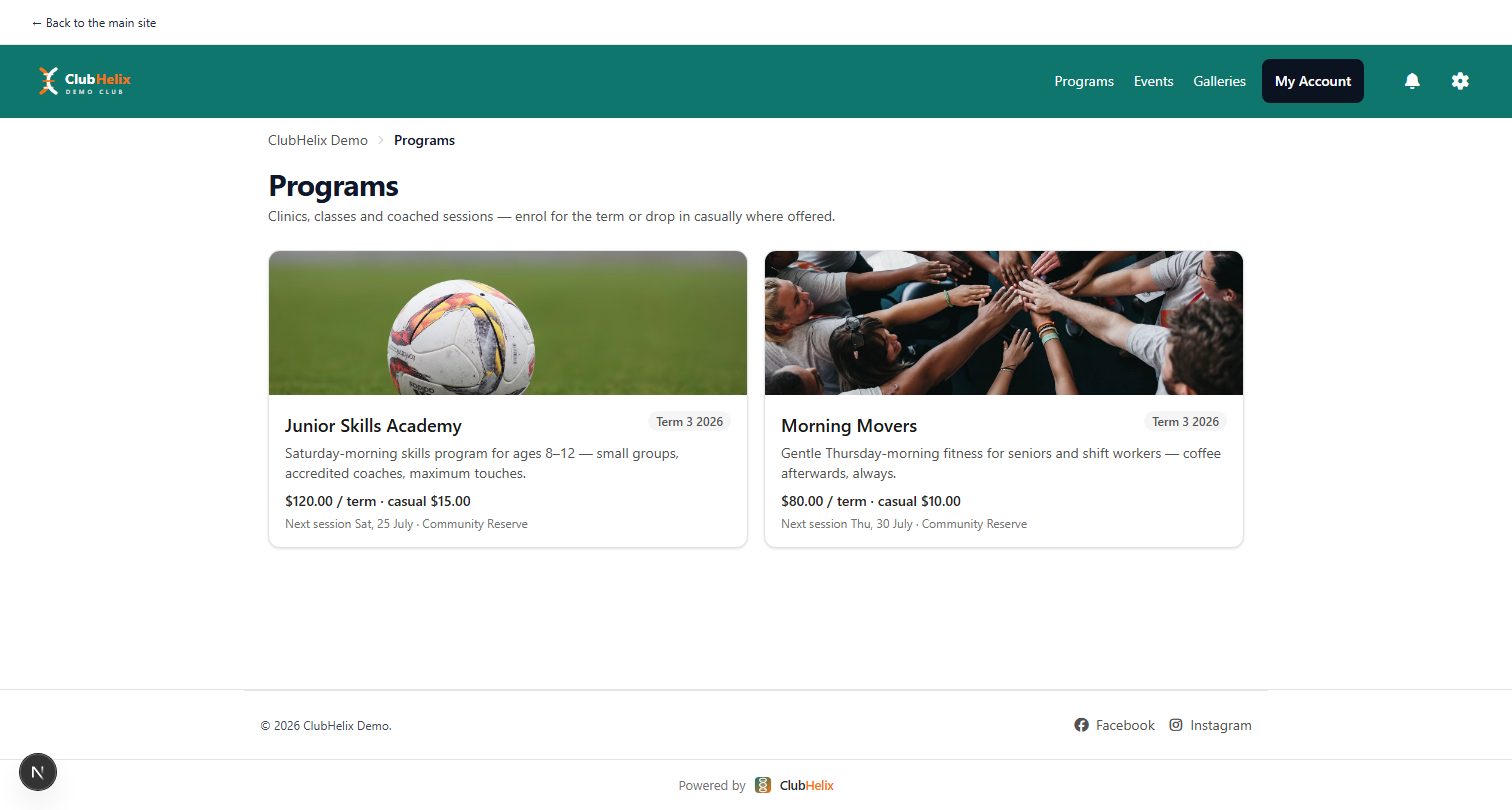
Almost everything above is admin: course bookings and waitlists, kit loans, competition entries, ratings updates, hall-hire dates, screening expiry, and the weekly "is training on?" message. ClubHelix puts those on one club website — programs and term enrolment takes course bookings and payment with capacity limits and a waitlist, events handles pool nights and open entries with RSVPs, and news posts publish your results and updated ratings where members and prospective members can see them. The fencing club management software page shows how those pieces fit together for a salle.
There is a free tier to start on, the pricing is published in full, and you can create your club site between one training night and the next. If your beginner course opens in six weeks, that is enough time.
Frequently asked questions
How long should a fencing beginners course be?
Six to eight weekly sessions is the sweet spot. It is long enough for a complete novice to fence a proper refereed bout and short enough that people commit to the whole thing up front. Shorter courses rarely reach the point where the sport becomes addictive, and longer ones lose people to holidays and life.
How much fencing kit does a club need to start?
Enough electric sets to run the strips your venue actually supports, plus one full non-electric set per beginner on your largest course. Most clubs start with a handful of masks, jackets, plastrons, gloves and blades bought second-hand or through a governing body scheme, then expand one course at a time as membership income allows.
How do you keep track of club fencing equipment?
Number every item, keep a loan register showing who has what and when it is due back, and grade condition rather than recording pass or fail. Run an annual audit before your first course of the year, quarantine doubtful items in a physical bin, and take a bond or signed agreement for season-long loans.
How often should a fencing club run internal competitions?
Monthly is the rhythm most clubs can sustain. A two-hour pool night with a running club rating gives every member several competitive bouts without travel, creates referees, and gives newer fencers a result sheet with their name on it — which matters more for retention than any single tournament.
Does a small fencing club need its own website?
Yes, mostly because of the beginner course. People searching for a course want dates, a price and a button, and if they cannot find those in under a minute they go and do something else. A club site that takes course bookings, publishes the ratings and answers "is training on tonight?" pays for itself in the first intake.
Keep reading — how to start a junior program and how to run a come and try day.


