
What this guide answers
- How do you start a darts league?
Find a home venue with a couple of good boards, gather eight or more regulars, pick one format (a teams night is the easiest start), and publish a short round-robin fixture with a ladder.
- What equipment does a darts club need?
Quality sisal boards with surrounds and mats, correct oche markings, good overhead lighting, spare boards and consumables (flights, shafts, chalk), loaner darts for newcomers, and trophies for season's end.
- How much does it cost to join a darts club?
Typically a modest annual membership plus a small weekly board fee on league nights that funds prizes and trophies.
- What is the standard dartboard height and throwing distance?
There are standard measurements for bullseye height and oche distance used in league play worldwide — your association or board manufacturer publishes the current numbers.
New Zealand edition. This guide is written for volunteer-run clubs in New Zealand. Where rules differ — grants, tax, incorporation, safeguarding — follow the New Zealand-specific pointers below or check with your national body.
Darts might be the most sociable sport there is: a couple of boards on a wall, a chalker keeping score, and a room full of people who came for the darts and stayed for the company. That sociability is also why darts clubs quietly fall over — everything runs on one organiser's goodwill, the fixtures live in their head, and when they step back the whole league wobbles.
Running a darts club well means putting just enough structure under the social heart of it: a reliable venue arrangement, a league format people can follow, fixtures and a ladder everyone can see, boards that are actually maintained, and communication that reaches players before they've left home. This guide covers how to run a darts club from first committee meeting to grand final night.
Getting set up: club, venue and affiliation
Most darts clubs live inside a licensed venue — a pub, RSA or sports club — rather than owning premises.
That makes the venue relationship your foundational asset, and it's worth treating like one. The deal is usually simple and unwritten: the venue provides boards, lighting, space and storage; the club brings a reliable crowd of thirsty regulars every week. Make it slightly more formal than a handshake — agree your regular nights for the year, who buys and maintains boards, what happens on function nights, and whether the venue will sponsor trophies or a weekly meal deal. A venue that sees the club as its Tuesday-night anchor will look after you; nail down the details before a change of manager tests the assumption.
Beyond the venue: decide whether to adopt a formal legal structure (sensible once you're holding prize funds and collecting fees), open a club bank account with two signatories, and consider affiliating with a darts association if your players want pathways into representative and sanctioned competition. Plenty of thriving darts clubs stay purely social; affiliation is a choice, not a requirement.
In New Zealand, formalising usually means registering as an incorporated society through the Companies Office register (is-register.companiesoffice.govt.nz), with representative pathways running through your regional association under the national darts body.
This is general information, not legal advice — check current requirements with your association and regulator.
Boards, oches and equipment care
Your equipment list is mercifully short, which is exactly why neglecting it is inexcusable. A proper setup per board: a quality sisal (bristle) board, mounted with the bullseye at the standard height, a marked oche at the standard throwing distance, good even lighting from above the board (no shadows across the doubles), a surround to protect the wall, and a mat to protect the floor and mark the line. Your association or board manufacturer publishes exact measurements — set up once, precisely, and check occasionally.
Board maintenance is a small routine with a big payoff:
- Rotate boards regularly so the wear from the twenty spreads around the board instead of shredding one segment.
- Retire tired boards to practice duty — league night deserves a board where the wire's true and the sisal springs back.
- Keep spares on hand: flights, shafts, a spare set of club darts for newcomers, chalk or markers for the scorers.
- Log it somewhere. A simple equipment register with purchase dates tells you honestly when boards are due — our equipment register template works fine for a darts cupboard.
Budget for a board or two per year in your fees, and the whole problem stays boring — which is the goal.
Running your darts league
The league is the engine of the club, and format decides whether it hums. The classic club structure mixes formats across the week or the season: a singles league for the purists, doubles for pairs, and teams nights — sides of four to six playing sets of singles and doubles that combine into a match result — which are the social glue that keeps the room full. A season of 10–18 rounds, a ladder, then finals for the top four gives everyone something to play for; a parallel handicap event or a "most improved" award keeps the bottom half coming back, because a league that only rewards the best three throwers slowly empties.
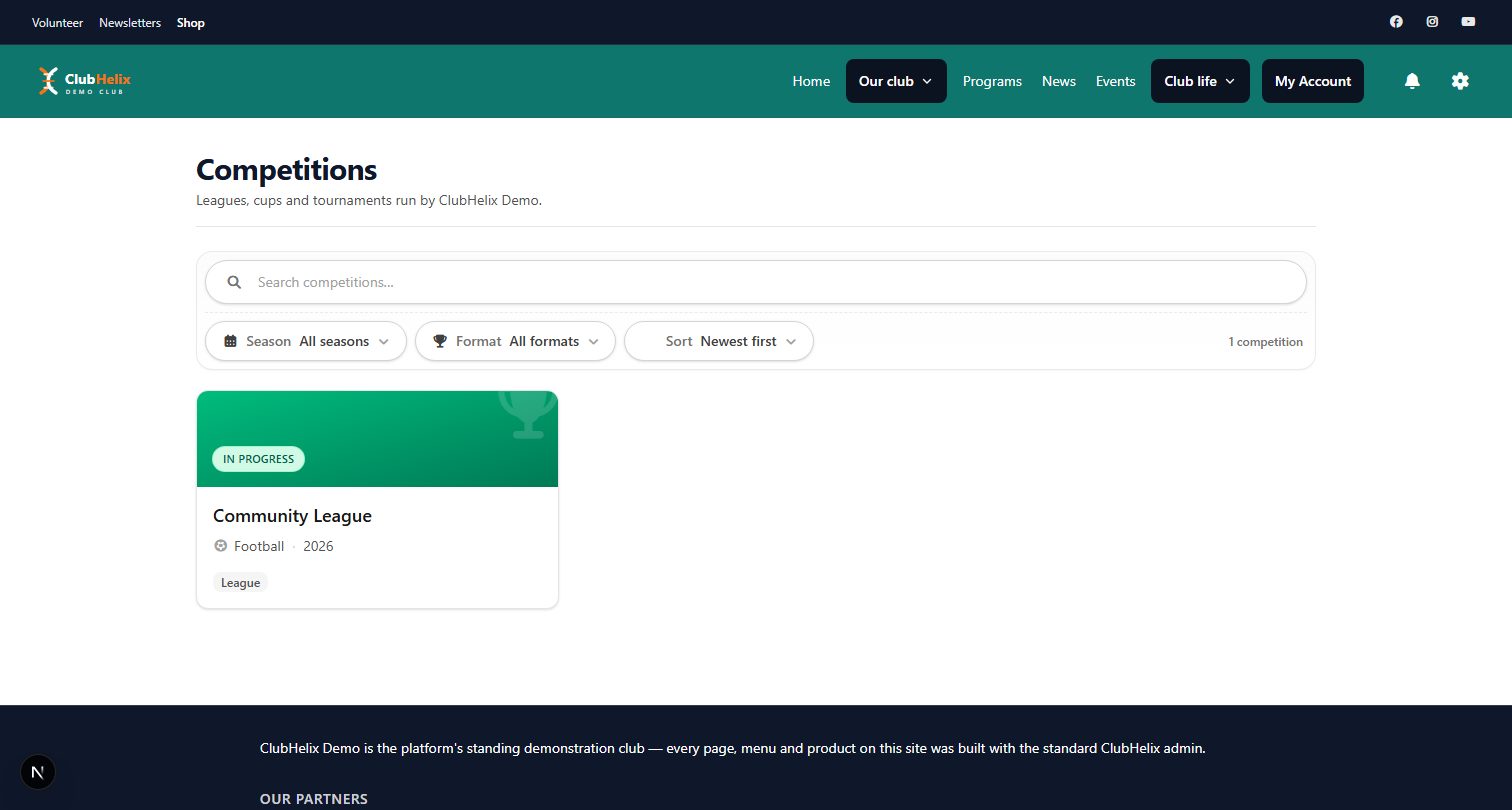
The admin behind it is exactly the kind of thing that shouldn't live in a notebook: the fixture draw, week-by-week results, the ladder, and finals qualification. Our guide to making a fixture draw covers round-robin mechanics, but the bigger win is putting the whole league online. ClubHelix's competitions runs fixtures, results entry and a live ladder your players can check from the bar or their couch — and finals brackets sort out the end of the season without a whiteboard.
Player etiquette does the rest: everyone chalks (scores) when rostered, matches start on time, and results go in the same night. A league where Thursday's ladder is updated by Thursday feels alive; one updated "when someone gets a chance" feels abandoned.
Membership, fees and club nights
Darts club membership is cheap to provide, so keep fees simple and visible. The common model is a modest annual membership (covering affiliation if any, equipment fund and insurance) plus a small weekly board fee on league nights that feeds the prize pool and trophies. Collect the annual fee online at registration — online registration takes two minutes per player and gives you a clean contact list — and keep the weekly fee cash-simple or as a season pass, whichever suits your room.

Beyond league nights, the clubs that grow run a rhythm of lighter events: a monthly open social night where newcomers borrow club darts and get a friendly game, novelty formats (round-the-clock, killer, blind doubles), an annual championship with proper trophies, and the odd trivia or games night for partners and friends. Social-first events are your recruitment funnel — most future league players first walked in for one relaxed night. If your club is starting from scratch, our guide on how to start a social club covers the early moves.
Communication and the money
A darts club's communication needs are modest but unforgiving: who's playing whom this week, at what time, on which board, and whether anything's changed. A fixture published online, a reminder message the day before, and a captains' group for teams nights covers nearly all of it — club chat keeps it off personal group threads that half the club isn't in. When a night moves or the venue has a function, one message to everyone beats a phone tree every time.
Money is similarly simple, and should be kept that way: fees in, prizes/trophies/boards/affiliation out, reported at the AGM. The one trap is prize funds accumulating in a shoebox — run everything through the club account, publish a one-page summary each season, and the treasurer's job stays a small one. Sponsorship is usually close to home: the venue, a local bottle shop or butcher backing the weekly raffle, a sponsor's logo on the club shirt.
Your darts club website
For a sport played in back rooms, being findable matters more than you'd think. A darts club website does three jobs: it tells prospective players you exist, when you play and that beginners are welcome; it hosts the living league — fixtures, results, ladder — so the club runs itself in public; and it gives your club a permanent home that survives any one organiser. Add a short history page and season honour boards, and you've also built the club's memory.
ClubHelix's darts club management software sets all of this up in one place: a club website, online registration, competitions with fixtures and ladders, events, messaging and a members list — with a free tier that suits a single-venue club (see pricing). One organiser can run the whole thing from a phone, which is the point: the club stops depending on the notebook.
Frequently asked questions
How do you start a darts league?
Find a home venue with a couple of good boards, gather eight or more regulars, pick one format (a teams night is the easiest start), and publish a short round-robin fixture with a ladder. Keep season one small and social — you can add singles and doubles leagues once the night is established.
What equipment does a darts club need?
Quality sisal boards with surrounds and mats, correct oche markings, good overhead lighting, spare boards and consumables (flights, shafts, chalk), loaner darts for newcomers, and trophies for season's end. It's a short list — the discipline is maintaining and rotating boards, not buying them.
How much does it cost to join a darts club?
Typically a modest annual membership plus a small weekly board fee on league nights that funds prizes and trophies. Darts is one of the cheapest club sports going — most players spend more on their own darts than on their membership.
What is the standard dartboard height and throwing distance?
There are standard measurements for bullseye height and oche distance used in league play worldwide — your association or board manufacturer publishes the current numbers. Set every board up to the standard once, precisely, and league players will trust your venue.

