
What this guide answers
- How do cycling club ride grades work?
Most clubs run three to five grades defined by average speed, distance and regrouping policy — for example a fast A bunch, a brisk B bunch, and no-drop C and social grades.
- What does a ride leader do?
The ride leader delivers the pre-ride safety briefing, sets the route and pace to the advertised grade, manages regroup points and makes calls in traffic; a sweep rider stays with the last wheel.
- Do cycling clubs need insurance?
Organised riding on public roads carries real liability considerations, which is a major reason most clubs affiliate with a recognised cycling body whose membership includes rider insurance.
- What should a cycling club website include?
The graded ride calendar with routes and start times, online membership and payment, ride rules and a digital waiver for new and visiting riders, kit orders, race results, and sponsor recognition — all in one place a…
UK edition. This guide is written for volunteer-run clubs in the UK. Where rules differ — grants, tax, incorporation, safeguarding — follow the UK-specific pointers below or check with your national body.
A cycling club is one of the easiest clubs to start and one of the trickiest to run well. There's no ground to book and no goalposts to put up — but every single club activity happens on public roads or trails, in traffic, in a bunch, at speed. That changes what "running the club" means: your real products are a reliable ride calendar, a graded bunch structure that riders trust, and a safety culture that survives contact with a wet Saturday morning.
This guide covers cycling club management from the road up: how clubs get set up and affiliated, ride grades, ride leaders and safety briefings, the club ride calendar, membership and kit, racing, communication and money — and the cycling club website that holds it all together.
Getting set up and affiliated
Most cycling clubs affiliate with a recognised cycling body, which typically brings member insurance, race permits, technical rules and a pathway into sanctioned racing. Recreational and social riding groups sometimes stay independent, but affiliation matters more in cycling than in many sports because of the insurance question — riders are sharing roads with cars, and organised rides carry real liability considerations. Whichever path you take, get your legal structure and insurance position sorted before your first official bunch roll-out, and ask your affiliation body exactly what its cover does and doesn't include.
Clubs here typically affiliate through the national cycling federation, which brings club insurance and event permits. Structure-wise, most start as unincorporated associations; a club taking on assets or bigger events can look at a charitable incorporated organisation (CIO) or Community Amateur Sports Club (CASC) status, which brings tax reliefs through HMRC (gov.uk).
This is general information, not legal or financial advice — check current requirements with your affiliation body and regulator.
Committee-wise, cycling clubs need the usual president, secretary and treasurer, plus roles that map to the sport: a ride captain (owns the ride calendar and grading), a ride-leader coordinator, a race secretary if you race, and a kit officer who manages the club clothing cycle.
Ride grades: the backbone of cycling club management
Nothing shapes a rider's experience of your club more than grading. A new member's first question is always the same: which bunch should I join, and will I get dropped?
Most clubs run three to five grades, published with honest, concrete descriptors — average speed on the flat, typical distance, and the bunch etiquette expected. For example:
| Grade | Typical pace (flat) | Character |
|---|---|---|
| A | 34+ km/h | Fast, race-style, minimal regrouping |
| B | 30–34 km/h | Brisk, structured, regroups at designated points |
| C | 25–30 km/h | Social-fitness pace, no-drop policy |
| D / Social | Under 25 km/h | Beginner-friendly, coffee is the point |
Two rules make grading work. First, no-drop means no-drop — if your C grade advertises that nobody gets left behind, the ride leader's job is to enforce it, every time. Second, publish how riders move between grades so it feels like a pathway, not a judgement. Clubs that get grading right retain new riders; clubs that let every ride drift into a smash-fest quietly lose them — which is worth remembering when you read our guide on how to grow club membership.
Ride leaders and the safety briefing
Every graded ride needs a designated ride leader — ideally a leader and a sweep. The ride leader owns the route, the pace promise, the regroup points and the pre-ride briefing; the sweep stays with the last wheel.
The safety briefing should be short, standard and non-negotiable, delivered before roll-out every single time:
- The route, distance and regroup points for today
- Calls and signals the bunch uses (holes, glass, cars, stopping)
- Two abreast where legal, single file where conditions demand
- What happens if there's a mechanical or a rider is dropped
- A reminder that helmets, working brakes and lights (if early) are conditions of riding
Back the briefing with paperwork that protects the club: new and visiting riders should acknowledge the ride rules and accept the club's risk statement before their first ride. Digital waivers make this painless — a rider signs once on their phone, and the club has a record instead of a soggy clipboard. Keep an incident log for anything that happens on a club ride, however minor; a simple incident reporting habit gives the committee the pattern data (that one descent, that one roundabout) to fix routes before something serious happens.
The club ride calendar
The club ride calendar is your shop window and your operating system in one. Riders plan their week around it, and prospective members judge your club by it. A good calendar shows, for every ride: the grade(s), start point and roll-out time, route (with a link), distance and climbing, the ride leader, and the coffee stop — never underestimate the coffee stop.
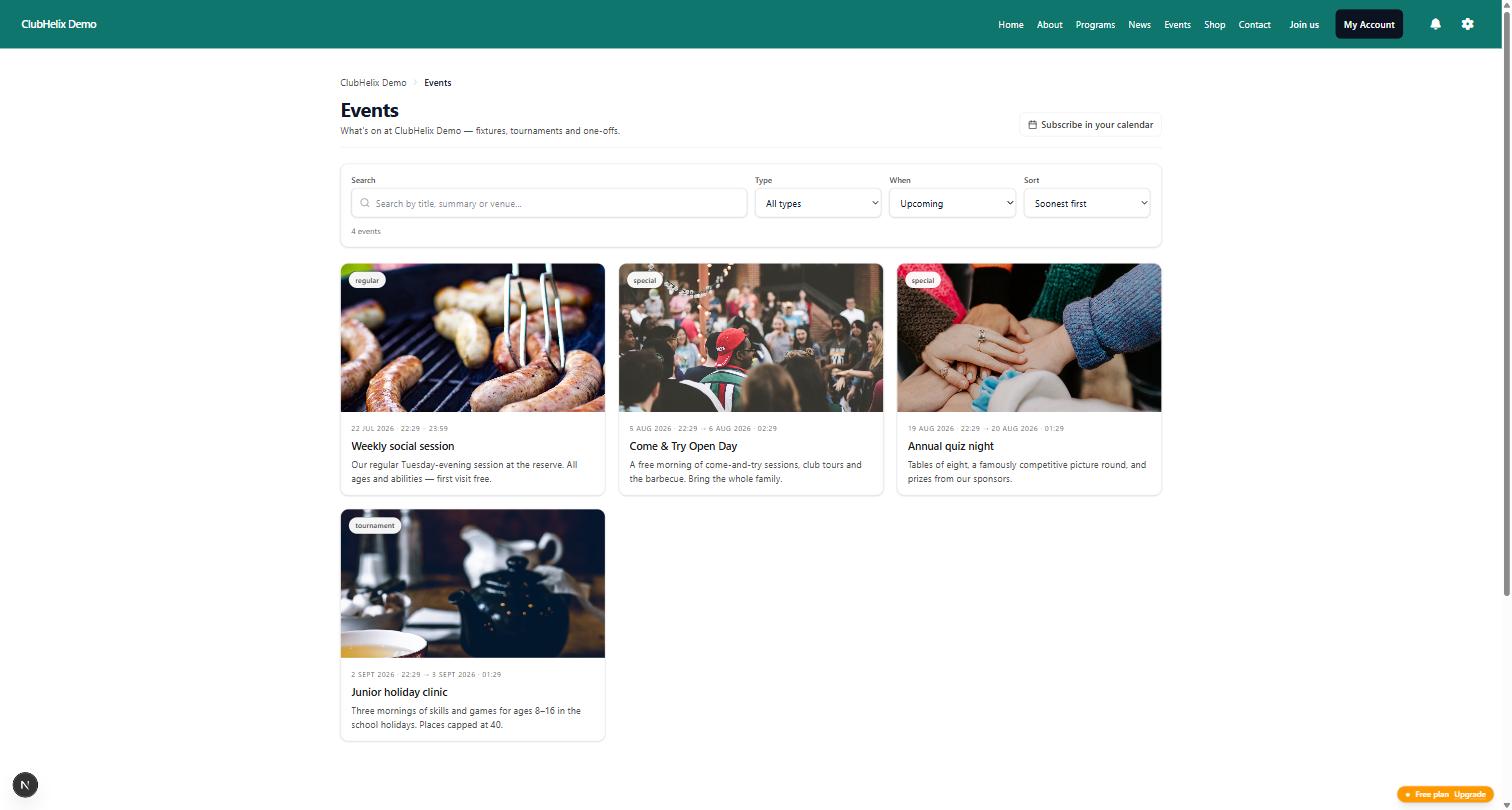
Put the calendar on your club website as a proper events calendar, not buried in a chat thread. Recurring weekly rides (the Saturday shop ride, the Tuesday hills loop) should repeat automatically, with one-off rides — the annual gran fondo trip, the hill-climb championship — added around them. With RSVPs turned on, ride leaders know numbers before roll-out, which matters when you're splitting one bunch into two for safety.
Wet weather deserves its own protocol: who makes the call, by when, and where it's announced. One authoritative channel — the website plus a push notification — beats three contradictory chat messages at 6:40am. Our wet-weather communication plan is worth stealing.
Membership, fees and kit
Cycling club fees are usually modest because the infrastructure is: an annual membership that covers affiliation, insurance and club running costs. Collect it online with the member's emergency contact and medical notes — details a ride leader may genuinely need at the roadside. Renewals are where clubs leak members, so use automatic reminders rather than a shame list read out at the AGM.
Kit is the other membership pillar. Club kit makes the bunch visible (a genuine safety feature), builds identity, and — with sponsor logos — funds the club. Run kit orders in windows two or three times a year through your club's online shop, so sizing, payment and pickup are tracked instead of living in the kit officer's inbox. Sponsors on the jersey are the classic cycling deal; our guide to getting sponsors for a sports club covers how to price and package it.
Racing: crits, time trials and the club championship
If your club races, the calendar grows: criteriums, road races, hill climbs and time trials, each needing permits (through your affiliation body), marshals, first aid and sign-on. Even a low-key club TT series needs entries, timing, results and a point score — and members will care about that point score far more than you expect. Publish results promptly on the club website and keep a running club championship pointscore; it's the cheapest retention tool in the sport. If racing isn't your club's thing, a well-run monthly hill-climb or a season-long KOM/QOM challenge scratches the same competitive itch with a fraction of the admin.

Communication and club culture
Cycling clubs generate constant chatter — ride changes, route notes, mechanical advice, race carpooling. Give it a home the club controls: safeguarded club chat with channels per grade or bunch keeps conversation on-club rather than scattered across consumer chat apps where half the bunch misses the message and nobody moderates. Save email broadcasts for the things everyone must read: the kit window closing, the AGM, the ride calendar for the month ahead.
Your cycling club website
A cycling club website has four jobs: publish the ride calendar and grades so newcomers can self-select, take memberships and payments online, host waivers and ride rules, and give sponsors a visible home. ClubHelix does all four — see the cycling club management software page for how clubs set it up, browse templates for a starting design, and check pricing (a free tier is available to get rolling). Most committees can get a club site live in an evening and add RSVPs, chat and the shop as the club grows.
Frequently asked questions
How do cycling club ride grades work?
Most clubs run three to five grades defined by average speed, distance and regrouping policy — for example a fast A bunch, a brisk B bunch, and no-drop C and social grades. Publishing honest grade descriptors and how riders move between grades is one of the most important things a cycling club can do.
What does a ride leader do?
The ride leader delivers the pre-ride safety briefing, sets the route and pace to the advertised grade, manages regroup points and makes calls in traffic; a sweep rider stays with the last wheel. Every official club ride should have one designated in advance on the ride calendar.
Do cycling clubs need insurance?
Organised riding on public roads carries real liability considerations, which is a major reason most clubs affiliate with a recognised cycling body whose membership includes rider insurance. Check exactly what your affiliation covers and whether the club needs additional cover for events.
What should a cycling club website include?
The graded ride calendar with routes and start times, online membership and payment, ride rules and a digital waiver for new and visiting riders, kit orders, race results, and sponsor recognition — all in one place a rider can check from their phone.


