
What this guide answers
- What's the difference between golf croquet and association croquet?
Golf croquet is the fast, social code — one shot per turn, everyone contesting the same hoop, games in well under an hour — and the usual entry point for beginners.
- How do croquet clubs attract new members?
Come-and-try days with loan mallets and a golf croquet intro, a discounted first-year membership with free coaching, partnerships with retirement communities and community groups, and twilight sessions for people still…
- How are croquet lawns maintained?
Much like bowling greens: mown very short and regularly, rolled for trueness, renovated seasonally, and irrigated.
- Does a croquet club need special equipment for beginners?
No — that's croquet's advantage. The club supplies hoops, balls and loan mallets, so a first-timer needs only flat-soled shoes.
UK edition. This guide is written for volunteer-run clubs in the UK. Where rules differ — grants, tax, incorporation, safeguarding — follow the UK-specific pointers below or check with your national body.
Croquet clubs are quiet achievers. Behind the hedges, a good club runs a surprisingly demanding operation: lawns mown as tight as a bowling green, several distinct codes of the game played to different rules and handicap systems, a full calendar of club sessions and interclub events, and a membership that skews older but plays several times a week — more court-hours per member than almost any sport going.
The challenge for most committees isn't enthusiasm, it's renewal: keeping the lawns true on a small budget, bringing new members through the gate in a sport most people have only played at a barbecue, and modernising the admin — membership, events, communication — so it doesn't all rest on one heroic secretary. Here's how to run a croquet club that's set up for its next twenty years, not just its last twenty.
Getting set up and affiliated
Croquet clubs affiliate with their state association under the national body. Affiliation brings the things a club can't provide alone: sanctioned tournaments and interclub competition, official handicapping, coaching and refereeing accreditation, and usually the club's insurance arrangements. If you're starting a new club — often as a section of an existing bowls or community sports facility — the structural groundwork (incorporation, constitution, committee, bank account) is covered in how to start a sports club.
The land question matters as much for croquet as for bowls: most clubs lease council land, and a committee that can demonstrate community use — come-and-try days, school and aged-care visits, corporate groups — is in a far stronger position at every lease renewal and grant application.
Know your codes: golf croquet, association and friends
A croquet club's programming decisions start with which codes it plays. Most clubs run at least two:
This is the sport's historic home, which has two practical consequences: the tournament and handicap structure is deep and well documented, so a small club never has to invent its own, and association croquet retains a stronger following here than almost anywhere. Golf croquet is still where nearly all your new members will start.
| Code | Character | Best for |
|---|---|---|
| Golf croquet | Fast, social, one shot per turn, everyone contests the same hoop | Beginners' entry point; the sport's growth engine |
| Association croquet | Deeply tactical, breaks and croquet strokes, games can run hours | Players who want the full strategic game |
| Ricochet | A bridge code — more tactics than golf croquet, simpler than association | Progressing players |
| Gateball | Team-based, fast, five-a-side on a smaller court | Groups and multicultural community outreach |
The practical wisdom: lead with golf croquet. It's easy to teach in twenty minutes, games are short, and new players are competitive (and hooked) quickly. Association croquet rewards the patient — offer a structured pathway into it (coaching sessions, ricochet as a stepping stone, handicap events where newcomers get bisques) rather than expecting beginners to leap in. Each code carries its own handicap system through the association, so keep a handicapper among your volunteers and get new members official handicaps early — handicap play is what lets a first-year member genuinely compete with a twenty-year veteran, and it's one of croquet's best retention tools.
Lawns, hoops and equipment
A croquet lawn is maintained much like a bowling green — mown very short, rolled flat and true — and it's the club's single biggest ongoing cost and quality signal. Whether you employ a contractor, share a greenkeeper with a neighbouring bowls club, or run on skilled volunteers, put the program in writing: mowing heights and frequency, renovation windows, irrigation, and top-dressing. Rotate court layouts periodically so hoop-running wear doesn't scar the same patches, and rest lawns in turn.
Equipment is croquet's quiet advantage: the club provides almost everything. Hoops (set firmly and to correct clearances — tight hoops for tournaments, kinder settings for club days), balls, corner flags and a shed full of loan mallets mean a first-timer needs nothing but flat shoes. Budget for a steady mallet replacement cycle and a few decent loan mallets — a warped hand-me-down is a poor first impression of the sport.

Committee, volunteers and the club calendar
The committee shape is standard — president, secretary, treasurer — plus croquet's specialists: a lawns coordinator, a captain or games coordinator per code (someone has to own the golf croquet calendar and the association calendar separately, or one quietly swallows the other), a handicapper, and a coaching coordinator who runs beginner sessions and the loan-mallet fleet. The general guide to club committee roles and responsibilities covers the rest.
The weekly calendar is the club's heartbeat, and croquet's is richer than most: regular club sessions per code (with names on a rota to set hoops and put the kettle on), coached beginner mornings, twilight sessions in summer for people still working, and the competitive layer — club championships per code, handicap events, and interclub pennant-style fixtures through the association. Publish the whole calendar where members and visitors can see it; ClubHelix clubs run theirs as a live events calendar on the club website, with club championship draws and interclub results published through the competition tools.
And protect the morning tea. It sounds quaint; it's actually the retention program. The social fabric — tea after Tuesday croquet, the birthday cake roster — is why members stay for decades. Schedule it, roster it, budget for it.
Growing membership in an older sport
Croquet's demographic reality — most members join after fifty — is a strength wrapped in a challenge: your recruitment market is the steady stream of people retiring, downsizing, or looking for low-impact sport, and it renews itself every year. The clubs that grow work that market deliberately:
- Come-and-try days are the sport's proven funnel: loan mallets, a twenty-minute golf croquet intro, games within the hour, tea afterwards, and a join offer on the spot. Run them each season and after any local press — the full playbook is in how to run a come-and-try day.
- A first-year introductory membership — discounted, with free coaching and loan mallet use — converts triers into members far better than a full-fee ask.
- Partnerships: aged-care and retirement-village visits, school programs with gateball, and corporate/social group bookings put mallets into new hands. Casual group sessions can be booked and paid online through facility booking, the same way bowls clubs run barefoot bowls.
- Twilight and weekend sessions catch the not-yet-retired — the fifty-something who'll be your club champion in five years.
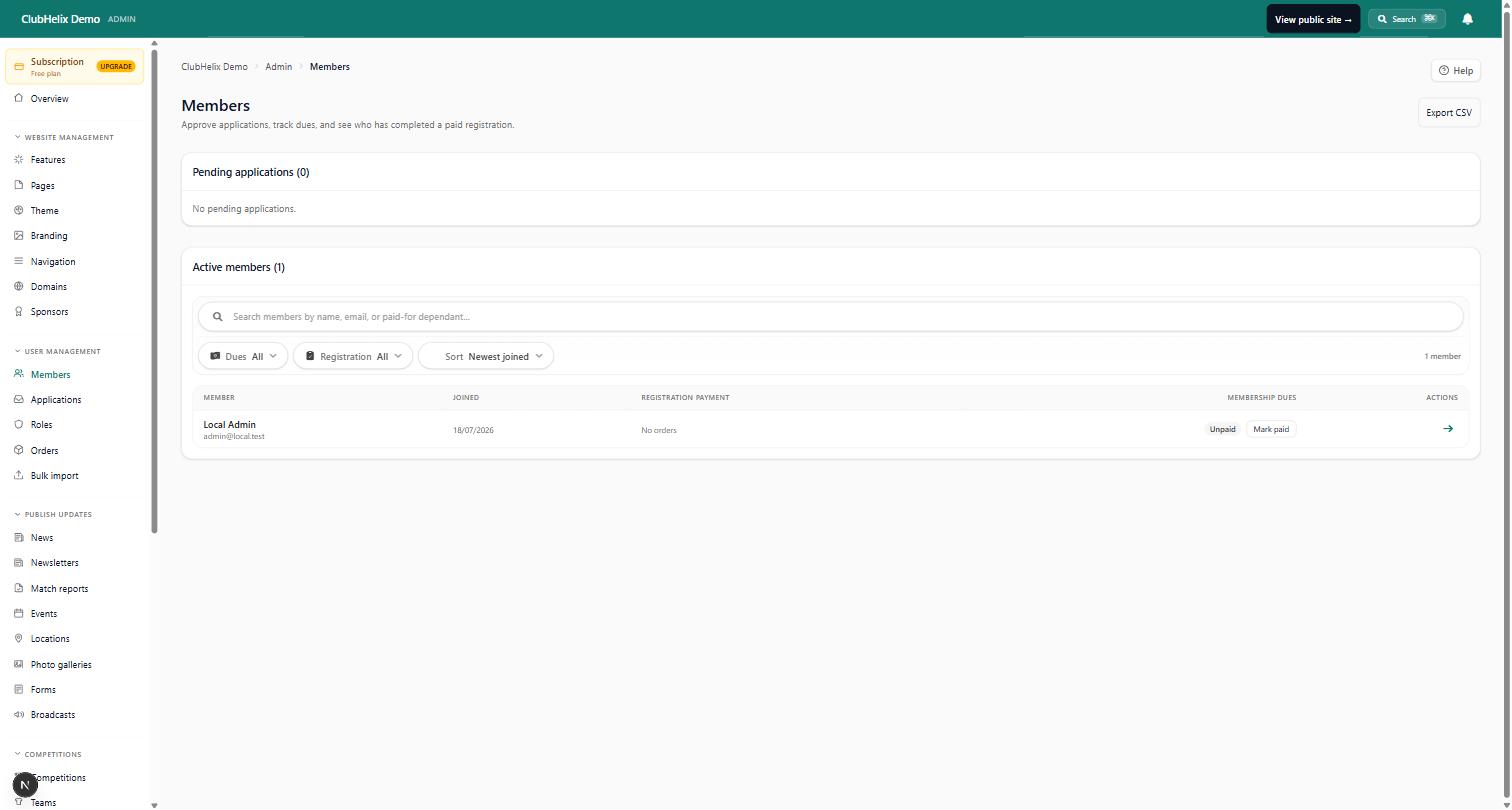
Membership itself should be online end-to-end: categories (full, introductory, social, student), card payment, automatic renewal reminders. A membership secretary with a live roster showing who's paid up and who's lapsed — instead of a hand-kept ledger — is the difference between a five-minute job and a fraught one. More growth tactics in how to grow club membership.
Money and the club website
Croquet club budgets are modest but real: lawns care, water, insurance and affiliation on the cost side; membership fees, green fees from visitors, group bookings, morning-tea tins, small sponsorships and the occasional grant on the income side. Local sports and seniors-participation grant streams suit croquet well — see grants for sports clubs — and a club that can show growing participation numbers writes a much stronger application.
The club website earns its keep with exactly the audiences a croquet club needs: the newly retired couple googling "croquet club near me", the daughter booking a group session for her mum's birthday, the visitor checking session times. It should show what's on each week, what a first visit looks like (mallets provided, no experience needed), how to join online, and photos that make the lawns look as good as they are. If the club's current site is a page nobody can update, see the ClubHelix croquet club management software page for what a modern setup looks like.
ClubHelix gives a croquet club a professional website with online membership and renewals, an events calendar, group bookings, email newsletters and competition results in one place — built for volunteer committees, with a free tier to start on. See pricing or set up your club site.
Frequently asked questions
What's the difference between golf croquet and association croquet?
Golf croquet is the fast, social code — one shot per turn, everyone contesting the same hoop, games in well under an hour — and the usual entry point for beginners. Association croquet is the deeply tactical code, built around breaks and croquet strokes, with longer games and a bigger learning curve.
How do croquet clubs attract new members?
Come-and-try days with loan mallets and a golf croquet intro, a discounted first-year membership with free coaching, partnerships with retirement communities and community groups, and twilight sessions for people still working. Croquet's recruitment market renews every year as people retire and seek low-impact sport.
How are croquet lawns maintained?
Much like bowling greens: mown very short and regularly, rolled for trueness, renovated seasonally, and irrigated. Clubs rotate court layouts and rest lawns to spread hoop-running wear, using a contractor, shared greenkeeper or trained volunteers.
Does a croquet club need special equipment for beginners?
No — that's croquet's advantage. The club supplies hoops, balls and loan mallets, so a first-timer needs only flat-soled shoes. Keeping a decent loan-mallet fleet is one of the best investments a club can make in recruitment.


