
What this guide answers
- How many hours a week does it take to run a sports club?
On manual systems, a typical community club consumes 20–40 committee hours a week in season — the treasurer, secretary and registrar carrying most of it.
- What club tasks should we automate first?
Registration with online payment, always — it collapses the registrar's retyping, the treasurer's reconciliation and the fee-chasing into one self-serve flow, and it fixes your member data at the source so every other…
- How do we prevent volunteer burnout on the committee?
Burnout is a workload-design problem before it's a wellbeing problem: shrink the jobs (automate the friction, split what remains into micro-roles), spread them (more people doing less, with role-scoped access so…
- Is club management software worth it for a small club?
Price it in the only currency that matters: volunteer hours.
New Zealand edition. This guide is written for volunteer-run clubs in New Zealand. Where rules differ — grants, tax, incorporation, safeguarding — follow the New Zealand-specific pointers below or check with your national body.
There's a conversation happening in club committee meetings all over the country, and it goes like this: everyone loves the club, everyone is exhausted, nobody can take on more, and there's somehow still more to do. The secretary answers messages at 9pm. The treasurer spends Sunday matching bank transfers to a spreadsheet. The registrar retypes paper forms. And the whole committee quietly wonders how long they can keep it up.
Here's the thing that conversation always misses: the workload is not fixed. A huge share of club admin exists only because of the way it's done — manually, reactively, and by the same few people. Clubs that redesign the work rather than redistributing the exhaustion routinely cut committee hours dramatically without dropping a single thing members care about. This guide is the redesign, in four moves: audit, automate, delegate, delete.
Move 1: Audit — find where the hours actually go
You can't fix what you haven't measured. Have each committee member jot, for a fortnight, roughly where their club hours went. Not to shame anyone — to reveal the pattern. It's remarkably consistent across clubs:
| Time sink | What it looks like | Root cause |
|---|---|---|
| Answering the same questions | "What time is training?" "How much are fees?" "Where's the ground?" — by text, at 9pm | Information isn't self-serve |
| Chasing money | Matching bank transfers, reminding unpaid members, counting cash floats | Payments aren't online and automatic |
| Retyping things | Paper forms into spreadsheets, spreadsheet into email list, email list into team app | Data entered more than once |
| Chasing people | Roster gaps, RSVP unknowns, "who's coming Saturday?" | No self-serve sign-up or reminders |
| Producing comms | Newsletter assembled from scratch, same announcement posted in four places | Tools don't share content or the member list |
| Meetings about the above | Two hours a month re-discussing whatever wasn't resolved last time | The other five rows |
Look hard at that table: almost none of it is club work. It's friction — the cost of running a 2026 club on message threads, spreadsheets and cash tins. Which is genuinely good news, because friction can be engineered away. Members-facing things — coaching, match day, the sausage sizzle — stay human. The admin behind them shouldn't be.
Move 2: Automate — the big five
Five automations do most of the work. In rough order of hours returned:
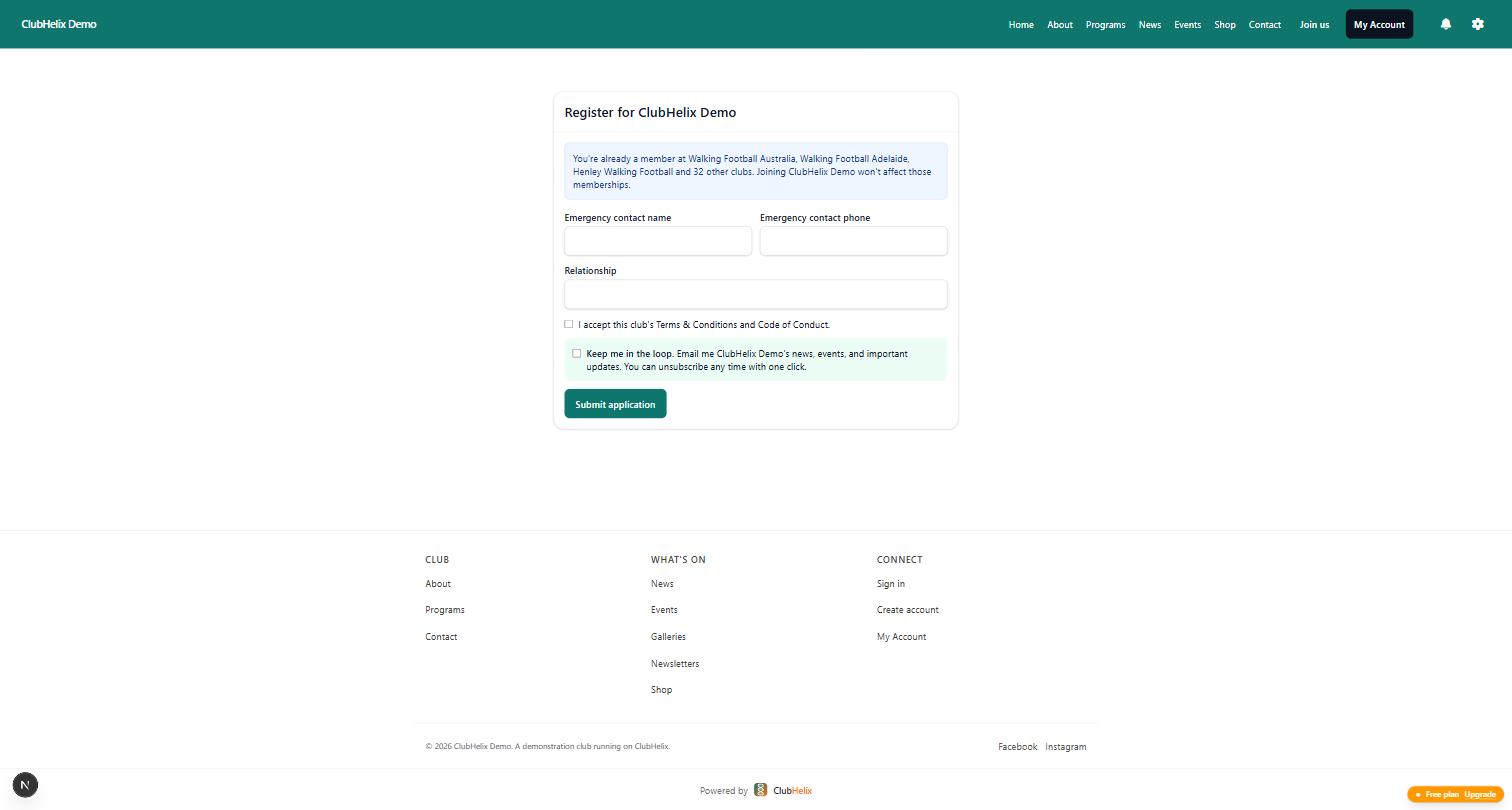
1. Self-serve registration with payment. The registrar's entire retyping-and-chasing workload exists because joining involves a form, a bank transfer and a human matching the two. With online self-registration, a member signs up, pays, gets a receipt, and appears in the member list — correct, paid and contactable — with zero committee touches. Renewals become a reminder email members action themselves. For most clubs this single change returns more volunteer hours than any other decision available to them.
2. Online payments for everything else. Every cash tin and "transfer to this BSB" is a future reconciliation job. Shop orders, event tickets, court fees — take them online with automatic receipts and the treasurer's Sunday spreadsheet ritual disappears. The treasurer's report becomes reading a dashboard, not producing one.
3. Answers that answer themselves. Training times, fees, venue maps, uniform info, wet-weather policy — every question your secretary answers by text should have a permanent home on the club website that members find before they ask. This is the "three jobs" logic from our club website guide: each question answered on the site is a message that never arrives. Clubs report this alone halves the secretary's inbox.
4. Reminders and RSVPs that run themselves. "Who's coming?" is not a job a human should do in 2026. RSVPs with automatic reminders mean events get headcounts, training gets attendance, and no-shows drop — with the chasing done by software that never feels awkward about the third nudge. The same applies to volunteer roster reminders: the day-before nudge that prevents the no-show costs a coordinator nothing.
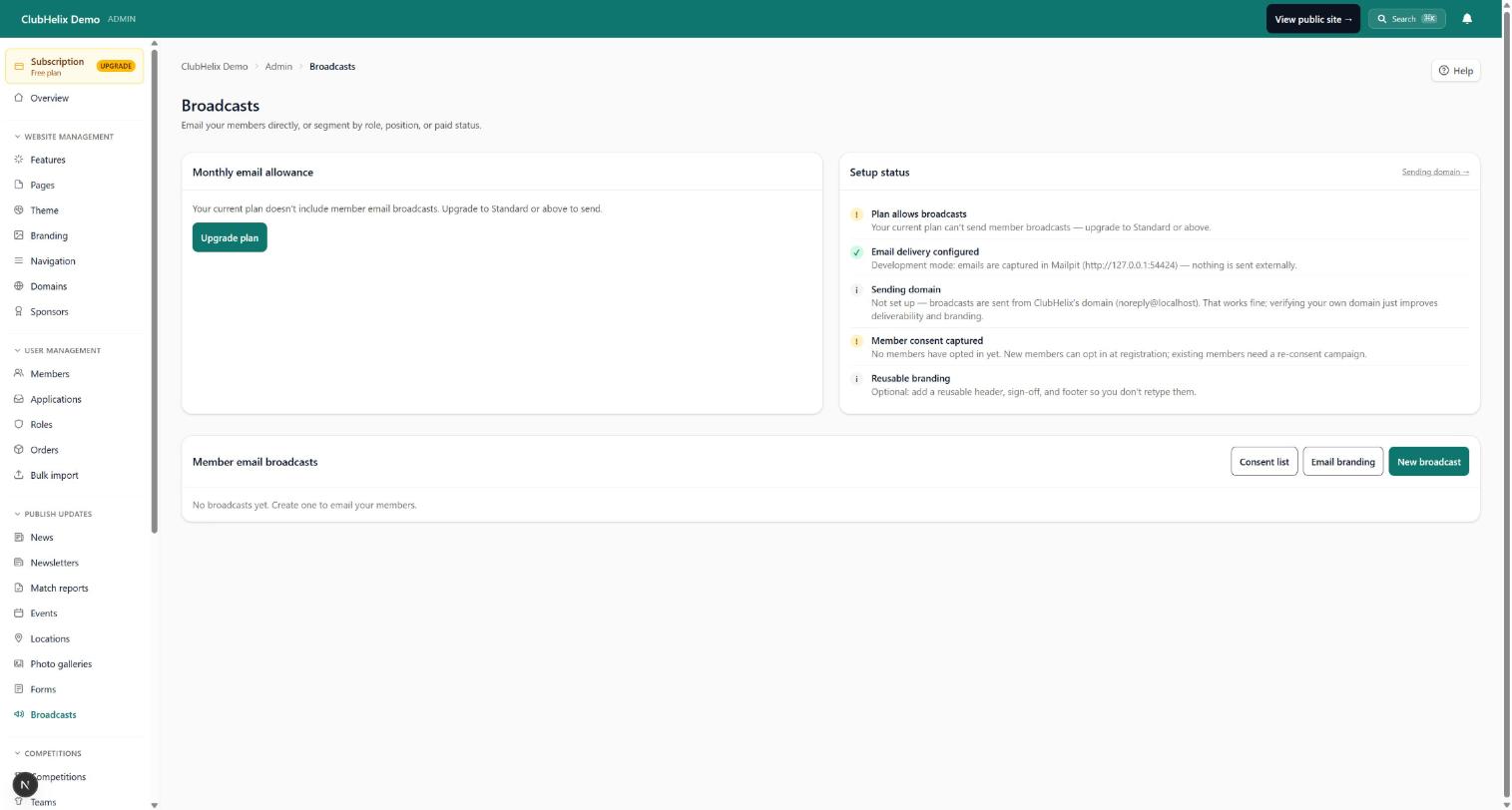
5. One broadcast, every channel. Write the announcement once and send it to the right people — a team, an age group, the whole club — with member broadcasts that pull from the always-current member list. No exporting addresses, no "I never got the email", no posting the same thing in four group chats and hoping.
The common thread: enter information once, in one system, and let everything else flow from it. The hours aren't in the tasks — they're in the seams between disconnected tools.
Move 3: Delegate — smaller pieces, more hands
After automation, what's left is human work — and the fix there is structural, not motivational. Time-poor clubs fail at delegation for one reason: the pieces are too big. Nobody has ten hours a week, but almost everyone has one.
- Break roles into micro-roles. Not "communications officer" but "match-report wrangler" (chases two paragraphs from each team, 20 minutes a week) and "socials poster" (15 minutes, Sundays). Small, named, bounded — the same role-design rules that make volunteer recruitment work.
- Give team managers real, small power. Team-level comms, availability and roster slots belong with team managers, not the secretary. Ten managers doing 20 minutes beats one secretary doing four hours — and members get faster answers.
- Delegate access, not passwords. The reason committees hoard tasks is fear: "if I give them the login they can break everything". Role-scoped admin access fixes that — the shop manager sees the shop, the registrar sees members, nobody can wander into the finance settings. Safe delegation is what makes wide delegation possible.
- Committee meetings decide; owners do. An agenda that assigns every item an owner and a date, and opens next meeting on the action list — the loop from our minutes template — keeps the meeting to an hour and the doing out of it.
Move 4: Delete — the bravest one
Some club work shouldn't be automated or delegated. It should stop. Once a year, put the whole calendar and task list on the table and ask of each item: would members notice if this vanished?
Honest candidates at most clubs: the fourth fundraiser that nets $400 for 60 volunteer-hours (keep the one big one that makes real money); the printed newsletter nobody's grandchild reads (the broadcast reaches more people); the perfect meeting minutes for the subcommittee that met about the meeting; the event tradition that outlived the people who loved it. Deleting feels like failure and is actually leadership: every deleted task is hours returned to the things members do notice.
A useful forcing question for the committee: "What would we do if we had half the volunteer hours?" Answer it honestly, then do that anyway — and bank the difference against burnout instead of spending it on more admin.
What this looks like a season later
Clubs that make these four moves describe the same after-state: the registrar's January is a dashboard, not a data-entry marathon. The treasurer reads reports instead of building them. The secretary's phone is quiet because the website answers first. Rosters fill from phones, reminders send themselves, and the committee meeting is an hour of actual decisions. Total committee load drops by something like half — and, tellingly, recruiting the next committee gets easier, because the jobs on offer are visibly humane. Nobody nominates to inherit a 9pm-texts lifestyle; plenty of people will take a well-systemised role with a written description and a two-hour week.
That's the real payoff. Automation doesn't just save this committee's hours — it makes the club succession-proof, which is the difference between a club that's tired and a club that's in trouble.

Frequently asked questions
How many hours a week does it take to run a sports club?
On manual systems, a typical community club consumes 20–40 committee hours a week in season — the treasurer, secretary and registrar carrying most of it. With registration, payments, comms and rosters automated in one platform, the same club runs on well under half that, concentrated in genuinely human work like events and match day. The variable isn't club size or committee dedication; it's how much of the admin is friction between disconnected tools.
The single biggest avoidable chunk here is bank-transfer reconciliation: clubs still taking fees by transfer spend more volunteer hours matching references to members than on any other administrative task.
What club tasks should we automate first?
Registration with online payment, always — it collapses the registrar's retyping, the treasurer's reconciliation and the fee-chasing into one self-serve flow, and it fixes your member data at the source so every other automation (broadcasts, rosters, RSVPs) works properly. Second, put the answers to your ten most-asked questions on the club website. Third, switch event and roster chasing to automatic reminders. Those three remove the bulk of the 9pm-message workload within a season.
How do we prevent volunteer burnout on the committee?
Burnout is a workload-design problem before it's a wellbeing problem: shrink the jobs (automate the friction, split what remains into micro-roles), spread them (more people doing less, with role-scoped access so delegation is safe), and normalise exits (understudies and honest mid-season intention checks, per our succession planning approach). Then add the human layer — specific public thanks and visible fairness in who does what. Wellness gestures without workload redesign just help people feel better while burning out on schedule.
Is club management software worth it for a small club?
Price it in the only currency that matters: volunteer hours. If a platform saves your committee even five hours a week — and moving registration, payments and comms online typically saves far more — that's hundreds of hours a season, versus a subscription that costs less than most clubs' sausage-sizzle float. Small clubs arguably benefit most, because they have the least slack when one exhausted office bearer quits. Start on a free tier, automate registration first, and let the hours saved in your first pre-season convince the sceptics — see ClubHelix pricing for where the tiers land.
ClubHelix is built for time-poor committees: self-serve registration and payments, one-send broadcasts, RSVPs and reminders that chase themselves, and role-scoped access so you can delegate safely. Start free and take back your evenings.


