
What this guide answers
- How much notice do we need to give for a club AGM?
Whatever your constitution says — commonly 14 or 21 days for an AGM, and often longer where a special resolution is proposed.
- What happens if our AGM doesn't reach quorum?
Follow the procedure in your constitution — typically the meeting is adjourned to a later date, and some rules provide that the adjourned meeting may proceed with whoever attends.
- Can we hold our AGM online or as a hybrid meeting?
Usually yes, but the permission has to come from somewhere — either your own constitution or the legislation your club sits under.
- Who can vote at a club AGM?
Financial members — those whose membership is current and paid — in the categories your constitution gives voting rights to.
- What if nobody nominates for a committee position?
It happens to every club eventually, and the fix is never at the meeting itself — it's in the weeks before, with personal asks backed by honest role descriptions.
South Africa edition. This guide is written for volunteer-run clubs in South Africa. Where rules differ — grants, tax, incorporation, safeguarding — follow the South Africa-specific pointers below or check with your national body.
The annual general meeting is the one meeting your club is legally required to hold, the one where the whole membership gets a say, and — run well — the best recruitment event on your calendar. Run badly, it's forty minutes of mumbled reports to eleven people, followed by an awkward silence when nominations are called.
The difference between the two is almost entirely preparation. This guide covers the whole cycle: what the law and your constitution require, the six-week countdown, a notice template and a full agenda template you can copy today, how to chair the meeting itself, and what to do in the week afterwards so the energy doesn't evaporate.
First, check your rule book
Every formally constituted club is governed by its own constitution or rules, sitting under whatever legislation gives the club its legal form. Before planning anything, look up four numbers in your own rules:
For most clubs that means your constitution, sitting under the legislation matching your legal form — the Non-profit Organisations Act for a registered NPO, or the common law of voluntary associations if you never registered. NPO registration brings annual reporting obligations that the AGM is the natural place to approve.
- Deadline: how soon after the end of the financial year the AGM must be held (commonly within five or six months).
- Notice period: how many days' notice members must receive — 14 or 21 days is typical.
- Quorum: how many voting members must be present for the meeting to be valid.
- Nominations: whether committee nominations must be lodged in writing before the meeting, and how many days before.
Get any of these wrong and the meeting's decisions can be challenged. Ten minutes with the constitution now saves an emergency "special general meeting to redo the AGM" later — a genuine and genuinely embarrassing occurrence.
The six-week countdown
Six weeks out — set the pieces. Fix the date, time and venue (straight after training or before a home game beats a cold Tuesday). Confirm the treasurer can have the financial statements ready and reviewed or audited if your rules require it. Start the quiet work of succession: the president and secretary should personally ask likely candidates to nominate. AGMs don't fill committees; the conversations beforehand do.
Four weeks out — approach people. Every retiring office bearer should be asked to help recruit their own replacement. Circulate the role descriptions and duties table so nobody is being asked to sign up for a mystery.
Three weeks out (or your notice period plus margin) — send the formal notice. Email every member, post it on the website and noticeboard, and keep evidence it went out. An email broadcast to all members from the club's system gives you a timestamped record of exactly who was notified — which is precisely what you want if quorum or notice is ever questioned.
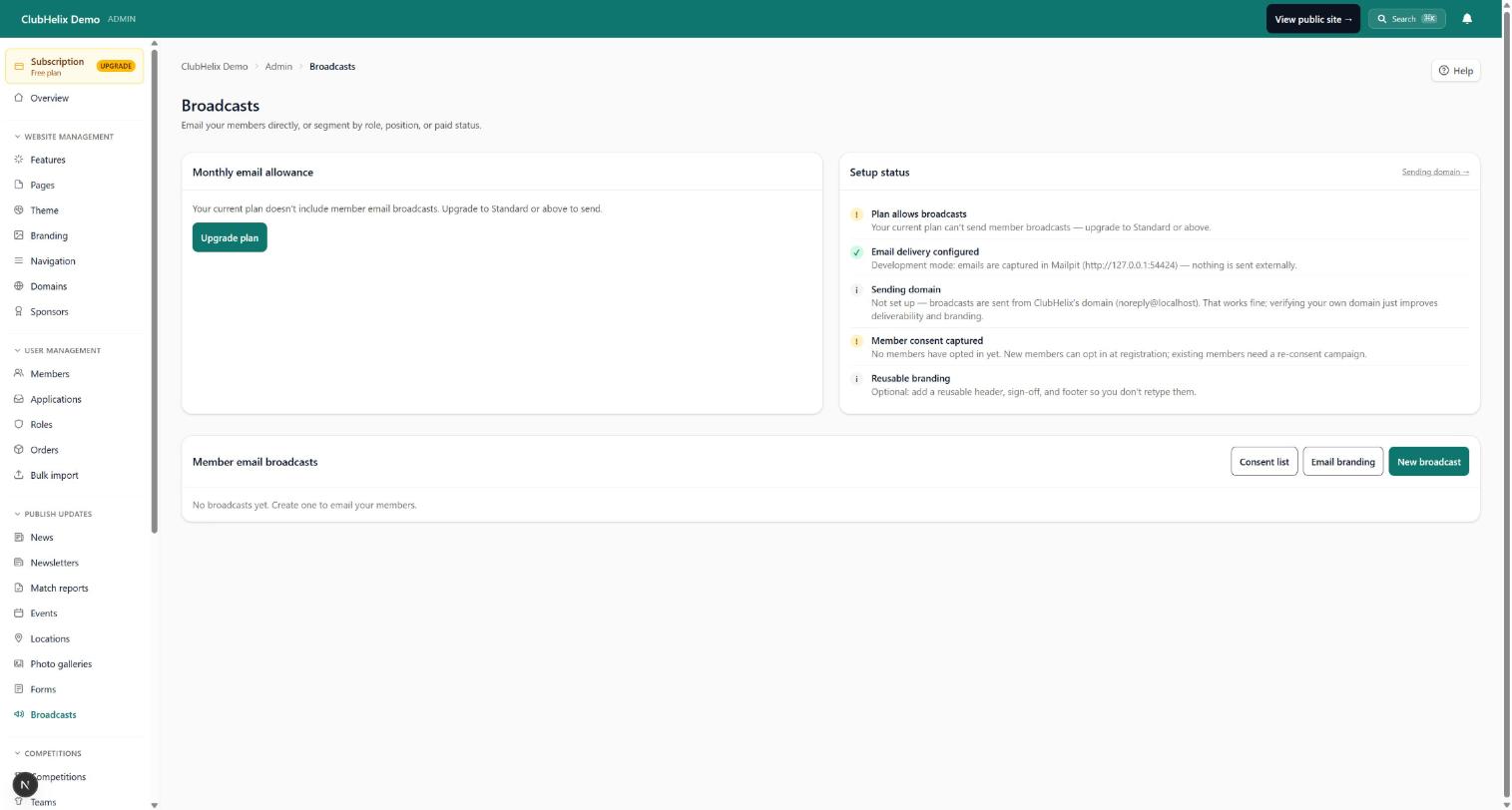
One week out — assemble the pack. Agenda, previous AGM minutes, annual reports, financial statements, and the nomination list. Circulate it to members in advance; people vote more confidently on things they've read.
Day before — logistics. Attendance sheet (it's your quorum evidence), printed spare packs, a laptop for the treasurer's numbers, and the urn. Never underestimate the urn.
AGM notice template
Adapt the bracketed parts and check the notice period against your constitution.
NOTICE OF ANNUAL GENERAL MEETING
[Club name] Inc.
Notice is hereby given that the Annual General Meeting of [Club name] Inc. will be held:
Date: [day, date] Time: [time] Venue: [venue and address, plus online link if offered]
Business:
- Confirmation of the minutes of the previous Annual General Meeting
- Receipt of the President's report
- Receipt of the Treasurer's report and annual financial statements
- Election of committee members for [year]
- Appointment of [auditor/reviewer], if required
- Setting of membership fees for [season/year]
- Special business: [any special resolutions, set out in full]
Nominations for committee positions [must be lodged with the Secretary in writing by [date] / may be made from the floor]. A nomination form is [attached / available at ...].
Only financial members are entitled to vote. [Proxy arrangements, if your rules allow them.]
[Name], Secretary On behalf of the Committee, [date]
Two details worth the pedantry: any special resolution (constitution changes, fee structure changes if your rules treat them that way) must usually be set out in full in the notice — you cannot spring one on the night. And the notice should state who is eligible to vote, so the "is Dave financial?" debate happens at the sign-in desk, not mid-election.
AGM agenda template
A good AGM runs 45–60 minutes. The chair's copy should have time allocations on it; here they are built in.
| # | Item | Who | Time |
|---|---|---|---|
| 1 | Welcome, acknowledgements, apologies, confirm quorum | President | 5 min |
| 2 | Confirmation of previous AGM minutes | President | 3 min |
| 3 | President's report — the year in review | President | 8 min |
| 4 | Treasurer's report and financial statements — motion to accept | Treasurer | 10 min |
| 5 | Other reports (juniors, canteen, sponsorship) — taken as read, questions only | Report authors | 5 min |
| 6 | Setting of membership fees | Treasurer | 5 min |
| 7 | All committee positions declared vacant; election of office bearers and committee | Returning officer | 12 min |
| 8 | Appointment of auditor/reviewer (if required) | President | 2 min |
| 9 | Special business as per notice | President | as needed |
| 10 | General business (time-boxed — items become new committee's action list) | Incoming president | 8 min |
| 11 | Thank-yous, life-member moments, close | President | 5 min |
Chairing notes that keep it to the hour:
- Circulate written reports beforehand and take them "as read". Reports at the AGM should be highlights and thank-yous, not a recital of the document everyone is holding.
- Use a returning officer for elections — a respected non-nominating member who declares positions vacant, calls for nominations position by position, and runs any ballot. Contested positions deserve a written ballot; friendships survive secret votes better than shows of hands.
- Time-box general business ruthlessly. It's where AGMs go to die. Anything needing real discussion is noted, minuted, and referred to the incoming committee's first meeting.
- Celebrate. Life memberships, volunteer awards, a photo of the new committee. The AGM is also your club's thank-you night; people rejoin committees that feel appreciated.
Minutes, quorum and the paperwork on the night
The secretary (outgoing, usually) minutes the meeting: attendance and apologies, that quorum was met, every motion with mover/seconder/result, election results, and the appointed reviewer. Use a proper minutes template so nothing gets missed in the moment — the AGM minutes are the ones your bank, your state regulator and next year's committee will actually read.
If quorum isn't met, don't soldier on: follow your constitution's procedure (typically adjourning to a set date). Decisions made without quorum are void, and the treasurer's new signatories will discover this at the worst possible moment — at the bank.
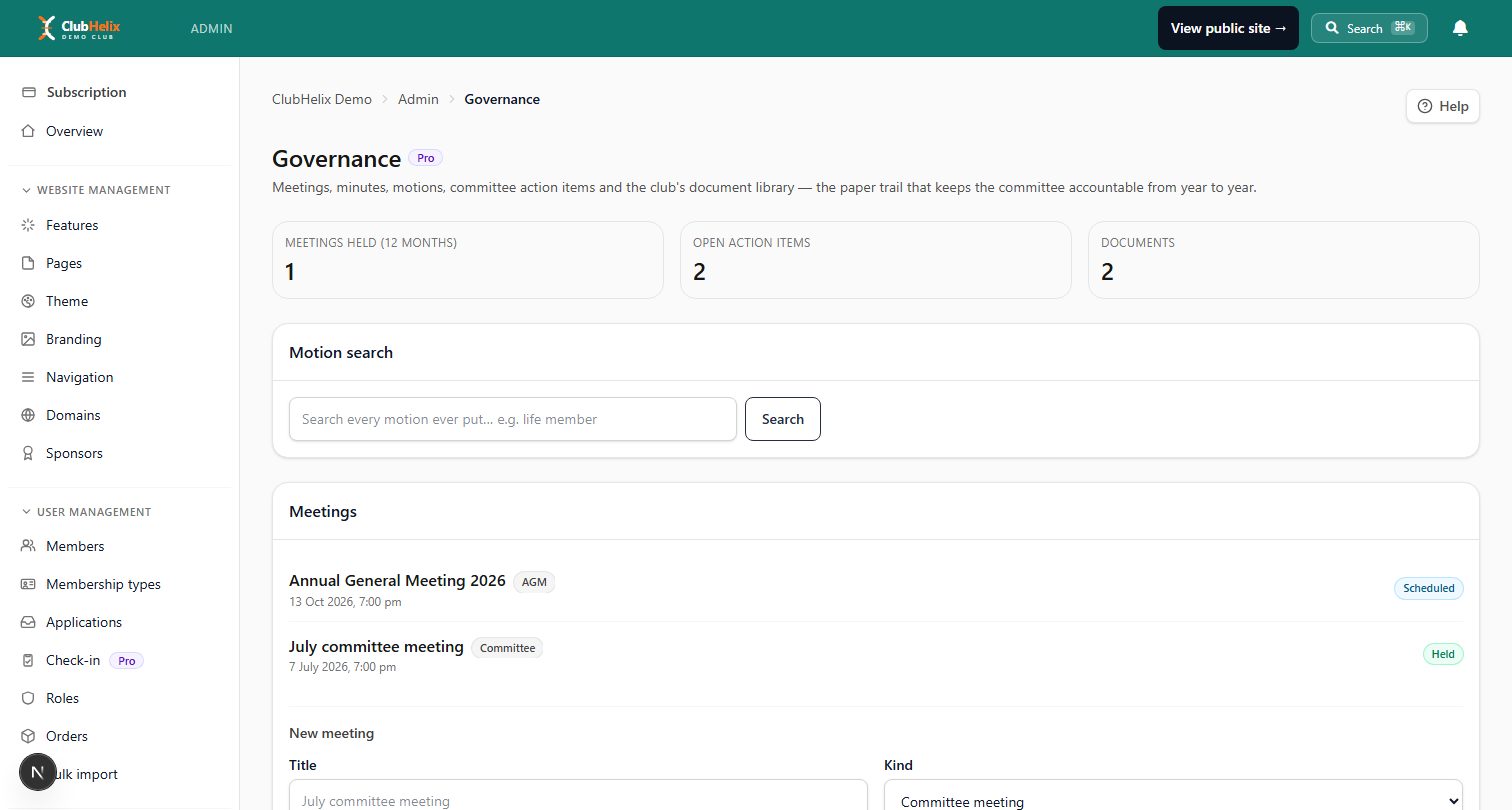
Clubs that keep the whole cycle — notice, agenda, attendance, motions, minutes, action items — in a governance and meetings system rather than a retiring secretary's laptop have a permanent, searchable record that survives every handover. Your 2030 committee will be able to look up what the 2026 AGM actually resolved.
The week after: banking the momentum
The AGM's real output is a mandate and a to-do list. Within seven days:
- Lodge the change of office bearers with your state regulator and update the club's records — many states require notification within a set period.
- Update bank signatories and every account the club holds. Book the bank appointment the day after the AGM; it always takes longer than anyone expects.
- Hand over access, not passwords. Update each new office bearer's admin access and permissions in your club platform, revoke the leavers', and point role-based emails (secretary@…) at the new holders.
- Send the thank-you and welcome broadcast to all members: results of the elections, a thank-you to outgoing volunteers, and one or two priorities for the year.
- Diarise the first committee meeting within a fortnight, with general-business items from the AGM as its opening agenda.

Frequently asked questions
How much notice do we need to give for a club AGM?
Whatever your constitution says — commonly 14 or 21 days for an AGM, and often longer where a special resolution is proposed. Count carefully (some rules specify "clear days", excluding the day of sending and the day of the meeting), send it by a channel your rules recognise, and keep evidence. A broadcast email from your club system, with its send log, is ideal proof that every financial member was properly notified.
What happens if our AGM doesn't reach quorum?
Follow the procedure in your constitution — typically the meeting is adjourned to a later date, and some rules provide that the adjourned meeting may proceed with whoever attends. What you must not do is quietly proceed without quorum: elections and resolutions from an inquorate meeting are invalid. If quorum is a recurring struggle, that's a signal to move the AGM to a time members already gather, and to check whether your quorum number still suits your membership size (a constitution change to fix it needs — yes — a valid meeting).
Can we hold our AGM online or as a hybrid meeting?
Usually yes, but the permission has to come from somewhere — either your own constitution or the legislation your club sits under. Check your constitution first, because it may predate the change and need updating before you can rely on it.
Whether you can depends on your constitution, which for many clubs is silent on the point. If yours is, amend it at a physical meeting before relying on a virtual one.
If you go hybrid, test the technology beforehand, take attendance for both rooms, and plan how remote members will vote in an election (a show of hands doesn't work down a video call — use the chat, a poll, or a returning officer calling names).
Who can vote at a club AGM?
Financial members — those whose membership is current and paid — in the categories your constitution gives voting rights to. Juniors typically can't vote, though a parent sometimes can on their behalf, depending on your rules. This is where accurate member records earn their keep: a club whose registrations and payments live in one system can produce the eligible-voter list in one click instead of arguing about it at the door.
What if nobody nominates for a committee position?
It happens to every club eventually, and the fix is never at the meeting itself — it's in the weeks before, with personal asks backed by honest role descriptions. On the night, the position can usually be left vacant and filled later by the committee as a casual vacancy (check your rules). If the presidency or treasury is going unfilled year after year, treat it as a design problem: split the role, reduce its load with better systems, and read our guide on running a club when nobody has time.
ClubHelix keeps your AGM cycle in one place — member broadcasts for notices with a send log, an accurate financial-member roll, and meetings, motions and minutes recorded in the club's own system. Start free before your next AGM.


