
What this guide answers
- What does it take to run a bridge club session?
A director, a dealt set of boards, a movement suited to the number of pairs, a desk that closes entries at a published time, and results out the same day.
- How many directors should a club have?
At least three who can run an ordinary session, and ideally two who can handle a competitive one.
- How do you attract younger members to a bridge club?
Add sessions rather than moving them — evenings and weekends reach people who work — and run beginner courses at times a working person can attend.
- What do you do when someone turns up without a partner?
Have a system, not goodwill. A rostered host who plays with whoever is left over, a standby list of members happy to be called on the morning, and a promise on your website that anyone can come alone and get a game.
- How should a club handle results and masterpoints?
Publish results the same day on the club website with an archive going back years, submit them to your national scheme within its deadline, and announce rank promotions publicly.
Ireland edition. This guide is written for volunteer-run clubs in Ireland. Where rules differ — grants, tax, incorporation, safeguarding — follow the Ireland-specific pointers below or check with your national body.
Five to one. Eleven tables are set, the boards are dealt, and there is a woman at the desk in a good coat who has not played here before and does not have a partner. Two of your regulars have rung in sick, which turns eleven tables into ten and a half. The director is doing the movement in her head while unjamming the scoring unit on table four, and somebody wants to know why last week's results have not gone up yet.
That five minutes is the whole business of running a bridge club. Everything else — the constitution, the lease, the annual dinner — is scaffolding around the question of whether a person who walks in on a Tuesday gets a game. Bridge is unusually unforgiving here, because the game needs exactly four people at a table and pairs are matched in advance. One missing partner does not reduce your session by one player; it can remove a table.
Two other things shape a bridge club more than a committee usually admits. The first is the director — the person who runs the session, makes the rulings and produces the results. Directors are made, not found, and a club that has not trained one in five years is a club with an expiry date. The second is demographics. Bridge clubs recruit almost entirely from lessons, because nobody arrives already knowing how to play, and most clubs have a membership whose average age climbs by about a year every year. Both of those are solvable, and both need a plan rather than good intentions.
This guide covers the session as a product, the director role and how to pay for it, movements and results, masterpoints, the partner problem, the lessons-to-members pipeline, and how to renew an older membership without alienating the people who built the club.
The session is the product
A bridge club sells one thing repeatedly: a well-run session that starts on time, finishes on time, produces accurate results and puts everyone at a table. Write the session down as a timetable with names against it, and the club stops depending on whoever happens to arrive early.
| Time | What happens | Who |
|---|---|---|
| 12.00 | Doors, urn on, tables and bidding boxes out, boards from the machine | Rostered pair |
| 12.30 | Desk opens — table money, visitor sign-in, partner desk staffed | Desk volunteer plus host |
| 12.50 | Entries closed, movement chosen for the actual number of pairs | Director |
| 12.55 | Standby pairs placed, phantom table announced if needed | Director and host |
| 1.00 | Session starts, announcements kept to under a minute | Director |
| Mid | Tea break at a fixed round, not "when it feels right" | Rostered pair |
| 4.15 | Last board, scores confirmed, results shown | Director |
| 4.30 | Results published to the website and emailed | Results officer |
| 4.45 | Pack-down, boards back in order, room left as found | Rostered pair |
Three details in that timetable do disproportionate work. Entries close at a published time so the movement is chosen once. The tea break happens at a fixed round so nobody drifts. And the results go out the same afternoon, because the single most common complaint at a bridge club is not about a ruling — it is about waiting three days to find out how you went.
Directors — the role the club cannot buy in
The director sets the tone of the club. A good one runs a session that finishes on time, gives rulings calmly and briefly, and does not make a beginner feel like they have committed an offence by revoking. A club with one director is a club that cancels sessions when that person has a hospital appointment.
Train more than you need. Aim for at least three people who can direct a normal session and two who can handle a competitive one. Send people to your national body's director training in pairs, because they will practise on each other afterwards. The best candidates are usually not your strongest players — they are the calm, organised members who are good with people.
Decide the payment model and publish it. There is no single right answer, but there is a wrong one, which is leaving it vague.
| Model | How it works | Suits |
|---|---|---|
| Fully voluntary | Directors play for free and direct for nothing | Small clubs with a deep roster and no paid sessions |
| Free session | The director plays free on the day they direct | Most community clubs, simple and easy to defend |
| Session honorarium | A set amount per session, paid monthly | Clubs running four or more sessions a week |
| Honorarium plus expenses | Session fee plus travel and training costs | Clubs employing a lead director across several sessions |
If you pay a director anything, get the arrangement in writing and check whether it creates any employment or tax obligations for the club. This is general information rather than advice, and it is worth a conversation with your accountant or your national body before the first payment, not after.

Movements, half tables and results
The movement is the club's quiet quality control. Choose it for the number of pairs you actually have, not the number you hoped for.
| Movement | Works best with | What players notice |
|---|---|---|
| Mitchell | 6 or more full tables | Simple, two winners, everyone plays the same direction all session |
| Howell | 3 to 6 tables | One winner, everyone plays everyone, more movement between rounds |
| Barometer or arrow-switched | Larger competitive fields | Live standings between rounds, popular for club championships |
| Individual | Social and teaching nights | Partners change every round, excellent for mixing a room |
Then plan for the half table before it happens. A phantom pair, a standby pair on call, or a rostered member willing to sit out and score are all fine — what is not fine is fifteen minutes of visible negotiation at ten to one while a newcomer watches.
Results deserve the same discipline. Publish them to the club website the same day, keep an archive that goes back years, and include the hand records if your dealing machine produces them. Members read the results page more often than any other page a bridge club has, and it is the page that quietly tells a visitor whether this is a serious club.
Masterpoints and what they actually do
Masterpoints are not just a ranking system — they are the reason a proportion of your membership plays on a Wednesday rather than at home. Awarded through your national body's scheme, they turn an ordinary session into something that accumulates, which is a powerful retention mechanism if the club uses it properly.
Use it properly means: award them at every session that qualifies, submit results on time, and celebrate promotions publicly. A short item in the club newsletter each time a member crosses a rank threshold costs nothing and matters enormously to the person named.
Master points in Ireland are administered by the national bridge union, with clubs affiliating through their regional structure and submitting session results for points. Different classes of event carry different awards, and the requirements for a qualifying session are published by the union.
The partner problem
More people give up on joining a bridge club over this than over anything to do with the bridge. A person who has finished lessons, or moved to a new town, or lost a regular partner, cannot simply turn up — and most clubs quietly leave them to solve that themselves.
Fix it structurally:
- Staff a partner desk at every session. One named person, listed on the website by role, whose job is to pair people up before play starts. Not "ask around at the desk".
- Keep a standby list. Members who are happy to be rung on the morning of a session if a pair is short. Some of your most valued members will be people who play mostly as standbys.
- Run a host system. A rostered member who plays with whoever is left over, and who is thanked for it publicly. This is the single highest-impact volunteer role a bridge club has.
- Publish a guarantee. "Come without a partner and we will find you one" on the front page of your website, in plain words. A club that can say that honestly will out-recruit a stronger club that cannot.
- Match by strength as well as availability. A nervous new player paired with your most impatient regular will not come back, and both of them will describe it differently.
From lessons to members
Lessons are not a community service that runs alongside the club — for most clubs they are the only source of new members. Treat the pipeline as a funnel with known leaks.
| Stage | Typical length | What it is | Where people are lost |
|---|---|---|---|
| Beginners course | 8 to 12 weeks | Taught from scratch, no experience assumed | Course ends with no obvious next step |
| Supervised play | A term | Play with a teacher circulating for advice | Feels like a class, not like belonging to a club |
| Gentle or graded session | Ongoing | A real session, slower, rulings explained | Scheduled at a time working-age learners cannot attend |
| Open club session | Ongoing | The main session | First visit without a partner, or a rough table |
| Membership and masterpoints | From joining | Subs, results, points, a name on the board | Nobody ever actually invites them to join |
The three fixes that move the most people through are simple and unglamorous. Announce the next stage before the current one finishes, with dates. Ask every learner to join at the end of the course rather than waiting for them to ask. And make sure at least one existing member knows each learner by name before their first open session, because people stay for the people.
Renewing an older membership without alienating it
Most bridge clubs need to attract younger and working-age members while keeping a loyal membership that has been there for decades. Those two goals are usually presented as a conflict. They are not, provided the club adds rather than replaces.
- Add sessions, do not move them. An evening or weekend session opens the club to people who work, without touching the Tuesday afternoon that half the membership organises its week around.
- Run everything on two tracks. Online entry, email results and a website for members who want them; a printed results sheet on the noticeboard and a phone call for members who do not. Announcing that "everything is online now" is how clubs lose twenty long-standing members in a season.
- Make the room work for everyone. Good lighting, large-print boards and result sheets, chairs with arms, a hearing loop or a director who uses a microphone, and clear space to move between tables. This is not a nicety — it is directly why some members stop coming.
- Solve transport before it becomes a resignation. A quiet lift roster keeps members playing for years after they stop driving at night.
- Handle absence with care. Notice when a regular misses three sessions and have someone ring — not to chase subs, but because in a club with this age profile a missing member is sometimes in hospital. A club that notices is a club people stay in.
- Drop the jargon in anything a newcomer reads. Plain words on the website and in emails, no assumed knowledge of what a barometer or an arrow switch is.
Our guide on how to retain club members covers the general retention mechanics; the bridge-specific version is mostly about the partner desk and the phone call.
Money, premises and the annual shape
Bridge club finances are simple and tight: table money and subs in, venue and affiliation out, with equipment replacement and director costs in between. Many clubs own or hold a long lease on their premises, which turns the club into a small property manager with a building fund to maintain and a room worth hiring out on the days you do not play. If that is you, how to hire out your clubrooms is worth a read.
Watch three numbers every month: average tables per session by day, table money per session against venue cost, and the number of members who played at least once in the past quarter. That third one is your early warning system, and it is invisible unless somebody tracks attendance.
For planning purposes, table money at clubs in Ireland commonly sits somewhere between €5 and €10 a session, with union affiliation and points levies charged separately. Annual subs are often modest. Hall hire is the swing factor, so build the table money from the real hourly room cost.
The annual shape is dominated by the dark months, when an afternoon session fills and an evening one struggles, and by the summer, when regulars disappear for weeks. Plan a lighter summer schedule, protect the afternoon sessions through winter, and schedule your club championship for a stretch when attendance is reliably high rather than hoping.
Getting the desk work off paper
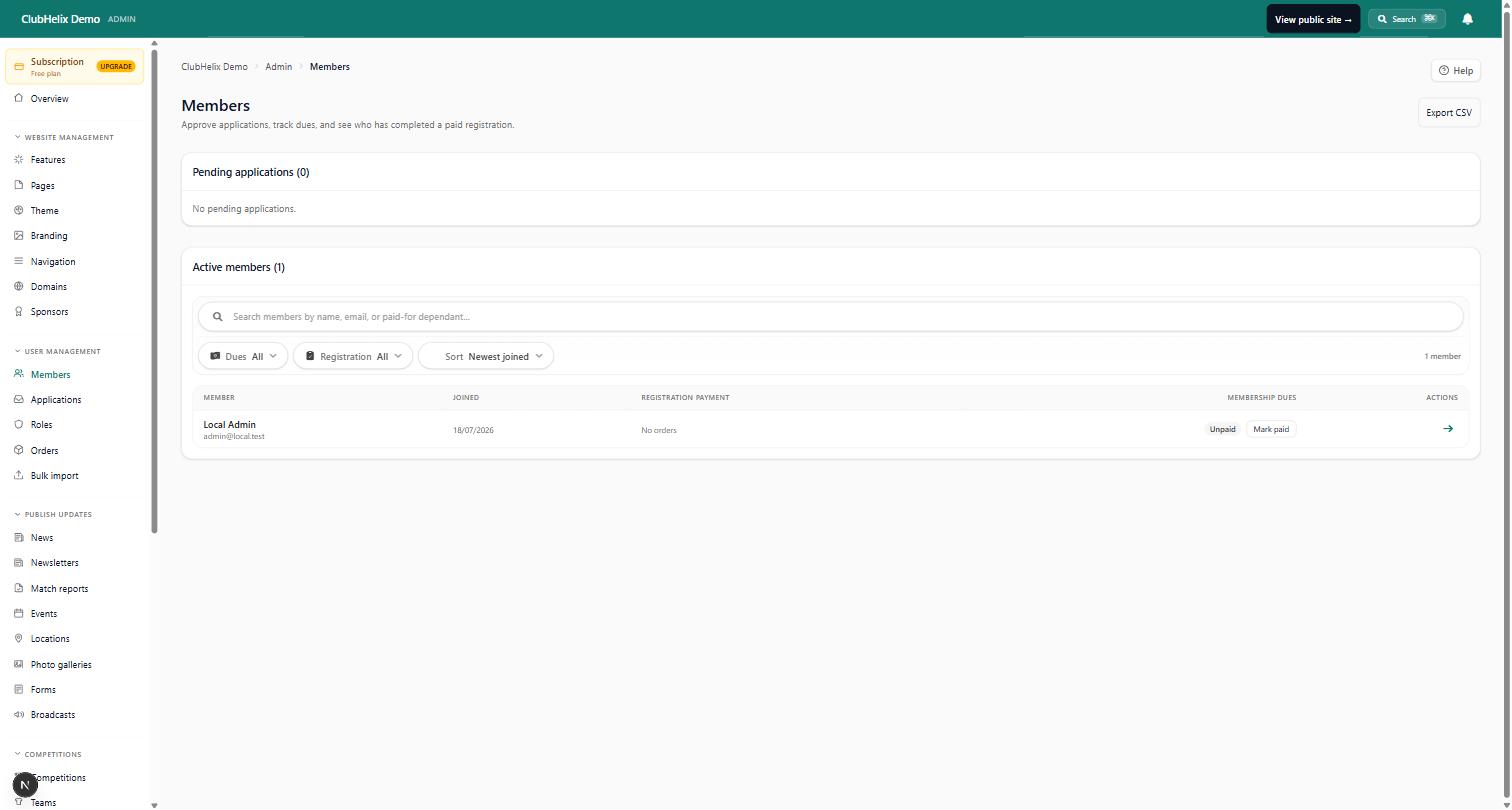
Almost everything above is administration: a member list that is actually current, subs collected without chasing, the partner and standby lists, session results published the same afternoon, and an email that reaches everyone including the members who never open a browser. ClubHelix gives your club a website that handles it — online joining and renewals so the treasurer stops reconciling bank transfers, events with sign-ups for congresses, lessons and the annual dinner, email broadcasts from your own address for the weekly results email, and reports that show you attendance by session so the committee argues about evidence rather than impressions.
You can start on the free tier and grow into the paid plans, whose costs are set out on the pricing page rather than quoted on request.
If your results currently go up when somebody remembers, create your club site and publish them the same afternoon instead — the hobby and interest club solutions page shows what that looks like in practice.
Frequently asked questions
What does it take to run a bridge club session?
A director, a dealt set of boards, a movement suited to the number of pairs, a desk that closes entries at a published time, and results out the same day. Everything else is comfort. The two failure points are a session that cannot start because of a half table and results that take days to appear.
How many directors should a club have?
At least three who can run an ordinary session, and ideally two who can handle a competitive one. Clubs that depend on a single director cancel sessions during illness and holidays, and lose the club entirely when that person stops. Train in pairs so people can practise on each other.
How do you attract younger members to a bridge club?
Add sessions rather than moving them — evenings and weekends reach people who work — and run beginner courses at times a working person can attend. Keep the club's online presence current, drop the jargon from anything a newcomer reads, and make sure a first-time visitor is met by a named host rather than left at the desk.
What do you do when someone turns up without a partner?
Have a system, not goodwill. A rostered host who plays with whoever is left over, a standby list of members happy to be called on the morning, and a promise on your website that anyone can come alone and get a game. Then match people by temperament and strength, not just availability.
How should a club handle results and masterpoints?
Publish results the same day on the club website with an archive going back years, submit them to your national scheme within its deadline, and announce rank promotions publicly. The results page is the most-read page a bridge club has, and public recognition of a promotion is retention that costs nothing.
Keep reading — how to run a mahjong club covers table games with a similar seating challenge, and how to retain club members goes deeper on renewals.


