
What this guide answers
- How many players should be in a box?
Five is the best default: ten matches in the box, four per player, and one a week over a calendar month, which a working member can actually manage.
- How long should a box league round be?
A calendar month, closing on the last day, for boxes of five.
- What do you do when a player never arranges their matches?
Award a walkover to any opponent who can show they offered at least three dates and got no reply, record the match as void if neither player made an offer, and move a player who concedes two walkovers to the reserve…
- Should a box league be scored on wins or on games won?
Start with wins — three points each, with a published tiebreaker order — because members can check it in their heads.
- How do promotion and relegation work in a box league?
Up two, down two is the standard for boxes of five and six: the top two players move up a box, the bottom two move down, and the middle stays.
South Africa edition. This guide is written for volunteer-run clubs in South Africa. Where rules differ — grants, tax, incorporation, safeguarding — follow the South Africa-specific pointers below or check with your national body.
Here is the quiet problem with a healthy racquet club. The courts are busy, the subs are paid, and a third of your members have never hit a ball with anyone outside the two people they arrived with. When one of those two moves house or has a baby, the third member does not find a replacement. They stop booking, then they stop coming, and eleven months later they do not renew — and nobody can point to the thing that went wrong, because nothing did.
A box league is the cheapest available fix. Members are sorted into small groups — boxes — of four to six players of roughly similar standard. Over a month, everyone in the box plays everyone else once, at times the players arrange between themselves. The results go into a table, the top players move up a box and the bottom players move down, and next month it happens again with a slightly different set of opponents. That is the whole machine. It costs a volunteer a couple of hours a month and it costs the club nothing but court time, which you already own.
This guide is written for whoever has ended up running the club ladder competition: how to design the boxes, how long a round should be, which scoring system to use, what to do about the player who never arranges a match, and how to publish it so people look. ClubHelix appears as the worked example in the final third.
Why a box league is the best retention spending you will never do
Three things happen when a member joins a box, and all three are the things that keep people at a club.
They book a court. A box match is a booking with a date attached, so the courts fill at the off-peak hours you have been trying to sell. They play someone new. Four opponents a month, a different four next month, and within a season a member knows twenty people by name instead of two. And they have a reason to come back next month, because the table is not finished. Nothing in our guide to retaining club members is cheaper per member than this.
It also works for every racquet sport with a court and a scoreboard: squash, tennis, badminton, table tennis and pickleball all run boxes the same way, and the only real difference is how long a match takes and therefore how many you can ask of a player in a month.
Designing the boxes: four, five or six
Box size is the one decision that determines everything else, because the number of matches grows faster than the number of players: a box of five has ten matches in it, and a box of six has fifteen.
| Box size | Matches in the box | Matches per player | Realistic round length |
|---|---|---|---|
| Four | 6 | 3 | Three weeks |
| Five | 10 | 4 | Four weeks (a month) |
| Six | 15 | 5 | Five to six weeks |
| Seven | 21 | 6 | Don't — split it into twos |
Five is the sweet spot and the size most clubs settle on. Four matches in four weeks is one a week, which a working member with a family can genuinely manage; it gives enough results to rank people honestly; and a single dropout leaves a playable box of four rather than a shambles. Boxes of four suit a small club or a sport with long matches. Boxes of six suit a keen membership with plenty of court availability, but expect one or two unplayed matches in every box, every round.
Sort members into boxes by standard, not by age or gender, and put the whole club in one ladder unless you have the numbers for separate junior and senior ladders. Round one's boxes are guesswork — ask two or three long-standing members to rank the entries with you, accept that you will get some of it wrong, and let promotion and relegation fix it over the next three rounds. It self-corrects faster than you expect.
The calendar: rounds, a break, and a season
Run rounds on calendar months. "Round four closes on 31 May" needs no explanation to anybody and no reminder from you, which is exactly the property you want in a volunteer-run competition.
Eight to ten rounds makes a season. Most clubs run for nine or ten months of the year with a mid-season break of a month — school holidays, the hottest or coldest weeks of the year, whenever your courts are least available — because a break you have planned is a break nobody has to apologise for, and it gives you a natural moment to re-seed boxes and take new entries. Then finish the season with a club championship (more on that below) rather than letting the ladder simply stop.
Publish the whole calendar before round one: the closing date of every round, the break, and the championship weekend. A competitions volunteer who publishes dates once answers far fewer messages than one who announces each round as it arrives.
Players arrange their own matches — and that is the point

Newcomers to running a box league often see self-arranged matches as the format's weakness — no draw, no allocated court, no start time, just four names and a deadline. It is the format's strength, and it is why a box league survives where a scheduled internal club competition dies.
A fixed draw needs every player free at the same hour, which in an adult membership is never. A box needs each pair to find one hour in four weeks, which is easy. Two members text each other, look at the court grid, and book. The club's only job is to make sure that last step is trivial: if booking a court means ringing a volunteer or writing in a diary behind the bar, arranging a match is work, and work does not happen. Online court booking that a member can complete on a phone at 10pm is a box league's real infrastructure.
Give players everything they need to do it themselves: the four names in their box, a contact method for each (with consent), the deadline, and the scoring rules. Then stay out of the way.
Scoring systems, compared on the same ten matches
Three scoring systems are in common use. They are all defensible, and they produce different tables, so choose deliberately and write the choice into the rules.
- Win/loss points. Three points a win, nothing for a loss. Simple, sport-neutral, and the easiest to explain.
- A point per game or set won. Every game or set counts, so a 3–2 defeat earns two points. Rewards competitiveness and makes retirements and short matches costly.
- Win points plus a close-loss bonus. Five for a win, plus two for a loss in which you took at least two games. Keeps the win decisive while recognising the player who nearly caused an upset.
Take one real box of five — Priya, Dan, Tom, Marcus and Elena, playing best-of-five games — and run all three over the same ten results.
| Player | Record | Games | Win/loss (3–0) | Point per game | Win + close-loss bonus |
|---|---|---|---|---|---|
| Priya | 3–1 | 11–5 | 9 — 1st | 11 — 1st | 17 — 1st |
| Dan | 3–1 | 9–6 | 9 — 2nd (tied) | 9 — 3rd | 15 — 2nd |
| Tom | 2–2 | 10–9 | 6 — 3rd | 10 — 2nd | 14 — 3rd |
| Marcus | 1–3 | 5–11 | 3 — 4th (tied) | 5 — 5th | 5 — 5th |
| Elena | 1–3 | 7–11 | 3 — 5th (tied) | 7 — 4th | 7 — 4th |
The same ten matches, three different orders. Win/loss needs two tiebreakers to separate five players. A point per game needs none and promotes Tom, who won two matches but lost his other two 2–3. The bonus system keeps Dan second, where his three wins arguably belong, and still separates the bottom two without a tiebreaker. Our guide to ladder tiebreakers goes deeper on what each measure actually measures.
For a first season, use win/loss with a published tiebreaker order. It is the system members can check in their heads, and being checkable matters more in month one than being subtle.
The worked box of five
This is the grid to put on the wall and on the website. Each cell reads games won by the player in that row.
| Priya | Dan | Tom | Marcus | Elena | W–L | Games | Pts | |
|---|---|---|---|---|---|---|---|---|
| Priya | — | 3–0 | 2–3 | 3–1 | 3–1 | 3–1 | 11–5 | 9 |
| Dan | 0–3 | — | 3–2 | 3–0 | 3–1 | 3–1 | 9–6 | 9 |
| Tom | 3–2 | 2–3 | — | 3–1 | 2–3 | 2–2 | 10–9 | 6 |
| Marcus | 1–3 | 0–3 | 1–3 | — | 3–2 | 1–3 | 5–11 | 3 |
| Elena | 1–3 | 1–3 | 3–2 | 2–3 | — | 1–3 | 7–11 | 3 |
Two ties, and the tiebreaker order decides both. Publish it before round one, in this order:
- Competition points.
- Head-to-head result between the tied players.
- Games difference (games won minus games lost).
- Games won.
- Higher placed in the previous round.
- A deciding match, or the toss of a coin if nobody can get on court.
Priya and Dan are level on nine, and step two settles it: Priya beat Dan 3–0, so Priya wins the box. Marcus and Elena are level on three, and step two settles that too: Marcus beat Elena 3–2, so Marcus is fourth and Elena is relegated. Notice what happens if you put games difference above head-to-head — Elena's −4 beats Marcus's −6 and the relegation swaps. Neither order is wrong. Publishing one of them before anybody plays is what stops that conversation happening in the car park.
The walkover, and the player who never arranges a match
This is the single failure mode that kills box leagues. One player in a box of five does not answer messages; four matches go unplayed; four members had a round with three opponents instead of four and quietly decide the competition is not serious. Three rules fix it.
Rule one: name who makes contact first, and by when. Put an order in the box — the player listed higher last round contacts first — and require an opening offer of at least three dates within the first week of the round. An obligation with a name and a date attached gets done; "arrange your matches" does not.
Rule two: an unanswered offer is a walkover, not a void match. If a player can show they offered three dates across two weeks and got no reply, the match is awarded to them as a maximum win (3–0 in games, full points) and the silent player takes nothing. If neither player made an offer, both get nothing and the match is recorded as void so it cannot flatter either of them. Take that evidence by email or message — never by memory.
Rule three: two walkovers conceded and you come out of the box. Not relegated: removed to the reserve list, with the box finishing the round as a four. The player is welcome back into the bottom box whenever they ask, and a reserve steps in next round. This sounds harsh and is the opposite — it protects the four members who did turn up, and it is far kinder than the slow rot of a box everybody knows is broken.
Rank a box that finished short on points per match played, not total points, so the four remaining players are not punished for a fifth player's silence.
Promotion, relegation and the new joiner
The standard is up two, down two: the top two players in each box are promoted, the bottom two relegated, and the middle stays put. It creates real movement, so a member who plays well is in a different box next month and a member who is outclassed gets a winnable round. With boxes of four, up one and down one is enough. Where boxes overlap in standard, one up and one down between adjacent boxes plus a swap of the very top and very bottom keeps things gentler.
Two details worth deciding now. Equal points at a promotion or relegation line go to the published tiebreaker order, all the way down to the deciding match if it has to — never to the volunteer's judgement. And the top box has nowhere to go, so its winner takes a season-long title instead: most clubs award a point per round-win and crown a club champion on the total.
A new member mid-season joins the bottom box at the start of the next round, not the middle of the current one. If a box has a vacancy from a withdrawal, you can fill it immediately, but only if there is more than a fortnight left in the round — otherwise the box plays short and ranks on points per match. Never insert a strong new player into a middle box on a guess; let them start at the bottom and climb. They will, in two rounds, and nobody will have grounds to complain about it.
Handicapping a mixed-ability box
Small clubs cannot always fill five boxes of even standard, so sooner or later you will have a box with a gap in it. A handicap keeps those matches worth playing: the weaker player starts each game on a fixed number of points — three points in a game to eleven is roughly one grade of ability — agreed before the match and written on the result.
Three rules keep handicaps honest. Publish them alongside the box so they are the competition's rules rather than a private arrangement between two members. Review them each round, because a junior improving fast will outgrow a handicap in weeks. And never carry a handicap across boxes — it applies inside the box that needed it, and the ladder itself records what was actually played.
Publishing results so members actually look
A grid on the clubhouse wall reaches the members who are already at the club. That is the wrong audience: the person you most need to reach is the one who has not been in for three weeks.
Publish to three places on the day the round closes. A page on the club website with every box, every result and the current standings, which is also the archive nobody has to maintain. A short message to everyone in the competition with the new boxes, the promotions and the two or three results people will talk about. And the wall grid, as a courtesy, not as the record — the moment the wall and the website disagree, the website wins and you say so in the rules.
Never let the round close silently. A box league's whole engine is the moment a member opens the new boxes and sees who they have got.
Running it on ClubHelix
ClubHelix has no dedicated box-league wizard, and it does not arrange matches between two members or message them for you — the arranging is the members' job, which is the point of the format. What it does is take the administration off the volunteer. Boxes run as the divisions of a club competition, one round a month:
- Create the competition and make each box a division. Round one's boxes are the seeding you agreed with two senior members; each round after that is a new round with players in their promoted or relegated boxes.
- Generate the fixtures. Every pairing in every box becomes a fixture with the round's closing date. Members can see their four opponents and what is still unplayed.
- Record results, in as much detail as the sport needs. A match can be a single result, or an ordered sequence of sub-fixtures — the sets or rubbers — that aggregates into the match result and feeds the ladder, which is what makes a point-per-game system practical to run.
- Set the ladder's tiebreakers to the order you published. The ladder is configurable, so the table on the website sorts by the rule in your own competition notes rather than by whatever the software assumed.
- Keep the courts clash-proof. Members book their own match on the court grid, and slot exclusivity means two pairs can never take the same court for the same hour.
- Publish and announce. Results and standings publish to the club site, and a broadcast sends the new boxes out to everyone in the competition the day the round closes.
- Finish with a championship. A finals series can be seeded from the ladder, so the season's table decides the draw instead of a volunteer with a pen.
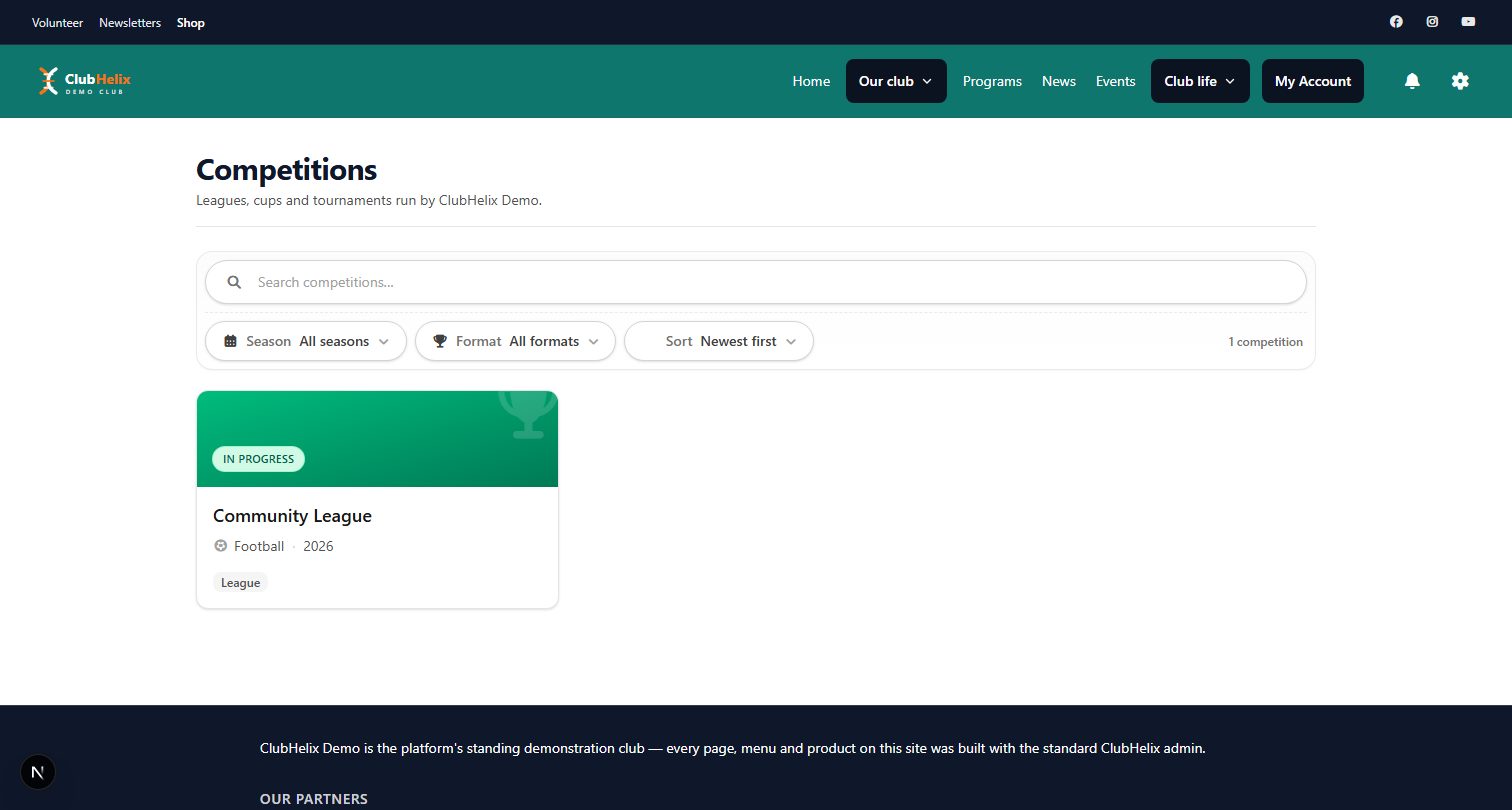
Club teams and squads live in team management beside the competition, which is handy when your best box players turn out to be the interclub side. Plans are on the pricing page, and you can start on the free tier to set up a first round.
The wrap into a club championship
End the season with a championship and the box league stops being a treadmill and becomes a qualifying campaign. Seed the draw from the final ladder: the top box's players go in as the top seeds, and the rest of the field is ordered by where members finished. Run a main draw for the top boxes and a plate or handicap event for the rest, so a player who spent the season in box five still has a weekend worth entering.
That is the shape of a good internal competition — a low-effort monthly rhythm that keeps members booking courts and meeting each other, finishing in one day everybody turns up to. Our guides to running a squash club, a tennis club and a badminton club cover where it sits in the rest of the club's year.
Frequently asked questions
How many players should be in a box?
Five is the best default: ten matches in the box, four per player, and one a week over a calendar month, which a working member can actually manage. Use boxes of four at a small club or in a sport with long matches, and six only where your members are keen and the courts are free.
How long should a box league round be?
A calendar month, closing on the last day, for boxes of five. Boxes of four can close in three weeks and boxes of six need five or six, but month-long rounds need no reminders because the deadline explains itself.
What do you do when a player never arranges their matches?
Award a walkover to any opponent who can show they offered at least three dates and got no reply, record the match as void if neither player made an offer, and move a player who concedes two walkovers to the reserve list so the box finishes the round as a four. Rank a short box on points per match played rather than total points.
Should a box league be scored on wins or on games won?
Start with wins — three points each, with a published tiebreaker order — because members can check it in their heads. Move to a point per game or set once the competition is established and you want to reward the player who loses 3–2 rather than 3–0.
How do promotion and relegation work in a box league?
Up two, down two is the standard for boxes of five and six: the top two players move up a box, the bottom two move down, and the middle stays. Ties at either line are settled by the published tiebreaker order, and the top box's winner takes a season-long title because there is nowhere above it to go.


