
What this guide answers
- What roles do you need to run a BMX race night?
At minimum a sign-on desk, a race secretary generating motos and recording results, a starter on the gate, a staging marshal, three or four corner marshals, finish-line recorders, a qualified first aider and a canteen…
- How do BMX motos work?
Riders are drawn into groups of up to eight and race their class three times from different gate positions.
- How often does a BMX track need maintenance?
Braking bumps get raked every race night, watering is a weekly job through the dry months, and a monthly working bee handles berms, jump faces and drainage.
- How do you get new riders into BMX racing?
Remove the barriers in order — gear, skill, nerves. Loan bikes and helmets at a come-and-try night, a short coached block on a closed track, then a first race free and a discounted second.
- How much should a club charge for race night entry?
Most clubs charge an annual membership plus a modest per-night entry, so occasional riders contribute fairly and weekly families are not subsidising everyone.
UK edition. This guide is written for volunteer-run clubs in the UK. Where rules differ — grants, tax, incorporation, safeguarding — follow the UK-specific pointers below or check with your national body.
Five o'clock on race night. The canteen roller door goes up, the sign-on table gets dragged out of the shed, and a queue forms of parents holding phones and kids in full-face helmets already sweating. By 6:15 the moto sheets are printed and taped to the board, ninety riders are checking which gate they drew, and someone's dad is walking the first straight picking up bark. By 6:30 the gate drops on moto one, and for the next two hours the club runs like a small machine.
That night is the club. Not a metaphor — the entire organisation exists to make one weekly event happen well, forty-odd times a year. Membership, grading, track maintenance, the canteen, the roster and the lighting bill all point at the same thing. Get race night right and you have a healthy BMX club; get it wrong and no amount of strategic planning saves you, because families do not renew for a strategy.
This guide is for the committee running a community BMX track. It covers the race-night run sheet, how classes and plates work, the track maintenance and machinery that eat your weekends, canteen economics, and how to turn a nervous eight-year-old on a borrowed bike into a rider who is still there in three years.
The club is one weekly event, repeated
| Period | What the club is doing |
|---|---|
| Pre-season, 6 weeks out | Track rebuild, gate service, licence and membership renewals open, roster set |
| Opening month | Come-and-try nights, loan bikes out, coaching block one, plate orders |
| Mid-season | Weekly racing, monthly working bee, points running, club open meeting hosted |
| Peak | Club champs round, a hosted open or state-level round, presentation planning |
| Off-season | Major dirt works, gate and lighting projects, grant applications, AGM |
Two roles carry disproportionate weight and should never be bolted onto the secretary's job. The race secretary owns sign-on, motos, results and points — a real weekly commitment all season. The track director owns the dirt, the machinery and the working bee calendar, and needs a standing crew rather than a general call-out. Everything else can rotate.
Most clubs affiliate to the national governing body, which sets the racing rules, the class structure and the racing licence system, and clubs sit within a regional structure for series racing. A day or trial licence is normally available so a newcomer can race before committing to a full one. Confirm the current categories with the governing body each season.
Race night, minute by minute
The difference between a club that finishes at 8:15 and one that finishes at 9:40 is not the number of riders. It is whether sign-on closes on time and whether the gate crew is in position before the first moto.
| Time | What happens | Roles on deck |
|---|---|---|
| 16:45 | Track walk-through, rake braking bumps, check gate and lights | Track director plus two |
| 17:00 | Canteen opens, sign-on desk opens, plate hire table out | Canteen crew of three, two on sign-on |
| 17:45 | Practice session opens, split by class group | Two marshals on the first straight |
| 18:00 | Sign-on closes. No exceptions, and say so on the website | Race secretary |
| 18:10 | Motos generated and printed, moto board up, announcement made | Race secretary |
| 18:20 | Practice ends, gate crew and corner marshals in position | Starter, gate marshal, four corners |
| 18:30 | Moto round one | Full crew |
| 19:05 | Moto round two | Full crew |
| 19:35 | Moto round three | Full crew |
| 20:00 | Mains for classes that qualify, presentations for the encouragement award | Starter, announcer, president |
| 20:20 | Results published, points updated, canteen cashes up | Race secretary, treasurer |
| 20:40 | Gate locked, lights off, tools away | Track director |
The roles you actually need filled
Twelve to fifteen people make a comfortable race night; it collapses to eight if you must. Publish the roster a fortnight ahead so families can plan.
- Sign-on desk (2) — membership and licence checks, entry fees, hire plates. The hard part is holding the cut-off politely.
- Race secretary (1) — motos, results, points table. The most technical job at the club and the first to succession-plan.
- Starter (1) — gate, cadence, restarts. Needs accreditation in most systems.
- Staging marshal (1) — gets the right eight riders to the gate for the right moto. Without this, everything runs late.
- Corner marshals (3-4) — watch for falls, signal, clear riders and bikes off the racing line.
- Finish line (2) — record placings for every moto so the secretary can score them.
- First aid (1) — qualified, on site, with the kit and the forms. Not doubling as a marshal.
- Canteen (3) — the second-biggest income line. Same crew every week if you can manage it.
- Announcer (1) — calls motos and staging, and does more for the atmosphere than anyone else.
How motos work, and why they matter
Riders are drawn into groups of up to eight and race the same class three times, from different gate positions. Points across the three decide who transfers to a main, or who wins the night in classes too small for a final. It suits a community club because everyone gets three races regardless of how the first goes, and a nervous first-timer is never eliminated in ninety seconds.
Two rules. Never combine classes without announcing it at sign-on and on the board — a parent who discovers at the gate that their nine-year-old is racing eleven-year-olds will not come back. And publish results the same night, not on Thursday. A rider refreshing the club site at 9pm is a rider coming back next week.

Grading, plates and classes
Class structure comes from your sanctioning body, but the club decides how humanely it is applied.
- Age classes run in single years for juniors and bands for adults and masters. Riders race the age they turn during the year, not their age tonight.
- Proficiency splits beginner from intermediate and expert riders, so a first season is not spent last. Moving a rider up carries real emotional weight for a ten-year-old — write the rule down rather than deciding at the desk.
- Plates carry the rider's number and class. Keep a box of numbered hire plates at sign-on on a small deposit rather than a fee.
- Combining is unavoidable at a small club. Combine on ability rather than convenience, upward for the younger rider rather than downward for the older one, and announce it.
Run a first-season pathway rather than dropping newcomers straight into racing. A four-week coached block on the first straight and the gate, alongside race night rather than instead of it, gets riders comfortable with the gate drop and the pack before they meet either at speed.
The first-race-free funnel
Most BMX clubs lose new families in one specific place — between "came to a come-and-try night and loved it" and "signed up, bought a licence and raced". The gap is money, gear and nerves. Remove all three, one at a time.
| Step | What removes the barrier | Illustrative numbers for a club of 90 |
|---|---|---|
| Come-and-try night | Loan bikes and helmets in the common sizes, no cost, no booking pressure | 40 attend across two nights |
| Four-week beginner block | Small paid block, same coach each week, gate practice on a closed track | 22 enrol |
| First race free | A voucher covering entry and a trial licence for one race night | 16 use it |
| Second race, half price | The genuinely decisive one — the second race is where the habit forms | 12 return |
| Season membership | Offered at the second race, pro-rata if the season is half gone | 9 join |
Those numbers illustrate the shape — run your own and watch which step leaks. Two habits make the funnel work. Capture contact details at the come-and-try night and follow up within 48 hours, while the kid is still talking about it. And hold a stock of loan bikes and full-face helmets in the sizes you actually see, because "we'd need to buy a bike first" ends more BMX careers than anything on the track.
Publish the pathway as a page a parent can read in ninety seconds — cost, gear required, what the club lends, what happens on a first race night. How to run a come and try day and how to start a junior program go deeper, and online registration turns sign-up into a link rather than a clipboard.
The track, the working bees and the machinery
Dirt is the asset. It moves under braking, dries out, washes away and grows bumps in exactly the places riders need grip. A well shaped, well watered track feels fast and safe; a neglected one feels sketchy within a fortnight, and riders stop coming long before they can explain why.
The rhythm
- Every race night — rake the braking bumps, check the gate mechanism and start hill, walk the track for anything loose.
- Weekly — water. Bound, slightly damp dirt holds its shape; dry dirt turns to dust and then ruts. The most valuable hour anyone puts into a BMX track.
- Monthly working bee — berms, jump faces, drainage, fence and netting checks, weed control, shed tidy.
- Annually — one substantial machinery-assisted dirt program in the off-season, plus a full service of the gate and lights.
Publish a task list, not a time slot. Say what each job needs — "two people with a wheelbarrow", "one licensed operator, four hours" — put a finish time on it, feed everyone, and finish when you said. How to organise a working bee covers the format, and volunteer rostering lets people claim a specific job rather than replying to a group message.
Machinery and the gate
Most clubs own or borrow a compact loader or tractor, a roller, a water pump or tank and a shed of hand tools. Three rules save a lot of grief. Only ticketed operators run machinery, and you keep a list of who they are. Nobody operates alone. And you keep a pre-start check and maintenance log per machine — for insurance, for the land owner, and because the log is what tells you the hydraulics have been weeping for four months.
The start gate is the club's most expensive moving part, and a failed gate cancels racing. Hold spares for the components that fail most often, and know who can fix it at 6:20 on a race night.
The gate and lighting sinking fund
Lights are what let a BMX club race on a weeknight, and weeknight racing is what makes it fit around families. A lighting upgrade or gate replacement is a capital-scale project and should be funded like one — a budget line every year, not a panic when something dies. Estimate the replacement cost, divide by the years of life you realistically have left, and treat that as an annual expense from today. Do the same for fencing, the shed roof and the mower. A club putting aside a modest amount a year can co-contribute to a grant, and co-contribution is what gets grants approved — see how to write a grant application.
Lighting, gate and drainage projects are exactly what National Lottery sport funding, local authority capital grants and cycling-specific facility funds are for. Floodlight projects need planning consent and a light-spill assessment, so start that conversation long before you apply for the money.
The canteen that pays for the lights
The canteen is not a nice extra. Ninety riders bring roughly two hundred people to a track for two hours on a weeknight, most arriving straight from school or work, with nowhere else to buy food — the most reliable non-membership income a small club has. An illustrative race night, to show the shape rather than to be copied:
| Item | Sold | Price each | Cost each | Gross margin |
|---|---|---|---|---|
| Hot food | 60 | 5.00 | 1.80 | 192.00 |
| Drinks | 90 | 3.00 | 1.20 | 162.00 |
| Snacks and confectionery | 70 | 2.00 | 0.80 | 84.00 |
| Hot drinks | 40 | 3.50 | 0.70 | 112.00 |
That is a meaningful contribution to the lighting bill every week, from a shed with a fridge in it. Four things protect it — buy in bulk on a schedule rather than on the way to the track, price in round numbers so the queue moves, take card as well as cash, and roster the same crew so nobody relearns the urn. How to run a club canteen covers stock, food safety and floats in detail.
The tuck shop or clubhouse kitchen is a regulated food business even when it is volunteer-run and only opens once a week. Check registration and food hygiene training requirements with your local authority environmental health team before the season starts.
Money across the season
| Income | Expenditure |
|---|---|
| Memberships and registration | Affiliation and insurance |
| Race night entry fees | Electricity, mainly lighting |
| Canteen | Canteen stock |
| Coaching blocks and holiday clinics | Coach payments and accreditation |
| Hosted open or series rounds | Track machinery fuel, hire and repairs |
| Sponsorship and signage on the fence | Trophies, plates, presentation night |
| Grants for capital items | Sinking fund transfers for gate, lights, fencing |
| Merchandise and club kit | Water, waste and portable toilet hire on big days |
Three habits keep a BMX club solvent. Charge a race-night entry separate from membership, so occasional riders pay their way and weekly families are not subsidising everyone. Bank the canteen the same night and reconcile weekly rather than before the AGM. And treat hosted rounds as a business decision — a regional round brings hundreds of visiting riders and real canteen income, but also portable toilets, extra officials, extra insurance and a fortnight of track preparation. Model it before you bid, using the club budget template as a frame.
Calling off a wet Tuesday
Rain is the recurring operational decision of a BMX season, and clubs get it wrong in both directions — cancelling at lunchtime when it clears by four, or leaving it until families are in the car park. Write the protocol down and publish it.
- A fixed decision time. 3:30pm, every race night, no exceptions. Families plan around a known time far better than a good decision made late.
- A named decision-maker. The track director, with the president as backup. Not a committee, not a group chat vote.
- A stated criterion. Standing water on the first straight or any jump landing, or lightning within the distance your safety policy specifies. Wet dirt is not automatically a cancellation; unsafe dirt is.
- One announcement, three channels, all from the same person within five minutes of the call.
- What happens to entries. Say in advance whether a cancelled night is refunded, credited or lost. Deciding afterwards is how committees make enemies.
Push notifications and the installable web app are the right channel, because an email at 3:30pm will not be read in time. Our wet weather communication plan has a full template.
Race night without the clipboard
A BMX club generates a relentless pile of admin — memberships and licence status, weekly entries, class lists, results and points, a roster of a dozen jobs, a maintenance log and a grant acquittal. Most clubs run it on a spreadsheet, a printer and one person's memory, and it holds together until that person takes a holiday. ClubHelix keeps it in one place — competitions with fixtures, results and standings published straight to your own site, event entries for race nights and hosted rounds, volunteer rostering where people claim the actual job, and online registration with card payment. BMX sits under our cycling club management software page, which shows how race nights, entries and memberships fit together.
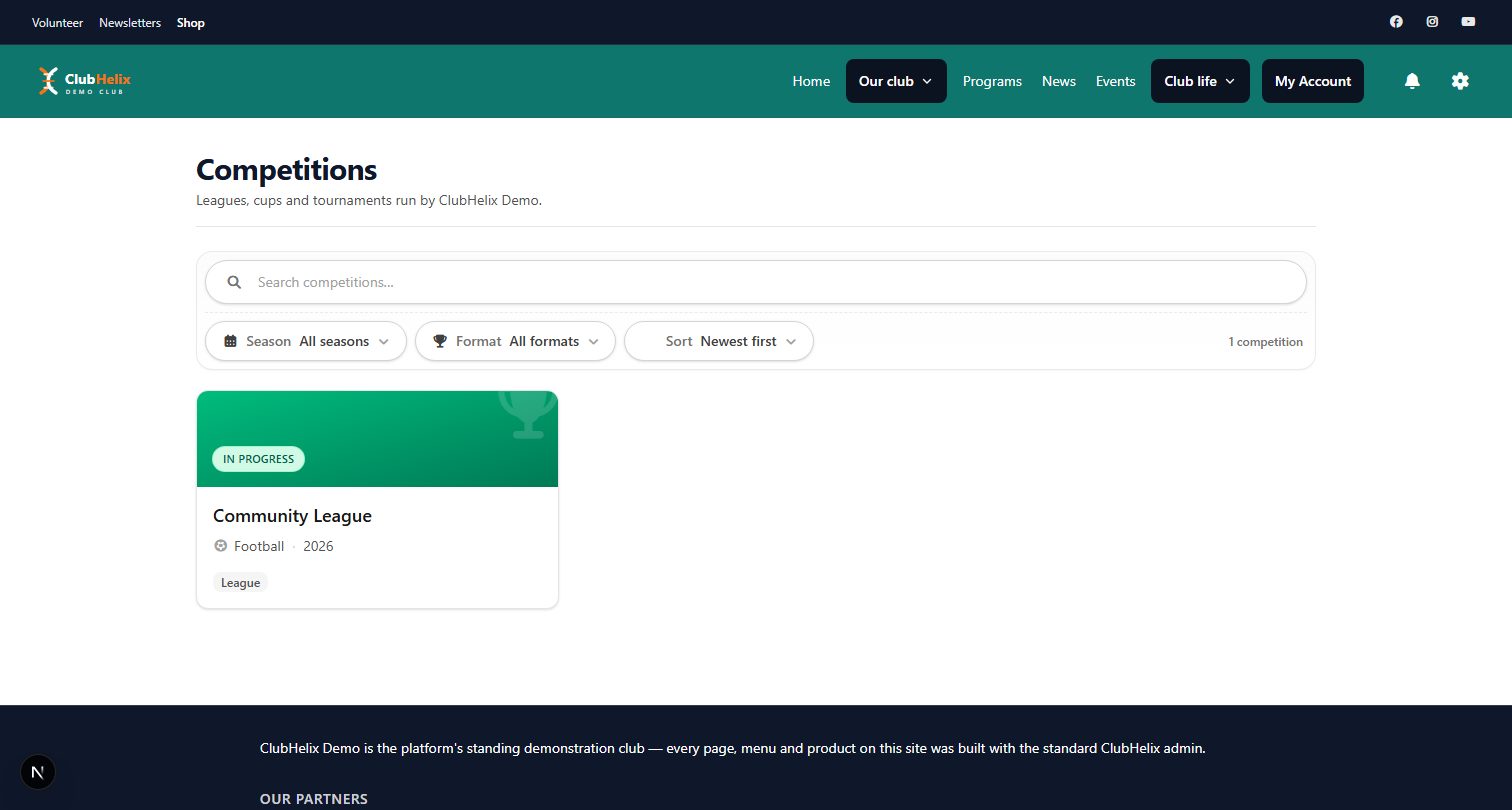
Start free and add what you need when the season demands it. The pricing is published up front, and a committee can have a working site — join page, race calendar, results and roster — up between a working bee and a race night. Set your club up and give the race secretary their Wednesdays back.
Frequently asked questions
What roles do you need to run a BMX race night?
At minimum a sign-on desk, a race secretary generating motos and recording results, a starter on the gate, a staging marshal, three or four corner marshals, finish-line recorders, a qualified first aider and a canteen crew. Twelve to fifteen people makes a comfortable night; eight is the practical floor.
How do BMX motos work?
Riders are drawn into groups of up to eight and race their class three times from different gate positions. Points across those three decide who transfers to a main, or who wins the night in smaller classes. Every rider gets three races regardless of how the first goes, which is why the format suits beginners.
How often does a BMX track need maintenance?
Braking bumps get raked every race night, watering is a weekly job through the dry months, and a monthly working bee handles berms, jump faces and drainage. One machinery-assisted dirt program in the off-season plus an annual gate and lighting service keeps the track from degrading.
How do you get new riders into BMX racing?
Remove the barriers in order — gear, skill, nerves. Loan bikes and helmets at a come-and-try night, a short coached block on a closed track, then a first race free and a discounted second. The second race is where the habit forms, so follow that step up hardest.
How much should a club charge for race night entry?
Most clubs charge an annual membership plus a modest per-night entry, so occasional riders contribute fairly and weekly families are not subsidising everyone. Set it against your actual per-night costs — lighting, first aid, consumables — and review it annually rather than leaving it untouched for a decade.
Keep reading — how to run a club canteen for the income line that funds your lights, and how to run a motocross club if your club shares a precinct with one.


