
What this guide answers
- How much work is maintaining a baseball diamond?
Plan for two to three volunteer hours per game day (dragging, lining, mound and box repair) plus monthly safety checks and two working bees a year.
- When does the baseball season run?
Club baseball is a spring and summer sport, squeezed at both ends by the weather, with registration opening in winter, indoor practices from late winter, and a compressed regular season giving way to playoffs by…
- What are pitch counts and why do they matter?
Junior competitions limit how many pitches a young pitcher can throw and mandate rest days afterwards, to protect developing arms.
- What should a baseball club website include?
Venue, season dates, fees, a join link, tee-ball information, current fixtures and results, sponsor recognition and a monitored contact.
Canada edition. This guide is written for volunteer-run clubs in Canada. Where rules differ — grants, tax, incorporation, safeguarding — follow the Canada-specific pointers below or check with your national body.
A baseball club is really two operations wearing one cap. The first is a sporting club — teams, coaches, a summer season of Friday night and weekend games. The second is a grounds crew, because a baseball diamond is the most maintenance-intensive playing surface in community sport: a clay mound to rebuild, batter's boxes to repair, an infield to drag and line, and a backstop, dugouts and cages to keep safe. Clubs that acknowledge both jobs — and roster people to each — run smoothly. Clubs that don't discover it at 7am on game day with a rake in one hand.
This guide covers how to run a baseball club end to end: affiliation and season structure, committee roles, diamond maintenance, tee-ball and junior pathways, pitch-count rules, fees and registration, money and fundraising, and building an online home that does some of the admin for you.
Affiliation and the shape of a baseball season
Club baseball runs through local or regional associations affiliated with the national body. Affiliation buys your competition entry, player insurance arranged through the governing body, umpire access and the representative pathway.
The season here runs spring through summer and is compressed by the weather at both ends, so your planning year starts in the depths of winter: registrations open, evaluations, team formation into divisions, then a short, dense run of games toward playoffs. Indoor cage time in late winter is the scarce resource — book it before you announce your pre-season schedule, not after.
Grade entries matter more in baseball than most sports because divisions often split by both standard and age. Confirm realistic playing numbers before nominating — withdrawing a team mid-season wrecks the draw and your reputation with the association. If the club is new or unincorporated, look into incorporating as an association so it can hold ground allocations, a bank account and grants in its own name; requirements differ by state, so check your regulator, for example Consumer Affairs Victoria.
This is general information, not legal or financial advice — check the current requirements with the official body linked above.
Committee roles, including the one baseball can't skip
Alongside president, secretary and treasurer, baseball clubs need a grounds and diamond coordinator with real authority and a real budget. This person owns the mound and plate areas, the infield surface, line marking, cage netting and the working-bee calendar. Give them a deputy — it's the role most likely to burn someone out, and the one where a handover hurts most.
Other roles worth defining: a registrar (registrations, clearances, age verification), a junior/tee-ball coordinator, a scorers coordinator (most competitions require each team to supply one), an umpires liaison to fill club duty slots, and a canteen coordinator. Write one-paragraph descriptions for each and recruit to the description — and put every role's contacts and handover notes somewhere central, not in a departing volunteer's inbox.
Diamond maintenance: the honest checklist
The diamond rewards routine, not heroics. Spread this across a duty roster rather than leaving it to one saint with a ute:
| Task | How often | Notes |
|---|---|---|
| Drag and level the infield | Before every game day | Kills bad hops; 20 minutes with two people |
| Repair mound and batter's boxes | Weekly in season | Tamp clay while damp; cover if you can |
| Re-mark foul lines and boxes | Every game day | Keep a laminated measurements card in the shed |
| Check backstop, fences, dugouts | Monthly | Loose wire and splinters are injury claims waiting |
| Batting cage nets and mats | Monthly | Worn nets fail exactly when a junior is behind them |
| Lights (if you host night games) | Pre-season + mid-season | Book electrical checks early; lead times are long |
| Full working bee | Pre-season and pre-finals | Feed people; it doubles turnout |
A mound rebuilt properly in pre-season and touched up weekly survives a whole summer. One ignored until round ten becomes a fortnight-long project. If your council prepares the ground, the coordinator's job becomes relationship management — allocation paperwork, booking works early and saying thank you. Our pre-season checklist for sports clubs covers the wider club audit worth doing before round one.
Membership, registration and fees
Baseball's costs — association fees, insurance, balls, umpires and all that clay — get funded mostly through subscriptions, so set fees deliberately: senior, student/concession, junior and tee-ball tiers, with family discounts if you can afford them. Publish what the fee covers; parents comparing summer sports will ask.
Move the whole intake online. With online registration, players and parents register from a phone, pay by card or instalments, and land on your roster automatically — with medical notes, emergency contacts and uniform sizes captured once instead of chased three times.
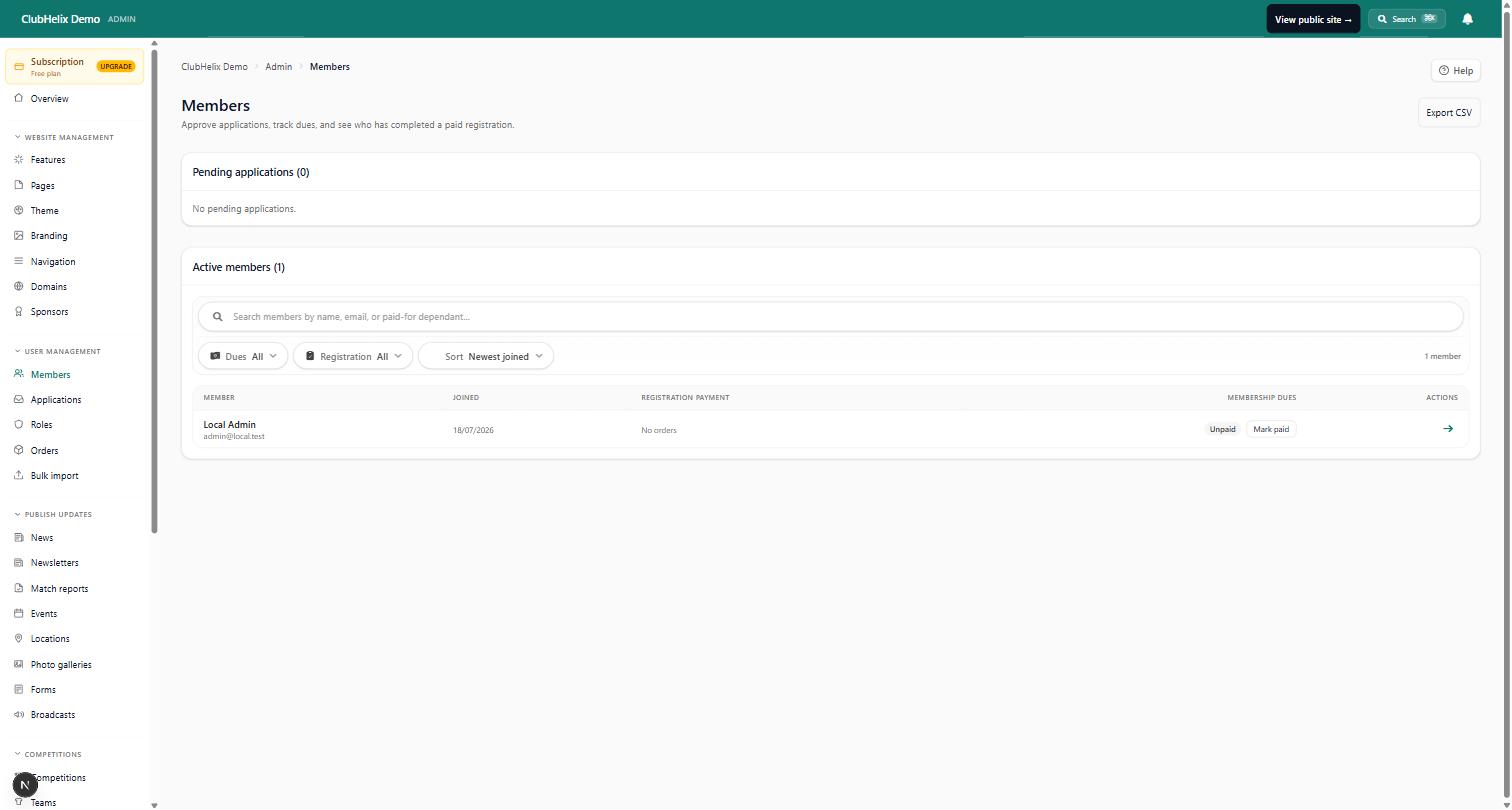
A live members roster showing who's registered, who's paid and until when turns the treasurer's least favourite job — chasing fees mid-season — into a five-minute filter-and-remind. Note that players usually need to exist in the governing body's registration system too for competition eligibility; make your club form the front door and point new members to both steps.
Game day, pitch counts and scoring
Baseball game days have obligations other sports don't. Most junior competitions enforce pitch-count limits and mandatory rest days for pitchers — the count must be recorded, and a club that gets it wrong risks forfeits and, worse, young arms. Make pitch tracking a named scorer's-table duty, not something a coach guesses at afterwards. Scorebooks (paper or app-based) are typically mandatory for every team, so keep accrediting new scorers each season — two per team is the comfortable minimum.
Structure each home game day around a duty team: diamond prep crew in the morning, canteen and barbecue shifts, scoreboard, and the umpires' liaison hosting officials. Publish the whole season's duty roster before round one through a volunteer roster with automatic reminders, and the weekly scramble disappears. Fixtures, results and standings belong on your public site via a proper competitions setup — enter the result once at the ground and it's published before the gear trailer is packed.
Juniors: tee-ball first, arms protected always
Tee-ball is baseball's recruitment engine: five-to-nine-year-olds hitting off the tee, every child batting and fielding, games short and loud and fun. Run it at the same venue and time as club games so families stay for the day, keep fees minimal, and give every tee-ball parent a small job immediately — base umpire, tee resetter, fruit roster. From tee-ball, juniors move into modified live-pitch divisions, then age-group baseball where pitch counts and proper coaching matter most.
The junior transition points — first live pitching, first curveball-free seasons, first senior call-up — are where clubs lose or keep kids. Handle them deliberately: pre-season pitching and catching clinics, a celebrated first-game milestone, and coaches who know the development rules cold. Every junior coach and helper needs a current Working with Children Check recorded centrally. For the bigger participation picture, see how to increase junior participation.
Money, the canteen and fundraising
A baseball club's reliable earners are the canteen and barbecue across a long home game day, sponsorship, and one or two flagship events. Night games under lights are gold — bigger crowds, hungrier crowds — so if you host them, staff the canteen properly and take cashless payments.

Sponsorship works when you sell something specific: outfield-fence signage priced per panel, a named home-run award, the game ball each week. Our guide on how to get sponsors for a sports club walks through packaging and pricing. Round out the calendar with a season-launch barbecue, a mid-season trivia night and a presentation-day raffle — and if your precinct also hosts softball, coordinate rather than compete for the same local businesses (see our companion guide, how to run a softball club).
Your baseball club online
New players find clubs the same way they find restaurants: they search. A baseball club website needs to answer the first-timer's questions — where you play, when the season runs, what it costs, how tee-ball works, how to join — and serve members with current fixtures, results and duty rosters. Because baseball's season is opposite to the big winter codes, your site is also your pitch to winter athletes looking for a summer sport; say that plainly on the homepage.
Baseball club management software that puts registration, teams, fixtures and payments behind the website beats a generic builder because nothing needs updating twice. See how baseball clubs assemble it on our baseball club management software page.
If your committee would rather be in the cages than in spreadsheets, ClubHelix runs the lot — registrations and payments, rosters and duty schedules, fixtures and standings, club-wide email and SMS, and a professional website — with a free tier to start on. Check pricing or set up your club before pre-season.
Frequently asked questions
How much work is maintaining a baseball diamond?
Plan for two to three volunteer hours per game day (dragging, lining, mound and box repair) plus monthly safety checks and two working bees a year. A dedicated grounds coordinator with a duty roster keeps it manageable; leaving it to one person doesn't.
When does the baseball season run?
Club baseball is a spring and summer sport, squeezed at both ends by the weather, with registration opening in winter, indoor practices from late winter, and a compressed regular season giving way to playoffs by mid-to-late summer. Confirm your own association's dates first — they vary considerably by province.
What are pitch counts and why do they matter?
Junior competitions limit how many pitches a young pitcher can throw and mandate rest days afterwards, to protect developing arms. Counts must be recorded at the scorer's table; getting them wrong risks forfeits and injuries, so make it a named game-day duty.
What should a baseball club website include?
Venue, season dates, fees, a join link, tee-ball information, current fixtures and results, sponsor recognition and a monitored contact. Linking the site to your registration and competition systems keeps everything current without double entry.


