
What this guide answers
- How much should a club charge for court hire?
Start from the hourly cost floor — power, surface wear, cleaning, the club's fixed costs and the volunteer's time — then set a casual rate that covers it comfortably and sits near what comparable local venues charge…
- Should we charge per person or per slot?
Charge per head when the number of people changes the wear or the value — horses on an arena, pupils on a coaching court — and per slot when it does not, such as four players on a tennis court.
- Can we charge more for evening or peak-time slots?
Yes. Rates vary by time of day and day of week on the resource itself, so the floodlit evening can carry its own price alongside the member and casual rates.
- How do we give regulars a discount?
Through a membership type or a standing block rather than an ad-hoc rate: a "Coach" or "Regular hirer" membership type books at the member rate, or the regular's weekly slot is held with an admin block and invoiced for…
- How do we know if our prices are right?
Read the reports after a season: booked value against collected shows whether the money is coming in, and hours or places booked against hours available shows whether the facility is full.
New Zealand edition. This guide is written for volunteer-run clubs in New Zealand. Where rules differ — grants, tax, incorporation, safeguarding — follow the New Zealand-specific pointers below or check with your national body.
Ask five committee members what the club should charge for an hour on Court 2 and you will get five numbers and one argument. Someone remembers what it cost in 2009. Someone thinks members should never pay. Someone has seen what the centre across town charges and wants double. Nobody has worked out what the hour actually costs the club.
Pricing facility hire is not hard, but it does need to be done in order: cost first, then shape, then the member and casual rates, then the edge cases everyone argues about — regulars, evenings, rounding. This guide takes that order, with illustrative figures throughout that you should replace with your own. The final third shows how the pricing lands in ClubHelix, where the price is shown to the booker before they commit and the reports tell you afterwards whether it was right.
Start from the cost floor
Every facility has an hourly cost, and most clubs have never written it down. Do it once and every later argument gets shorter.
| Cost | How to estimate it | Illustrative figure per hour (your currency) |
|---|---|---|
| Power and lights | Last year's electricity bill ÷ hours the facility was actually in use | 2.50 (more for floodlights) |
| Surface wear and maintenance | Annual resurfacing or top-up cost ÷ expected life in hours | 3.00 |
| Cleaning and consumables | Cleaner's hours or the volunteer's, plus supplies | 1.00 |
| Insurance and rates share | The facility's share of the fixed annual costs ÷ hours in use | 1.50 |
| The volunteer hour | Booking admin, key handover, chasing — honestly counted | 2.00 |
| Cost floor | 10.00 |
Two things jump out of that table every time. The first is that the volunteer hour is real money: a booking that takes twenty minutes of somebody's evening to administer has a cost even if nobody is paid. Systemising the booking is a pricing decision as much as an administrative one. The second is that the cost per hour falls as use rises, because the fixed costs are spread over more hours — which is the whole argument for pricing to fill the facility rather than to squeeze each booking.
The floor is not the price. It is the number below which a booking loses the club money, and the reason "free for everyone" is a policy choice with a cost attached, not the absence of a policy.
The four pricing shapes
Once you know the floor, choose the shape. Almost every facility fits one of four.
| Shape | What the booker pays for | Example (your currency) | Best for | Watch out for |
|---|---|---|---|---|
| Flat per slot (exclusive) | The whole facility for the slot | Court, 60 min: member 10, casual 20 | Courts, greens, rooms, pitches | One person on a four-person court pays the same as four — simple, but not per-use |
| Per head, with a cap | The slot price × the number they bring, up to a maximum | Arena: 10 per horse per hour, up to 4 | Arenas, coaching courts, a room hired per attendee | The number stated at booking is the number allowed in; say so in the terms |
| Per place on a shared facility | Their own place, alongside other bookings, until it is full | Pool: 6 lanes, 5 per lane; climbing wall: 12 places at 8 | Lanes, bays, walls, shared arenas | Full is full — decide what "full" means for safety, not just income |
| Free for members, casual pays | Nothing if financial; the casual rate if not | Court: member 0, casual 15 | Clubs where facility use is the membership benefit | Members' bookings still cost the floor; watch the empty-but-booked hours |
The shapes are not exclusive of each other: a shared arena is per place and per head (each rider pays per horse for their own place), and a free-for-members court is a flat per-slot price with the member rate set to zero. What matters is picking one shape per facility and writing it on the booking page in a sentence a stranger understands — "per horse, per hour, up to four horses" or "book a lane, five per hour".
Per head or per slot? Ask whether the number of people changes the wear or the value. Four horses do four times the damage of one, so an arena is per head. Four tennis players do not wear a court four times as fast, so a court is per slot. A coaching court where the coach charges each pupil is per head because that is how the coach thinks about it.

Member rates, casual rates, and what "financial member" means
Nearly every club runs two rates for the same slot, and the gap between them is the most powerful pricing tool you have.
- The member rate rewards people who have already paid a subscription. Set it low enough that a member feels the benefit every time they book; set it at zero if facility use is the membership.
- The casual rate is what a non-member pays for the same slot. It should cover the floor comfortably and sit close to what a comparable local venue charges, because the casual rate is also your recruitment tool: a casual who books three times a month should be able to see that a membership would have been cheaper.
- Financial member means paid up, not "on the list". The member rate should follow the member's paid-until date automatically, or the treasurer will spend every winter deciding by hand who lapsed in October. When the rate follows financial status, the renewal reminder writes itself — book at the member rate again by renewing.
A worked example, with figures to replace. Floor 10 per hour; casual rate 20; member rate 8 — below the floor, deliberately, because the membership fee already covers the difference and the member rate is there to fill hours that would otherwise be empty.
On a booking page that reads as "Member $8 / Casual $20 per hour", and a lapsed member simply sees $20 until they renew.
Regulars, discounts and standing bookings
The coach who books Court 1 every Tuesday at six, the swim squad that takes three lanes every morning, the dressage trainer with a weekly arena hour — regulars are the best customers a facility has, and they always ask for a discount. Be honest with yourself and with them about how you give it.
There is no automatic "book ten, get one free" in a per-slot booking system, and inventing one on a spreadsheet is how the discount ends up applied to the wrong person. The practical tools are these:
- A membership type. Create a "Coach" or "Regular hirer" membership type with its own fee, and make the facility's eligibility or member rate follow it. The regular pays once for the season and books at the member rate; the discount is the membership, and it is visible in the members list rather than hidden in the diary.
- A standing block. For a regular whose slot is fixed, hold the hour with an admin block each week and invoice the season in one go. The slot is off the public grid, the regular never has to remember to book, and the club has one payment to chase instead of forty.
- A separate resource. "Court 1 — coaching" with its own hours and price, open only to the coaching membership type, keeps the coach's rate away from the members' rate without any arithmetic.
What you should not do is quietly charge one regular less than another for the same slot without a membership type or a block to explain it. It surfaces at the AGM.
Peak, off-peak and evening rates — honestly
Every committee wants floodlit Tuesday evenings to cost more than a wet Wednesday morning, and that is a rate you can now set directly: a resource carries rates by time of day and day of week, on top of its member and casual prices. A court can have a 6 pm price.
Two details decide whether members accept it. The first is the boundary: a booking is priced slot by slot, so one that starts at five and runs to seven pays one off-peak hour and one peak hour rather than being charged at whichever rate it started on — which is the version nobody argues about. The second is history: the price is kept on the booking, so raising the evening rate next season never rewrites what somebody was charged this season.
Set the peak window off your own booking data rather than off instinct: read last season's grid, find the hours that are actually full, and start there. A gap too small to notice changes nobody's behaviour, and one too large just annoys the members you already have. Our guide on peak and off-peak court pricing works through the arithmetic with a real utilisation table.
Currency, rounding and tax
Small things, but they cause a surprising number of gate arguments.
Currency should follow the club's own default, so a price typed once shows the right symbol on the booking page, in the email and in the reports. Check it before you publish a single rate — a club that has moved country in the settings but not in the facility will show the wrong symbol to every booker.
Rounding. Price in whole units where you can. A rate of 12 per horse per hour is easy to pay by QR code at a gate; 12.35 is not, and the difference is not worth the coins.
Tax. Whether facility hire attracts a sales tax, and whether the club must register for it, depends on where you are and how big the club's turnover is. Decide whether your published price includes any tax the club must add, say so on the booking page, and check the position with your accountant. This is general information, not tax advice.
For clubs registered for GST, hire fees are usually taxable; a club under the registration threshold may not need to register. Inland Revenue publishes guidance for non-profit organisations — confirm your own position with your accountant.
Show the price before anyone books
A price that only appears after the booker has chosen a slot is a price that starts arguments. The booking page should show the rate on the resource before a slot is picked, show the total as the booker changes the number of hours or the number of horses, and repeat the total in the confirmation. If the price is per head, the arithmetic should be visible: "3 horses × 2 h = [total]", not a number that appears from nowhere.
The same applies to the club's side. When you set a per-head price with a cap, you should be able to see what a full booking costs before you save it — if "4 horses × 1 h" comes out at a figure that would embarrass you at the AGM, you want to know at the form, not from a rider.
In ClubHelix facility booking, the resource form does exactly this: a live preview under the sharing-and-payment step shows the arithmetic for the member and casual rates as you type, and updates as you tick "Charge per horse" on or off or change the maximum per booking.
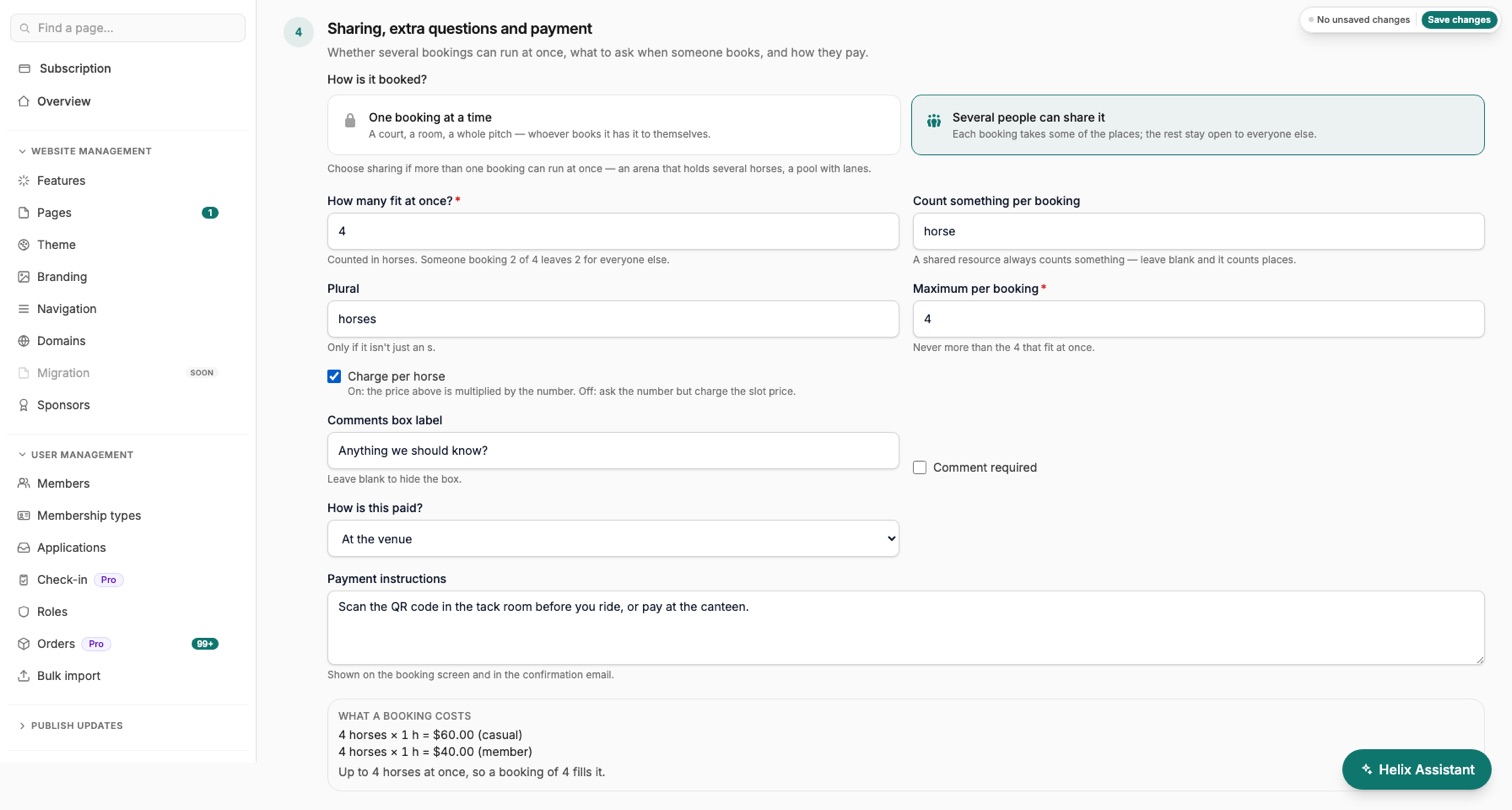
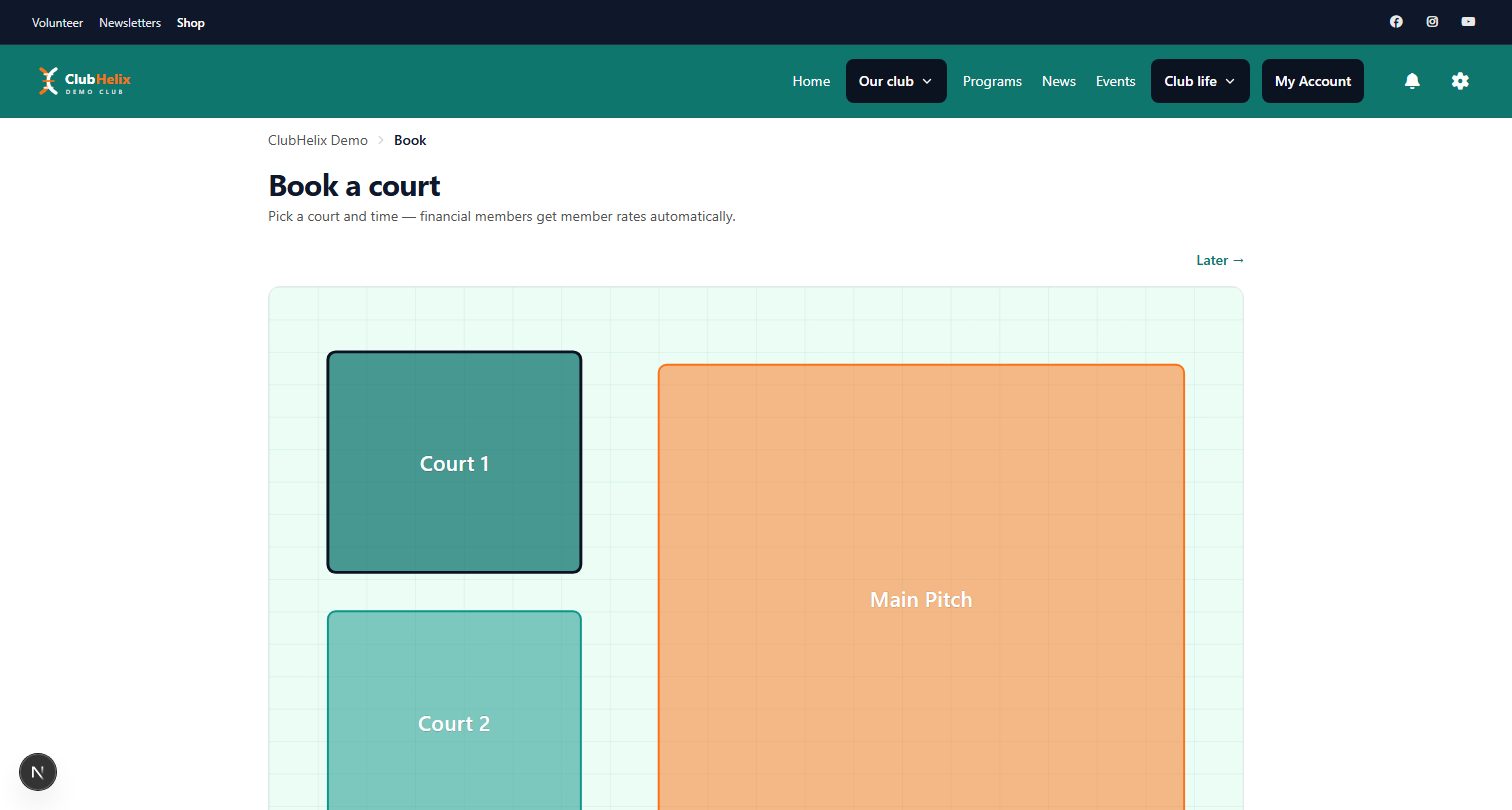
On the public page, each resource shows its member and casual price; a financial member automatically sees the member rate, a guest or lapsed member the casual rate; and the total updates as the booker changes the slots or the number of horses, players or places. If the resource is paid at the venue, the same figure appears as "Pay [amount] at the venue" on the confirmation.
Review prices with the reports, not the AGM
Set the prices, run a season, then read three numbers before anyone argues.
Booked value is the price of every booking taken. Collected is the money actually recorded — the same as booked value if everything is paid by card at booking, and lower by whatever is still owed at the venue if you take payment on site. The gap is the owed list. Hours booked against hours available tells you whether the facility is full, and this is where a caveat matters: a shared arena that is "booked" every hour with one horse in it is not full, so read utilisation by places or units, not by bookings, on a shared resource.
Then act on what you see. Empty weekday mornings mean the off-peak rate is too high, or nobody knows the facility is for hire — try a lower member rate before you try advertising. A casual who books every week and never joins means the casual rate is too close to the member rate. A booked-but-empty court on Friday nights means the free member rate needs a no-show rule, not a price change. Put the collected figure, never the booked one, into the club budget.
The reports page in ClubHelix carries the Booking revenue report with booked value and collected side by side, and the bookings list exports to CSV with the units and the payment method in the columns. Together with member self-registration keeping the paid-until dates current, the member rate looks after itself. Pricing for the platform is per club, with no per-booking fee on money the club records itself.
Frequently asked questions
How much should a club charge for court hire?
Start from the hourly cost floor — power, surface wear, cleaning, the club's fixed costs and the volunteer's time — then set a casual rate that covers it comfortably and sits near what comparable local venues charge, and a member rate low enough to fill the empty hours. Illustrative figures in this guide are examples; price against your own costs and the venues your members actually use.
Should we charge per person or per slot?
Charge per head when the number of people changes the wear or the value — horses on an arena, pupils on a coaching court — and per slot when it does not, such as four players on a tennis court. A shared facility such as a pool is priced per place, so each booker pays for their own lane.
Can we charge more for evening or peak-time slots?
Yes. Rates vary by time of day and day of week on the resource itself, so the floodlit evening can carry its own price alongside the member and casual rates. A booking that straddles the change is priced slot by slot, paying each hour at its own rate, and the price is kept on the booking so a later rise never alters an old receipt.
How do we give regulars a discount?
Through a membership type or a standing block rather than an ad-hoc rate: a "Coach" or "Regular hirer" membership type books at the member rate, or the regular's weekly slot is held with an admin block and invoiced for the season. There is no automatic loyalty discount, and inventing one on a spreadsheet is how it ends up applied to the wrong person.
How do we know if our prices are right?
Read the reports after a season: booked value against collected shows whether the money is coming in, and hours or places booked against hours available shows whether the facility is full. Empty off-peak hours usually mean the member rate is too high; casuals who book every week and never join mean the casual rate is too close to it.


