
What this guide answers
- Should we count members who moved away or aged out?
Count them as lost, and note the reason separately if you know it.
- What about family memberships?
Decide whether the unit is the membership or the person, and be consistent.
- How many seasons of data do we need?
Two gives you a comparison; three gives you a trend. Start now even if the first figure is embarrassing — the point is the direction, and you cannot get a direction without a first point.
- Can we improve retention quickly?
Renewal conversion, yes — a clear reminder sequence with a working payment link routinely recovers members who simply forgot, and that shows up within weeks.
- Where does attendance fit in?
It is the earliest warning you have. A member who has not attended in eight weeks is far more likely to lapse at renewal, and unlike the renewal date, attendance is something you can see and act on while the season is…
Ireland edition. This guide is written for volunteer-run clubs in Ireland. Where rules differ — grants, tax, incorporation, safeguarding — follow the Ireland-specific pointers below or check with your national body.
Ask three committee members for the club's retention rate and you will get three numbers, all calculated honestly. That is not a competence problem — it is a definition problem, and it is why retention is simultaneously the most useful number a club can track and the most commonly mangled.
This guide gives you the three formulas that actually get used, worked through with numbers you can follow, and the handful of decisions you have to make before any of them mean anything.
Why retention beats headcount
Headcount is a lagging measure of everything. Retention is a leading measure of most of it.
Consider two clubs that both finish the season with 400 members. Club A started with 380 and gained 20. Club B started with 500, lost 180 and recruited 80. Identical headcount, completely different clubs: Club B is running a recruitment treadmill that will exhaust its volunteers within three seasons.
Headcount cannot tell those two apart. Retention can, immediately.
The three decisions you make first
Before any formula, settle these — in writing, once — or your figure will move every time somebody new calculates it.
1. What is a member? Everyone on the roster, or only those who paid? Most clubs should use "paid up", because an unpaid registration that never converts is not a retained member. Whatever you choose, use it on both sides of the fraction.
2. What is the period? For seasonal clubs, the season. For year-round clubs, the financial or membership year. Not the calendar year unless your membership actually runs on it.
3. What is the grace period? Someone who renews six weeks late is retained; someone who renews eight months after the season started is a re-join. Pick a window — 30, 60 or 90 days past the due date — and apply it consistently.
Write those three lines directly above the number, wherever it is published. It costs one sentence and saves a recurring argument.
Formula 1: simple retention rate
The one most clubs mean when they say "retention".
Retention rate = (members at the end who were also members at the start) ÷ (members at the start) × 100
Note what is not in the numerator: new members. They did not exist at the start, so they cannot be retained. Including them is the single most common retention error, and it inflates the figure exactly when the club most needs the truth.
Worked example
A netball club starts the season with 240 paid members. At the end of the season:
- 186 of those original 240 have renewed
- 62 new members have joined during the year
- Total membership is 248
The tempting calculation is 248 ÷ 240 = 103 per cent, and the club congratulates itself on growth.
The retention rate is 186 ÷ 240 = 77.5 per cent.
Both figures are true and they say different things. The club grew by 8 members and lost 54 — it is running to stand still, and the 54 is the number that should be on the agenda.
Formula 2: cohort retention
The most useful version, and the one worth the extra effort.
Cohort retention = (members from joining cohort X still current at year N) ÷ (size of cohort X) × 100
Instead of measuring everyone at once, you follow each intake through time.
Worked example
The same club looks at the 62 who joined in 2024:
| Anniversary | Still current | Cohort retention |
|---|---|---|
| Year 1 | 38 of 62 | 61% |
| Year 2 | 29 of 62 | 47% |
| Year 3 | 25 of 62 | 40% |
Read the shape, not the numbers. The steep fall is between joining and the first anniversary; after that the curve flattens hard. That is the standard club pattern, and it tells you precisely where to spend effort: a member who survives their first season is likely to stay for several, so the first-season experience is worth more attention than any recruitment campaign.
Compare cohorts and you get something better still. If the 2025 cohort's year-one retention is 71 per cent against 2024's 61, whatever the club changed that year worked — and you should find out what it was before the person who did it steps down.
Formula 3: churn rate
The same information, expressed as the loss. Some committees respond better to it.
Churn = 100 − retention rate
At 77.5 per cent retention, churn is 22.5 per cent. Multiply by your average membership fee and you have the annual revenue the club loses to churn — which is usually the sentence that gets a retention plan approved.
For the club above, 54 lost members at an average $180 fee is $9,720 a year, walking out for reasons nobody has recorded. That figure will do more work in a committee meeting than any percentage.
The traps
Counting new members as retained. Covered above. The most common error by a distance.
Comparing different definitions across years. If last year's figure used "on the roster" and this year's uses "paid up", the trend is fiction. Recalculate the old years on the new definition, or do not compare.
Ignoring the grace period. Measuring on the renewal due date rather than 30 or 60 days after it can understate retention by ten points or more, purely as an artefact of when you looked.
Treating juniors and seniors as one population. Junior members leave for structural reasons — they age out, they change schools, they choose one sport over three. Blending them with adult social members produces a number that describes neither. Segment and report separately.
Measuring only once a year. Retention is annual by nature, but the leading indicators — attendance, renewal conversion, communication reach — are monthly. Watch those, and the annual figure stops being a surprise.

What a good rate looks like
There is no credible universal benchmark, and you should be sceptical of anyone offering one. A junior club in a sport children age out of at 12 cannot be compared with an adult social club. A competitive senior club that cuts squads cannot be compared with either.
Use your own history as the benchmark. Three seasons of consistently calculated cohort retention tells you far more than any industry average, because it controls for everything specific to your club — your fees, your facilities, your coaches, your town.
If you want one rough orientation: for most community clubs, first-year retention in the 60s is normal, the 70s is good, and above 80 means you are doing something worth writing down. What matters more is the direction.
Making it something you actually track
Retention is arithmetic on data you already hold — joining dates and paid-up dates. The difficulty is never the maths; it is that the joining dates are in a 2023 spreadsheet, the payments are in a bank statement, and the roster has been rebuilt twice since.
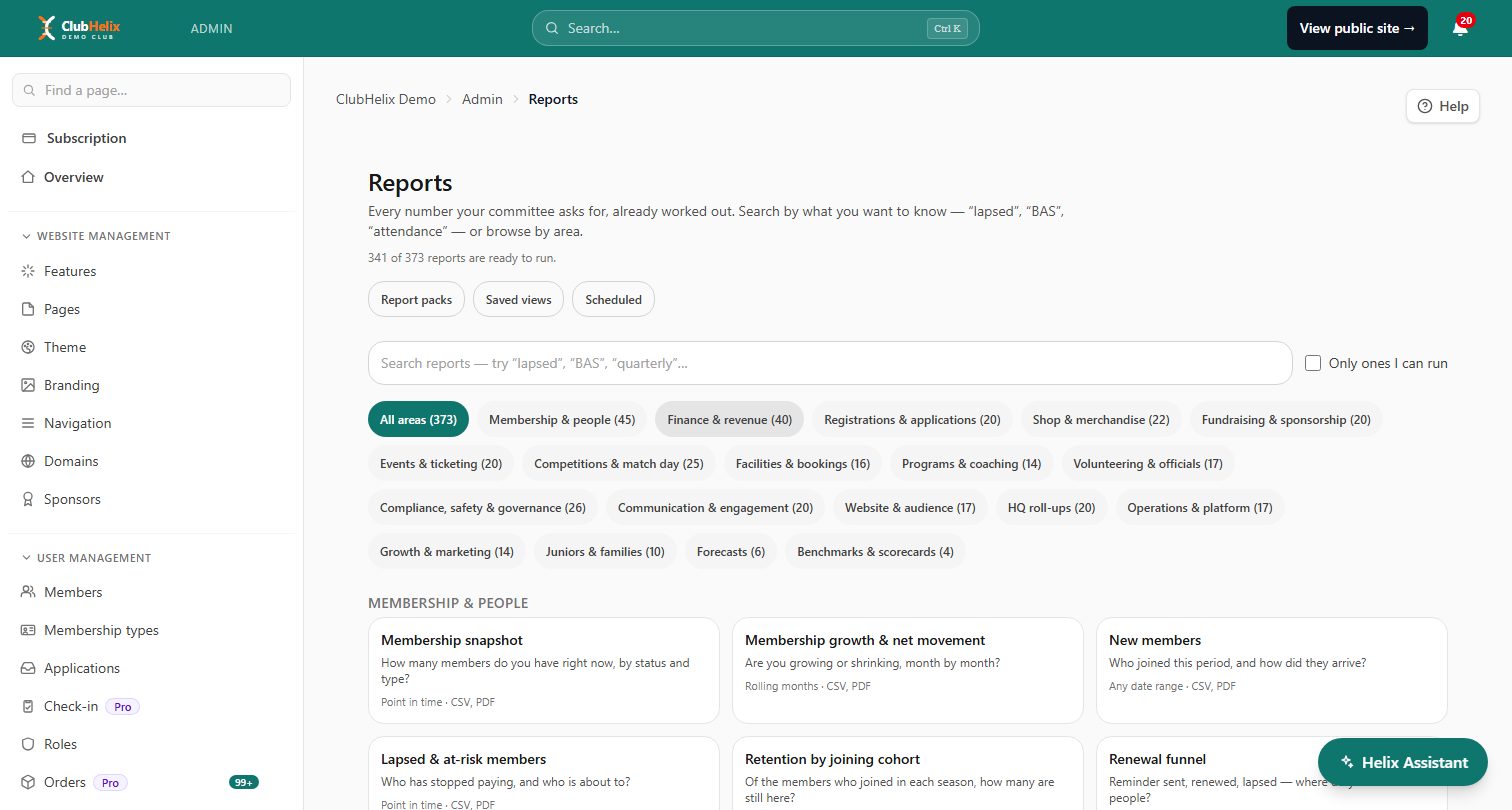
If your membership records live in one place with joining and paid-until dates against each member, retention by cohort is a report rather than a project. That is the whole difference between a club that knows its retention curve and one that intends to work it out someday.
Then put it in the monthly committee pack as a quarterly item, next to the renewal conversion rate. Retention is the outcome; renewal conversion is the lever you can actually pull this month.
Frequently asked questions
Should we count members who moved away or aged out?
Count them as lost, and note the reason separately if you know it. Excluding "unavoidable" departures produces a flattering number that cannot be compared with anyone else's — including your own from last year. Track the reasons as a second, softer measure.
What about family memberships?
Decide whether the unit is the membership or the person, and be consistent. Most clubs get more use from counting people, because a family that drops from three registered children to one has lost the club two participants even though the membership renewed.
How many seasons of data do we need?
Two gives you a comparison; three gives you a trend. Start now even if the first figure is embarrassing — the point is the direction, and you cannot get a direction without a first point.
Can we improve retention quickly?
Renewal conversion, yes — a clear reminder sequence with a working payment link routinely recovers members who simply forgot, and that shows up within weeks. Genuine retention improvement is slower, because it is about the first-season experience: contact in the first month, a clear path into a team or session, and somebody noticing when a new member stops turning up.
Where does attendance fit in?
It is the earliest warning you have. A member who has not attended in eight weeks is far more likely to lapse at renewal, and unlike the renewal date, attendance is something you can see and act on while the season is still running.


