
What this guide answers
- Should a club use a newsletter tool or its club platform to send email?
If your members are the audience, send from the platform that holds the member records — the list stays current on its own and segments by team, program or payment status without an export.
- Why do our club emails go to spam?
Usually because the club has not proven it is allowed to send from its domain.
- How do we stop emailing members who have left?
Make the member record the list. When resignations and expiries are recorded in one place and email sends from that same place, departed members drop out of the general send automatically — and no import can…
- Can we email members who did not tick a box?
There are usually grounds to send operational messages to current members — receipts, cancellations, meeting notices, safety information — but promotional sending is governed by electronic-marketing rules that differ…
- How often should a club send a newsletter?
For most clubs, monthly out of season and fortnightly in season, with team-level messages as often as they are genuinely needed.
New Zealand edition. This guide is written for volunteer-run clubs in New Zealand. Where rules differ — grants, tax, incorporation, safeguarding — follow the New Zealand-specific pointers below or check with your national body.
There is a file on the club secretary's laptop called something like members_final_v3.csv. It was exported in February, cleaned by hand over two evenings, and uploaded to the newsletter tool before the season launch. It is now July. Since then the club has taken ninety new registrations, lost about forty members, corrected a dozen typed-in addresses and changed three team managers. None of that reached the file.
So the newsletter goes out to a list that is five months stale. Forty people who left still get it. Ninety who joined never have. Two families get it twice because a parent registered under both addresses. The open rate looks fine, because the people who open it are the same committed hundred who would have turned up anyway.
That gap — between the list your tool holds and the members your club actually has — is the entire difference between a standalone newsletter tool and email built into a club platform. This guide is for the person who sends your club's email. It covers where lists rot and what to do about it, how deliverability actually works so your mail lands in inboxes rather than spam, what real segmenting looks like for a club, and where a dedicated marketing tool still beats a platform. We build a club platform with sending in it, so read our conclusion with that in mind — the sections on deliverability and list hygiene apply whichever you choose.
Two models, and the difference that decides most of it
| Standalone newsletter tool | Club platform email | |
|---|---|---|
| Where the list comes from | You import and maintain it | The member records themselves |
| When someone joins | You add them, eventually | They are in the list immediately |
| When someone resigns | You remember to remove them | They move out of the member segment |
| Segments | Tags and groups you maintain by hand | Teams, programs, payment status, already known |
| Design tools | Usually excellent | Good enough for a club newsletter |
| Automations | Deep — sequences, journeys, testing | Focused — renewals, receipts, reminders |
| Pricing model | Usually by contact count | Usually included in the subscription |
| Fails when | The export gets forgotten | You want sophisticated marketing automation |
Everything else in this comparison follows from row one. A newsletter tool is a publishing product that assumes someone else owns the truth about your audience. A club platform already owns that truth, because the same records run registration, teams and payments.
Where club lists go wrong
Club lists rot in specific, repeatable ways. Recognise yours:
| Failure | How it happens | Cost |
|---|---|---|
| Never added | A member joins mid-season; nobody re-exports | They miss everything and feel unwelcome |
| Typed wrong | A volunteer transcribes an address from a paper form | A permanent hard bounce nobody looks at |
| Left but still on | Resignations are not reflected in the export | You pay for them, and they get renewal mail |
| Duplicates | Parent registers two children with different addresses | Same email twice, looks amateurish |
| Wrong person | Child's address on file, parent needs the message | Under-12 does not read the fee reminder |
| Bounces ignored | Nobody checks the bounce report | Sender reputation slowly degrades |
| Unsubscribes lost | Someone opts out in the tool but stays in the member record | Next import re-adds them, which is a serious problem |
| Five lists | Registrar, treasurer, team managers and canteen all keep one | Nobody knows which is right |
That last row is the one to fix first. Most clubs do not have one list — they have five partial ones, and the newsletter goes to whichever the secretary can find. Everything else here is downstream of picking a single source of truth and making everyone else's list a view of it.
The unsubscribe row deserves a warning. If someone opts out in your newsletter tool and your next import re-adds them, you have emailed a person who told you to stop. Whichever system you use, the opt-out must flow back to the member record — which is automatic when the member record is the list, and manual when it is not.

A list-hygiene routine that takes twenty minutes a month
- Open the bounce report. Delete hard bounces; investigate anything that bounced twice.
- Reconcile new members since last send. If you are exporting by hand, do it on the same day each month.
- Remove resigned and expired members from the general send, but keep their record — you may want to win them back later.
- Check the unsubscribe list against your member records and mark them in both.
- Fix duplicates by household, not by address — a family with two addresses is fine; the same address twice is not.
- Ask, once a season, for corrections. A short "is this still your address?" note in a newsletter beats any cleaning tool.
If that routine sounds tedious, notice what it is: manual synchronisation between two systems that both think they know your members. A platform that registers members and sends the email removes the task rather than making it faster.
Deliverability — getting into the inbox at all
Neither product helps if your mail lands in spam. Deliverability is mostly about proving you are who you say you are, and both models can do it — but a surprising number of clubs never set it up.
Send from your own domain. Mail from a free personal address will increasingly be treated as suspicious when it claims to be from a club, and it looks amateurish beside a proper club address. Getting your own domain and addresses is a one-evening job — see how to get a club email address.
Then publish three records in your domain's DNS. Plain-language versions:
- SPF — a list of the services allowed to send mail claiming to be from your domain. Your sending tool tells you what to add.
- DKIM — a cryptographic signature proving the message really came from an authorised sender and was not altered.
- DMARC — your instruction to receiving mail servers about what to do when a message fails the first two, plus an address to send reports to.
Any decent tool of either kind will give you the exact values to publish and a button to verify them, so treat the setup as "follow your provider's instructions" rather than anything you should improvise. What differs is the default: if a sending service is not configured to authenticate your own domain, mail can arrive marked as sent on behalf of that service rather than by your club. Whichever product you use, check the verification screen says your domain is authenticated before you rely on it.
The other half is behaviour. Complaints and bounces damage your reputation for months; consistent, wanted mail rebuilds it slowly. Practical rules: never buy or scrape addresses, never mail a list you have not sent to in a year without re-permissioning it, keep the unsubscribe link obvious and honour it immediately, and avoid sending to hard-bounced addresses ever again. If your mail is already landing in junk folders, why club emails go to spam works through the diagnosis in order.
Consent, unsubscribes and the rules that apply to you
Club email sits inside electronic-marketing law wherever you are, and "we are a volunteer club" is not an exemption. The universal principles are simple: send only to people who asked to hear from you or have a genuine existing relationship with the club, identify the club clearly in every message, and make unsubscribing easy and immediate. Treat the notes below as general information rather than advice, and check the current position with your regulator or your own adviser.
In New Zealand the Unsolicited Electronic Messages Act governs commercial electronic messages and is administered by the Department of Internal Affairs. Its requirements centre on consent, clear identification of the sender and a working unsubscribe facility that is honoured promptly. Consent may be express or inferred in some circumstances, so keeping accurate membership records is part of your compliance, not separate from it. Confirm the current guidance with the regulator.
Segmenting — the thing clubs actually need and rarely have
Most club email is boring because it goes to everyone. The moment you can send to a subset, the writing gets specific and people start reading. The segments a club genuinely needs:
| Segment | Typical message |
|---|---|
| One team | Selection, training change, wash-out |
| One program or term intake | Session reminders, next-term enrolment |
| Juniors' parents | Consent forms, pick-up arrangements, uniform |
| Unpaid or lapsed | Renewal reminders that escalate politely |
| Volunteers on the roster | Duty reminders for this weekend |
| Committee | Meeting papers and minutes |
| Sponsors and life members | The dignified annual update |
| Everyone | Three or four sends a year, and no more |
Here is where the two models diverge sharply. A standalone tool can absolutely do this — if the tags exist and stay current. Every segment above is a field that must be exported, mapped and refreshed: team, program, payment status, roster, role. Miss a sync and you email a renewal reminder to someone who paid last week, which does more damage to goodwill than not sending at all.
A club platform knows those fields already because they run the rest of the club. The team list is the team list. "Unpaid" is a query, not a tag. That is the honest core of the argument: not that platform email is more powerful, but that its segments cannot go stale. For the words to put in those sends, membership renewal reminder templates and club email templates will save you an evening.
The messages that are not marketing
One nuance most committees miss: some club email is not a newsletter at all. Receipts, registration confirmations, ticket deliveries, cancellation notices, AGM notices required by your constitution and safety information are operational messages. They need to reach everyone concerned regardless of whether that person opted out of your monthly round-up, and they need to arrive within seconds, not on the day you schedule a campaign.
Standalone newsletter tools are built for campaigns and generally treat operational mail as a separate, more expensive product. Club platforms send it as a matter of course, because a registration that does not produce a receipt is a support ticket. Keep the two streams separate in your own head as well: an unsubscribe should stop the newsletter, never the receipt for money someone just paid you.
Cost, as your list grows
Standalone tools price by contact count, and contact counts only ever go up — every past member, every parent, every one-off ticket buyer sits on the list, and you pay for the ones who left. Platform email is usually included in a subscription priced by club size, which is a different curve.
As an illustrative New Zealand example, a club with 800 contacts might pay roughly NZ$50 to NZ$110 a month for a mid-tier standalone plan with automation, plus the volunteer hours to keep the list synced. Compare that with an all-in club platform tier for the same membership, and check whether transactional receipts are included or charged separately — that is usually where the quoted price stops matching the bill.
When your governing body emails your members too
Plenty of clubs discover that members are being emailed twice — once by the club, once by the body above it — with nobody sure who holds the opt-out.
Many New Zealand national bodies and regional sports organisations hold their own participant databases and communicate directly with registered members. Establish what they send and how their opt-outs interact with yours, then space your club newsletter away from their regular sends so members are not hit twice in a week.
When a standalone newsletter tool is still the right call
Being straight about it: keep the dedicated tool when
- Your audience is mostly not members. A club running a genuine public marketing list — a supporters' database, a community mailing list, a fundraising appeal audience — is doing marketing, and marketing tools are better at it.
- You need sophisticated automation — multi-step journeys, split testing, behaviour-based sends. Club platforms deliberately do not go that deep.
- A volunteer with real design skill runs your newsletter and wants the finer template control.
- You already have one, it works, and it is nobody's pain. Do not migrate a working system for tidiness alone.
In those cases the sensible pattern is a platform as the source of truth and a scheduled sync into the marketing tool, so the export ritual stops being a person's memory. Our integrations exist for exactly that arrangement.
Sending from the list that keeps itself current
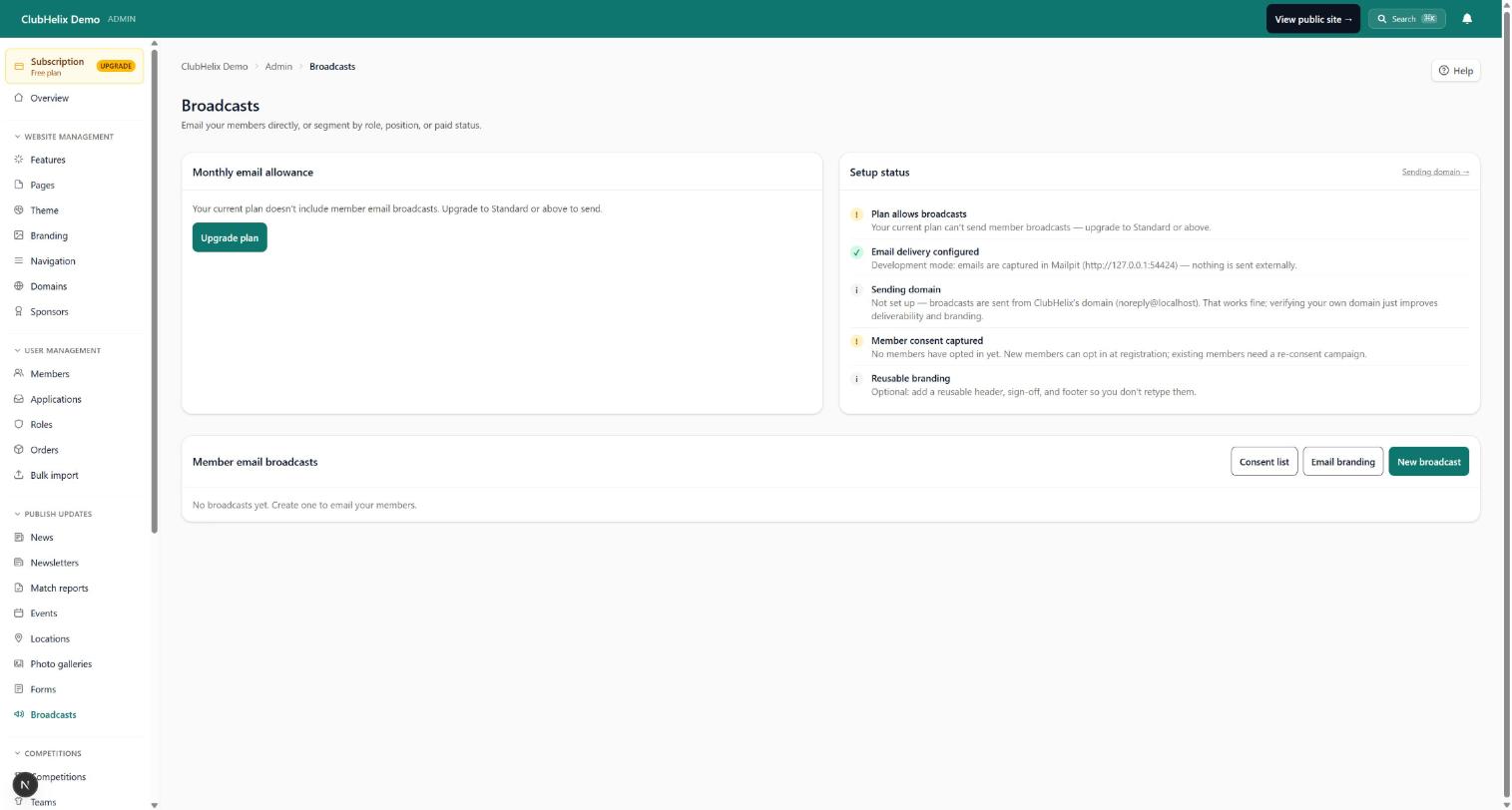
If your club's email problem is really a list problem, that is what ClubHelix fixes. Members join through self-registration, so the moment someone signs up they are in the right segment; our club newsletter software sends to a team, a program, everyone unpaid or the whole club without an export; and your own sender domain means mail arrives signed as your club rather than on behalf of a marketing service. Receipts and confirmations go out automatically alongside, so nobody has to remember them.
Member email starts on the Standard tier — the free tier runs a five-member site with transactional email only, so it is the wrong place to judge broadcasts. What you can do for nothing is set the club up, import the roster and see the segments build themselves; what a paid tier costs is on our published pricing page, and the trial asks for a card up front and charges nothing until it ends. Set your club up, then send one message to just one team — the difference in replies will make the case for you.
Frequently asked questions
Should a club use a newsletter tool or its club platform to send email?
If your members are the audience, send from the platform that holds the member records — the list stays current on its own and segments by team, program or payment status without an export. Keep a standalone marketing tool when your main audience is supporters and the wider community rather than members.
Why do our club emails go to spam?
Usually because the club has not proven it is allowed to send from its domain. Set up SPF, DKIM and DMARC records, send from a club address rather than a personal one, remove hard bounces and honour unsubscribes immediately. Reputation recovers slowly, so fix the technical side and then send consistently.
How do we stop emailing members who have left?
Make the member record the list. When resignations and expiries are recorded in one place and email sends from that same place, departed members drop out of the general send automatically — and no import can accidentally resurrect someone who unsubscribed.
Can we email members who did not tick a box?
There are usually grounds to send operational messages to current members — receipts, cancellations, meeting notices, safety information — but promotional sending is governed by electronic-marketing rules that differ by jurisdiction. Record how and when each person joined and what they agreed to, and check the current requirements with your regulator or adviser.
How often should a club send a newsletter?
For most clubs, monthly out of season and fortnightly in season, with team-level messages as often as they are genuinely needed. Frequency matters far less than relevance — a segmented note that concerns the reader beats a club-wide round-up every time.
Keep reading — how to write a club newsletter covers what goes in it, and why club emails go to spam covers what to do when nobody receives it.

