
What this guide answers
- Do we legally have to keep a conflict of interest register?
It depends on how your club is set up and what its rules say.
- What is the difference between the register and the minutes?
The minute records the decision — this item, this declaration, who withdrew, how the vote went.
- Should we record nil returns?
Yes, and date them. A nil return is evidence that the person was asked and answered.
- What do we do when a committee member leaves?
Close their open rows with an end date and leave everything in place.
- Who is responsible for keeping it up to date?
Usually the secretary, because they are already writing the minutes the register points at, and doing both in one sitting is what keeps the two records consistent.
Canada edition. This guide is written for volunteer-run clubs in Canada. Where rules differ — grants, tax, incorporation, safeguarding — follow the Canada-specific pointers below or check with your national body.
Your secretary stands down in March after six years. She was good at the job, and part of being good at it was that she carried the whole picture in her head: who was related to whom, which member's employer sponsored which team, which committee member had quietly stopped supplying the club two seasons ago. Nobody ever had to ask whether a purchase was clean, because she knew, and she would say so.
In June the club goes to market for ground maintenance. Three quotes come back, and one is from a business belonging to the deputy chair's brother-in-law. The deputy chair may well declare it. But if he doesn't — because he has half forgotten, or because he assumes everyone already knows — there is now nobody in the room who can catch it, and no document anyone can check. The club's entire conflicts process walked out the door in a laptop bag.
That is the gap a register fills, and it is a different gap from the one a policy fills. A policy tells the committee what counts as a conflict and what to do about one; if you haven't written that yet, start with our conflict of interest policy guide, which has a template you can adopt in a single meeting. This guide is about the register itself — the standing table that outlives the person keeping it. What goes in the columns, how it connects to your minutes, who is allowed to read it, how long you keep it, and the five ways a register stops being true without anybody noticing.
This is general information for volunteer committees, not legal advice. Many association and incorporation rules require a committee member to disclose a material personal interest — check what your own rules and your regulator require.
What a register is, and what it is not
A conflict-of-interest register is one table, kept continuously, recording every interest a committee member has declared, what the committee decided to do about it, and when it stopped being relevant.
It is not the policy. The policy is the rules; the register is the record. A club can have a beautifully written policy and no evidence that it was ever applied.
It is not the minutes, and this is the distinction clubs get wrong most often. The minute records a decision — this item was discussed, this person withdrew, this motion carried. The register records an interest, which is a longer-lived thing that touches many decisions across many meetings. One is a record of an evening; the other is a record of a relationship. You need both, and they point at each other.
It is not an accusation. A row in the register says nothing about anybody's honesty. Community clubs are built out of overlapping relationships — the coach on the committee, the treasurer whose partner runs the canteen, the member whose employer puts its name on the jerseys — and a register with plenty of rows is a sign of a committee that is paying attention, not a committee with a problem. A register with no rows at all is the one worth worrying about.
Why a standing register beats a form once a year
Plenty of clubs do the annual version and stop there: a sheet goes round at the first meeting after the AGM, everyone writes "nil" or names their employer, it goes in a folder, and the year's governance is considered done. That is better than nothing, and it is not enough, for four reasons.
- Interests change mid-season. A member takes a job with the club's insurance broker in August. Their nil return from March is now wrong, and nothing in the annual process will ever correct it.
- A form captures the interest and loses the handling. Knowing that the treasurer's partner runs the canteen is only half the story. The half that defends the club is: the committee decided that a second signatory approves every canteen payment, and here is the meeting where it decided that.
- The reader is always in the future. Nobody reads a register this month. It gets read in two years, by a new treasurer, an auditor, a governing body, or a member who has heard something in the car park. What that person needs is a continuous record, not seven annual snapshots they have to reconcile.
- An annual form teaches people that declaring is paperwork. A standing register, mentioned at every meeting, teaches them that declaring is normal. That cultural difference matters more than any of the mechanics below.
A standing register fixes all four, because it is never finished. You add to it whenever something is declared, you amend it when something changes, and you refresh the whole thing once a year.
The columns a workable register needs
Eight columns. Fix them before your first entry and never change them, so a row written three committees ago reads exactly like a row written last week.
| Column | What goes in it | Why it earns its place |
|---|---|---|
| Who | Name and the role they hold at the time | The role is what makes the interest matter, and roles change |
| The interest | One plain sentence — the relationship or the benefit, not a category | A category cannot be assessed by a future reader; a sentence can |
| Class of interest | Financial or non-financial; actual, potential or perceived; direct or through family | Sets the level of handling and stops everything being treated the same |
| When declared | The date it was declared | Proves the declaration came before the decision, which is the whole point |
| Which meeting | The meeting and item reference where it was declared | The pointer into the minutes, so the two records can be checked against each other |
| What was decided | How the committee resolved to manage it, in the committee's own words | This is the club's defence; without it the register records a problem and no answer |
| When it ended | The date the interest ceased, or blank while it is live | A live register needs to show what is still true today |
| Review date | When it is next to be looked at | Turns a standing declaration into something that gets revisited rather than assumed |
A few notes on the ones people get wrong.
The interest, in plain words. "Family connection to a supplier" is not usable two years from now. "Brother-in-law is a director of the business that quoted for ground maintenance" is. Write what you would want to read if you were the person defending the decision later, and remember that you are writing about real people — record the relationship and the connection to the club, not their private business.
Class of interest is three small judgements, not one. Is it financial or not? Is it actual, potential, or only perceived? Is it the member's own interest or one that reaches them through family or an employer? Perceived and non-financial interests are the ones committees wave away, and they are the ones that damage a club, because a perception cannot be argued away after the event — it can only be prevented by being on the record beforehand.
What was decided belongs to the committee, not to the person declaring. The person declares; the committee decides the handling. If that column reads "will use their judgement", the register has recorded nothing.
When it ended is why a register is a living document. An interest that has finished still belongs in the register — you close the row, you never delete it. More on that below.
Standing declarations and point-of-decision declarations
Two different things live in the same table, and it helps to name them.
A standing declaration is an interest that is simply true all the time: you are employed by a sponsor, your partner holds the canteen contract, you also sit on the association's committee. It is declared once, given a review date, and governs every item it touches until it ends. A standing declaration is the efficient kind — it means the committee does not re-litigate the same relationship every month.
A point-of-decision declaration attaches to one item: one of the three quotes in front of the committee tonight is from your cousin's company. It is declared in the room, handled in the room, and closed when the item is done.
Both go in the register, and the practical difference is what happens next.
- A standing declaration needs a review date and a prompt, or it silently rots. The person's circumstances change and nobody asks.
- A point-of-decision declaration needs a minute reference, because the handling happened live and the minute is the only place the detail exists.
- A standing declaration does not excuse anyone from declaring again in the moment. "It's in the register" is not a declaration; the chair still asks, and the person still says it out loud, because the people in the room tonight may not have read the register and the person taking the minutes needs to hear it.
The reverse mistake is just as common: declaring in the room and never carrying it into the register, so the interest exists in exactly one meeting's minutes and vanishes from the club's memory the moment that meeting is filed.
How the register and the minutes fit together
The rule is one line long: the minute records the decision, the register records the interest.
In practice that means each record carries a pointer to the other. The minute for the item names the interest, the committee's decision about how to handle it, who withdrew and when they returned, and the outcome of the vote. The register row for that interest carries the meeting and item reference so anyone reading the register can go and find the full story.
Getting there is a habit rather than a system:
- The chair asks the standing question at every meeting, early on the agenda, before any business is discussed — our committee meeting agenda template puts it near the top for exactly this reason.
- Anything declared is minuted as it happens, in the item it affects, not summarised at the end.
- The secretary transfers it to the register while writing up the minutes, in the same sitting. A register updated a fortnight later is a register updated from memory.
- The register is re-read before any significant purchase, appointment or contract, by whoever is preparing the paper.
Step four is the one that turns the register from a filing exercise into something that actually prevents a problem, and it is the step almost everybody skips.
Who may see the register, and what happens to personal details
A register holds personal information about volunteers, including facts about their families, employers and finances that they told you because the club asked. Treat it the way you treat your member roster, not the way you treat the fixture list.
A workable default for a small club:
- The committee can see the whole register, at any time, without asking.
- The club's auditor or reviewer can see the whole register.
- Members can see it in accordance with your club's rules — which for many clubs means on request, and for some means a summary in the annual report rather than the table itself.
- Nobody else, and it never goes on the public website.
Two details are worth deciding in advance. First, write only what the register needs: the relationship and its connection to the club, never a home address, a salary figure, a medical detail, or somebody else's contact details. Second, if a member asks to see it, decide as a committee once how you will respond rather than improvising — and check your own rules, because some rules give members a right of access you cannot decline.
A good habit for the annual report: a single honest line summarising related-party transactions, without naming private details, ends the conversation that would otherwise happen in the car park after the AGM.
How long to keep it
Keep the register at least as long as you keep the minutes it references. A register pruned to keep it tidy destroys the only evidence that a decision was handled properly, and it destroys it exactly in the years when someone is most likely to ask.
Three practical rules:
- Close rows, never delete them. Fill in the end date and leave the row where it is.
- Keep the register with the club's governance records, alongside the policy, the constitution and the insurance certificates — not in a personal drive, a personal email account, or a chat thread.
- Keep an archived copy at each handover, so a mistake in this year's file cannot erase earlier years.
Write the retention period into your club's record-keeping schedule once, with the minutes, and you never have to think about it again.
The annual refresh, at the first meeting after the AGM
Once a year, at the first meeting of the new committee, the whole register gets a deliberate pass. It takes fifteen minutes and it is the single habit that keeps the document honest.

- Everyone declares, including nil returns. A nil return is a row, not an absence of one, and it is dated. An empty line proves nothing about whether the person was asked.
- Every open row is confirmed, amended or closed. Ask each person whether their standing declarations are still accurate.
- Roles are updated — people move between portfolios, and the register records the role at the time as well as the role now.
- New committee members are inducted into the policy and the register on day one, as part of the induction pack, so their first declaration happens before their first decision.
- The refresh is minuted, so there is a dated record that the committee did it.
- The register is handed over properly when the secretary changes, on the handover checklist rather than as a favour.
A worked example
Here is what a small club's register looks like after one year. The names are placeholders; everything else is the shape to copy.
| Who | The interest | Class | Declared | Meeting | What was decided | Ended | Review |
|---|---|---|---|---|---|---|---|
| [name], Treasurer | Partner holds the canteen contract with the club | Financial, actual, via family | 4 Mar | 2026-03/2.1 | Standing: a second signatory approves every payment to the canteen | — | Mar |
| [name], Deputy chair | Brother-in-law is a director of a business quoting for ground maintenance | Financial, actual, via family | 6 May | 2026-05/7.3 | Withdrew for discussion and vote; three quotes considered; not counted to quorum | 6 May | — |
| [name], Selector | Child eligible for selection in the age group they select | Non-financial, perceived | 4 Mar | 2026-03/2.1 | Standing: does not sit on the panel deciding that age group | — | Mar |
| [name], Committee | Employed by a business that sponsors the senior team | Financial, perceived, indirect | 4 Mar | 2026-03/2.1 | Standing: withdraws from sponsorship renewal items | 12 Aug | — |
| [name], President | Nil | — | 4 Mar | 2026-03/2.1 | Annual nil return | — | Mar |
| [name], Facilities lead | Offered a trade discount by a supplier because of their club role | Financial, actual, direct | 1 Jul | 2026-07/5.2 | Declined; recorded so the offer is on file | 1 Jul | — |
Six rows, one page, and any one of them can be explained to a member in thirty seconds. Notice that two rows are closed, one records something that was declined rather than accepted, and the nil return is dated like everything else.
Five ways a register quietly stops being true
1. It lives on one person's laptop. The commonest failure by a distance, and the one in the opening of this guide. If the register exists in exactly one place and that place is somebody's personal device or personal email, the club does not have a register — it has a person. Keep it with the club's governance documents where the committee can reach it.
2. It is blank. A register with no entries almost never means a committee with no conflicts. It means nobody has asked. If your last four meetings produced no declarations at all, the problem is the standing question, not the register.
3. Nobody reads it before a decision. A register that is written to and never read is an archive, not a control. Before any significant purchase, appointment or contract, whoever prepares the paper opens the register first. Build it into how papers are prepared, not into somebody's good intentions.
4. A departed member's row is deleted. When someone leaves the committee, the temptation is to tidy their rows away. Don't. The decisions they took part in are still the club's decisions, and the register is the evidence those decisions were handled properly. Close the row with an end date; keep the history.
5. The "everyone knows" defence. Everyone knows the treasurer's partner runs the canteen — until the four people who knew have all stood down, and the only person left holding that knowledge is a member with a grievance. "Everyone knows" is not a record, and it has a shelf life of about two committees.
Where ClubHelix fits
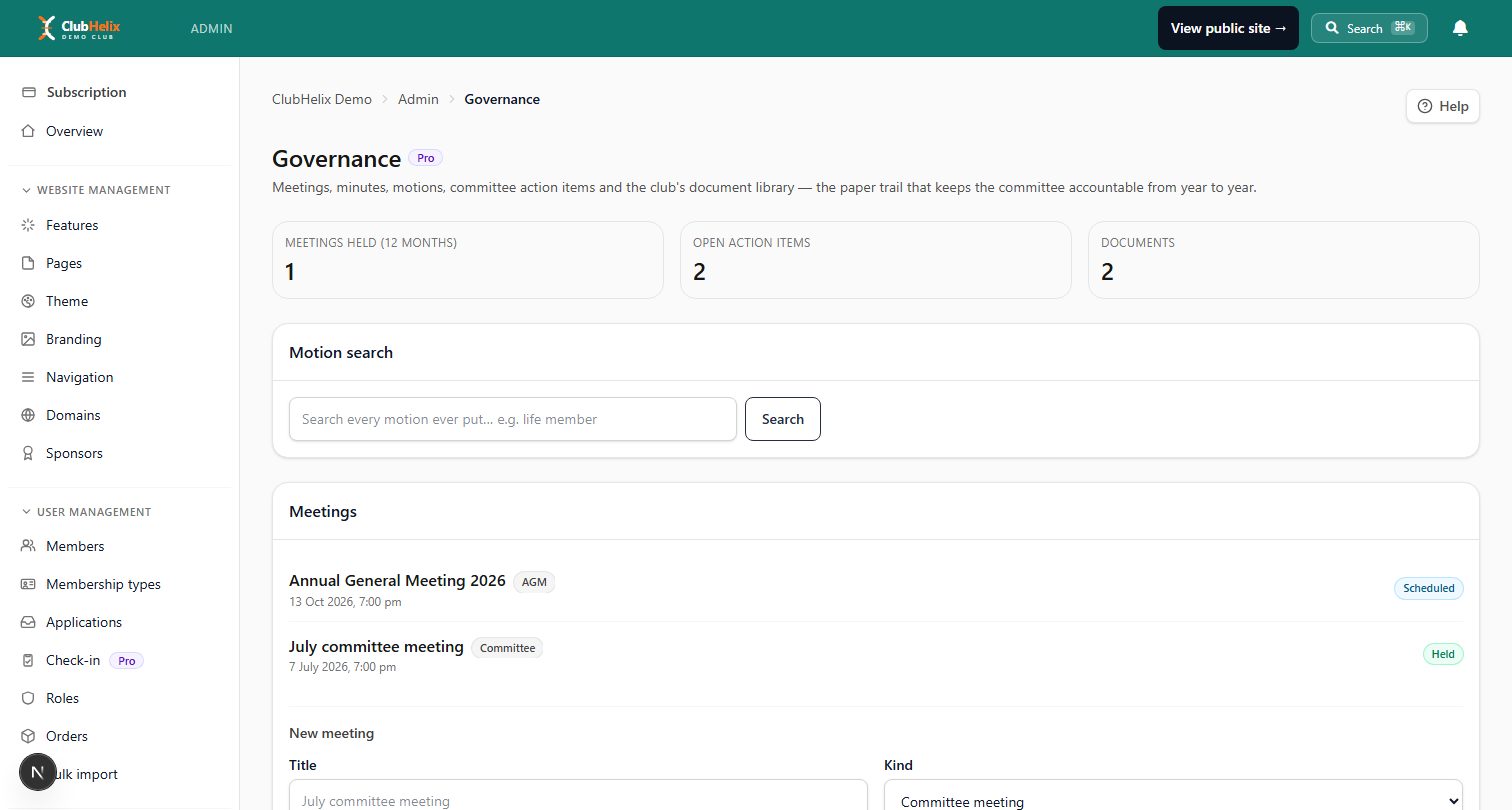
ClubHelix has a conflicts register built in, on the Pro plan. You will find it in your admin under Club operations → Conflicts of interest, and the help page walks through it. It holds a row per declared interest, keyed to the committee position rather than to the person — so when a position changes hands, the history stays with the club instead of leaving with the member. You can still run the register as a spreadsheet your committee owns, and a club that does is not doing it wrong; what the built-in one saves you is the part that goes wrong most, which is keeping the register, the minutes and the positions in step with each other.
Your club's governance and meetings tools cover the whole committee year: meeting minutes you can publish to your site, motions with recorded votes, action items and a committee task board, plus document storage for the club's policies and insurance certificates. Keep the register there with the policy it belongs to, minute every declaration in the meeting it happened in, and raise the annual refresh as a motion so the vote is recorded. Setting a review date as an action item is what stops a standing declaration going stale.
Separately, the audit log records every admin action, role change and configuration change in your club's account. It is not a conflicts register and it will not tell you who declared what — but when a question later becomes "who changed that, and when", it is the record that answers it. If you are weighing up what your committee needs, the pricing page lists what each plan includes.
Frequently asked questions
Do we legally have to keep a conflict of interest register?
It depends on how your club is set up and what its rules say. Many association and incorporation rules require a committee member to disclose a material personal interest — check what your own rules and your regulator require, and ask your governing body whether it expects one. Even where nothing compels it, a register is cheap insurance, and an auditor may ask to see it.
What is the difference between the register and the minutes?
The minute records the decision — this item, this declaration, who withdrew, how the vote went. The register records the interest, which lasts longer than one meeting and touches many decisions. Each should point at the other: the register row carries the meeting reference, and the minute names the interest and the handling.
Should we record nil returns?
Yes, and date them. A nil return is evidence that the person was asked and answered. A blank line is evidence of nothing, and a future reader cannot tell the difference between someone with nothing to declare and someone who was never asked.
What do we do when a committee member leaves?
Close their open rows with an end date and leave everything in place. Do not delete the history — the decisions they took part in are still the club's decisions, and the register is what shows those decisions were handled properly. Their departure is also a good moment to check that nothing they were managing has been left unowned.
Who is responsible for keeping it up to date?
Usually the secretary, because they are already writing the minutes the register points at, and doing both in one sitting is what keeps the two records consistent. The responsibility for declaring, though, belongs to every committee member individually, and the responsibility for deciding how an interest is managed belongs to the committee as a group, never to the person declaring. Write those three lines into your policy so nobody has to guess.
How often should we review the whole register?
Once a year as a set piece, at the first meeting after the AGM, plus a glance at every meeting when the chair asks the standing question. Standing declarations also carry their own review dates, which is what keeps a three-year-old row from being quietly assumed to still be true.

