
What this guide answers
- What should be in a club handover document?
Six sections cover it: money (accounts, signatories, financial position, recurring payments); logins and digital assets (domain, website, email, social accounts, storage); keys and physical assets; documents and…
- When should committee handover happen?
Start before the AGM — each office holder updates their section in the weeks prior — and complete the person-to-person handovers within a fortnight after it.
- Who is responsible for the handover?
The outgoing president owns the overall handover happening; each outgoing office holder owns their section; and the secretary typically custodians the document itself.
- What if the outgoing committee member is uncooperative or has already left?
Work the recovery paths in order: check what's registered to club role emails (those you control immediately); use platform account-recovery and ownership processes for anything registered to the club's domain or…
South Africa edition. This guide is written for volunteer-run clubs in South Africa. Where rules differ — grants, tax, incorporation, safeguarding — follow the South Africa-specific pointers below or check with your national body.
Every club knows the scene: three weeks after the AGM, the new secretary asks where the insurance certificate is. The old secretary thinks it's "in the email somewhere". The website login belonged to a volunteer who left in 2023. Nobody knows who has the key to the equipment shed, and the bank still lists a president from two committees ago.
None of this is anyone's fault — it's what happens by default when a volunteer organisation changes hands without a system. The fix costs one document and a couple of hours a year: a handover checklist that captures everything the club needs to keep running, maintained as things change rather than reconstructed in a panic.
This guide is that checklist, item by item, plus the timeline for using it and the structural habits that make next year's handover nearly automatic. Use it as your club handover document template: copy the sections into a document in club-owned storage, fill in the blanks, and review it at every AGM.
The principle: the club owns everything, people just hold it
Before the list, the mindset that makes it work. Every account, key, login and document in this checklist should be owned by the club and held by a role — never owned by a person. The test for every item: if this person vanished tomorrow, could the club recover it without them? Where the answer is no, that's not a handover problem to solve at the AGM; it's a structural problem to fix now. The recurring fixes are always the same three:
-
Role-based email addresses (
secretary@yourclub.org.za) on a club-owned domain, forwarding to the current holder — so every account registered to them survives every changeover. -
A club password manager (or at minimum a sealed, access-controlled credentials record) instead of passwords living in personal heads and text threads.
-
Two people with access to everything critical, always — accounts, admin roles, keys. One is a single point of failure.
Section 1: Money — accounts and banking
The highest-stakes section, and the one with real lead time because banks are slow:
-
Bank accounts — institution, branch code and account number, current signatories, and the change-of-signatory process (the forms, ID requirements and typical wait — knowing this saves the new treasurer a month).
-
Online banking access — who has it, at what permission level.
-
Payment platforms — the club's payment provider accounts for registrations and shop, merchant facilities, square/terminal hardware and where it lives.
-
Accounting software — login, subscription renewal date, who's the admin.
-
Current financial position — the outgoing treasurer's final reconciled report: balances, money owed to the club, upcoming large payments, active grants and their acquittal deadlines.
-
Recurring payments and subscriptions — everything that auto-debits the club account: insurance, affiliation, software, storage, domain renewal. Amount, date, which card/account it hits.
-
Petty cash and floats — amounts, locations, who counts them.
Handover action: signatory change forms lodged within two weeks of the AGM, and the treasurer's first month includes verifying every recurring payment still makes sense.
Section 2: Logins and digital assets
The section that's a disaster in most clubs, and trivially fixable:
-
Domain name — registrar, account login, renewal date, auto-renew status, which card pays it. The domain is the club's most losable critical asset: if it lapses, the website and every club email address die together.
-
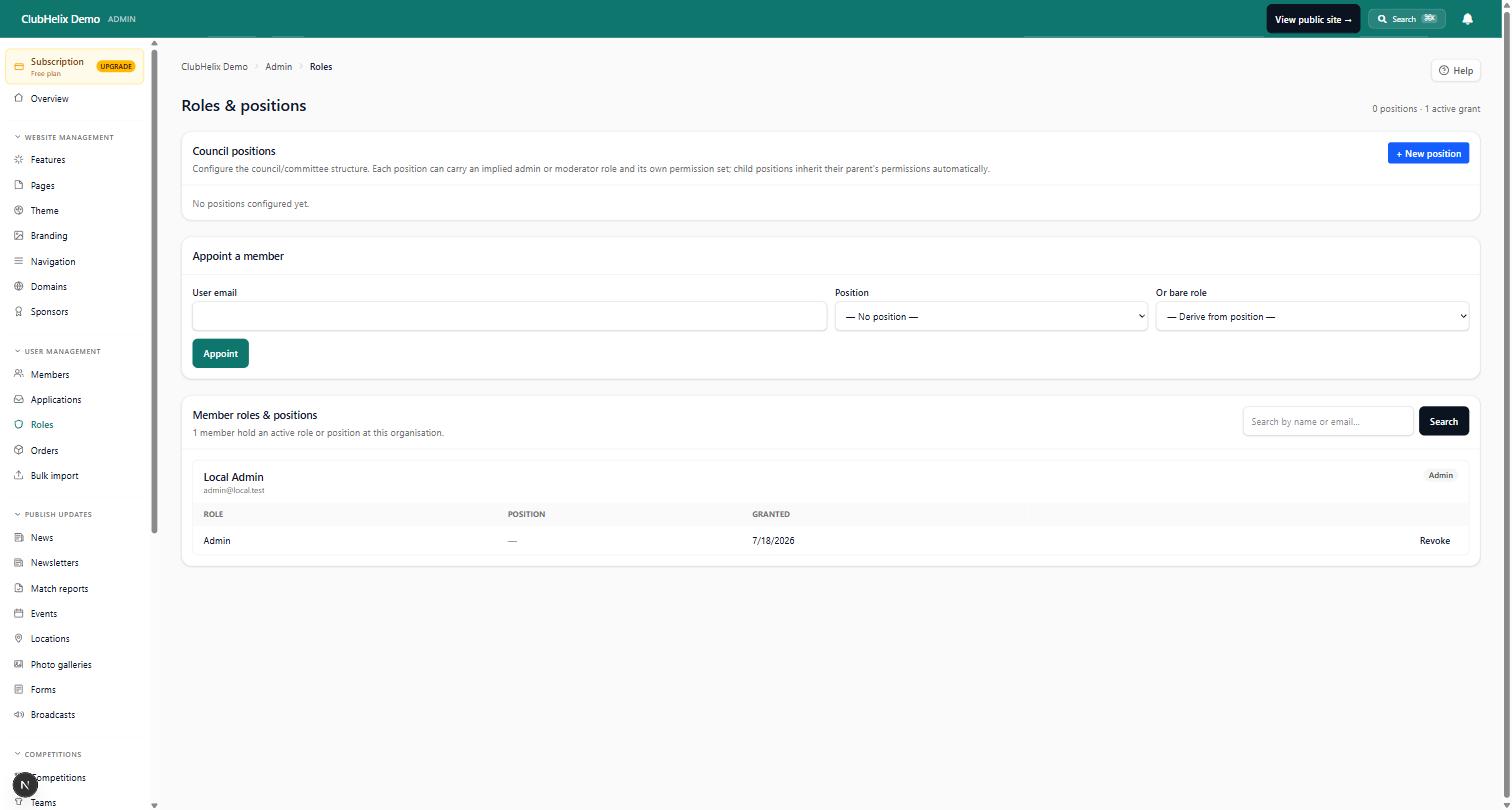
Website / club platform — admin accounts and their roles. On a proper platform this is clean: each committee member has their own login with role-based permissions, so handover means granting the new people access and removing the old — not passing a shared password around. An audit log of who changed what closes the loop when questions come up later.
-
Email accounts and forwarding rules — every role address and where it currently forwards.
-
Social media — every account, the email it's registered to, who holds admin roles, recovery settings. (Our social media setup guide covers structuring this properly.)
-
Google Business Profile and any directory listings — which account owns them.
-
Cloud storage — the club's document drive: owner account, sharing structure.
-
Other services — design tools, survey tools, photo storage, mailing lists, competition/association portals, grant and funding portals (funding bodies' systems have logins clubs forget annually).
Handover action: within a week of the AGM, new office holders are added to everything with their own access; departed members are removed. Removal matters as much as addition — clubs routinely discover ex-members still holding admin rights years later.
Section 3: Keys and physical assets
- Keys and access — clubroom, canteen, equipment shed, ground gates and lights, facility swipe cards. Who holds each copy, and the facility owner's process for replacements.
- Alarm and lock codes — recorded securely, changed when holders change.
- Equipment register — the big stuff: mowers, marquees, defibrillator (and its pad expiry date), training gear, canteen appliances, trophies and honour boards in storage. Location and condition, one line each.
- Uniform and merchandise stock — what's on hand, where, and the supplier relationship (contact, artwork files, last order pricing).
- Trailer/vehicle if the club has one — registration renewal, where it's kept, who's insured to tow it.
Section 4: Documents and records
-
Constitution / rules — current adopted version, and the certificate of incorporation.
-
Insurance — every policy (association-linked and club-held), certificates of currency, broker contact, renewal dates.
-
Affiliation — governing body registration, renewal timing, the club's login to association systems.
-
Ground and facility agreements — leases, seasonal ground allocations, permits with the council or municipality, and the history of correspondence (the new committee inherits the relationship, not just the paper).
-
Policies — codes of conduct, child safety, complaints, privacy, reimbursement. Plus the register of police clearance certificates for relevant roles.
-
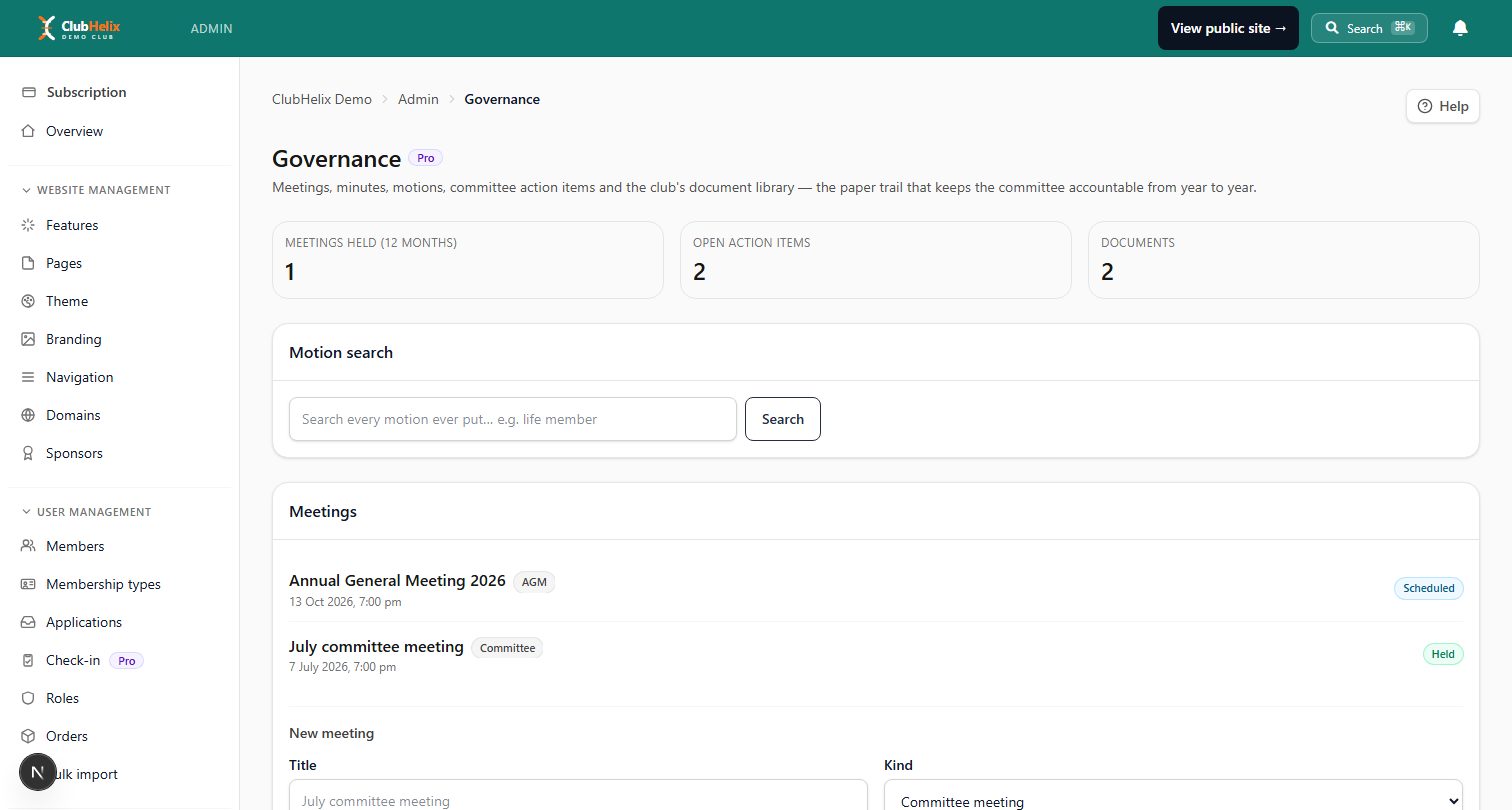
Minutes archive — committee and general meetings. If these live in a governance system rather than scattered inboxes, this checklist item handles itself: agendas, minutes and resolutions are already organised, searchable and owned by the club.
-
Member register — where it lives and who maintains it (commonly a legal requirement for incorporated clubs, and always good practice).
-
Grant files — applications, agreements, acquittal evidence, deadlines.
-
Brand assets — logo files (vector versions!), club colours, letterhead, photo library with consent records.
Section 5: Calendar and contacts
The soft knowledge that makes the first year survivable:
- The annual compliance calendar — annual return due date, affiliation renewal, insurance renewal, grant rounds, AGM notice requirements. (The secretary's annual calendar is the template.)
- The season calendar — registration dates, season start, photo day, presentation night, association meeting dates.
- Key contacts, annotated — association contact, council officer, ground curator, major sponsors, kit supplier, the electrician who knows the clubroom wiring. Names, roles, and the one-line context ("prefers phone, hates email; sorted our lights fault in 2024").
- Live issues memo — the honest page: ongoing disputes, promises made to sponsors, the drainage problem on field two, the grant that must be acquitted by March. Every committee inherits live threads; writing them down is the difference between continuity and re-learning by accident.
The handover timeline
Four weeks before the AGM: each office holder updates their section of the handover document. (If it's maintained year-round, this is a fifteen-minute review each.)
At or immediately after the AGM: outgoing and incoming holders of each role meet for a proper session — an hour per role, walking the document, not just emailing it. Keys change hands against the register. The famous coffee handover, where the real context transfers, happens here.
Within two weeks: bank signatory forms lodged; office-bearer details updated with the NPO Directorate (and with SARS if the club is PBO-approved); digital access granted and revoked; the federation, the municipality and the insurer given new contacts — though if you're using role-based emails, most external parties need no update at all.
Within a month: the new committee reviews the live-issues memo at its first meeting, and each new office holder confirms their section of the document is accurate — the errors found now are next year's handover already improving.
Making next year's handover automatic
The deeper win is making the document boring. Three habits get you there:
- Maintain, don't reconstruct. Any change — new signatory, new key holder, new subscription — updates the document the same week. The AGM review becomes a read-through, not a research project.
- Structure beats memory. Every move from personal tools to club systems (role emails, club storage, a platform where access is role-based and every change is logged) permanently deletes items from the "things that can be lost" list.
- Two-deep on everything. The vice-president shadow-holds the president's access; an assistant treasurer sees the bank; two people admin every social account. Clubs that run two-deep never have a catastrophic handover, because nothing ever depends on one goodbye.
Frequently asked questions
What should be in a club handover document?
Six sections cover it: money (accounts, signatories, financial position, recurring payments); logins and digital assets (domain, website, email, social accounts, storage); keys and physical assets; documents and records (constitution, insurance, minutes, member register, policies); the calendar of dated obligations; and annotated contacts plus a live-issues memo. The template in this guide lists every item — but the structure matters less than the habit: one document, club-owned storage, updated as things change and reviewed at every AGM.
When should committee handover happen?
Start before the AGM — each office holder updates their section in the weeks prior — and complete the person-to-person handovers within a fortnight after it. The dated items drive the urgency: bank signatory changes take weeks to process, most regulators require notification of new office holders within a set period, and role-based access should change the week the roles do. A handover that drifts past a month usually means the new committee is already reconstructing things the old one could have simply handed them.
Who is responsible for the handover?
The outgoing president owns the overall handover happening; each outgoing office holder owns their section; and the secretary typically custodians the document itself. Incoming people share the duty — the handover isn't complete when the document is sent, but when the new holder has walked through it with their predecessor, has verified their access works, and can find what they need without a phone call. Put "handover complete" on the first new-committee meeting agenda so it's checked, not assumed.
What if the outgoing committee member is uncooperative or has already left?
Work the recovery paths in order: check what's registered to club role emails (those you control immediately); use platform account-recovery and ownership processes for anything registered to the club's domain or documented as a club asset; contact the bank, registrar and regulator with your AGM minutes showing the change of office holders — minutes are your proof of authority. Then fix the structural cause: everything you had to recover the hard way gets re-registered to club-owned addresses with two current holders, so it can never leave with one person again.
Half this checklist disappears when the club's admin lives in one club-owned system: ClubHelix gives every committee member their own login with role-based permissions, keeps meetings and minutes with the club, and records every change in an audit log. See pricing or start free.


