
What this guide answers
- What is the difference between ClubZap and Clubforce?
They are close in shape. Both are Irish platforms with strong GAA roots covering membership, payments, communications and lotto or fundraising.
- How much does club lotto software cost?
Neither company publishes a full price list, so anyone quoting you a specific annual figure online is guessing.
- Do we need a licence to run a club draw?
Rules on lotteries, raffles and prize draws are regulated and differ significantly by jurisdiction — permits, prize caps, reporting and who may sell tickets all vary.
- Should our club buy an app or a website first?
A website, in almost every case. The app serves people who already belong; the website is where everyone else meets you — new families, sponsors, grant assessors and anyone searching your club's name.
- How do we compare two quote-based proposals fairly?
Send both vendors the same written list of questions, insist on written answers, and total three years rather than one.
In a lot of community clubs, the most important number of the week is not the score. It is the lotto take. Somebody counts the envelopes on a Monday night, somebody else reconciles the online lines, the draw goes out, and a jackpot that has rolled for eleven weeks pulls another few hundred people into caring about the club. That weekly rhythm — draw, promote, roll, repeat — funds pitches, gear and coaching in a way that no single grant ever does.
ClubZap and Clubforce are both built around exactly that rhythm. They are the two names that come up when a community club goes looking for software that treats a weekly draw as a first-class product rather than an afterthought, and they are close enough in shape that committees genuinely struggle to separate them. Both are Irish, both cut their teeth in the GAA world, and both wrap membership, payments, communications and fundraising into one subscription.
This comparison does three things that a feature list will not. It breaks the fundraising engine down into the mechanics that actually differ, it works through what a draw costs to run online and what the club keeps, and it separates the website question from the app question — because clubs habitually buy an app and then wonder why nobody new can find them.
The declaration of interest first. ClubHelix is ours, it sells into the same general club-software market as both companies below, and we have an obvious commercial reason to want you on this page — so judge what follows on its sourcing, not on our tone. Every factual claim below comes from what these companies publish, current as at July 2026, and both price by quotation, which shapes a lot of what follows. Rules about lotteries, raffles and prize draws are regulated and differ by jurisdiction — nothing here is legal advice, and your permit and reporting obligations come from your regulator and your governing body, not from a software comparison.
Two platforms, one rhythm
ClubZap, based in Cork, is a club app, website, payments and fundraising platform aimed at GAA and grassroots clubs across Ireland and the UK. Its published pricing is structured as two plans — a Payments plan, and an Engage plan that adds the website and hosting — both quote-based, billed annually, with transactions from 3.75% + 10c. Club lotto is treated as a genuine product category rather than a bolt-on, with weekly draws and jackpots built into the platform. In the fundraising space it is the more visible of the two.
Clubforce, based in Galway, covers membership, lotto, ticketing and communications with a similarly strong GAA base, and has relaunched its platform under a NextGen banner. Pricing is a quote-based subscription with no public price list, multi-year discounts available, lotto included in the subscription rather than sold separately, and a €200 setup fee that has at times been waived as a promotion. Its published content leans into compliance — the practical "how do we run this legally" material that clubs actually search for.
The honest summary is that these are close cousins. ClubZap carries more website and hosting in its own product line-up; Clubforce sits closer to a membership-and-fundraising engine. Neither is an outlier, and any committee choosing between them is really choosing between two proposals rather than two philosophies.
Side by side
| Area | ClubZap | Clubforce |
|---|---|---|
| Base | Cork, Ireland — sells into Ireland and the UK | Galway, Ireland |
| Core shape | Club app, website, payments, lotto and fundraising | Membership, lotto, ticketing, communications |
| Plans | Payments plan; Engage plan adds website and hosting | Single quote-based subscription |
| Published price list | Quote-based, billed annually | Quote-based, no public price list |
| Transaction cost | From 3.75% + 10c | Not published — ask for it in writing |
| Lotto | Core product category — weekly draws and jackpots | Included in the subscription |
| Setup fee | Not published | €200, at times waived as a promotion |
| Discounts | Annual billing | Multi-year discounts available |
| Website and hosting | Available in the Engage plan | Membership and fundraising led |
| Typical customer | GAA and grassroots clubs | GAA and community clubs |
Two notes on that table. First, because both price by quotation, no honest comparison article can hand you a total — the only published transaction figure between them is ClubZap's "from 3.75% + 10c", and even that is a floor rather than a rate. Second, treat any specific per-club price you find on a forum as unverified, including for the vendor you are leaning towards.
The fundraising engine, mechanic by mechanic
"Lotto module" on a feature list tells you nothing. A weekly draw has about a dozen moving parts, and the difference between a good and a bad implementation is whether volunteers still need a spreadsheet on Monday night. Take this list into both demos and make each vendor show you the screen rather than describe it.
- Recurring subscriber lines. Can a supporter set up one line on the same numbers, billed weekly, monthly or annually, and change it themselves without emailing anybody?
- One-off online entries. Can somebody who saw a jackpot post enter in under a minute on a phone, without creating an account?
- Paper lines and sellers. Envelope sales still exist. Can a seller or promoter be tracked, so you know which pub, shop or volunteer is producing, and can paper lines be entered without re-typing names every week?
- The draw itself. Are numbers drawn and results published from the platform, or does a volunteer transcribe them into a post?
- Jackpot and roll-over rules. Cap, increment, roll-over logic, and what happens when the cap is reached — all configurable, or a support ticket?
- Match-three and consolation tiers. Lucky dips, match-three prizes and split jackpots are what keep people playing through a long roll. Can you configure the tiers yourself?
- Winner handling. Automatic notification, a published winners list, and a record you can hand an auditor.
- Reporting. Weekly take, seller performance, subscriber churn, and the annual figures your permit conditions require you to be able to produce.
- Promotion. Can the draw result and the new jackpot go out as a push notification and a post without three people copying text between apps?
ClubZap treats lotto as its own product category with weekly draws and jackpots built in, and it is the more prominent of the two in the fundraising conversation generally. Clubforce includes lotto in the subscription rather than pricing it separately, which is a genuinely different commercial shape and worth pressing on — bundled means predictable, and predictable is easy to budget.

What the club actually keeps
Here is where lotto software differs from every other kind of club software, and it catches committees out. A draw is high volume and low value — hundreds of small transactions, every week, forever. That makes the flat per-transaction component nearly as expensive as the percentage, which is the opposite of how membership fees behave.
Work it through with ClubZap's published floor of 3.75% + 10c. These are illustrative figures to demonstrate the method, not a quote.
| Scenario | Weekly online take | Average line | Transactions | Weekly cost | Effective rate |
|---|---|---|---|---|---|
| Larger lines, fewer of them | €1,500 | €5 | 300 | €86.25 | 5.75% |
| Small lines, many of them | €1,500 | €2 | 750 | €131.25 | 8.75% |
Same money, same platform, same rate — and a €45 a week difference, purely from the shape of the transactions. Over a season that is real money that never reaches a pitch.
Which points at the single most valuable operational move in club fundraising, and it costs nothing to implement:
Push supporters onto annual or monthly subscriber lines instead of weekly ones. One €104 annual line costs about €4.00 to process at that rate. The same €104 collected as fifty-two weekly €2 payments costs about €9.10. That is roughly €5 saved per line per year, and a club with 300 subscriber lines has just found about €1,500 a year without asking anyone for another cent. It also collapses your reconciliation work and removes the failed-payment churn that eats a volunteer's Monday.
Twelve questions that make two quotes comparable
Both vendors quote. Quotes are only comparable if you force them into the same shape, so send the same list to both and ask for written answers.
- What is the total annual subscription, including every module we have discussed?
- Is lotto included, or priced separately?
- What is the exact transaction fee — percentage and fixed component — on lotto, membership and tickets?
- Who pays that fee, the club or the supporter, and can we choose?
- Is there a setup or onboarding fee, and is any waiver in writing?
- What is the contract term, and what is the price in year two and year three?
- What are the multi-year discount terms, and what happens if we exit early?
- When do funds settle into the club account, and are there payout fees?
- What is included in support, and what is chargeable?
- What reporting can we export ourselves for our permit and audit obligations?
- If we leave, what data do we get back, in what format, and how quickly?
- Which parts of the quote are promotional and will not apply at renewal?
Question twelve is the one that saves clubs the most money and gets asked the least.
Website depth versus app depth
Clubs conflate these, and the two audiences could not be more different. An app serves people who already belong — push notifications about a cancelled session, team messages, the draw result, the fixture change at nine on a Friday night. A website serves people who do not belong yet — the family that moved into the estate last month, the sponsor deciding whether you look organised, the journalist checking a result, the grant assessor reading your programs at eleven at night.
The test is one question: which one does a stranger meet first? It is always the website, and it is almost always the thing a club has under-invested in, because the app is where the members are and the members are who committees hear from.
ClubZap carries website and hosting within its Engage plan, so the public layer is part of the product rather than a separate purchase. Clubforce leads with membership, lotto, ticketing and communications. If a proper public site matters to you — and for sponsorship and recruitment it should — establish exactly what is included before the quote is signed, rather than discovering the answer in week three.
The other thing worth saying about apps generally: a native app-store app is a real advantage for engagement and a real cost in adoption, because every member must find it, install it, and keep it updated. Ask what proportion of a comparable club's members actually installed it. That number is more useful than any feature list, and a vendor who has it to hand is a vendor worth trusting.
Where each is strong, and who should pick which
ClubZap is strong where fundraising and the public face need to be one purchase — lotto as a properly built product category, weekly draws and jackpots, plus website and hosting in the Engage plan, and the only published transaction figure between the two.
Clubforce is strong where predictability and compliance matter — lotto bundled into the subscription rather than metered separately, multi-year discount terms for clubs that plan in three-year cycles, and published guidance on the legal side of running a draw that reflects a company paying attention to what actually stops clubs.
- Fundraising is the club's financial backbone, and the website is embarrassing. Push hard on the plan that includes the public site, and get the transaction rate in writing.
- A stable club with a long-running draw and a committee that wants one predictable annual number. The bundled subscription shape, on a multi-year term, with question twelve answered.
- A club with sponsors, a shop, events and a growth plan on top of the draw. Neither is a complete commerce platform, so scope the rest before you commit.
Fundraising, the shop and the club site in one place
If your club's money arrives from more than one direction — a weekly draw, a season ticket, a jersey order, a golf classic, a sponsor's package — the awkward part is never any single stream. It is that they live in four places and the treasurer stitches them together by hand every month.
ClubHelix brings them under one roof: raffles and prize draws with online ticket sales, donations for appeals and jersey sponsorship, a club shop with proper tax handling for gear and merchandise, and an installable app with push notifications so a draw result or a wet-weather call reaches members without an app-store download.
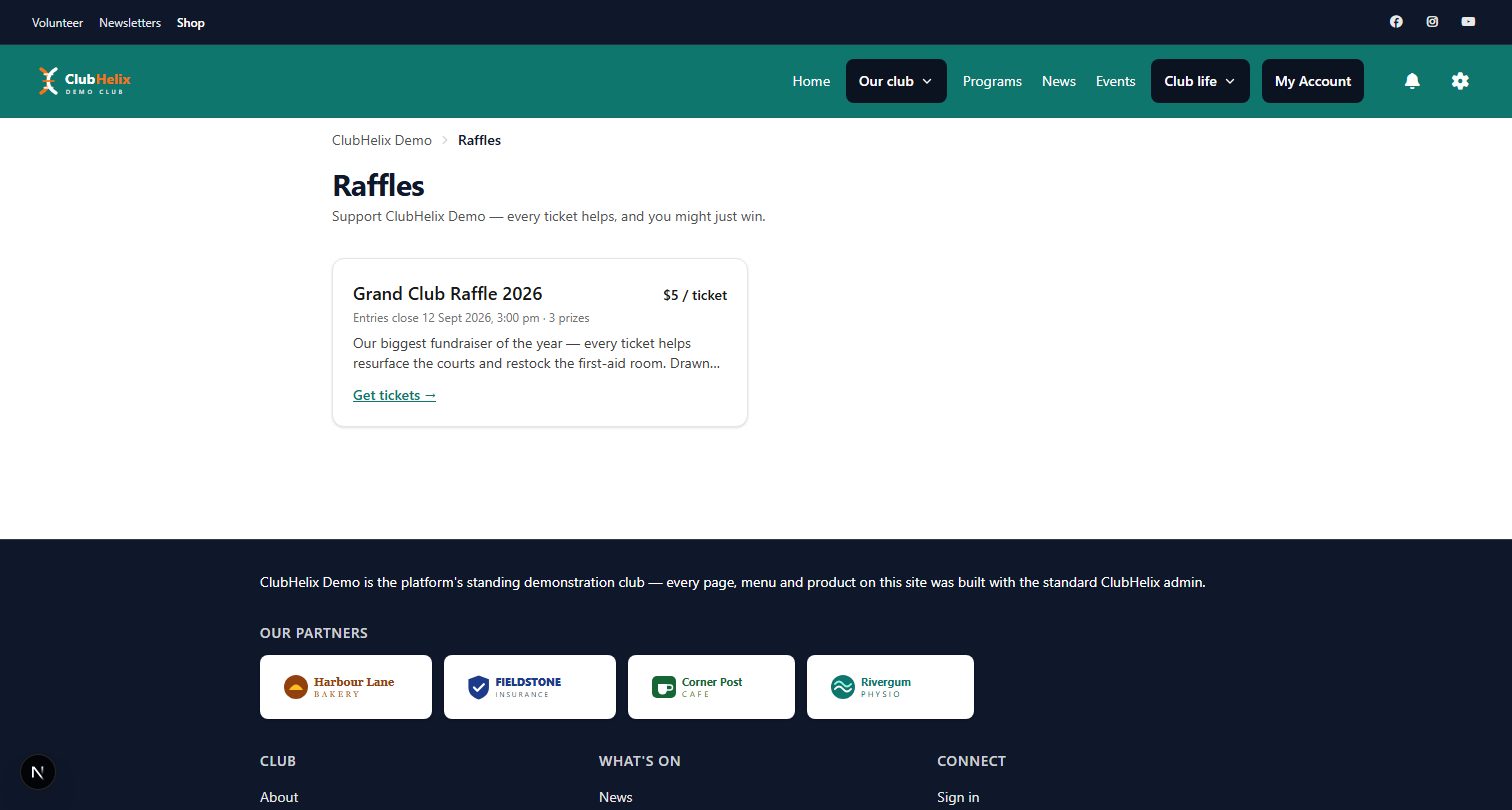
If chasing comparable numbers out of two quotes has worn your committee down, our answer to that is the pricing page itself — bands published in the open, the same for every club, no proposal required. It is free to start building, and the platform is Australian-built and hosted. A treasurer and a secretary with one spare evening can open a club account, load a fee table and run a test draw before anyone signs anything.
The limits, stated plainly. Our raffles module is not a weekly lotto engine — no jackpot roll-over logic, no promoter and seller ledgers, no match-three tiers — so a club whose whole financial model rests on a Monday-night draw is better served by a specialist, and we would say so on a sales call too. We do not carry the GAA-specific structures those two platforms understand culturally. We publish no native app-store app, so members add ours from the browser instead. Lottery and prize-draw permits stay yours to hold whatever software you use — confirm the conditions with your regulator before you sell a single line, and how to run a club raffle covers the general shape of getting that right.
Frequently asked questions
What is the difference between ClubZap and Clubforce?
They are close in shape. Both are Irish platforms with strong GAA roots covering membership, payments, communications and lotto or fundraising. ClubZap carries website and hosting in its Engage plan and publishes a transaction floor of 3.75% + 10c; Clubforce sells a quote-based subscription with lotto included, multi-year discounts and a €200 setup fee that has at times been waived. Both quote per club, so the real comparison happens in your proposals.
How much does club lotto software cost?
Neither company publishes a full price list, so anyone quoting you a specific annual figure online is guessing. What is published as at July 2026 is ClubZap's transaction floor of 3.75% + 10c and Clubforce's €200 setup fee alongside a quote-based subscription. Model your own weekly volume against whatever rate you are quoted, because the per-transaction component matters more than clubs expect on small ticket values.
Do we need a licence to run a club draw?
Rules on lotteries, raffles and prize draws are regulated and differ significantly by jurisdiction — permits, prize caps, reporting and who may sell tickets all vary. Check the current requirements with your regulator and your governing body before you start, and keep records you can produce on request. Software helps you comply, but the obligation sits with the club.
Should our club buy an app or a website first?
A website, in almost every case. The app serves people who already belong; the website is where everyone else meets you — new families, sponsors, grant assessors and anyone searching your club's name. The strongest position is both, with the website carrying discovery and joining, and the app or push notifications carrying the weekly rhythm.
How do we compare two quote-based proposals fairly?
Send both vendors the same written list of questions, insist on written answers, and total three years rather than one. Include the subscription, every transaction fee, any setup charge, and the renewal price after promotional terms expire. Then divide the three-year total by the money you expect to process, so you are comparing an effective rate rather than a monthly headline.
Keep reading — club fundraising ideas covers the streams beyond the weekly draw, and the 100 club fundraiser explained breaks down a simpler subscriber draw you can run alongside it.


