
What this guide answers
- Is print-on-demand worth it for a club?
It is worth it when you cannot confidently forecast demand, when nobody has time to hold and distribute stock, or when you want a long tail of items you would never order in bulk.
- How much margin should a club make on merchandise?
Enough to be worth the work, which usually means a retail price well above the landed cost once setup and freight are spread across the run.
- How many of each size should we order?
Use your own data first. Ask every member for a size at registration, even if they are not buying, and build the order from that distribution.
- Should merchandise be included in the membership fee?
Include an item in the fee only when it is genuinely compulsory, such as a playing shirt or socks, and say clearly what the fee covers.
- Can we run a club shop without holding any stock?
Yes, in two ways. A print-on-demand storefront lets a supplier make and post each item as it is ordered.
New Zealand edition. This guide is written for volunteer-run clubs in New Zealand. Where rules differ — grants, tax, incorporation, safeguarding — follow the New Zealand-specific pointers below or check with your national body.
Somewhere behind the canteen there is a plastic tub. Inside it are eleven hoodies, all extra small, ordered three seasons ago by a committee that got a very good price on a hundred. Nobody wants to throw them out because they cost real money, and nobody will ever buy them, so every year they get moved slightly further back on the shelf. That tub is the reason clubs go looking for a third-party merchandise store — and it is a completely rational reason.
A print-on-demand storefront makes the tub impossible. A member orders a hoodie, a supplier prints it, posts it and pays the club a share. No stock, no sizing decisions, no cash tied up, no volunteer standing in a car park handing out parcels. The catch arrives when the treasurer looks at the statement and works out what the club actually earned per hoodie, because print-on-demand does not sell you convenience — it sells you insurance, and the premium is most of your margin.
This guide is for the person running the merchandise side of a club and trying to decide which way to go. It models 100 hoodies both ways with numbers you can change, finds the exact sell-through rate where the answer flips, works through size curves and pre-orders so the tub never happens again, and makes the case that the highest-margin merchandise decision most clubs can make has nothing to do with a storefront at all — it happens on the registration form.
Three ways a club sells merchandise
Almost every club is doing one of these, often without having chosen deliberately.
| Third-party storefront | Bulk buy and own shop | Pre-order run | |
|---|---|---|---|
| Who carries the stock risk | The supplier | Your club | Nobody |
| Cash needed up front | None | The whole order | None, members pay first |
| Margin per item | Thin | Wide | Wide |
| Range you can offer | Large, printed to order | Whatever you bought | Whatever you list |
| Time from order to member | Postal delivery | Immediate, if you have the size | Weeks, and members know it |
| Volunteer hours | Very few | Many | Moderate, in one burst |
| Best for | Long-tail items and away supporters | High-turnover core items | Anything with a deadline |
| What goes wrong | Members complain about price and delivery | The tub | Members forget they ordered |
Most well-run clubs end up with two of the three: a pre-order run for the items everyone needs, and a small permanent shop of the two or three things that always sell. Very few need all three.
The 100-hoodie model
Here is the arithmetic, with every assumption on the table. The figures are illustrative and in your own currency — replace them with real quotes and rerun it before you decide anything. What matters is the relationship between the columns, not the totals.
Through a third-party print-on-demand storefront
| Line | Per hoodie |
|---|---|
| Retail price set by the club | 65.00 |
| Supplier's base cost, garment and decoration | 52.00 |
| Club's margin | 13.00 |
| Cash the club puts up | 0 |
| Stock the club holds | 0 |
| Margin on 100 sold | 1,300.00 |
Buying a run of 100 and selling them yourself
| Line | Amount |
|---|---|
| Blank hoodie, per unit | 24.00 |
| Decoration, per unit | 9.00 |
| One-off setup and artwork digitising | 120.00 |
| Freight in on the whole order | 90.00 |
| Landed cost per unit across 100 | 35.10 |
| Retail price | 60.00 |
| Margin per unit | 24.90 |
| Cash the club puts up before selling anything | 3,510.00 |
| Margin if all 100 sell | 2,490.00 |
So a bulk run earns nearly twice as much per hoodie and sells at a lower price. On those numbers it is not close. Which is exactly the trap, because that row assumes every single one sells.
The number that decides it
Watch what happens when they do not.
| Hoodies actually sold | Print-on-demand profit | Bulk run of 100, profit | Units left in the tub |
|---|---|---|---|
| 100 | 1,300.00 | 2,490.00 | 0 |
| 85 | 1,105.00 | 1,590.00 | 15 |
| 75 | 975.00 | 990.00 | 25 |
| 70 | 910.00 | 690.00 | 30 |
| 55 | 715.00 | -210.00 | 45 |
On this model the two approaches break even at about 75 per cent sell-through. Above that, buying your own stock wins comfortably. Below it, you have done more work, tied up more cash and made less money — and you still own the leftovers. Below about 59 units the run loses money outright.
That single number reframes the whole decision. The question is not "which is more profitable", it is "can we confidently sell three quarters of what we order?" For a training shirt every junior needs, the answer is obviously yes. For a hoodie in seven sizes and two colours, it is a guess dressed up as a plan. Print-on-demand is not a worse deal; it is a fee you pay for not having to make that guess.

For local calibration, a decorated club hoodie in New Zealand commonly retails from the high fifties upwards depending on garment quality and decoration method, with juniors a little under. Ask your decorator for quotes at 25, 50 and 100 units — the per-unit drop between tiers is often steep, and with a smaller domestic supplier base it is worth asking what their minimum order actually is before you design anything.
Where the margin actually goes
If a supplier's price seems high, it usually is not padding. Merchandise pricing is stacked, and knowing the layers lets you negotiate the right one.
- The blank garment. Weight, fabric and brand. Moving from a heavyweight brushed fleece to a mid-weight blend can save meaningfully per unit and most members will not notice.
- Decoration method. Embroidery costs by stitch count, so a detailed crest is dearer than a simple one, and it is a one-off digitising charge plus a per-unit rate. Screen printing costs by colour and has a per-colour setup, so a two-colour version of your crest is dramatically cheaper at volume. Heat transfer suits very small runs and wears out sooner.
- Setup charges. Digitising, screens and artwork. These are one-off per design and are the reason 25 units cost far more each than 100.
- Freight in and out. Bulk freight on a carton is cheap per unit. Posting individual parcels is not, and it is the line that quietly eats a print-on-demand margin.
- Payment processing. A percentage of every sale, whichever route you take.
- Wastage and returns. Wrong size, wrong colour, changed mind.
Two practical levers do more than haggling. Reduce colours in the decoration — a version of your crest designed for two-colour print is a genuine cost saving on every future order. And combine orders: one run covering the training shirt, the supporter hoodie and the coaching polo pays setup once instead of three times.
Sizing, and how the tub happens
Nobody orders eleven extra smalls on purpose. It happens because a committee splits the order evenly across sizes, or because the volunteer doing the ordering guesses from the sizes they know.
Use a size curve instead. The illustrative adult curve below is a starting point, not a rule — the real one is sitting in your own registration data.
| Size | Share of an adult order | Units in a run of 100 |
|---|---|---|
| XS | 4% | 4 |
| S | 10% | 10 |
| M | 22% | 22 |
| L | 26% | 26 |
| XL | 22% | 22 |
| 2XL | 11% | 11 |
| 3XL | 5% | 5 |
Three rules turn that from a guess into a plan.
Ask for the size at registration, from everyone, whether or not they are buying. One optional field on the form gives you an actual distribution for your club, by age group, before you place any order. It is the single highest-value question on a registration form after the emergency contact.
Weight the curve toward the tail you can actually sell. Leftover mediums and larges sell eventually — to a new member, at presentation night, to a parent. Leftover extra smalls and triple extra larges do not. When in doubt, under-order both ends.
Order a sample set first, in three sizes, and photograph it on real people. Half of all size complaints are about fit differing from the label. A photograph of a member wearing the medium, with their height noted, prevents more exchanges than any size chart.
The pre-order run — the option most clubs should default to
Collect the orders and the money first, then order exactly that many plus a small buffer. On the model above, a 60-unit pre-order with setup and freight spread across fewer units lands at about 36.50 each, sells at 60, and returns around 1,410 with no cash outlay and no leftovers. It earns less than a perfect bulk run and far more than a bad one, and it is the only option where the downside is capped.
Make it work by running it like an event, not a shop:
- Publish the range, the prices and a hard closing date — two weeks, no extensions.
- Take payment at the time of order, not on collection.
- Send one reminder three days before close, and one on the final morning.
- Order within 48 hours of close so the supplier lead time starts immediately.
- Add a 10 per cent buffer in the middle sizes only, to cover late requests and one exchange.
- Announce two named collection dates at the clubhouse, then a single postage option for anyone who cannot make either.
That last step is where a pre-order quietly leaks money, because posting is almost always dearer than the club remembers and members expect it to be cheap.
Postage in New Zealand punishes bulky items, and rural delivery addresses carry a surcharge that will quietly eat the margin on a single hoodie. Charge postage as a separate line at cost, price it per parcel rather than per item so a family ordering three pays once, and make clubhouse collection the obvious default by naming the dates before orders open.
Bundling merchandise into registration
Here is the part committees underrate. A standalone shop asks a member to make a second decision, on a second visit, with a second payment. A registration add-on asks them to tick a box while their card is already out.
The mechanics are simple and they change the numbers more than any pricing decision:
- Put the item on the registration form as an optional line — training shirt, socks, club cap, supporter scarf.
- Capture the size on the same form, conditionally, so it only appears if they tick the item.
- Offer a bundle price that is genuinely better than buying separately, and say what the saving is.
- Make one item compulsory if it genuinely is — many clubs require playing socks or a training shirt, and rolling that into the registration fee removes an entire chase-up cycle.
- Close the merchandise window with registration, so you place one supplier order per season with real numbers rather than a guess.
A worked illustration: a club with 180 registering juniors adds a 22.00 training shirt as an optional line at a landed cost of 12.00. If 120 tick it, that is 1,200 of margin from a form field, with the sizes already collected, one order placed, and no shop to run. The same 120 shirts sold through a storefront over a season would take repeated reminders and a volunteer's evenings, and would very likely convert lower — because the member has to come back and decide again.
ClubHelix handles this directly: online registration can carry paid add-ons and conditional size questions, the club shop holds your permanent items with tax handled properly, and discount codes run the bundle pricing and the family discount without a spreadsheet. Our guide to selling club merchandise online covers the storefront side in more depth.
On the money side, whether GST applies to your merchandise sales depends on your club's registration status and turnover, and it affects both your pricing and what you can claim on the stock you buy. Clubs in New Zealand that are registered generally price inclusive and account for it on each sale. This is general information — confirm your position with your accountant before setting prices for a season.
Who actually does the work
Merchandise fails on logistics far more often than on pricing. Before you commit to holding stock, allocate these jobs to named people:
- Storage. A dry, secure place that is not a volunteer's garage — because that garage becomes inaccessible the moment they step down or go on holiday.
- Stocktake. Someone counts what is there, twice a season, against what was sold. Without this the shop quietly loses items and nobody can say when.
- Distribution. Two announced collection windows beat "see me at training", which turns into eleven separate handovers.
- Exchanges. A written rule, published with the shop — sealed items only, within a set window, sizes only.
- Reconciliation. Sales matched against banking, monthly, by someone other than the person handing out the stock. This is basic financial control, not distrust.
Print-on-demand removes every one of those jobs, which is worth real money in a club short of volunteers. Count that honestly when you compare the two margins — if holding stock costs you the volunteer who would otherwise run the canteen, you have not made 24.90 a hoodie.
Timing matters. Order so that stock lands before the season starts, not six weeks into it. Supplier lead times in New Zealand stretch over the December and January shutdown, and a lot of blank stock is imported, so a delayed shipment can push delivery past your first round. Ask for the lead time in writing and add two weeks to whatever you are told.
Choosing, by the shape of your club
| Your situation | What to do |
|---|---|
| Under 60 members, no volunteer for logistics | Third-party storefront only, plus one pre-order run a year for the core item |
| 60 to 250 members, one reliable merch volunteer | Pre-order runs for everything, small permanent stock of the two best sellers |
| 250+ members with a compulsory playing item | Bulk buy the compulsory item, bundle it into registration, pre-order everything else |
| Strong supporter following beyond members | Keep a small own-stock range for match days, use a storefront for the long tail |
| A one-off milestone item, such as a centenary shirt | Pre-order, always — demand is impossible to forecast and the design never reorders |
If merchandise is genuinely meant to raise money rather than build identity, be honest about which it is. Merchandise is usually a modest earner and an excellent identity builder, and clubs that treat it as a fundraiser tend to over-order. There are higher-return options in club fundraising ideas, and a written club uniform policy will stop half the arguments before they start.
Running the shop where the members already are
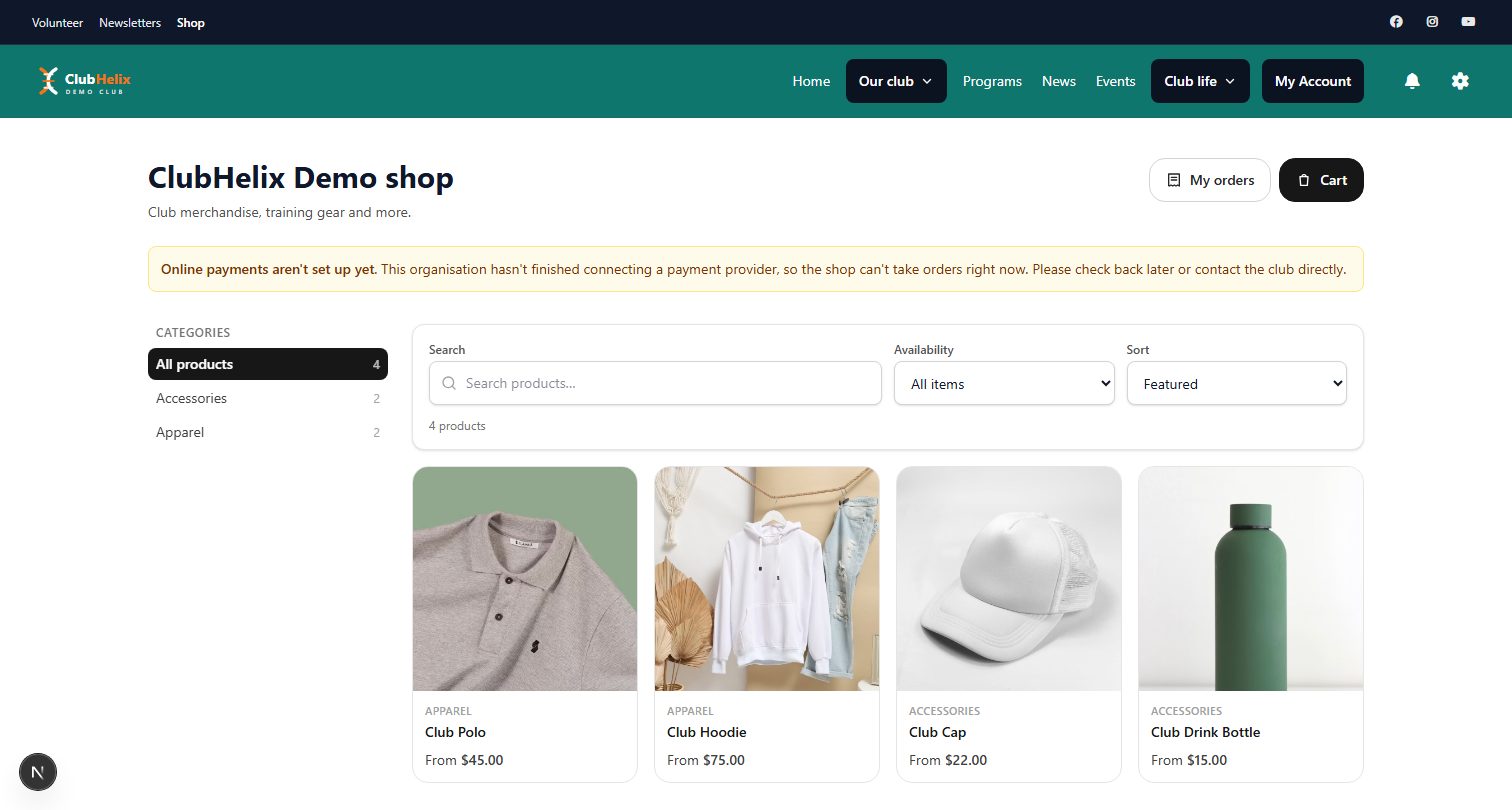
The reason a club storefront underperforms is almost never the products — it is that it lives somewhere separate from everything else the club does. ClubHelix puts the club shop inside your own site, with taxes handled, stock counts that go down as things sell, discount codes for bundles and families, and reports that tell you what actually sold and in which sizes, so next season's order is based on evidence instead of the treasurer's memory. Because it is the same system your members register through, the size question and the payment happen once.
The cheapest way to test any of this is to run a single pre-order through it before you commit a cent to bulk stock — list one item, set a two-week window, and see what the real size distribution in your club looks like. The free tier is enough to do exactly that, the pricing is published rather than quoted, and you can set your club up in an afternoon.
Frequently asked questions
Is print-on-demand worth it for a club?
It is worth it when you cannot confidently forecast demand, when nobody has time to hold and distribute stock, or when you want a long tail of items you would never order in bulk. You give up most of the margin in exchange for zero risk and almost no volunteer time. For a core item that every member needs, buying your own stock or running a pre-order earns considerably more.
How much margin should a club make on merchandise?
Enough to be worth the work, which usually means a retail price well above the landed cost once setup and freight are spread across the run. Model it at several sell-through rates rather than assuming everything sells — on a typical run the point where holding stock stops beating print-on-demand sits around three quarters of the order.
How many of each size should we order?
Use your own data first. Ask every member for a size at registration, even if they are not buying, and build the order from that distribution. Failing that, weight heavily toward the middle sizes, under-order both extremes, and remember that leftover middle sizes eventually sell while leftover extremes almost never do.
Should merchandise be included in the membership fee?
Include an item in the fee only when it is genuinely compulsory, such as a playing shirt or socks, and say clearly what the fee covers. Everything optional should be an add-on line on the registration form rather than a separate shopping trip — the member is already paying, the size question is already there, and you get one accurate supplier order instead of a season of chasing.
Can we run a club shop without holding any stock?
Yes, in two ways. A print-on-demand storefront lets a supplier make and post each item as it is ordered. A pre-order run lets you take orders and payment on your own site, then place one supplier order for exactly what was sold — which keeps the wider margin while still holding nothing at risk.
Keep reading — how to sell club merchandise online covers the storefront in detail, and how to run a club canteen tackles the other place clubs quietly lose money.


