
What this guide answers
- Do we need our own registration if the governing body already has one?
Usually yes, because they cover different populations. The mandated system registers people who play or hold a formal role for one season.
- Will members have to fill in two forms?
They will complete two steps, but the second one should be short.
- Can the two systems talk to each other?
Assume not, unless your governing body has specifically built and published an integration.
- Which system should hold the money?
Whichever one you can reconcile. If the mandated platform collects the club fee and pays it out to you, check how often it settles and whether it itemises by member, because a lump-sum payout with no breakdown creates…
- What happens to our data if we change platforms?
Ask before you commit, not after. You want to know that you can export your member list, your payment history and your consent records in a usable format, at any time, without asking permission.
South Africa edition. This guide is written for volunteer-run clubs in South Africa. Where rules differ — grants, tax, incorporation, safeguarding — follow the South Africa-specific pointers below or check with your national body.
Every club registrar knows the two-tab week. In the first tab is the system the governing body requires — the one that issues the player number, checks eligibility, records the code of conduct tick and quietly collects the affiliation levy on the way through. In the second tab is a spreadsheet, holding every person the first tab has never heard of: the woman who runs the food outlet, the life member who last played in 2009, the forty families in the school-holiday program, the two dozen social members who pay a small annual fee to use the clubrooms, and the retired couple who bring the urn to every home game.
This guide is not an argument for replacing the first tab. In most sports you cannot. If your competition, your insurance arrangement and your eligibility rules all flow through one mandated pipeline, that pipeline stays, and any advice that pretends otherwise is wasting your time. The useful question is narrower and far more answerable — given that the mandated system exists and will keep existing, what should your club run itself, and how do the two live together without your members noticing the seam.
So this is a comparison of scope, not of software. It covers what a governing-body registration actually captures and why it captures exactly that; the substantial half of your club it will never hold; how to decide which system is the record of truth for which question; and a practical sequence for running both in one registration window without a single family typing their address twice.
The half you do not get to choose
Affiliation is a bundle, and registration is how the bundle gets counted. When a player registers through the mandated system, the governing body is not collecting a mailing list. It is doing five specific jobs, and each one is a genuinely good reason for the system to exist.
| What the registration does | Why the body needs it | What breaks without it |
|---|---|---|
| Confirms who is eligible to play | Age, grade, transfer status, outstanding sanctions | Forfeits, protests, results overturned weeks later |
| Counts participants | Funding submissions, development planning, insurance sizing | The sport is undercounted and underfunded |
| Captures the participation agreement | Codes of conduct, rules acceptance, parent consent | Disciplinary matters become arguments about what was agreed |
| Collects the levy | The per-player charge that funds the tier above you | The body has to invoice clubs and chase them |
| Links the player to the competition | Team lists, match records, statistics, finals eligibility | Nobody can prove who played in what |
Read that table as a definition rather than a complaint. The mandated register is a competition register. It is scoped to the season, scoped to people who play or hold a formal role, and scoped to the governing body's purpose. Every limitation your club runs into is a direct consequence of that scope, not an oversight.
In South Africa the chain usually runs national federation, then a provincial union, then a district or region, then your club, and it is generally the provincial union that mandates registration and sets the levy. Because unions differ considerably in how much they centralise, treat "what does the union do for us and what must we do ourselves" as a question to ask directly rather than assume, and get the answer from the union rather than from the club that ran things three seasons ago.
What the mandated registration actually captures
Before you can decide what to run yourself, look honestly at what already gets collected. The field list is remarkably consistent across sports, because it is derived from those five jobs.
| Field group | Typically captured | Available back to the club |
|---|---|---|
| Identity | Legal name, date of birth, gender for grading | Yes, in the club's admin view |
| Contact | One email, one mobile, a postal address | Usually yes |
| Guardian details | Parent or guardian for juniors | Usually yes |
| Eligibility | Grade, previous club, transfer status, clearances | Yes, as a status rather than a history |
| Agreements | Code of conduct, photo permission, rules acceptance | As a tick, rarely as a stored document |
| Health flags | A medical note field, sometimes an emergency contact | Varies, and often deliberately restricted |
| Money | The levy, and the club fee if it is collected in the same transaction | As a paid or unpaid status |
| Role | Player, coach, official, team manager where the sport registers those | Yes |
Three qualities of that list matter more than any individual field.
It is scoped to a season. The register answers "is this person registered right now". It is not designed to tell you that a family has been at the club for eleven years, that they had two seasons off, or that the eldest child now coaches.
It is scoped to participation. If a person does not play, coach or hold a registered official role, the system has no reason to know they exist — and generally does not.
It is scoped to the body's purpose, not yours. The data is collected for eligibility, counting and levy collection. That is why it is often read-only to you, why exports can be limited, and why the fields you most want for club life — dietary requirements for the presentation night, which trailer licence a volunteer holds, whether a member wants the newsletter — are simply absent.
None of that is a failing. It is a system doing its job. The failing only appears when a club assumes the mandated register is its member database, and then discovers in October that it cannot email the people who make the club work.

The people it will never hold
Here is the exercise that changes committee minds. Write down every category of person your club deals with in a year, then mark which ones appear in the mandated register.
| Person | In the mandated register? | Who needs that list |
|---|---|---|
| Playing member | Yes | Registrar, selectors, treasurer |
| Coach or team manager | In some sports only | Coaching coordinator, safeguarding lead |
| Committee member | Rarely | Secretary, governing body reporting |
| General volunteer | No | Volunteer coordinator, grant writer |
| Social or non-playing member | No | Treasurer, functions committee |
| Life member and past player | No | President, history and reunions |
| Come-and-try or holiday program kid | No | Junior coordinator, next-season recruiting |
| Casual facility hirer | No | Facilities coordinator, treasurer |
| Ticket buyer or function guest | No | Events team, sponsorship |
| Sponsor contact | No | Sponsorship coordinator |
| Parent who is not a player | Only as a guardian record | Everyone, constantly |
For most community clubs the second half of that table is larger than the first. A club with 180 registered players routinely has 400 or more people it needs to reach, invoice, roster, thank or invite. The mandated system holds fewer than half of them, and it holds those for one season at a time.
This is the whole case for club-run registration existing alongside the mandated one. Not as a competitor, and not as a duplicate — as the layer that covers everything the mandated system was never built to cover. That is where online registration and payments on your own site earn their keep, along with forms for the one-off things and program and term enrolment for the clinics and courses that sit outside the competition entirely.
Deciding what is the record of truth
The way clubs get hurt is not by running two systems. It is by running two systems where nobody has decided which one is right when they disagree. Do this once, at a committee meeting, and write it into the registrar's handover notes.
| Question | Record of truth | Why |
|---|---|---|
| Is this player eligible to take the field? | Governing-body system | It is the only one with authority to say so |
| Has this family paid the club? | Your system | You set the fee, you issue the receipt |
| Who is rostered on Saturday? | Your system | It knows non-playing volunteers |
| Who receives club communications? | Your system | Consent and preferences are yours to manage |
| Does this coach hold a current screening? | Whichever your body mandates, recorded in yours | You must be able to produce it on request |
| Who are our active sponsors? | Your system | The other one has never heard of them |
| Who came to the presentation night? | Your system | It is not a participation event |
| What did we charge juniors three years ago? | Your system | Season-scoped registers do not keep your history |
The rule that follows is short enough to remember: the governing body owns eligibility, you own the relationship. Anywhere the two overlap, the mandated system wins on facts about playing and yours wins on facts about membership, money and contact.
One practical consequence — do not "correct" a name or a date of birth only in your own system. If the two disagree on an identity field, fix it in the mandated one first and mirror it, or you will spend finals week explaining why the team sheet does not match.
Running both without asking families to type it twice
Be clear about the constraint before designing around it: there is no pipe between a club platform and a governing body's registration system unless that body has built one. Assume there is not. Everything below is process design, and it works precisely because it does not depend on an integration.
One link, one order, one confirmation
- Publish exactly one join page on your own site. Every poster, text, social post, school flyer and QR code points at that page and nothing else. It explains both steps in plain language before anyone starts.
- Put the mandated step first. Families do the hard, long form once, in the system with the authority, while their motivation is highest. Your page links straight into it with the correct club and season pre-selected if the platform allows.
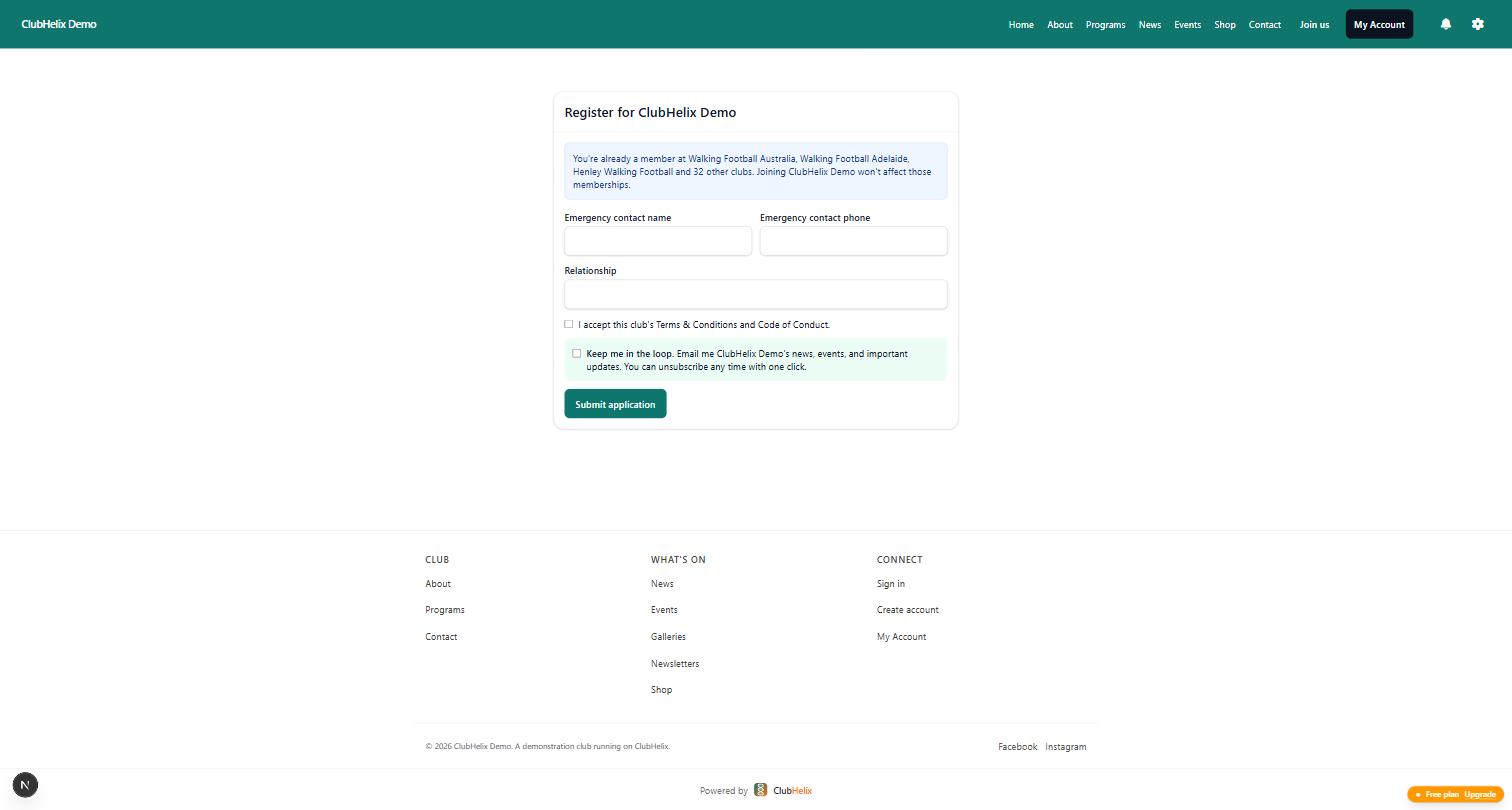
- Make your club step short — genuinely short. It should ask only for what the first step cannot know. Ten fields is a lot. Six is better.
- Do not re-ask for anything you can already see. If the mandated system shows you a date of birth, an emergency contact and a guardian email, asking again is not thoroughness, it is attrition. Every duplicated field costs you completions.
- Confirm once, for both. A single welcome email that says "you are registered to play and you are a member of the club" — with what happens next, when training starts and who their contact is.
What to ask on your side, and what to skip
| Ask | Skip |
|---|---|
| Volunteer preference and availability | Date of birth |
| Dietary requirements for club functions | Playing grade or division |
| Communication preferences and newsletter opt-in | Previous club or transfer history |
| Uniform sizes | Emergency contact, if you can see it |
| Second parent or partner contact | Medical notes the body already holds |
| Skills the club can use — trade, licence, first aid | The code of conduct tick already captured |
| Whether the household wants a social membership too | Anything you will never act on |
That right-hand column is the discipline. Every field a committee adds "because it might be useful one day" is a real cost paid by four hundred families and a benefit paid to nobody.
If you must run your step first
Some clubs deliberately reverse the order, taking the club membership and payment before sending families on. It is a legitimate choice with one clear advantage — you capture and bank the club fee before anyone abandons the process — and one clear risk, which is a member who has paid you but never completes the mandated step and therefore cannot play. If you reverse the order, run a weekly reconciliation between the two lists for the whole window and chase the gap by phone, not email.
Clubs in South Africa handling member data fall under the Protection of Personal Information Act, which applies to community organisations as much as to businesses. Practical version — collect only what you need, say on the join page what it is for, be careful with children's information, and get a proper opt-in before adding anyone to a marketing list. This is general information rather than advice, so confirm the detail with the union or an adviser before you finalise your forms.
The registration window, week by week
A two-system registration only feels seamless if it is run as a project with a start and an end. This run sheet assumes a six-week window and a committee of volunteers with day jobs.
| Week | What happens | Who owns it |
|---|---|---|
| Week 6 | Confirm fees, confirm the levy, publish both on the join page. Test both steps yourself on a phone. | Treasurer, registrar |
| Week 5 | Open. Send to last season's members first — they are the easiest completions and they surface problems early. | Registrar |
| Week 4 | Public push. Posters, local groups, school newsletters, the come-and-try day. | Communications |
| Week 3 | First reconciliation. Anyone in one system but not the other gets a personal message. | Registrar |
| Week 2 | Chase the half-finished. Most abandoned registrations stall at payment, not at the form. | Treasurer |
| Week 1 | Last call, with a stated deadline and what happens after it. | Communications |
| Close | Final reconciliation, hand the paid list to team selectors, archive the window. | Registrar |
Two habits inside that run sheet do most of the work. Reconcile weekly rather than at the end, because a discrepancy found in week three is a phone call and the same discrepancy found in week zero is a forfeit. And keep a single named person as the answer to "who do I ask" for the whole window — our guide on what a club registrar does sets out the role properly, and running a registration day covers the in-person version where both steps get done at a table with a volunteer beside you.
What it buys you when reports are due
The reward for keeping a proper club-side record arrives at the least convenient time of year, when the governing body wants participation numbers, the council wants a community report and a grant application wants volunteer hours. A season-scoped competition register can give you one of those three. Your own system, if you have kept it honestly, gives you all of them plus the history — retention across seasons, growth by age group, how many of last year's holiday-program children came back as members.
That is also the difference between a report you assemble in an evening and one that takes a fortnight of asking people to remember things. Our guide on reporting to your governing body covers what is usually asked for and when.
Owning the half nobody else runs
The mandated system will keep doing its job, and it does that job well. What it leaves you is everything else — membership that is not tied to a competition, volunteers, social members, programs, functions, sponsors and the years of history that make a club feel like a club. ClubHelix is built for exactly that half: self-registration with payments so families join and pay in one go, forms and surveys for the one-off collections, programs and term enrolment for clinics and courses, and volunteer rostering that knows about the people who never appear on a team sheet.
You can put it beside your mandated pipeline without disturbing it — nothing changes in the system your body requires. There is a free tier to start on, published pricing rather than a quote, and it is built and hosted by a small independent team rather than bundled into someone's competition contract. Create your club site and have the second half of your registration running before the window opens.
Frequently asked questions
Do we need our own registration if the governing body already has one?
Usually yes, because they cover different populations. The mandated system registers people who play or hold a formal role for one season. Your own registration covers volunteers, social and non-playing members, program participants, past players and everyone else the club needs to contact, invoice or roster. If your club has no non-playing members and no volunteers outside the registered roles, you may genuinely not need a second layer.
Will members have to fill in two forms?
They will complete two steps, but the second one should be short. Design your club form to ask only what the mandated system cannot know — volunteer availability, uniform sizes, dietary requirements, communication preferences — and never to repeat a field the first step already captured. Done properly the second step takes under a minute and families barely register it as separate.
Can the two systems talk to each other?
Assume not, unless your governing body has specifically built and published an integration. Most clubs run the two side by side and reconcile the lists weekly during the registration window. That is a small, predictable job when it is scheduled, and a genuine crisis when it is left until the first round.
Which system should hold the money?
Whichever one you can reconcile. If the mandated platform collects the club fee and pays it out to you, check how often it settles and whether it itemises by member, because a lump-sum payout with no breakdown creates work for the treasurer. Many clubs prefer to take their own membership fee themselves so that the payment, the receipt and the member record all sit in one place.
What happens to our data if we change platforms?
Ask before you commit, not after. You want to know that you can export your member list, your payment history and your consent records in a usable format, at any time, without asking permission. The mandated register is the governing body's to keep — your own records are yours, and a platform that makes them hard to leave with has told you something important.
Keep reading — how to run a club registration day covers the in-person version of this, and how to collect club membership fees online goes deeper on the money side.


