
What this guide answers
- Do club minutes have to be signed?
Most constitutions require minutes to be confirmed at the following meeting and signed by the chair as a true and accurate record — that confirmation is what makes them evidence.
- How detailed should committee meeting minutes be?
Detailed about decisions, silent about debate. Every motion word-for-word with its result, every figure and payment approved, every action with an owner and date — but discussion summarised in a single neutral line…
- Can ordinary members see the committee's minutes?
Check your constitution — many model rules give members a right to inspect minutes of general meetings (like the AGM), while committee minutes are commonly available at the committee's discretion.
- Who takes the minutes if the secretary is away?
The chair asks any attending committee member to act as minute-taker, and the minutes record that.
Canada edition. This guide is written for volunteer-run clubs in Canada. Where rules differ — grants, tax, incorporation, safeguarding — follow the Canada-specific pointers below or check with your national body.
Minutes are the least glamorous document your club produces and the one most likely to matter years later. They're the legal record of what the committee decided, the proof your bank wants before changing signatories, the evidence your insurer or regulator may ask for, and — week to week — the only reliable engine for making sure decisions turn into actions.
Yet most club minutes fall into one of two failure modes: a transcript nobody will ever read ("Sandra then said that she thought the pie warmer..."), or three vague lines that record a two-hour meeting as "finances discussed, all going well". This guide gives you the template that avoids both, explains exactly what belongs in minutes and what doesn't, and shows how to run the action-item loop that makes meetings worth having.
What minutes are actually for
Good minutes answer four questions for someone who wasn't in the room — including the committee member reading them in 2031:
- Was the meeting valid? Who attended, who apologised, was quorum met, who chaired.
- What was decided? Every motion, who moved and seconded it, and whether it carried.
- Who is doing what by when? Action items with a single named owner and a date.
- What was reported? The headline facts received — the bank balance, the member count — not the discussion around them.
That's it. Minutes are a record of decisions and outcomes, not conversation. The moment you accept that, minute-taking drops from an hour of frantic typing to a calm fill-in-the-blanks exercise.
For incorporated not-for-profits, keeping minutes of board and general meetings is an obligation under the provincial or federal legislation the club is incorporated under.
The secretary is normally the officer responsible, as covered in our committee roles guide.
The club meeting minutes template
Copy everything below into your club's document system and reuse it every meeting. Bracketed text is instruction; delete it as you fill in.
[CLUB NAME] Minutes of Committee Meeting
Date: [date] Time opened: [time] Venue: [venue / video call] Chair: [name] Minute-taker: [name]
1. Attendance Present: [names and roles] Apologies: [names] — motion: That the apologies be accepted. Moved [name], seconded [name]. Carried. Absent without apology: [names, if any] Quorum: [Met — X of Y committee members present.]
2. Confirmation of previous minutes Motion: That the minutes of the meeting held [date] be confirmed as a true and accurate record. Moved [name], seconded [name]. Carried. [Note any corrections.]
3. Business arising / action items from last meeting
# Action Owner Status 3.1 [carried-over action] [name] [Done / In progress / Carried over to [date]] 4. Correspondence In: [sender — one-line subject — action required?] Out: [recipient — one-line subject] Motion: That inward correspondence be received and outward correspondence endorsed. Moved [name], seconded [name]. Carried.
5. Treasurer's report Bank balance at [date]: [amount]. Income since last meeting: [amount]. Expenditure: [amount]. Accounts presented for payment: [payee — purpose — amount, one line each]. Motion: That the treasurer's report be accepted and the accounts presented be paid. Moved [name], seconded [name]. Carried.
6. Other reports [one block per report: registrar, canteen, juniors, sponsorship...] [Role] report: [two or three factual headlines]. Motion to accept: Moved [name], seconded [name]. Carried.
7. General business 7.1 [Topic] — [One or two sentences of context. Then either:] Motion: [exact wording of what was resolved]. Moved [name], seconded [name]. Carried / Lost [record votes if close or if any member asks]. Action: [what] — [owner] by [date]. 7.2 [Next topic] — ...
8. New action item summary
# Action Owner Due 8.1 [action] [name] [date] 9. Next meeting: [date, time, venue] Meeting closed: [time]
Confirmed as a true and accurate record: Chair: _______________ Date: _______ (signed at the following meeting, or confirmed electronically)
For an AGM, use the same skeleton with the AGM's items — the full running order is in our AGM guide — and be extra precise about election results: for each position, who was nominated, who was elected, and that positions were declared vacant first.
What to record — and what to leave out
Always record:
- The exact wording of every motion, its mover and seconder, and the result. If the vote was counted, record the count. If a member asks for their dissent to be noted, note it — that's their right and their protection.
- Financial figures as reported, and every payment approved. This is the treasurer's authority to pay.
- Conflicts of interest declared, and that the member left the room or abstained.
- Anything the constitution requires the committee to decide: new member approvals, casual vacancy appointments, setting fees.
Leave out:
- Who said what during discussion. "The committee discussed three quotes for line-marking" — full stop. Attributed debate makes minutes long, makes meetings guarded, and adds zero legal value.
- Adjectives and atmosphere. "A heated exchange followed" helps nobody in five years.
- Sensitive personal detail. Discipline, medical or child-safety matters should be minuted as "the committee considered a confidential member matter and resolved [outcome reference]", with details held separately and access-controlled.
The style rule that covers everything: write so that a stranger — or a lawyer — reading only the minutes can tell what was decided, but not what the argument sounded like.
The action-item loop is the whole point
Meetings don't fail at deciding; they fail at doing. The template above builds the fix in — a fortnight-by-fortnight loop:
- Every decision that needs work becomes an action with one owner (never "the committee") and a due date.
- Actions are summarised in their own table at the end, so nobody re-reads seven pages to find their jobs.
- The secretary circulates minutes within a week — while memories are fresh and deadlines are far.
- Next meeting opens with the action table. Done, in progress, or carried over — no item silently disappears.
Clubs that run this loop feel dramatically better to volunteer for, because things visibly happen. Clubs that don't have the same conversation every month for a season.
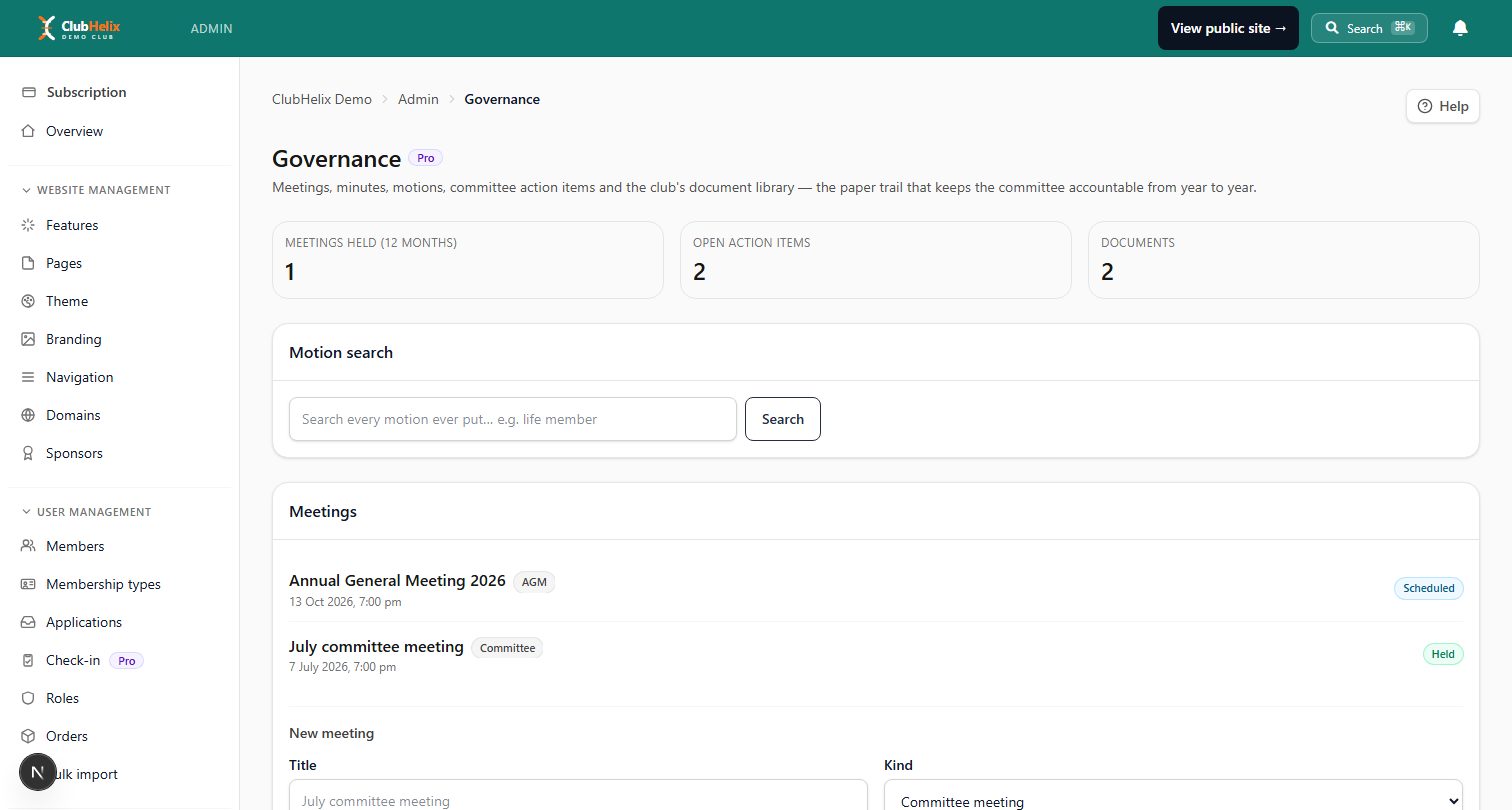
This is also where a purpose-built governance and meetings tool beats a folder of documents: agendas roll forward automatically, motions and resolutions are captured as structured records you can search ("when did we resolve to buy the defibrillator?"), and action items carry their owner and status from meeting to meeting instead of being retyped.
Storage: minutes are club property
Minutes belong to the club, not to the secretary who typed them. Three storage rules:
- One canonical home. The club's own system or drive — under the club's account — never a personal laptop or inbox. When the secretary changes at the AGM, the archive must not change hands; only the access does.
- Keep them permanently. Minutes are among the few club records with no sensible disposal date. The 1998 minute book is the only proof of why the club owns its land, holds its name, or made a life member.
- Confirm and lock. Once the following meeting confirms the minutes, they're final — corrections after that point are made by a note in the next minutes, never by editing history. A system with an audit trail does this for you.

Frequently asked questions
Do club minutes have to be signed?
Most constitutions require minutes to be confirmed at the following meeting and signed by the chair as a true and accurate record — that confirmation is what makes them evidence. Electronic confirmation (the confirming motion recorded in the next meeting's minutes, in a system with an audit trail) satisfies the same purpose for most clubs, but if your bank or rules want ink, print the confirmed minutes and have the chair sign them. What matters is that a confirmed, unalterable version exists.
How detailed should committee meeting minutes be?
Detailed about decisions, silent about debate. Every motion word-for-word with its result, every figure and payment approved, every action with an owner and date — but discussion summarised in a single neutral line, without names attached to opinions. A well-minuted two-hour meeting usually fits on two to three pages. If your minutes routinely run longer, you're transcribing; if motions appear without wording or movers, you're summarising too hard.
Can ordinary members see the committee's minutes?
Check your constitution — many model rules give members a right to inspect minutes of general meetings (like the AGM), while committee minutes are commonly available at the committee's discretion. Good practice for most community clubs is openness: publish committee minutes to members with confidential items (discipline, individual member matters, some financial negotiations) recorded by reference only. Transparency is cheap, and secrecy is what actually breeds the car-park conspiracy theories.
Who takes the minutes if the secretary is away?
The chair asks any attending committee member to act as minute-taker, and the minutes record that. What makes this painless is the template: with a fill-in-the-blanks structure, anyone can take serviceable minutes. What makes it a disaster is when the template, past minutes and action list all live on the absent secretary's laptop — which is the real argument for keeping the whole meeting record in the club's shared system.
ClubHelix's governance tools give your secretary structured agendas, minutes, motions and rolling action items in the club's own account — nothing lost at handover. Start free, or see everything else ClubHelix runs for your committee.


