
What this guide answers
- How often should we review KPIs?
Collect monthly, review quarterly, act immediately on anything in the compliance measure.
- What is a good retention rate for a club?
There is no universal benchmark worth trusting — junior sport, adult social and competitive senior clubs behave completely differently.
- Should we share KPIs with members?
Some of them, yes. Membership numbers, participation and a summary financial position build genuine trust when published in an annual report.
- Do we need a fancy dashboard tool?
No. A one-page document updated quarterly beats a dashboard nobody opens.
- How do these relate to a grant application?
Directly. Participation, retention and volunteer coverage are exactly what funding bodies ask for, and a club that has tracked them quarterly for two years can answer in an afternoon.
South Africa edition. This guide is written for volunteer-run clubs in South Africa. Where rules differ — grants, tax, incorporation, safeguarding — follow the South Africa-specific pointers below or check with your national body.
Most clubs track two numbers: how many members, and how much money. Both are lagging indicators. By the time membership has dropped, the reasons dropped eighteen months ago; by the time the account is thin, the decisions that thinned it are long past.
A useful club KPI set mixes lagging measures — the ones that prove what happened — with leading ones that tell you what is about to. Here are twelve worth the effort, what each actually predicts, and how to define it so two committee members cannot compute it differently.
Before the list: three rules
Define it once, in writing. "Active member" means at least four different things. Whatever your club decides, write the definition next to the number, permanently. Most disputes about club data are definition disputes wearing a numbers costume.
Track it monthly, review it quarterly. Monthly collection, quarterly interpretation. Reacting to one month's movement is how committees chase noise.
Never track more than you will act on. A dashboard nobody acts on is a hobby. Six measures acted on beats twenty admired.
Membership KPIs
1. Active members
What it is: members whose membership is current on the day you measure.
Definition that works: paid up to a date in the future, or within a stated grace period, on the measurement date. State the date. "As at 1 June" turns a slippery figure into a fact.
What it tells you: the base for everything else. On its own, not much.
2. Net movement
What it is: joiners minus leavers over the period.
Definition that works: joiners are memberships that started in the window; leavers are memberships that lapsed and were not renewed within the grace period. Note that most clubs cannot see why someone left, so this is a count, not an explanation.
What it tells you: more than headcount does. A club that gained 40 and lost 38 looks stable and is not — it is churning, which costs far more in volunteer effort than a club that gained 5 and lost 3.
3. Retention rate by cohort
What it is: of the members who joined in a given season, what proportion are still here one, two and three seasons later.
Definition that works: count the joining cohort, then count how many of that same group have a current membership at each anniversary. There is a full worked example if you want the arithmetic.
What it tells you: the single most predictive number a club has. Cohort retention tells you whether the club is a place people stay, and it moves long before headcount does.
4. Renewal conversion
What it is: of the members due to renew this period, what proportion did.
Definition that works: renewals completed divided by renewals due, measured 30 days after the due date.
What it tells you: where your leak is. A club with a good product and a bad renewal process loses members it never needed to lose — and unlike most club problems, that one is fixable in a fortnight.
Money KPIs
5. Income by source, as a mix
What it is: the percentage of income from each source, not just the totals.
Definition that works: cash received in the period, dated by when it arrived, grouped consistently.
What it tells you: concentration risk. A club taking 80 per cent of its income from one sponsor is one phone call from a crisis, and the totals alone will never show that.
6. Revenue per member
What it is: total income divided by active members.
Definition that works: all income in the period over the average active membership in the same period.
What it tells you: whether growth is actually paying. Clubs that grow headcount while revenue per member falls are usually discounting their way to a bigger problem.
7. Debtor days
What it is: how long money owed to the club stays owed.
Definition that works: the ageing bands — current, 30, 60, 90+ — and the total in each.
What it tells you: the health of your collection process. A rising 90+ band is the earliest reliable warning of a cash problem, usually visible a full season before it bites.
8. Cost per participant
What it is: what it costs the club to deliver a season for one member.
Definition that works: total operating expenditure over active members. Crude, and useful precisely because it is crude.
What it tells you: whether the fee is anywhere near reality. Most clubs that discover they are subsidising each junior by a meaningful amount had never divided the two numbers.
Engagement KPIs
9. Participation rate
What it is: of your members, how many actually turn up.
Definition that works: members with at least one recorded attendance — training, match, session or event — in the last 60 days, over active members.
What it tells you: the club's real size. Members who never attend renew once out of loyalty and then quietly leave. Attendance is the leading indicator; retention is the lag. If you record attendance at all, this becomes the most actionable number on the list.
10. Volunteer coverage
What it is: the proportion of duty slots, roles and rosters that are filled.
Definition that works: filled slots over required slots for the period.
What it tells you: how close the club is to volunteer exhaustion — the most common cause of a club folding, and one that never appears in a financial statement.
11. Communication reach
What it is: the proportion of members who open what you send.
Definition that works: unique opens over delivered, per broadcast, tracked as a trend.
What it tells you: whether the club can still reach its members. Falling reach precedes falling attendance, which precedes falling renewals — the same decline showing up three times, earliest here.
Compliance KPI
12. Compliance coverage
What it is: the proportion of people who need a check, accreditation or signed waiver who currently hold one.
Definition that works: current and unexpired at the measurement date over required.
What it tells you: exposure. This is the one KPI where the target is 100 per cent and anything else is a plan with a deadline. It is also the number an insurer or association will ask for at the worst possible moment.

The metrics to leave out
Social media followers. Almost entirely uncorrelated with club health. Followers are not members and do not turn up.
Website visits. Useful for one thing — whether your registration page converts — and misleading for everything else.
Total money raised, all time. A trophy, not a measure.
Anything you cannot act on. If nobody in the room can name what the club would do differently at a better number, the number does not belong on the dashboard.
Building the dashboard
Twelve measures sounds like a project. In practice it is one page, reviewed quarterly, and most of it should come out of the systems the club already runs.
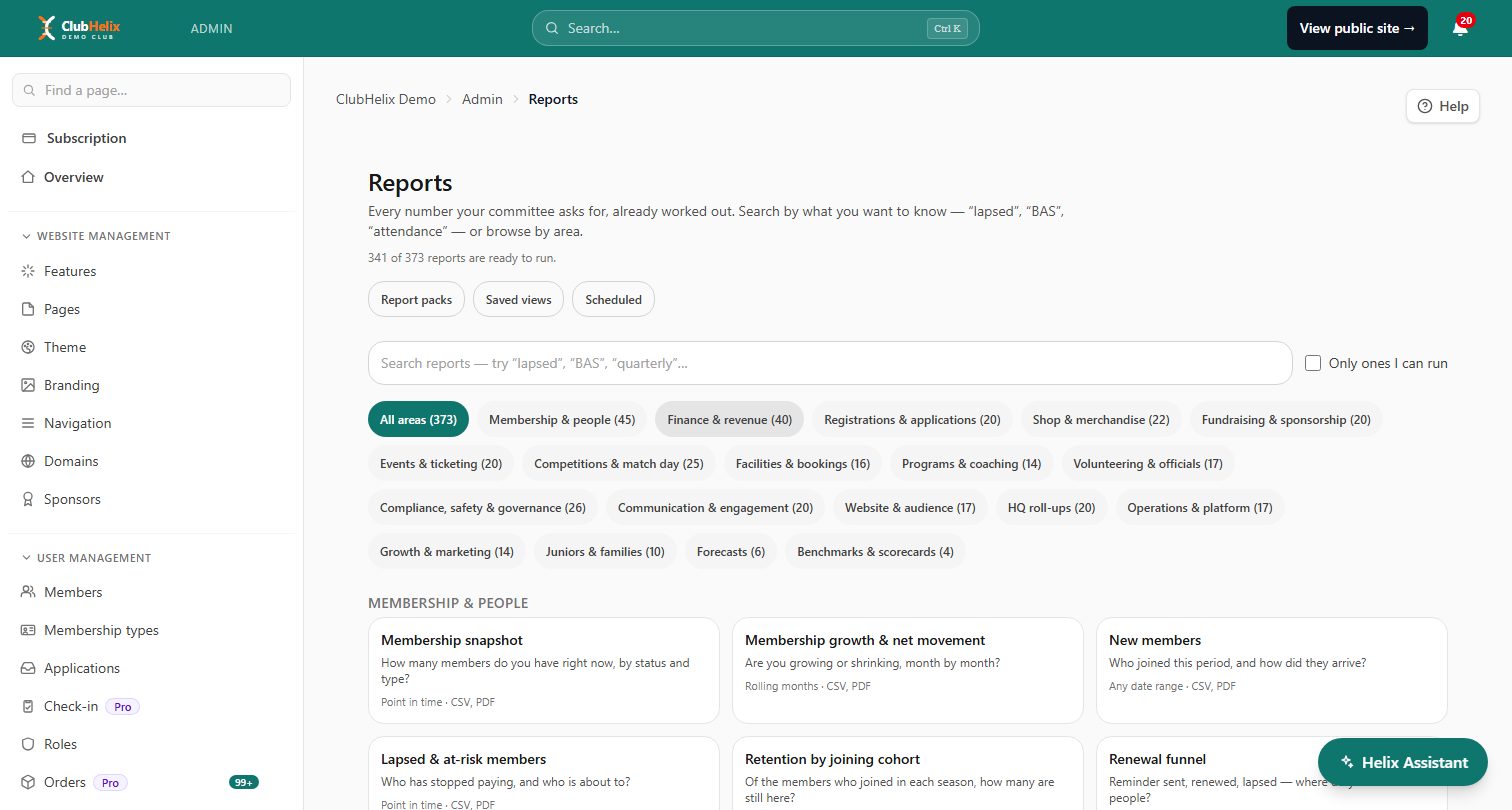
The trick is to make collection automatic. If membership, money, attendance and compliance all live in the same place, most of these are reports you open rather than figures you assemble — which matters, because a KPI set that depends on manual collection survives about two quarters.
Start with four: cohort retention, income mix, participation rate and compliance coverage. Those four cover people, money, engagement and risk, and they will tell you more about your club than the next eight combined.
Frequently asked questions
How often should we review KPIs?
Collect monthly, review quarterly, act immediately on anything in the compliance measure. Quarterly review keeps the committee looking at trends rather than reacting to one quiet month.
What is a good retention rate for a club?
There is no universal benchmark worth trusting — junior sport, adult social and competitive senior clubs behave completely differently. Your own trend is the benchmark. If year-one retention is climbing, whatever you changed is working.
Should we share KPIs with members?
Some of them, yes. Membership numbers, participation and a summary financial position build genuine trust when published in an annual report. Debtor ageing and compliance detail should stay with the committee.
Do we need a fancy dashboard tool?
No. A one-page document updated quarterly beats a dashboard nobody opens. What matters is that the numbers are defined consistently and produced without a fortnight of effort — the presentation is the easy part.
How do these relate to a grant application?
Directly. Participation, retention and volunteer coverage are exactly what funding bodies ask for, and a club that has tracked them quarterly for two years can answer in an afternoon. Keeping the census-style counts alongside them makes the application close to automatic.


