
What this guide answers
- What is the difference between profit and cash?
Profit is income less expenditure over a period; cash is what is in the account right now.
- Do we need accounting software as well?
Most clubs benefit from it for the statutory side — the annual statements, and anything an accountant will touch.
- How often should the committee see financial reports?
Every ordinary meeting, in the same shape. Monthly for most clubs.
- Who else should be able to see them?
Anyone the committee grants access to, and no one else by accident.
- What if the treasurer will not produce reports?
Almost always this is capability or time, not evasion. Offer the structural fix — reports the system produces — before the confrontation.
Canada edition. This guide is written for volunteer-run clubs in Canada. Where rules differ — grants, tax, incorporation, safeguarding — follow the Canada-specific pointers below or check with your national body.
Most people who join a club committee are not accountants. They are a parent who coaches, a member who is good at organising, a former player who wanted to help. Then a set of financial reports arrives in the meeting pack and there is a quiet, widely shared reluctance to admit that nobody is entirely sure what they are looking at.
That reluctance is expensive. A committee is collectively responsible for the club's money, and a committee that cannot read the reports cannot discharge that responsibility — it can only trust the treasurer, which is unfair to the treasurer and unsafe for the club.
Here is what each report actually shows.
The four reports that matter
1. The income report — where money came from
Also called income by source, or a revenue report. It answers one question: over this period, what came in and from where.
How to read it in two minutes. Ignore the total first and look at the mix. Registrations, canteen, merchandise, events, fundraising, sponsorship, hire. Ask which line grew, which shrank, and whether any single line is large enough that losing it would hurt.
What to watch for. Concentration — a club taking most of its income from one source has a fragility that the total conceals. And seasonality: a club that looks healthy in April and thin in November is normal; one that does not know which months are which is not budgeting.
The trap. "Income" can mean money received or money invoiced. For a community club it should almost always mean received, dated by when the payment arrived. Check which one, once.
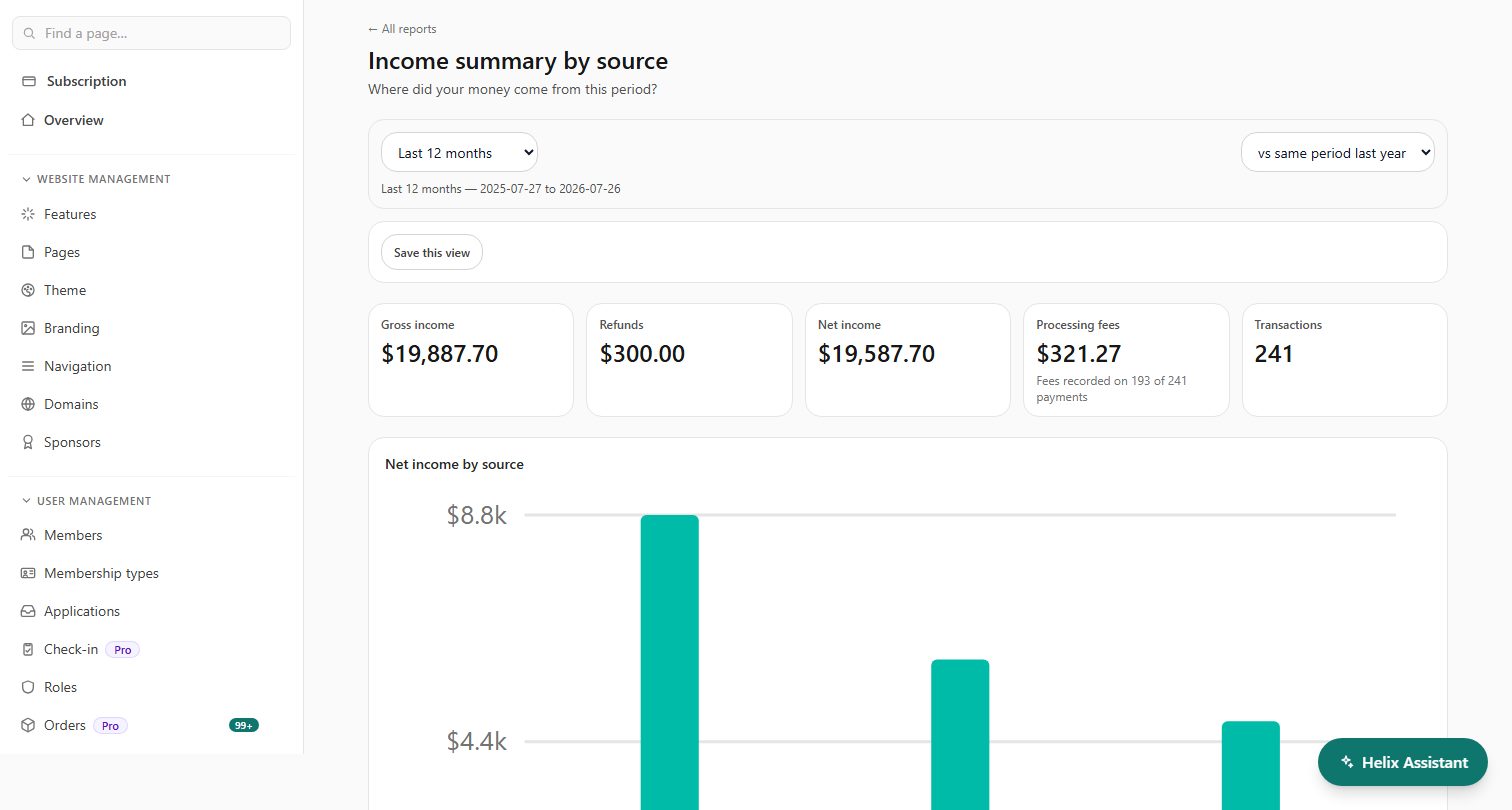
2. The expenditure report — where it went
The same shape, in reverse: what the club spent, grouped into categories.
How to read it in two minutes. Compare each category with the same period last year. Anything that has moved by more than about 20 per cent deserves a sentence of explanation, in either direction.
What to watch for. Categories that change shape between reports. If "ground costs" included umpires last year and does not this year, the comparison is meaningless and nobody will notice unless someone asks.
The trap. One-off purchases distorting a trend. A new set of goals in March makes equipment spend look alarming until it is separated out. Good reports distinguish recurring from one-off; if yours does not, ask.
3. Outstanding and overdue — what is owed to the club
Sometimes called debtors, or an ageing report. It lists money owed and, crucially, how long it has been owed, in bands: current, 30 days, 60 days, 90-plus.
How to read it in two minutes. Look at the 90-plus band first. That is the money the club is least likely to see.
What to watch for. The 90-plus band growing quarter on quarter. This is the earliest reliable warning of a cash problem and it typically appears a full season before it becomes one.
The trap. Treating outstanding fees as money the club has. A surplus of $8,000 that includes $6,000 of ninety-day debt is not a surplus, it is a hope.
4. The position — what the club actually holds
The cash position: every account, on a stated date, plus what is committed but not yet paid.
How to read it in two minutes. Total funds, minus committed spending, equals what the club can actually decide about tonight. That is the only number that matters when the committee is voting to spend.
What to watch for. Restricted funds. Grant money held for a specific purpose, bonds, and money collected for something else are not available, and a position report that blends them overstates what the club can do.
The four questions to ask about any set of numbers
You do not need an accounting qualification to hold a treasurer's report to account. You need these four questions.
1. "As at what date?" Every figure is true at a moment. Half of all disagreements about club finances are two people quoting correct numbers from different days.
2. "Cash or invoiced?" Money in the account, or money billed. Both are legitimate; mixing them is not.
3. "What is not in this number?" Restricted funds, committed spending, an account that is not included, a source recorded elsewhere. A good report states its exclusions; a good committee member asks anyway.
4. "Compared with what?" A single figure is trivia. Against last year, against budget, against the same point last season — that is information. If there is no comparison column, ask for one.
Four questions, thirty seconds, and the quality of financial oversight at your club improves permanently.

Reports that are useful less often
Worth knowing they exist, and when to ask for them.
Budget versus actual. Only meaningful if the club actually set a budget. If it did, this is the most useful report in the set, and it should be in every meeting pack.
Revenue per member. Total income over active members. Tells you whether growth is paying for itself. Worth looking at annually.
Refunds and chargebacks. Small in most clubs. Worth a glance quarterly, because a rising refund rate usually means something is wrong with a product or a process rather than with the money.
Fees and charges. What payment processing costs the club. Frequently a surprise, and occasionally worth acting on.
Transaction register. Every payment, line by line. Not for the meeting — for reconciling against the bank, and for answering a specific question precisely.
Where clubs go wrong
Reporting the bank balance and calling it a financial report. A balance is one of four numbers and the least informative of them.
Changing the categories. Consistency is what makes reports useful. Agree the categories once and hold them for at least three years.
Presenting detail instead of interpretation. A committee cannot absorb four hundred transactions. It can absorb "canteen income is down 30 per cent because we lost two home games to weather", which is the sentence the detail exists to support.
Only reporting annually. By the time an annual report reveals a problem, the year in which it could have been fixed is over. Monthly collection, quarterly interpretation.
Depending entirely on one person. Not because treasurers are untrustworthy — overwhelmingly they are not — but because a club whose finances only one person can read is one resignation away from a very bad quarter.
Making the reports easy to produce
Everything above assumes the reports exist. In many clubs they do not, because producing them means reconciling four systems by hand and nobody has a weekend.
The structural fix is to take the money in one place. When registrations, shop sales, event tickets, donations and facility hire all land in the same ledger, these four reports are things you open rather than things you build — with the comparison column already there, and the definitions printed on the report so nobody has to guess.
Then put them in the monthly pack, in the same order every month. The committee learns to read them, the treasurer stops spending weekends on assembly, and the meeting spends its time deciding rather than establishing.
Frequently asked questions
What is the difference between profit and cash?
Profit is income less expenditure over a period; cash is what is in the account right now. A club can be profitable and unable to pay a bill, usually because a large amount is owed to it. Read both.
Do we need accounting software as well?
Most clubs benefit from it for the statutory side — the annual statements, and anything an accountant will touch. Club software is where the club's own money is taken and reported; accounting software is where it meets the formal return. What matters is that the export from one imports cleanly into the other without hand-editing.
How often should the committee see financial reports?
Every ordinary meeting, in the same shape. Monthly for most clubs. Quarterly is workable for a small club with simple finances, but the gap is where problems grow.
Who else should be able to see them?
Anyone the committee grants access to, and no one else by accident. Good practice is for reporting access to be granular — a treasurer can be given every financial report without also being given member medical notes or safeguarding records. Access should follow the role, not the person.
What if the treasurer will not produce reports?
Almost always this is capability or time, not evasion. Offer the structural fix — reports the system produces — before the confrontation. If a treasurer genuinely refuses to report to the committee, that is a governance matter, and your constitution will say how to deal with it.


