
What this guide answers
- How long should a club email be?
As short as it can be while carrying the action: for most operational emails that's under 150 words.
- What's the best time to send club emails?
Evenings between 6pm and 9pm generally work well for volunteer-run clubs, because that's when members are off work and checking phones.
- Should clubs use email or SMS?
Both, for different jobs. Email suits anything with detail or links — newsletters, invitations, fee reminders — while SMS is for time-critical messages like same-day cancellations, where you need it read within the hour.
- How do I stop club emails going to spam?
Send from an authenticated address on your club's own domain, email only opted-in members, and keep content clean and text-led.
South Africa edition. This guide is written for volunteer-run clubs in South Africa. Where rules differ — grants, tax, incorporation, safeguarding — follow the South Africa-specific pointers below or check with your national body.
Most club emails get written at 9.45pm on a Tuesday by a volunteer who has already answered fourteen messages that day. Nobody has time to craft each one from scratch — and nobody should. The same ten emails come around every season at every club, so the smart move is to keep a set of club email templates you can copy, tweak and send in two minutes.
Below are ten copy-ready templates covering the messages every club sends, plus a few rules that make the difference between an email that gets read and one that gets ignored. Swap the square brackets for your details and you're done.
Five rules before you copy anything
- One email, one job. If your message asks people to pay fees AND volunteer AND note the AGM date, they'll do none of it. Split it up.
- Subject lines say the thing. "Training cancelled tonight" beats "Club update — please read". Members skim inboxes on their phones; tell them the point before they open it.
- Front-load the action. Date, time, link or amount in the first two lines. Background and thank-yous come after.
- Write like a person. You're a club, not a bank. "Hi Sam" and "Cheers, Kelly (Treasurer)" will always outperform "Dear Member" and "Regards, The Committee".
- Send from your club's own address. Emails from a personal address (or worse, a generic no-reply) look like spam and get treated like it. A club-branded sender address on your own domain builds trust and improves deliverability — more on that below.
The 10 templates
1. Welcome email (new member)
Subject: Welcome to [Club Name]!
Hi [First name],
Welcome aboard — we're glad to have you at [Club Name]. Here's what you need to know:
- Training: [day/time] at [venue]
- Season starts: [date]
- Uniform: [where to get it]
- Questions: reply to this email or message [name] on [number]
Everything else — fixtures, news, contacts — lives on our website: [link].
See you at training, [Name], [Role]
Send this the moment someone registers. If your registration runs through your website, this can go out automatically — see the sending section below.
2. Registration is open
Subject: [Year] registration is open — secure your spot
Hi [First name],
Registration for the [year] season is now open. It takes about three minutes online: [link]
Fees this year are [amount] ([what it includes]). The season kicks off [date].
Register by [date] and you're locked in for round one. Any questions, just reply.
[Name], [Role]
3. Fees due
Subject: [Club Name] fees due [date]
Hi [First name],
A quick reminder that your [year] membership fee of [amount] is due by [date]. You can pay online here: [link] — it takes about a minute.
If anything makes paying by that date difficult, reply and we'll sort something out quietly. We'd always rather know.
Thanks for being part of the club, [Name], Treasurer
The second paragraph matters. Every club has families doing it tough, and a standing offer to talk keeps them at the club. For the full follow-up sequence, see our guide to membership renewal reminders that actually work.
4. Wet weather / cancellation
Subject: CANCELLED — training tonight [date]
Hi everyone,
Tonight's training at [venue] is cancelled due to [reason]. Nothing you need to do — we'll see you [next session day/time].
[Round/fixture] this weekend is still going ahead as planned. Any change and we'll email and SMS by [time].
[Name]
Speed beats polish here. Put the decision in the subject line, send it the moment the call is made, and pair it with an SMS for same-day changes. A wet weather communication plan agreed before the season saves the 4pm scramble.
5. Event invitation
Subject: [Event name] — [date], tickets now available
Hi [First name],
Our [event name] is on [date] at [venue], from [time]. [One sentence on what it is and why it's good.]
Tickets are [amount] and you can grab them here: [link]. Numbers are capped at [n], so don't sit on it.
See you there, [Name]
6. Volunteer ask
Subject: Can you give us one hour on [date]?
Hi [First name],
We need [number] helpers for [task] on [date] — shifts are just [length], and you'll be done by [time].
Grab a slot here: [link]. First in gets first pick of shifts.
Every shift filled means the same two people don't do everything — thank you.
[Name]
Small, specific, time-boxed asks get volunteers; vague appeals for "anyone who can help out" don't. Our guide on how to recruit club volunteers goes deeper.

7. AGM notice
Subject: Notice of AGM — [Club Name], [date]
Hi [First name],
The Annual General Meeting of [Club Name] will be held on [date] at [time], at [venue/online link].
Business will include: annual reports, election of the committee, and [any special business]. Agenda and papers: [link].
Nominations for committee positions close [date] — the nomination form is here: [link]. All members are welcome and encouraged to attend.
[Name], Secretary
Check your constitution for the required notice period (commonly 14–21 days) and send this well inside it.
8. Sponsor thank-you
Subject: Thank you from [Club Name]
Hi [First name],
On behalf of everyone at [Club Name], thank you for backing us this season. Your support paid for [specific thing — e.g. new junior playing kit], and it made a real difference.
A few photos of your signage and the team in action are attached — feel free to use them. We've also featured [Business Name] on our website and socials: [link].
We'd love to have you on board again next season — I'll be in touch in [month].
[Name], [Role]
Specifics are everything: sponsors renew when they can see what their money did.
9. Match-day details
Subject: This week: [Team] v [Opponent], [day] [time]
Hi [First name],
Details for this week's game:
- When: [day, date, time] (arrive by [time])
- Where: [venue + map link]
- Wear/bring: [kit, water, etc.]
- Canteen/BBQ roster: [names]
Full fixture list is always on the website: [link].
[Name], Team Manager
10. End-of-season thank-you
Subject: That's a wrap — thank you for a great season
Hi [First name],
That's the [year] season done. [One or two genuine highlights — a premiership, a first win, a record junior intake.]
None of it happens without our volunteers, sponsors and families — thank you.
Dates for your diary: presentation night [date], AGM [date], and [year+1] registration opens [date].
Enjoy the break, [Name], President
Getting your club emails delivered
The best-written template is worthless if it lands in spam. Three things move the needle most:
- Send from your own club domain, properly authenticated — not a personal address or a free webmail account. ClubHelix sets up a custom sender address with the right DNS records (SPF and DKIM) handled for you.
- Only email people who opted in, and honour unsubscribes instantly. Bought or scraped lists poison your sending reputation for everyone.
- Avoid spammy habits — ALL-CAPS subjects, walls of images, a dozen links. Plain, useful emails from a recognised sender get through.
For a South African club that usually means an address like news@yourclub.org.za or .co.za — a local domain reads as legitimately yours to members and to spam filters alike.
If your emails are already going missing, our guide on why club emails go to spam walks through diagnosing and fixing it.
Sending at scale (without the BCC field)
Once your club is past about thirty members, sending from a personal inbox with everyone in BCC stops working: you can't see who received what, unsubscribes are manual, and one typo re-sends to the whole list.
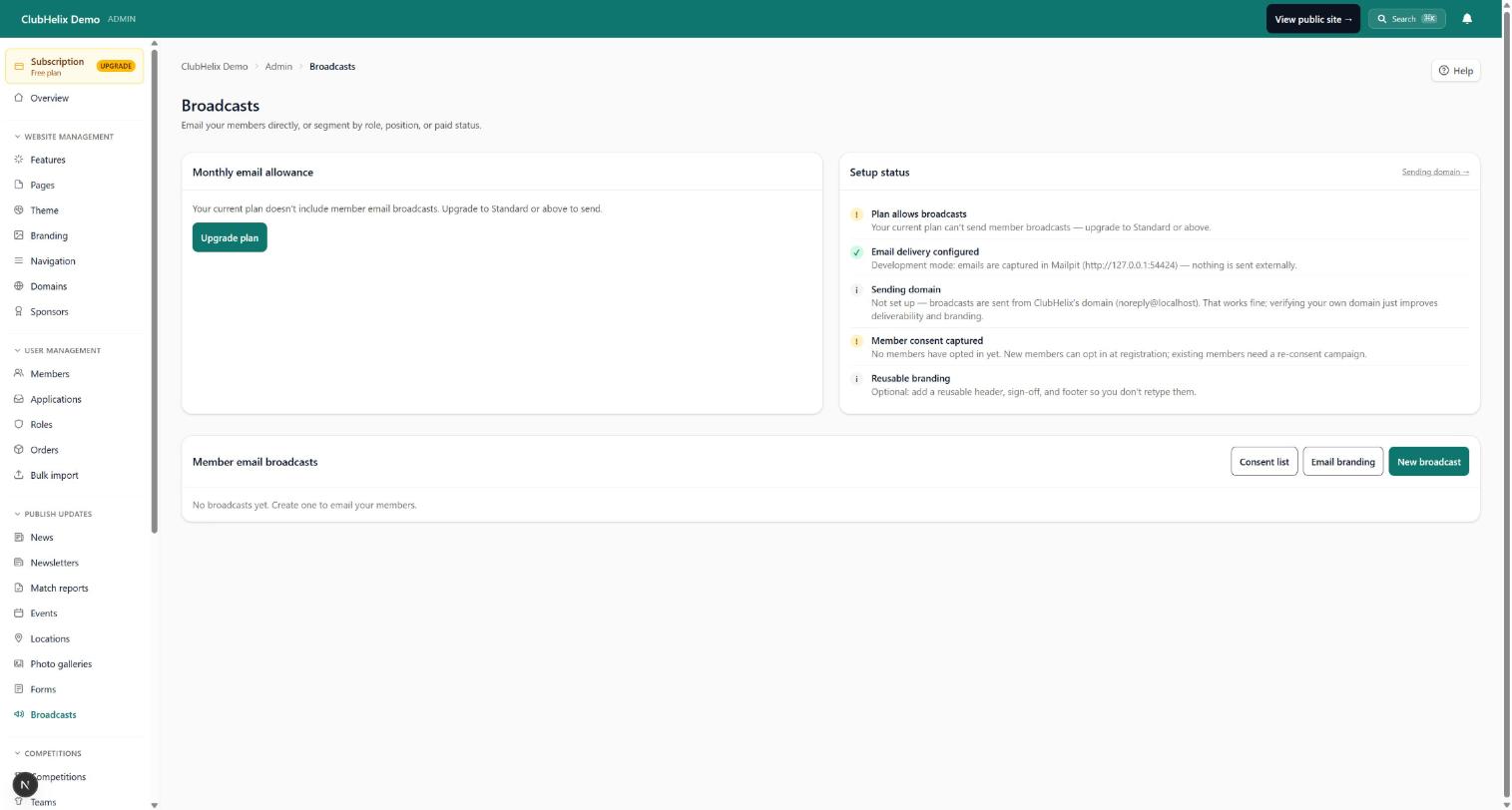
A proper email broadcast tool lets you pick an audience (whole club, one team, unpaid members), drop in your template, and schedule the send — with delivery and open tracking so you know it arrived. Meanwhile automatic transactional emails — welcome messages, payment receipts, registration confirmations — go out on their own the moment they're triggered, which quietly retires templates 1 and 3 from your to-do list. Tie it together with a simple club communication plan so everyone knows what gets sent, when, and by whom.
| When to send | Best channel | |
|---|---|---|
| Welcome | Immediately on registration | Automatic email |
| Registration open | 4–6 weeks before season | Broadcast |
| Fees due | 2 weeks before due date | Broadcast + follow-up |
| Wet weather | The moment the call is made | Email + SMS |
| Event invite | 3–4 weeks out, remind at 1 week | Broadcast |
| Volunteer ask | 2 weeks before the day | Broadcast |
| AGM notice | Per your constitution (14–21 days) | Broadcast |
| Sponsor thank-you | Within a week of season end | Personal email |
If you'd rather spend your Tuesday nights on anything else, ClubHelix bundles the whole pipeline — member database, audience-targeted broadcasts, automatic welcome and receipt emails, and a branded sender on your own domain — with a free tier to start on. See pricing for what's included.
Frequently asked questions
How long should a club email be?
As short as it can be while carrying the action: for most operational emails that's under 150 words. Save longer storytelling for a monthly newsletter, and keep reminders, cancellations and invitations to a few lines with one clear link.
What's the best time to send club emails?
Evenings between 6pm and 9pm generally work well for volunteer-run clubs, because that's when members are off work and checking phones. Consistency matters more than perfection — urgent messages like cancellations should simply go the moment the decision is made.
Should clubs use email or SMS?
Both, for different jobs. Email suits anything with detail or links — newsletters, invitations, fee reminders — while SMS is for time-critical messages like same-day cancellations, where you need it read within the hour.
How do I stop club emails going to spam?
Send from an authenticated address on your club's own domain, email only opted-in members, and keep content clean and text-led. If problems persist, check your SPF and DKIM records — our spam guide covers the fixes step by step.


