
What this guide answers
- Does being a member count as consent to club emails?
In many places membership can support inferred or implied permission for messages genuinely about the club — fees, training, the AGM.
- Should we ever turn off the opted-in-only option?
As a rule, no. It exists to stop the club emailing people whose records say they did not agree, and turning it off shifts a legal risk onto the committee.
- How do we email members who have never opted in?
You ask them, rather than emailing around the problem. Run a single, clear re-consent message to current members explaining what the club sends and linking straight to their account page, back it up in person at…
- What is the difference between unsubscribing and being suppressed?
An unsubscribe is the member's decision: they used the link, their consent is withdrawn, and they are excluded from future sends.
- Do we need consent for text messages too?
Treat SMS as a separate question with its own answer. In several countries text messaging sits under stricter rules than email, with its own consent requirements and its own penalties, and an email opt-in does not…
New Zealand edition. This guide is written for volunteer-run clubs in New Zealand. Where rules differ — grants, tax, incorporation, safeguarding — follow the New Zealand-specific pointers below or check with your national body.
Most committees discover consent the same way. Somebody goes to send the fee reminder, sees a recipient count of 61 against a roster of 240, and assumes the software is broken. It isn't. It is telling you that 179 of your members have never said the club may email them, and it is declining to guess on your behalf.
That moment is worth taking seriously rather than working around. Consent is the one part of club email that is not a technical setting you can tune later — it is a record of what each member actually agreed to, and you either have it or you do not. The good news is that collecting it properly is a form field, a short campaign and a habit, and a club that does it once rarely has to think about it again.
A note before we start: this is a plain-language guide to general practice, not legal advice. Anti-spam and privacy rules differ between countries and they change. Check your own obligations with your national body, your insurer or a solicitor before you rely on anything here — especially if your club sells anything, runs fundraising, or emails people who are not members.
Permission and deliverability are two different problems
It is easy to run these together, and clubs that do end up fixing the wrong one.
Deliverability is the technical question: will a mail provider trust this message enough to put it in front of the reader? That is authentication records, sender reputation and list decay, and it is covered in why club emails go to spam.
Permission is the prior question: are you entitled to email this person at all? Nothing about SPF, DKIM or a warmed-up sending domain answers it. A perfectly authenticated message to somebody who never agreed to hear from you is still a message you should not have sent.
The two do meet in one place, and it is worth knowing where. People who did not ask for your mail are far more likely to mark it as spam, which is how a permission problem turns into a deliverability problem a few months later. Fix permission first and most of the other problem quietly goes away.
Express consent and inferred consent
Broadly, permission comes in two flavours.
Express consent is somebody actually saying yes. A ticked box on a registration form that was not pre-ticked, a reply to an email asking them to confirm, a signature on a paper form with a clear line about club emails. It is unambiguous, it is recordable, and it is what you should be collecting.
Inferred or implied consent is permission that arises from the relationship itself. The reasoning is that a person who has joined your club, paid a subscription and put their address on the form plainly expects the club to contact them about club things. This is real in most places, and it is why your committee has not been in trouble for the last decade of AGM notices.
Two cautions about relying on it, though. The first is that inference is narrower than clubs assume: it covers messages that are genuinely about the relationship — training times, fees, the AGM — and it gets thin fast once a message is really about a sponsor's promotion, a merchandise sale or a third party's offer. The second is that inference generally has an expiry date. The relationship it rests on is the current membership; once somebody stops being a member, the basis for writing to them starts to run out.
So the practical policy for a club is simple: collect express consent anyway. It is cheap, it removes the arguments, and it means nobody on the committee has to make a judgement call about whether this particular email counts.
The governing law is the Unsolicited Electronic Messages Act 2007, administered by the Department of Internal Affairs. It recognises express, inferred and deemed consent — membership of a club can support an inference for club-related messages — but it also requires accurate sender identification and a working unsubscribe facility that is actioned promptly, within five working days. There is no exemption for small or volunteer-run organisations.
The tick box that is on by default, and why
When you compose a broadcast there is an audience option reading Only members who opted in to club emails, and it is switched on before you touch anything. The same option appears, ticked, in the newsletter send dialogue.
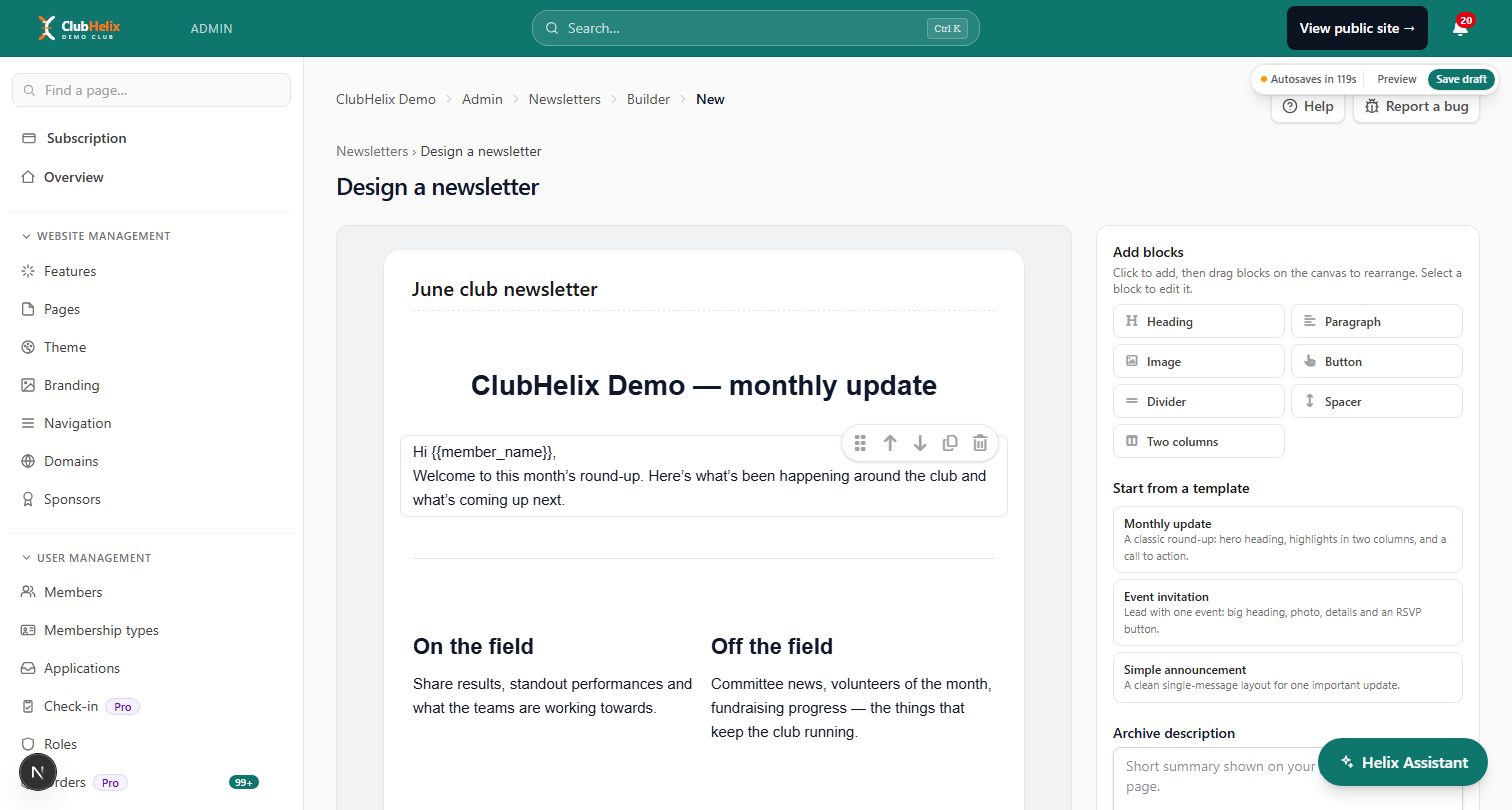
That default is deliberate, and it is the safe position rather than the cautious one. Turning it off means writing to people whose records say they have not agreed to club email — which is a legal exposure for the club and the committee, not a technical preference. There are legitimate reasons to reconsider the audience (a constitutionally required AGM notice is the obvious one, and worth a conversation with your own adviser), but "the count looked too low" is not one of them.
If the count looks too low, the answer is to go and collect the consent. That is what the rest of this guide is about.
Where opt-in actually gets captured
Consent has to be asked for somewhere. In a club there are exactly three places that work, and they cover different people.
At registration. This is the big one. Members can opt in to club emails at the point they join, as part of the self-registration flow, which means every person who joins from today forward arrives with an answer already recorded. If your club adds nothing else from this guide, add this — it turns consent from a project into a background process.
On the member's own account page. Existing members can set their own email preference from their account at any time. This matters for two reasons: it is where you send people during a re-consent campaign, and it means a member who changes their mind does not have to email the secretary and wait.
On a paper or in-person form. Plenty of clubs still sign people up at a come-and-try day with a clipboard. That is fine, provided the form has a clear, unticked line about club emails and somebody transfers the answer into the member record the same week. A consent recorded on paper and never entered is a consent you cannot prove and cannot use. If you are building that form digitally, the club's forms and surveys can capture the same question and keep the answer with the submission.
Ask the question so the answer means something
A consent question that nobody understands is worth very little, however many people tick it. Four things make a difference:
- Never pre-tick the box. A pre-ticked box is the clearest possible way to make a consent record worthless, and under several regimes it is not consent at all.
- Say what you will send and roughly how often. "Club news, fixtures, fee reminders and the monthly newsletter — around two emails a month" tells somebody what they are agreeing to. "Receive communications from us" tells them nothing.
- Keep it separate from the other tick boxes. Bundling email consent into the same box as the code of conduct, the photo permission or the terms of membership makes it impossible to say which one the member actually agreed to. One question, one box, one answer.
- Say it can be changed at any time. People agree more readily to things they can undo, and it is true — their account page is right there.

Running a re-consent campaign
If your club has an existing roster with no consent recorded against it, you need to ask. This is a short, one-off piece of work, and the shape of it is the same everywhere.
- Work out who you can legitimately write to at all. Current members with a live relationship with the club are the straightforward group. People who lapsed years ago are not — see below.
- Send one clear message, not a campaign. Explain what the club sends, how often, and exactly where to say yes: their account page. Keep it under 200 words. There is a house style you can borrow from club email templates — the welcome email's structure works well for this with the ask swapped out.
- Make the yes one click away. Every extra step loses people who genuinely wanted to say yes. A direct link to the account page beats "log in and find your preferences".
- Back it up offline. Mention it at training, put it in the newsletter, hand the club captains a line to say at the end of the session. A re-consent campaign that lives only in email is asking people who may not see your email to confirm that they want your email.
- Send one reminder, then stop. Two messages is asking. Five is the behaviour the rules exist to prevent, and it converts people who were undecided into people who report you.
- Set the expectation with the committee. A realistic response is a decent fraction of your active members, not all of them. The people who do not answer are not lost — they will answer at renewal, when the registration form asks them again.
Run it once a year alongside renewals, and the question answers itself from then on.
Unsubscribes: honour them immediately, no exceptions
Every broadcast automatically carries an unsubscribe link in its footer. It cannot be removed, and it should not be — it is required, and it is also the pressure valve that stops an annoyed member reporting you as spam instead.
When somebody uses it, they come off the consent list straight away and are excluded from future sends whatever audience you pick. That is the whole mechanism, and the committee's job is simply not to undermine it: do not re-add somebody from a spreadsheet, do not "just this once" include them in a send because the message is important, and do not treat a reply saying "please take me off the list" as anything other than an unsubscribe — action it in the member's record the same day. The legal timeframes are measured in days, but the only sane policy is immediately.
One thing an unsubscribe does not stop is transactional email — the receipt for a payment they just made, a registration confirmation, a booking reminder. Those are not marketing, they are the club fulfilling something the member did, and they continue. The line is easy to hold as long as you do not start putting promotions in receipts.
Your consent list is the evidence
Consent you cannot demonstrate is consent you do not really have. The consent list in the broadcasts area shows the members who have opted in, lets you page through them, and exports to CSV.
Use the export deliberately, not just when something has gone wrong:
- Take a copy at the start and end of each season and keep it with the committee's records. If somebody ever asks when and how a member agreed, you want an answer with a date on it.
- Check the number against your roster before a major send, so you learn about a gap in advance rather than at 9pm on deadline night.
- Hand it over at changeover. The incoming secretary inheriting a dated consent export is in a completely different position from one inheriting a folder of spreadsheets.
Treat the export like any other member data: it is personal information, so keep it where the committee keeps its other confidential records, and delete old copies rather than letting them accumulate on somebody's personal laptop.
Suppression, bounces, and what they tell you about permission
Alongside the consent list there is a suppression list, which your club's admins can view under the club's email settings. Addresses land on it automatically when mail to them bounces or when somebody reports a message as spam, and the platform then stops sending to that address. An admin can remove an entry, which is the right call for a genuine typo that has since been fixed, and the wrong call for somebody who complained.
Read the list as information about permission rather than as a technical fault:
- A hard bounce usually means the address no longer exists — the member changed jobs, left the provider, or the address was mistyped on a paper form. Fix the member record; do not keep trying.
- A spam report is a member telling you, in the bluntest available way, that they did not want this. It is not a deliverability bug to be engineered around. Treat it as a withdrawn consent, leave them suppressed, and look at whether the message should have gone that wide at all.
- A cluster of new suppressions after one send is a signal about the send, not about the addresses. Something went to too many people, or said something they did not expect from the club.
People who have left
The hardest habit for a club to build is letting go of addresses.
A former member is exactly the person for whom implied permission has run out, and in some places it does so on a defined clock. It is also the person most likely to report an unexpected email, because from their side the club has no obvious reason to be writing to them. "We'll keep them on the list in case they come back" is how a friendly club ends up with a complaint.
A workable policy:
- Keep membership status current in the roster, so "current members" means something. This is the whole reason for sending to the live database rather than an exported list, as how to email your club members sets out.
- Stop marketing to people who have left once their membership has genuinely lapsed. One "sorry to see you go, here is how to rejoin" message at the end of a season is defensible; a monthly newsletter two years later is not.
- Write down how long you keep member records, and hold to it. Your privacy policy should say what the club keeps and for how long, and old member data you have no reason to hold is a liability rather than an asset.
- Keep the alumni question separate. If your club genuinely wants a past-players list for reunions and fundraising, that is a list people should join on purpose — not one they get put on by lapsing.
A consent checklist for your next committee meeting
- The registration form asks the email question, unticked, in plain words.
- Members can change their answer themselves from their account page.
- Your consent count and your member count are in a sensible relationship, and you know why any gap exists.
- The opted-in-only option stays on, and nobody turns it off without a conversation.
- Unsubscribes and emailed opt-out requests are actioned the same day.
- A dated consent export lives with the committee's records.
- Somebody has read the suppression list this season.
- Former members drop off the list when their membership lapses.
- Your privacy policy says what the club keeps and for how long.
Eight of those nine are the work of one evening. The ninth is the habit, and it is the one that makes spam-safe club email something your club simply does rather than something it worries about.
Frequently asked questions
Does being a member count as consent to club emails?
In many places membership can support inferred or implied permission for messages genuinely about the club — fees, training, the AGM. But the inference is narrower than most committees think, it weakens as the content gets more promotional, and it generally expires when the membership does. Rules also differ by country, which is why the safe answer is to collect express consent at registration and treat inference as a backstop rather than a plan. Check your own obligations rather than relying on what another club does.
Should we ever turn off the opted-in-only option?
As a rule, no. It exists to stop the club emailing people whose records say they did not agree, and turning it off shifts a legal risk onto the committee. There is a genuine question about constitutionally required notices such as an AGM, where your rules may oblige you to notify every member — but that is a question to put to your own adviser and to record the answer to, not a setting to flip because a recipient count looked disappointing.
How do we email members who have never opted in?
You ask them, rather than emailing around the problem. Run a single, clear re-consent message to current members explaining what the club sends and linking straight to their account page, back it up in person at training and in the newsletter, send one reminder, and then let the registration form pick up the rest at renewal. Members who never answer are not permanently lost — they simply answer the next time they renew.
What is the difference between unsubscribing and being suppressed?
An unsubscribe is the member's decision: they used the link, their consent is withdrawn, and they are excluded from future sends. Suppression is the system's decision: mail to that address has bounced or been reported, so nothing further is sent to it. An admin can remove a suppression entry — appropriate for a typo that has been corrected, not for somebody who complained. Neither one stops a receipt or a registration confirmation.
Do we need consent for text messages too?
Treat SMS as a separate question with its own answer. In several countries text messaging sits under stricter rules than email, with its own consent requirements and its own penalties, and an email opt-in does not carry across. If your club plans to send texts, ask for that permission explicitly and keep the record of it separate from the email one.
ClubHelix records email consent on the member's own record, captures it at registration, keeps receipts and confirmations separate from marketing, and defaults every broadcast to opted-in members only. Start a club site and have it right from the first send.


