
What this guide answers
- Does a small club really need a conflict of interest policy?
Yes, and small clubs need it more than large ones, because their committees are drawn from a small pool where everyone is connected to everyone.
- What is the difference between an actual, potential and perceived conflict?
An actual conflict exists now — you own the business bidding for the work.
- Can a committee member's business supply the club?
Usually yes, provided the interest is declared, the person takes no part in scoping the work, choosing the supplier, approving the invoice or receiving the goods, the club follows its normal procurement process…
- How should a conflict be recorded in the minutes?
Record four things — the interest declared and by whom, how the committee decided to manage it, the physical fact of any withdrawal with times if the person left the room, and the outcome of the vote taken without them.
- Who keeps the conflict of interest register?
The secretary normally maintains it as part of the club's governance records, with the president responsible for making sure the annual declarations actually get completed.
Canada edition. This guide is written for volunteer-run clubs in Canada. Where rules differ — grants, tax, incorporation, safeguarding — follow the Canada-specific pointers below or check with your national body.
The committee is choosing a supplier for next season's playing kit. Three quotes are on the table. The cheapest is from a business owned by the vice-president's brother — and it genuinely is the cheapest, because he has been doing the club a favour on price for years. Nobody in the room thinks anything dishonest is happening. The committee accepts the quote, the minutes record "kit supplier confirmed", and everyone goes home.
Eighteen months later a member who missed out on a coaching role asks, at a general meeting, why the club buys its kit from a committee member's family. There is no good answer available in the moment, because the only record is one line that mentions neither the relationship nor the other two quotes. A decision that was completely defensible when it was made is now indefensible, and the vice-president — who did nothing wrong — resigns.
That sequence is the reason clubs need a conflict of interest policy, and it is not the reason most people assume. Small community clubs are built out of overlapping relationships: the coach on the committee, the treasurer whose partner runs the canteen, the president who is also the ground's neighbour, the secretary whose employer sponsors the jerseys. Those overlaps are not a failure of governance, they are what a community club is made of. The failure is only ever this — not declaring, and not recording how the decision was handled. This guide gives you the policy, the register, the words to use when it happens live in a meeting, and a clean way to handle buying from people you know.
This is general information for volunteer committees, not legal advice. Your own rules and the regulator that oversees your club's structure set the actual obligations, so check the current requirements with them or with your governing body.
What counts as a conflict of interest
A conflict exists whenever a committee member's duty to act in the club's best interests could be affected by another interest of theirs. Three flavours, all of which need declaring.
- Actual. A direct interest right now — you own the business tendering for the resurfacing job.
- Potential. An interest that could become live — your firm is likely to bid when the club goes to market next year.
- Perceived. Nothing improper is happening, but a reasonable member looking at it from outside could think otherwise — your daughter is selected in the representative side you helped choose.
Perceived conflicts are the ones clubs dismiss, and they are the ones that cause the damage, because a perception cannot be argued away after the fact. It can only be prevented, by being on the record in advance.
The interest does not have to be money. Non-financial conflicts are just as real and more common in clubs: family and close friendships, loyalty to a particular team or age group, a personal dispute with someone affected by the decision, a role at another organisation the club deals with, or a position you hope to be appointed to.
A quick test that works in the room, before anyone reaches for the policy: would you be comfortable if this decision, and your connection to it, were printed side by side in the club newsletter? If the honest answer is a wince, declare it.
The conflicts every small club actually has
Rather than a theoretical list, here are the ones that turn up in real committees, with a proportionate way to handle each. Proportionate is the operative word — treating a five-dollar interest like a five-thousand-dollar one is how policies get quietly ignored.
| Situation | Why it is a conflict | Proportionate handling |
|---|---|---|
| A committee member's business quotes for club work | Direct financial interest in the outcome | Declare, leave the room for discussion and vote, record the quotes considered |
| The coach also sits on the committee | Sets the terms of their own role | Declare annually, withdraw from coaching appointment, pay and review decisions |
| A selector's child is eligible for the team being selected | Perceived interest in a discretionary decision | Declare, and use a selection panel where they do not decide their own child |
| The treasurer's partner runs the canteen | Related-party trading and payment approval | Declare, second signatory approves any payment to that party |
| A committee member also holds office at the association or league | Divided loyalty on disputes and entries | Declare on appointment, withdraw from items where the two bodies differ |
| A member applies for a paid role the committee is filling | Direct interest, and access to other candidates' details | Step aside from the whole recruitment process, not just the final vote |
| A sponsor's owner joins the committee | Interest in sponsorship terms and renewals | Declare, withdraw from sponsorship negotiation and approval |
| Two committee members are related | Voting blocs and perceived control | Declare the relationship on appointment; both withdraw from decisions affecting either |
| A committee member is subject to a disciplinary matter | Cannot be a decision-maker in their own case | Excluded from the process entirely, with the exclusion minuted |
| A grant application benefits one team a member coaches | Perceived preference in allocating club resources | Declare, participate in discussion, abstain from the vote, record the abstention |
Notice that the answer is almost never "that person should resign" or "the club should not do business with them". In a town with one signwriter and one earthmoving contractor, refusing to deal with anyone connected to the club would mean not fixing the ground. The answer is declare, manage, record.

The policy — copy, adapt, adopt
Adopt this by resolution at a committee meeting, minute the adoption, and put the review date in your annual calendar. Adjust the wording to match your own rules, which always take precedence.
[CLUB NAME] — Conflict of Interest Policy Adopted: [date] Review: [date, annually] Owner: Secretary
1. Purpose. The club is run by volunteers drawn from its own community, so overlapping interests are expected. This policy exists so that those interests are declared, managed openly and recorded — protecting both the club's decisions and the reputation of the people making them.
2. Who this applies to. Every committee member, every person co-opted onto a sub-committee or panel, and any volunteer involved in selecting suppliers, appointing people to roles, allocating club funds, or making selection or disciplinary decisions.
3. What must be declared. Any interest — financial or not — that could reasonably be seen to influence how a person carries out their club duties. This includes interests held by a spouse or partner, close family member, household member, employer, business partner, or an organisation the person is an officer of.
4. Annual declaration. Each person covered by this policy completes a written declaration on appointment and again each year after the annual general meeting, listing known interests. A nil return is still a return.
5. Declaration at meetings. Conflicts are a standing item at the start of every committee meeting. Where an interest arises during a meeting, it is declared as soon as the person becomes aware of it, before discussion of that item continues.
6. Managing a declared conflict. The committee, excluding the person concerned, decides which of the following applies and records the decision — (a) participate normally, the interest being immaterial; (b) participate in discussion but not vote; (c) remain but neither speak nor vote; (d) leave the room for discussion and decision; (e) step aside from the matter entirely, including any related correspondence or documents.
7. Quorum and records. A person who withdraws is not counted towards quorum for that item. The minutes record the interest declared, the management decision, who was absent for what, and the outcome of the vote.
8. The register. The secretary maintains a conflict of interest register recording every declaration and how it was managed. The register is available to any committee member on request and to members in accordance with the club's rules.
9. Gifts and benefits. Gifts, hospitality or discounts offered to a committee member because of their club role are declared and recorded above a nominal value set by the committee. Nothing is accepted where it could reasonably be seen to influence a decision the club has not yet made.
10. Related-party transactions. Purchases from, or payments to, a committee member or a person or business connected to them follow the procurement rules in section 11, are approved by people with no interest in them, and are disclosed in the club's annual report.
11. Procurement. Above the threshold set by the committee, the club obtains at least three quotes, records why the successful one was chosen, and has the payment approved by two people with no interest in the supplier.
12. Breaches. Failing to declare a known interest is a breach of this policy. The committee considers each case on its facts and may re-open the affected decision, record a caution, remove the person from the relevant portfolio, or refer the matter under the club's disciplinary rules.
13. Review. Reviewed annually by the committee, and whenever the club's rules change.
The declarations register
The register is what makes the policy real, and it is a single table. Keep it with the club's governance records, not in the secretary's personal files.
| Date | Name | Role | Interest declared | Type | How managed | Minute ref |
|---|---|---|---|---|---|---|
| 12 Mar | [name] | Treasurer | Partner operates the canteen under club contract | Actual | Second signatory approves canteen payments | 2026-03/7.2 |
| 12 Mar | [name] | Committee | Employed by a business that sponsors the senior team | Perceived | Withdraws from sponsorship renewal items | 2026-03/7.4 |
| 9 Apr | [name] | Selector | Child eligible for representative selection | Perceived | Not on the panel deciding that age group | 2026-04/6.1 |
| 9 Apr | [name] | President | Nil | — | Annual nil return | 2026-04/2 |
Run it on three rhythms and it maintains itself. Annually, everyone completes a declaration at the first meeting after the AGM. Every meeting, the chair asks the standing question and any new declaration is added — which is exactly why conflicts sit at item two on the committee meeting agenda, before any business is discussed. Per decision, anything declared in the room is written into the minutes for that item as well as the register, so the two records agree.
Three things make a register survive a committee change. Fix the fields before the first entry — the seven columns above, unchanged, so a row from 2024 reads the same way as a row from this month; a register whose shape drifts cannot be scanned. Decide who may read it: it holds personal information about your committee members, including facts about their families and employers, so treat it the way you treat the member roster rather than the way you treat the fixture list — the committee and the club's auditor, not the whole membership, unless your rules or your association say otherwise. And decide how long you keep it, alongside the minutes it references, because a register pruned to keep it tidy destroys the only evidence that a decision was handled properly. Your record-keeping and retention schedule is the place to write that down once.
In a spreadsheet all three are decisions your committee has to keep making. Kept in ClubHelix, the first two are settled once — the fields are fixed and who may read it is enforced rather than agreed — and the third is still yours, because only your club knows what its own rules and its regulator expect. There is more on that at the end of this guide.
One more habit worth adopting: summarise related-party transactions in the annual report. A single honest line — "the club purchased ground maintenance services totalling the amount shown in note 4 from a business associated with a committee member; three quotes were obtained and the member took no part in the decision" — permanently ends the conversation that would otherwise happen in the car park at the AGM.
Handling a conflict live in a meeting
The policy is easy. The awkward thirty seconds in the room is the hard part, and having words ready is most of the job. Here is how it runs.
The chair asks, every meeting, at item two. "Before we start — does anyone have an interest in tonight's items?" Asking every time is what makes declaring routine rather than dramatic. The first month it feels stiff; by the third it is as unremarkable as apologies.
The declaration itself is one sentence. "On item 6.2, the fencing quote — one of the quotes is from my cousin's company. I will step out for that item." No apology, no explanation, no defensiveness.
The committee decides how to manage it, not the person declaring. That is the part clubs get backwards. The chair puts it briefly: "Thanks. Committee, are we comfortable that leaving the room for that item is the right handling?" Ten seconds, and the decision belongs to the group.
The minute is written at the time. Something like — "Item 6.2. [Name] declared an interest, being a family connection to one of the quoting businesses. The committee resolved that [name] withdraw for discussion and voting. [Name] left the room at 7.42pm. Three quotes were considered. Motion — that the quote from [supplier] at the amount in paper 4 be accepted. Moved [name], seconded [name]. Carried, 6 votes to 0. [Name] returned at 7.51pm." That minute is the entire defence of the decision, forever. Our minutes template has the wider structure this fits into.
Nobody comments on it afterwards. No jokes as the person leaves, no "we didn't say anything bad about you" when they return. The culture around declarations is what determines whether people keep making them, and clubs that make it feel like an accusation train their committee to stay quiet.
Some of this is not optional. Not-for-profit corporations legislation generally requires a director or officer with a material interest in a contract or transaction to disclose it and to refrain from voting, and registered charities face additional restrictions on transactions that benefit directors. Check the current requirements under the statute your club is incorporated under, and with the CRA if the club is a registered charity.
Related-party purchases, kept clean
Buying from people connected to the club is normal in community sport and often good value. Four rules make it safe.
Set a threshold and stick to it. Below the threshold, a declaration in the register is enough. Above it, the full procurement process runs — three quotes, written reasons for the choice, two disinterested approvers.
For most community clubs a threshold somewhere between $500 and $1,000 for a single purchase works, with a lower figure for anything involving a related party — say $250 — because the point is transparency rather than price. Set the numbers in the policy, review them annually, and keep them in the same currency and format as your budget so nobody has to convert anything in their head.
Separate the roles. The person with the interest does not scope the work, does not choose the supplier, does not approve the invoice and does not receive the goods. In a small committee that can feel like overkill, right up until the day it is the only thing standing between a volunteer and an accusation.
Write down why, not just what. "Accepted quote B, which was not the lowest, because it included removal of the old surface and a two-year warranty." Future committees and members can live with a decision they understand. They cannot live with one that looks arbitrary.
Disclose it. In the minutes at the time, in the register, and in the annual report. Disclosure is what converts a related-party purchase from a rumour into a recorded, reasoned decision.
The same logic applies to gifts and hospitality. A supplier shouting the committee dinner during a tender is a problem; a long-standing sponsor donating a hamper for the raffle is not. Set a nominal value in the policy, record anything above it, and decline anything offered while a decision is still open.
When someone does not declare
Assume oversight before assuming dishonesty — most non-declarations are genuine blind spots, especially perceived conflicts and interests held by a family member. A proportionate ladder:
- A quiet word from the president, plus a retrospective entry in the register. This resolves the overwhelming majority of cases.
- Re-open the decision where the undeclared interest could have affected the outcome. Retaking the decision cleanly, with the person absent, removes the problem entirely — and is far cheaper than defending it later.
- Remove the person from the relevant portfolio where the conflict is structural and continuing, rather than removing them from the committee.
- Refer it under the club's disciplinary rules where the failure was deliberate or the club suffered a loss. That step belongs to the rules in your constitution, not to this policy — the constitution guide covers how those provisions usually work.
Whatever the step, record it. A club that handles one non-declaration openly teaches its whole committee the standard far more effectively than any amount of policy circulation.
Keeping the record where the club can find it
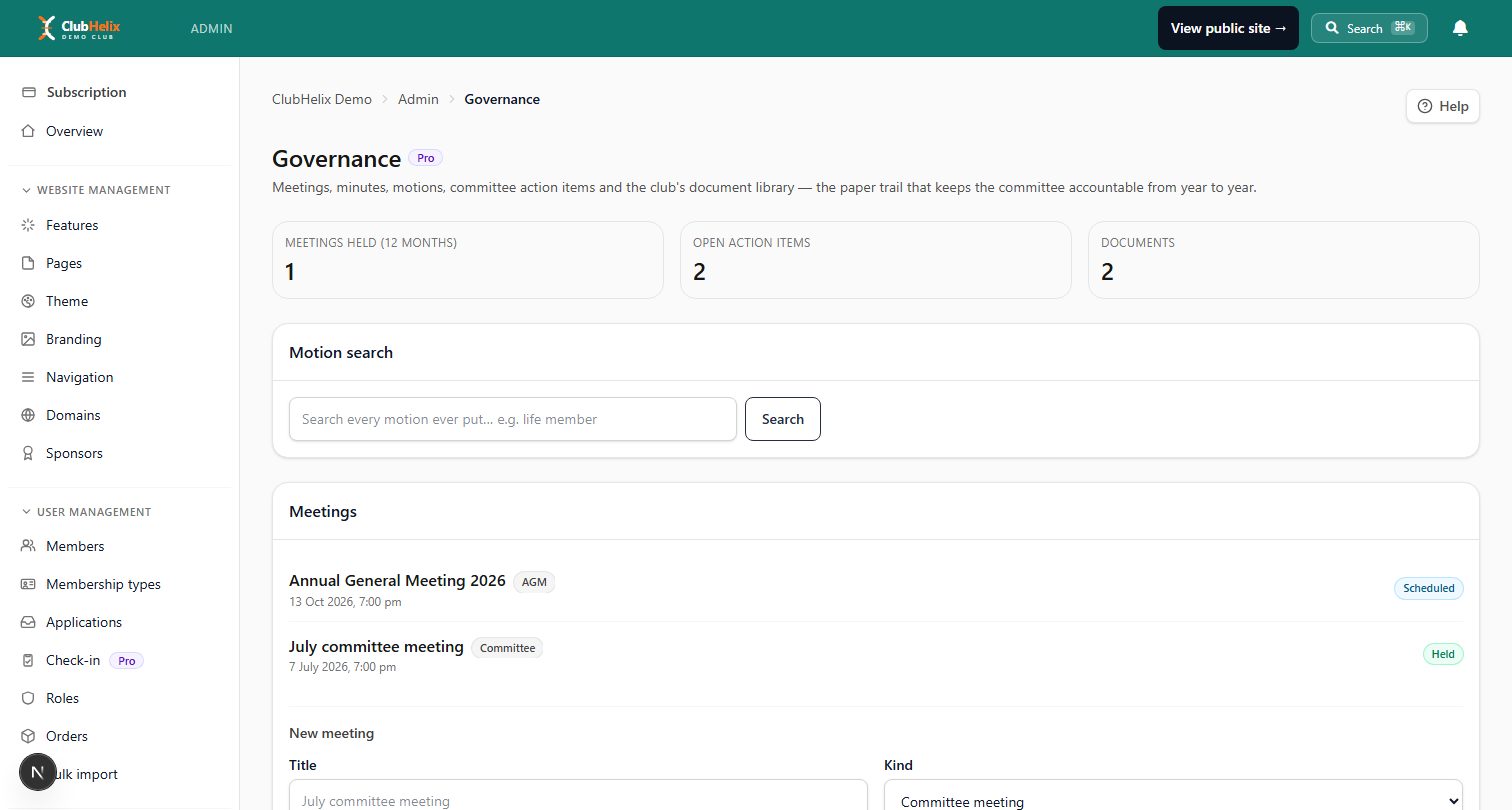
A conflicts policy fails in exactly one way — the register sits in a document on someone's laptop, the minute that explains the decision sits in a different document, and neither is findable three years later when the question is finally asked. ClubHelix keeps meetings, minutes and motions in the club's own account: minutes lock once adopted, every motion is stored with its mover, seconder and result, and motion search pulls up each resolution the club has carried on a topic. The policy itself belongs in the same document library, where each document carries its own visibility — admins only, the committee, or all members through a documents page on your public site. Alongside it, the audit log records who changed what and when.
The register now has a home there too, beside the minutes it refers to. On the Pro plan, Club operations → Conflicts of interest is the table this guide describes, built in. Each entry records who disclosed the interest and what it is, the other party, the meeting or the decision it relates to, and — as a required field rather than an optional one — how the committee managed it. Three counts sit above the entries — interests still in force, entries in total, and interests declared but not yet tabled at a meeting, which is the gap worth chasing before anyone else notices it. An entry is attached to the office as well as the person, so a handover carries it to whoever holds that position now while keeping the title the office had at the time. Marking an entry tabled makes it permanent — after that it can be marked lapsed or withdrawn, never deleted, which is the difference between a register and a list.
Who may read it is not a setting somebody can get wrong. The secretary keeps it, through the same permission that covers meetings and documents, and so does any club administrator. Committee position holders and the person named in an entry may read it, though opening the admin page itself takes that same permission, so in practice a committee member asks an administrator or reads it in the minutes. Ordinary members, the public and any organisation above you in a federation see nothing at all — a disclosure names a person and usually their money, and that is not a member page. The help page walks through recording a disclosure, tabling it and retiring it.
Good governance should not cost a volunteer their weekend. ClubHelix runs your website, members, payments, events and committee records together, with a free tier for small clubs and pricing published in full. Create your club's account and put your first declarations register somewhere it will still be findable in a decade.
Frequently asked questions
Does a small club really need a conflict of interest policy?
Yes, and small clubs need it more than large ones, because their committees are drawn from a small pool where everyone is connected to everyone. The policy is not an accusation of dishonesty — it is what protects honest volunteers when a decision is questioned later. It also tends to be expected by funders, insurers and governing bodies, and some legal structures impose disclosure duties on committee members regardless of whether the club has written a policy.
What is the difference between an actual, potential and perceived conflict?
An actual conflict exists now — you own the business bidding for the work. A potential conflict could arise — you are likely to bid when the contract comes up next year. A perceived conflict is where nothing improper is occurring but an outside observer could reasonably think otherwise, such as helping select a team your child plays in. All three should be declared, because perception is the one you cannot correct after the decision has been made.
Can a committee member's business supply the club?
Usually yes, provided the interest is declared, the person takes no part in scoping the work, choosing the supplier, approving the invoice or receiving the goods, the club follows its normal procurement process including comparison quotes, and the transaction is minuted and disclosed. Some structures place extra restrictions on payments to committee members or trustees, so check what applies to your club before entering into an arrangement rather than afterwards.
How should a conflict be recorded in the minutes?
Record four things — the interest declared and by whom, how the committee decided to manage it, the physical fact of any withdrawal with times if the person left the room, and the outcome of the vote taken without them. Add the same entry to the standing declarations register with a reference back to the minute. Those two records together are what make the decision defensible years later.
Who keeps the conflict of interest register?
The secretary normally maintains it as part of the club's governance records, with the president responsible for making sure the annual declarations actually get completed. Keep it in club-owned storage rather than a personal drive, review it at the first meeting after the annual general meeting, and make sure the incoming committee is handed a current version — a register that resets to blank at every changeover is not a register. In ClubHelix that is the Conflicts of interest page under Club operations, which keeps entries against the office rather than only the person, so a handover carries them across instead of losing them.
Keep reading — the committee meeting agenda template shows where the standing declaration item sits, and the minutes template covers recording the decision that follows.
