
What this guide answers
- How long should the pack be?
Aim for something a busy volunteer reads in ten minutes on a phone.
- Should the pack go to all members or just the committee?
The committee, by default. Some clubs publish a members' version — membership numbers and a summary financial position — which builds real trust, but it should be a deliberate decision with the personal data stripped…
- What if a portfolio holder never files their bit?
That is exactly the problem automation solves. Reports generated from the club's own data do not depend on anyone filing anything.
- We are a tiny club. Is this overkill?
Do the three-report version. The habit matters more than the size: a small club that has been tracking membership and income monthly for two years can answer a grant application in an afternoon, and one that has not…
- How do we start?
Take one meeting to agree the list, the cadence and the owners, and minute it.
USA edition. This guide is written for volunteer-run clubs in the United States. Where rules differ — grants, tax, incorporation, safeguarding — follow the USA-specific pointers below or check with your national body.
Here is the meeting most clubs actually have. Someone asks how membership is tracking. Three people give three answers, all sincerely, all from different sources. Twenty minutes later the committee agrees to "get the numbers" and moves on, and next month the same twenty minutes happen again.
The fix is not better arguing. It is a committee report pack: the same set of reports, in the same order, distributed before the meeting rather than described during it. It takes one meeting to agree and then it runs itself.
What a report pack is
A pack is a fixed list of reports, produced on a fixed cadence, sent to a fixed group. That is all. Its power comes entirely from the three "fixed"s:
- Fixed list means nobody has to decide each month what to bring, so nothing is quietly dropped in a busy month.
- Fixed order means this month can be laid next to last month and read as a trend.
- Fixed group means the people making decisions have seen the numbers before they walk in.
The alternative — each portfolio holder bringing whatever they got around to — produces a meeting where the committee spends its time establishing facts instead of deciding things.
The eight reports in a monthly pack
This is the general-purpose set. Cut what does not apply; do not add much.
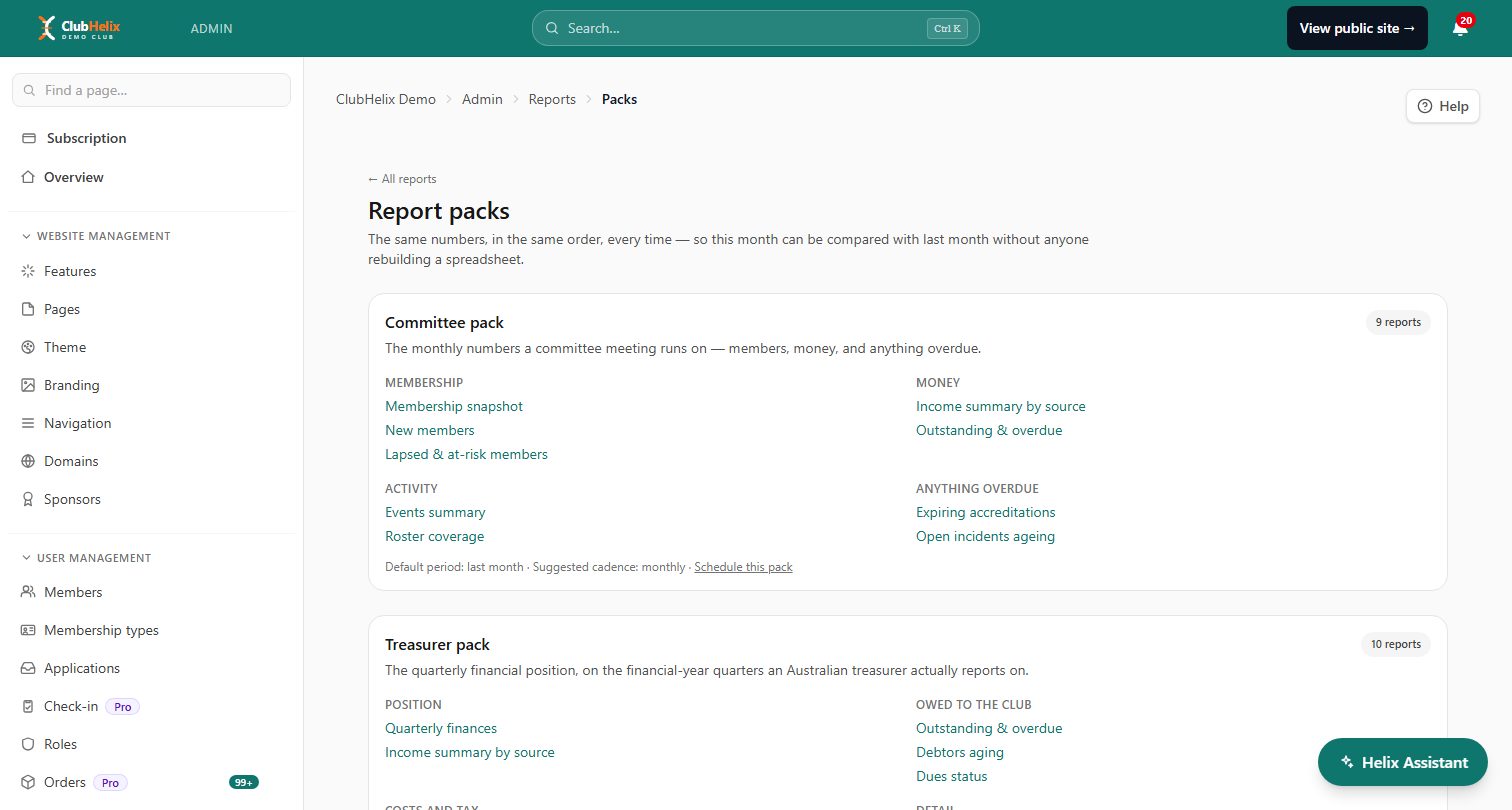
1. Membership snapshot. How many members right now, by status and type. One number, on a stated date, with the definition attached. This is the club's pulse.
2. New members this period. Who joined, and how they arrived. It tells you whether your recruitment is working, and it is the single best morale item in the pack.
3. Lapsed and at-risk. Who has stopped paying and who is about to. This is the report nobody wants to look at and everybody needs to. Acting on it in month one costs an email; acting in month six costs a member.
4. Income by source. Not a bank balance — a breakdown. Registrations, canteen, merchandise, events, fundraising, sponsorship, hire. The treasurer's report covers the position; this covers the mix.
5. Outstanding and overdue. What is owed to the club, aged. Pair it with the treasurer's written report, which explains what is being done about it.
6. Activity this period. Fixtures, sessions, events run and attendance at them. The club's actual output, which is easy to lose sight of when the agenda is all money and admin.
7. Anything overdue in compliance. Accreditations and checks expiring in the next ninety days, and open incidents that are ageing. Two short lists; usually empty; occasionally the most important page in the pack.
8. Roster and volunteer coverage. Which duties, roles and slots are unfilled. A committee can fix a coverage gap in a meeting if it knows about the gap in the meeting.
Who owns what
A pack fails when one person has to assemble it from other people's goodwill. Assign ownership explicitly, in the minutes, once:
| Report | Owner |
|---|---|
| Membership snapshot, new members, lapsed | Registrar / membership officer |
| Income by source, outstanding | Treasurer |
| Activity, attendance | Secretary or competition coordinator |
| Compliance expiries, open incidents | Safeguarding or compliance officer |
| Roster coverage | Volunteer coordinator |
If your club is small enough that those are three people wearing eight hats, the ownership still matters — it names who notices when something is missing.
Then agree the cadence, and put it in the minutes: "the committee pack is circulated five days before each ordinary meeting". Five days is the sweet spot. Two is not enough time to read it; ten and the numbers are stale by the meeting.
Making the pack arrive by itself
The reason packs lapse is that producing one is a chore that recurs forever, and volunteer attention is finite. Every pack that depends on somebody remembering will eventually stop.
So do not depend on it. If your club's members, money and activity all live in the same system, the pack is a saved set of reports that can be generated and emailed on a schedule — the first of the month, five days before the meeting, whatever you agree — as attachments the committee can read on a phone.
Two details make the automated version genuinely better than the manual one:
- The period is relative, not fixed. A saved view stores "last month", not "1 June to 30 June", so the same pack keeps producing the right window forever without editing.
- Permissions are per-report. A general committee member can receive the activity and membership counts without receiving member personal details or the money detail. That is not a nicety — it is what makes it safe to circulate the pack widely.

Reading the pack in the meeting
The pack is not the meeting. If someone reads the pack aloud, you have wasted it.
Run the item like this:
- "Any questions on the pack?" — thirty seconds. Most months, none.
- The exceptions only. The chair names the two or three things that moved: a drop in renewals, a category running behind, an accreditation about to lapse.
- A decision or an owner for each. "Registrar to run a reminder to the 14 unrenewed juniors before the 15th" is a minute. "We should look at renewals" is not.
That takes eight minutes and replaces the forty the club used to spend. The committee's time then goes to the things a committee is actually for — the lights, the coach, the sponsor, the grant.
Common mistakes
Too many reports. A twenty-page pack is not read, and an unread pack is worse than none because it creates the illusion of oversight. Eight is a good ceiling.
Changing the shape every month. The comparison is the point. Resist the urge to reformat.
No comparison figure. A number on its own is trivia. "412 members" means nothing; "412 members, up 9 on this time last season" is information.
Sending it during the meeting. If the pack lands as people sit down, they read it in the meeting, and the meeting becomes a reading room.
Confusing the pack with the minutes. The pack is evidence; the minutes are the record of what the committee decided about it. Keep them separate and file both.
Scaling the pack up and down
A club of forty members does not need eight reports. Start with three — membership, income by source, outstanding — and add as the club grows.
A club of two thousand, or an association with affiliated clubs, needs the opposite: a quarterly board pack sitting above the monthly one, with trend lines rather than snapshots, and comparison against the same period last season. The monthly pack answers "what is happening?"; the quarterly one answers "where is this going?"
For a body with clubs beneath it, the same discipline applies one level up — participation, compliance coverage and affiliation across every club, on definitions every club shares, so the comparison means something. That is a different pack for a different meeting, and it is worth reporting it separately rather than bolting it onto the club's own.
Frequently asked questions
How long should the pack be?
Aim for something a busy volunteer reads in ten minutes on a phone. Eight one-screen reports, not eight pages of tables. Detail belongs in an annexure people can open if they want it.
Should the pack go to all members or just the committee?
The committee, by default. Some clubs publish a members' version — membership numbers and a summary financial position — which builds real trust, but it should be a deliberate decision with the personal data stripped, not the committee pack forwarded.
What if a portfolio holder never files their bit?
That is exactly the problem automation solves. Reports generated from the club's own data do not depend on anyone filing anything. Reserve the human contributions for the parts that genuinely need judgement — the treasurer's commentary, the coaching report.
We are a tiny club. Is this overkill?
Do the three-report version. The habit matters more than the size: a small club that has been tracking membership and income monthly for two years can answer a grant application in an afternoon, and one that has not, cannot.
How do we start?
Take one meeting to agree the list, the cadence and the owners, and minute it. Then produce it once by hand so everyone sees the shape. Then automate it, so the second one costs nothing.


