
What this guide answers
- What should be on a club committee meeting agenda?
Open and attendance, conflicts of interest, a consent agenda covering minutes and routine written reports, the action register from last meeting, finance decisions, two or three decision items with papers attached, a…
- How long should a committee meeting be?
Sixty minutes is a realistic target for a monthly meeting once reports are read in advance, and 75 to 90 minutes is reasonable in the busiest weeks before a season starts.
- What is a consent agenda and does a small club need one?
A consent agenda is a block of routine items — previous minutes, correspondence, written reports containing no decision — approved together in one motion with no discussion.
- How far in advance should agendas and papers go out?
At least three days for a routine meeting, and the notice period in your own rules is the minimum for anything formal.
- How do we stop the same items coming back every month?
Give every item one named owner and a date, summarise them in an action table at the end of the agenda, and open the next meeting by walking that table.
New Zealand edition. This guide is written for volunteer-run clubs in New Zealand. Where rules differ — grants, tax, incorporation, safeguarding — follow the New Zealand-specific pointers below or check with your national body.
Eight people give up a Tuesday night. The meeting opens at 7.15 because two of you were still parking at 7.00. The treasurer reads out a bank balance everyone could have read for themselves. Someone asks a question about the canteen, which turns into twenty minutes on the coffee machine. General business opens at 9.05. At 9.50 you all go home, and the only thing anybody could name as a decision is the date of the next meeting.
Nobody in that room did anything wrong. That is what a committee meeting does by default, because the default agenda is a list of topics rather than a plan for using an hour. Change the agenda and the same eight people, with the same club problems, will make four or five real decisions and be in the car park by eight thirty.
This guide gives you a 60-minute committee meeting agenda you can copy tonight, the standing items most clubs only remember after something goes wrong, the discipline of sending papers before the meeting instead of reading them during it, and the small ritual that turns every agenda item into a recorded decision with a name and a date attached. It is written for volunteer committees of five to fifteen people who meet monthly or fortnightly.
Why committee meetings run long and decide little
Almost every over-running club meeting is suffering from one of three things.
Reports are performed rather than read. Six office holders each speak for six minutes about things they already wrote down. That is thirty-six minutes of the meeting gone before anything is decided, and nobody remembers the third report by the time the sixth finishes.
Items arrive without a question. "Canteen" is a topic. "Should we buy a second fridge before finals, at up to the amount in the treasurer's paper?" is a question. A topic can be discussed forever; a question ends when it is answered. Most long discussions are simply items that nobody phrased as a question before the meeting started.
General business is a bin. When any item can be raised at 9.05 with no paper, no numbers and no warning, the most tired part of the meeting gets the least prepared decisions. Some of the worst calls a committee makes are made in the last ten minutes by people who want to go home.
The agenda below fixes all three structurally, so the chair does not have to fix them with personality.
The 60-minute committee meeting agenda template
Copy this into your club's system and reuse it every month. The timings are the point — an agenda without them is a wish list. Distribute it with the papers at least three days ahead.
[CLUB NAME] — Committee meeting agenda Date: [date] Time: 7.00pm–8.00pm Venue: [clubroom / video call] Chair: [name] Minutes: [name] Timekeeper: [name] Papers attached: [list them, numbered]
7.00 — 1. Open, attendance, apologies (3 min) Welcome, apologies received, quorum confirmed. Any acknowledgement your club opens with.
7.03 — 2. Conflicts of interest (2 min) Chair asks whether any member has an interest in tonight's items. Declarations recorded before discussion, not after.
7.05 — 3. Consent agenda (5 min, one motion) Circulated in advance and taken as a block with no discussion — previous minutes, correspondence, and the routine written reports that contain no decision. Any member may pull a single item out for discussion before the motion is put. Motion: That the minutes of [date], the correspondence schedule and the written reports be received as circulated. Moved [name], seconded [name].
7.10 — 4. Action items from last meeting (10 min) Straight down the action register. Each owner says done, in progress with a date, or blocked and what they need. No item is discussed again here — a blocked item becomes a decision item next meeting or gets five minutes at the end if there is room.
7.20 — 5. Finance — decisions only (10 min) The written treasurer's report was in the consent agenda. This slot is for what needs a decision or a warning — payments over the delegation limit, budget variances that change the year, anything the committee must authorise. Motion: That the accounts listed at item 5.1 be approved for payment. Moved [name], seconded [name].
7.30 — 6. Decision items (20 min, two or three items maximum) 6.1 [Decision question in one sentence] — paper [n], moved by [name]. Options and recommendation in the paper. 7 min. 6.2 [Decision question in one sentence] — paper [n], moved by [name]. 7 min. 6.3 [Decision question in one sentence] — paper [n], moved by [name]. 6 min.
7.50 — 7. Watch list (5 min) Standing scan, no debate — risks, incidents since last meeting, renewals falling due in the next 90 days, volunteer vacancies, the next month of the club calendar. Anything that needs work becomes an action or a decision item for next time.
7.55 — 8. Confirm and close (5 min) Chair reads back tonight's decisions and the new action items with owners and dates. Next meeting date confirmed. Meeting closed.
Three deliberate design choices are doing the work. The consent agenda removes reading-aloud from the meeting entirely. The decision block is capped at three items, which forces the committee to choose what actually matters this month. And the close reads decisions back in the room, so the minutes are confirmed by memory that is four minutes old rather than four weeks old.
If your committee genuinely needs longer, extend the decision block and nothing else — a 75-minute meeting with four decision items is fine. A 75-minute meeting because reports got read out is not.

The standing items most committees forget
Every club has the obvious recurring items. These are the ones that only appear on an agenda after something has already gone wrong. Put each on a fixed rotation so it arrives before the problem does.
| Standing item | How often | Why it bites when it is missing |
|---|---|---|
| Conflicts of interest declaration | Every meeting | Undeclared interests are the most common source of avoidable club disputes |
| Incidents and near misses | Every meeting | Patterns only show up if someone reports them month by month |
| Renewals falling due in the next 90 days | Every meeting | Insurance, affiliation, domain names and permits lapse quietly and cost a fortune to restore |
| Membership numbers against the same point last year | Monthly | Decline is invisible in a single month and obvious in a comparison |
| Volunteer vacancies and who is not coming back | Monthly | Recruiting is easy in March and impossible in August |
| Grant deadlines and acquittals due | Monthly | A missed acquittal can disqualify the club from the next round |
| Member safety and safeguarding | Quarterly | Screening records and training expire without telling anyone |
| Facilities and equipment condition | Quarterly | Deferred maintenance turns into a capital problem |
| One policy from the register | Every meeting | Reviewing one policy a month reviews twelve a year with no special effort |
| Forward calendar for the next 60 days | Every meeting | Stops the committee approving things three weeks before they are needed |
The policy rotation is the sleeper. Rather than an annual policy review that never happens, put a single policy on every agenda — code of conduct in one meeting, complaints in the next, reimbursement after that. Twelve meetings, twelve policies read by the people who have to apply them. Our guides on the committee roles and the monthly report pack explain who should own each of these lines.
The safeguarding line means something specific for clubs working with young people — police vetting has a shelf life, and the register needs a set of eyes on it more often than once a year. Confirm the current expectations with your national body, since vetting requirements sit alongside whatever your funders ask for.
Papers before, not during
The single biggest change you can make to a club meeting is to stop reading things out in it. A committee meeting is expensive — eight volunteers times ninety minutes is twelve hours of donated labour. Spending a third of it on information transfer that email does better is the waste that makes people stop coming.
The rule is simple and needs the committee to agree to it once: papers go out at least three days before the meeting, and anything that arrives later waits for the next meeting unless the chair rules it urgent. Three days is long enough to read on a commute and short enough that the numbers are still current.
Every paper fits on one page and follows the same shape:
Paper [n] — [Decision question, as a question] Author: [name] For: decision / discussion / noting
Background (3–5 lines). What is happening and why it is on this agenda now. Options. Two or three, each with what it costs, who does the work, and the risk. Recommendation. One sentence, in motion wording, ready to be moved. If we do nothing. The honest consequence of deferring.
That last line is worth more than the rest combined. Half of all club decisions get deferred because deferring feels free, and writing down what deferral actually costs is what stops a decision drifting across four meetings.
When someone has not read the papers — and someone will not have — the chair's line is a friendly one that only needs saying twice: "the paper covers that, so let us go straight to the question in front of us." Explaining the paper in the meeting rewards not reading it, and the whole committee learns fast.
Sorting every item into decide, discuss or note
Before an agenda is published, the chair and secretary label every item. Three labels, three different time budgets, three different behaviours in the room.
| Label | What it means | Time budget | What must be attached |
|---|---|---|---|
| Decide | The committee will resolve this tonight | 5–10 min each | A one-page paper with options and a motion |
| Discuss | Direction wanted before anyone drafts a proposal | 10 min, once | A short framing note and a clear question |
| Note | Information, no committee action needed | 0 min, consent | Written report only |
The discipline is that a discuss item comes back as a decide item next meeting with a paper. It is not allowed to be discussed twice. If a topic has been discussed at three consecutive meetings without becoming a decision, that is your signal that nobody actually owns it — assign an owner or take it off the agenda.
The wording matters too. A decision item should be phrased so it can be answered yes, no, or by picking between named options. "Fees for next season" becomes "do we hold junior fees flat and raise senior fees by the amount in paper 4, or hold both and cut the equipment budget?" You can answer that in seven minutes. You cannot answer "fees for next season" at all.
Fit the shape of your agenda to the season. In the months before the season starts, the decision block belongs to registrations, fees, uniforms and coach appointments, and the meeting may need to be fortnightly. Through the middle of the season the committee mostly needs the watch list and a short decision block. In the weeks after the last game, the agenda turns to the presentation night, the annual report and the transition to next year's committee.
Turning an agenda item into a recorded decision
An item is not finished when the talking stops. It is finished when three things exist, and the chair should say them out loud before moving on.
- The resolution, in words. "That the committee approves the purchase of a second canteen fridge at up to the amount in paper 4, funded from the equipment reserve." Not "we agreed to look at fridges."
- One owner. A name, never "the committee" and never two names. A second person can help; only one is accountable for it appearing on next month's action register as done.
- A date. The next meeting is the default. If the work is bigger than a month, the date is for a defined checkpoint, not the finish.
Worked example of the ritual, using illustrative figures. The committee spends seven minutes on fridge options. The chair closes it: "So — resolution, that we buy the mid-range unit at up to the paper's figure from the equipment reserve. Moved by the treasurer, seconded by the canteen coordinator. Any against? Carried. Owner is the canteen coordinator, purchased and installed before the first home game on the 14th. Next item." Fifteen seconds, and the minute writes itself.
That ritual also makes the secretary's job smaller — the minutes are a transcription of what the chair just said, not an interpretation of a discussion. Our meeting minutes template picks up exactly where this agenda leaves off, and the treasurer's report template covers the finance paper that feeds item 5.
Two structural details come from your rules rather than from this guide — the notice period for calling a committee meeting and the quorum required to make decisions. Both are set in the society's constitution, which under the current incorporated societies legislation has to cover how committee meetings are called and run. Decisions made without quorum are open to challenge later, so confirm it at item 1 every time, and check the register's guidance if your constitution is silent.
Chairing to the clock without being rude
Timings only work if someone enforces them, and it is much easier to enforce a rule the committee agreed to than a preference the chair has. Agree these four at one meeting and they become normal by the third.
- A timekeeper who is not the chair. They call "two minutes left on this item" and nothing else. It takes the clock out of the chair's authority, which is what makes it feel neutral.
- The parking lot. A visible list where good but off-agenda points go. Nothing is dismissed, it is scheduled — and the chair genuinely puts the top parked item on next month's agenda, or the device stops working.
- The go-around. When two people are dominating an item, the chair asks each member in turn for one sentence. It surfaces the quiet dissent that otherwise arrives by text message the next morning.
- Close the item, then move. No item ends with "let us come back to that". It ends with a resolution, an owner, or a parking-lot line.
If a decision genuinely cannot be made because information is missing, that is a legitimate outcome — but record it as one. "Deferred to [date], pending [the specific missing thing], owner [name]" is a decision. "We ran out of time" is not.
Variants of the same agenda
- Annual general meeting. Different animal, different order — notice periods, reports, accounts, elections and member motions. Use the AGM running order instead of this one, and the annual report template for the papers.
- Special or urgent meeting. One item only, stated in the notice. The discipline of a single decision question is what keeps an urgent meeting from becoming an unstructured crisis.
- Sub-committee meeting. Same shape, half the length — canteen, juniors, facilities and fundraising all work well with items 4, 6 and 8 only, reporting one page into the main committee's consent agenda.
- Online meeting. Shorten every timing by a third and cap the meeting at 50 minutes, because sustained attention on a video call is shorter than in a room. Put the decision block first while people are fresh, and have the chair read the resolution wording on screen before the vote.
Running the meeting cycle in one place
The reason committee agendas decay is that each part lives somewhere different — the agenda in a document, papers in an email thread, minutes on the secretary's laptop, action items in someone's head. ClubHelix keeps the whole cycle together with governance and meetings tools: schedule the meeting with its agenda, take the minutes on the platform and lock them once adopted, record each motion with its mover, seconder and outcome so you can search every resolution the club has ever carried, and give action items named owners and due dates. Assign an action to a position rather than a person and it moves to whoever holds that office next. The policy set, constitution and certificates the committee keeps referring to live in the same document library, and the audit log quietly answers "when did we actually change that?" a year later.
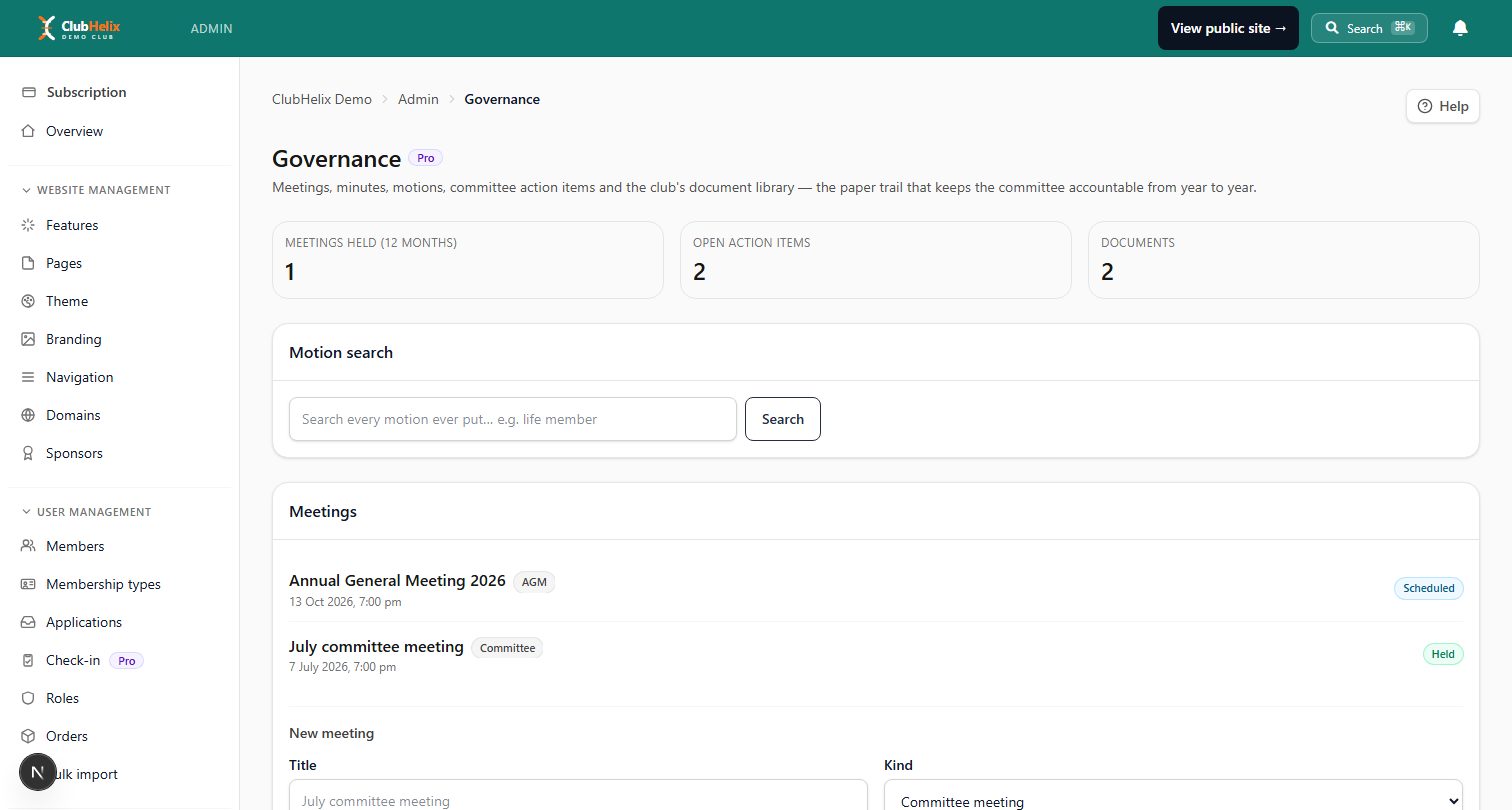
It runs alongside everything else your committee is meeting about — members, payments, events, teams and the club website — in one club-owned account rather than six subscriptions. There is a free tier to start on, the pricing is transparent, and you can create your club site and have your next agenda in it before the meeting.
Frequently asked questions
What should be on a club committee meeting agenda?
Open and attendance, conflicts of interest, a consent agenda covering minutes and routine written reports, the action register from last meeting, finance decisions, two or three decision items with papers attached, a short watch list of risks and renewals, and a close that reads back tonight's decisions with owners and dates. The order matters as much as the contents — put the decisions where the committee is still fresh, and keep information transfer out of the meeting entirely.
How long should a committee meeting be?
Sixty minutes is a realistic target for a monthly meeting once reports are read in advance, and 75 to 90 minutes is reasonable in the busiest weeks before a season starts. Length is a symptom rather than a problem in itself — if meetings routinely run past two hours, the cause is almost always reports being read aloud, items arriving without a clear question, or a free-form general business slot that lets unprepared decisions in at the end.
What is a consent agenda and does a small club need one?
A consent agenda is a block of routine items — previous minutes, correspondence, written reports containing no decision — approved together in one motion with no discussion. Any member can pull an item out of the block before the vote if they want to talk about it. Small clubs benefit most, because they have the fewest volunteer hours to spend and the same amount of routine business to get through.
How far in advance should agendas and papers go out?
At least three days for a routine meeting, and the notice period in your own rules is the minimum for anything formal. Three days is long enough for people to read properly and short enough that the figures are still current. The rule only works if it is enforced in both directions — late papers wait for the next meeting unless the chair rules the item urgent, and the chair does not re-explain a paper in the room for people who did not read it.
How do we stop the same items coming back every month?
Give every item one named owner and a date, summarise them in an action table at the end of the agenda, and open the next meeting by walking that table. Add one rule on top — an item that has been discussed at three consecutive meetings without becoming a decision either gets an owner and a deadline that night, or comes off the agenda. Recurring items are almost always ownerless items.
Keep reading — the meeting minutes template covers what the secretary does with this agenda afterwards, and the committee roles guide sets out who should be bringing which item to the table.

