
What this guide answers
- What should a sports club budget include?
Every expected income line (fees, sponsorship, fundraising net, canteen net, grants, events) and every expense line (affiliation and insurance, facilities, equipment, match-day costs, administration, events…
- How much cash reserve should a club keep?
A common and sensible target is three to six months of fixed costs — enough to survive a washed-out season, a lost grant, or a facility surprise without an emergency levy.
- What does a treasurer report to the committee each month?
Eight short items: cash position, income and expenses for the month, budget-versus-actual year to date with variances explained, outstanding money owed to the club, upcoming large payments, any decisions needing a…
- Do we need accounting software or is a spreadsheet enough?
A well-kept spreadsheet is genuinely enough for many small clubs — the template above is designed for one.
Canada edition. This guide is written for volunteer-run clubs in Canada. Where rules differ — grants, tax, incorporation, safeguarding — follow the Canada-specific pointers below or check with your national body.
Nobody joins a club committee dreaming of spreadsheets. But the budget is the one document that keeps every other club ambition honest: it's how a committee knows whether it can afford new playing gear, whether fees are set right, whether the canteen or concession stand is actually making money, and whether the club will still be solvent when the insurance invoice lands in the same month as the ground hire.
The good news is that a club budget is not corporate finance. It's a one-page table of realistic income and expense estimates, reviewed monthly against reality, owned by a treasurer whom the committee actually supports. This guide gives you the whole kit: a budget template with the categories that fit almost every community club, a monthly treasurer report outline you can copy into your agenda, and the small set of habits — reserves, reconciliation, clean handover — that separate calm treasurers from burnt-out ones.
How a club budget actually works
Three principles before the template:
- Budget the season, review monthly. Build the budget once a year (before fees are set — the budget drives the fee, not the reverse; see how much should club membership cost). Then, every committee meeting, compare actuals against budget and explain the gaps. The comparison is the tool; the budget alone is just a wish.
- Be conservative on income, honest on costs. Budget member numbers you're confident of, sponsorship that's committed, and fundraising at last year's net — not the optimistic gross. Pad nothing on the cost side; surprise costs are the norm, which is what the contingency line and reserves are for.
- Match the timing, not just the totals. Clubs rarely die of annual deficit; they die of March — when insurance, affiliation and equipment orders all land before most fees arrive. Sketch your big items month-by-month so you know your low-water mark in advance.
The club budget template
Copy this structure into a spreadsheet — one row per line, three columns: Budget, Actual (year to date), Variance. Delete what doesn't apply; resist adding categories until a real transaction forces you to.
Income
| Category | Line items | Notes |
|---|---|---|
| Membership fees | Senior / junior / family / social / concession | Number × fee per category, at conservative member counts |
| Registrations & programs | Clinics, holiday programs, term programs | Only programs you've committed to running |
| Sponsorship | Major partner / mid-tier / supporter / in-kind | Committed agreements only; pipeline is a note, not a number (see getting sponsors) |
| Fundraising (net) | Raffles, events, drives — each at expected net | Budget at last year's net per event (ideas + portfolio) |
| Canteen & bar (net) | Sales less cost of goods | Track gross and COGS separately in your records; budget the margin |
| Merchandise (net) | Club shop sales less stock cost | Pre-order drops make this predictable |
| Grants | Local government, sport bodies, foundations | Only when approved; applications live on a separate pipeline list |
| Events & ticketing | Presentation night, social functions | Net of venue/catering |
| Donations | One-off + recurring giving | Recurring supporter programs make this a real line |
| Facility hire & other | Ground/clubhouse hire, interest |
Expenses
| Category | Line items | Notes |
|---|---|---|
| Affiliation & insurance | Association fees, per-player levies, public liability, personal accident | Usually the biggest single block; get real quotes early |
| Facilities | Ground/court hire, utilities, line marking, maintenance | Include the month the big facilities invoice lands in your cashflow sketch |
| Equipment & uniforms | Match/training equipment, playing kit, first aid | Split capital purchases (mower, defib) onto their own line |
| Match-day costs | Umpires/referees, entry fees, match balls | Scale with team count |
| Coaching & development | Course fees, accreditation, guest coaches | Development spend members can see |
| Administration | Software, website, bank/transaction fees, PO box, stationery | Keep transaction fees visible — they're a cost of easier collection, and worth it |
| Communications & marketing | Printing, signage, come-and-try day costs | |
| Events (cost side) | Presentation night, functions | Pairs with the income line |
| Volunteer & member recognition | Awards, life-member honours, thank-yous | Small line, large returns |
| Compliance & governance | Incorporation fees, audit/review, permits (raffle, food, liquor) | |
| Contingency | 5–10% of total expenses | Not optional; this is the "we didn't see it coming" line |
Below the table, keep two summary lines: planned surplus (aim for a small one — roughly 5–10% of turnover) and cash reserve target (best practice: enough to cover three to six months of fixed costs, built over several seasons). A club with a term's worth of costs in reserve makes decisions; a club without one takes whatever it can get.
One line every treasurer should confirm early is the club's tax position.
That means knowing whether the club needs to register for GST/HST, and whether registered-charity or not-for-profit status applies — the Canada Revenue Agency's pages at canada.ca cover both.
General information, not financial advice — confirm your club's position with the tax authority or an accountant.
The monthly treasurer report outline
The treasurer's report should take ten minutes to prepare from good records and two minutes to read. Copy this outline into your meeting template:
Treasurer's report — [Month, Year]
- Cash position. Balance per account (operating, reserve/term deposit) and total. Compared with this time last month and last year.
- Income this month. Two or three lines: what came in, against which budget categories, anything unusual.
- Expenses this month. Same treatment; flag any unbudgeted spend and who approved it.
- Budget vs actual (year to date). The one table that matters: category, budget, actual, variance — with a one-sentence explanation for any variance over an agreed threshold (say 10%, or a fixed amount the committee sets).
- Outstanding money. Unpaid membership fees (count and total), unpaid sponsor invoices, grants awaited. This is the action list — e.g. the fee-chasing sequence from our fee collection guide.
- Upcoming commitments. Known large payments in the next 60 days (insurance, affiliation, uniform order) and whether cash covers them.
- Decisions required. Anything needing a committee vote: unbudgeted spend approvals, write-offs, transfers to reserve.
- Recommendation. "That the report be accepted and the payments listed be ratified." Minute it.
Two reporting disciplines that pay off all year: every payment ratified in minutes (protects the treasurer as much as the club), and variances explained the month they appear — a mid-sized equipment overrun discussed the month it happens is a footnote; discovered at the AGM it's a scandal.
Where the numbers come from (the part that saves the treasurer)
A budget is only as good as the records behind it, and this is where volunteer treasurers drown: transactions scattered across a bank account, cash tins, a card reader, someone's PayPal, and a fee spreadsheet three tabs deep.
The fix is structural, not heroic: collect club money through as few channels as possible, and make each channel produce its own records.
- Fees: collected online at registration, so every payment lands against a member record with a receipt issued — the "unpaid fees" line in the report becomes a filter, not a forensic project.
- Sponsorship: invoiced and tracked per sponsor, so outstanding sponsor money is a list the system already knows.
- Shop, raffles, events, donations: each sold online through its own tool, each reconciling to its own income category.
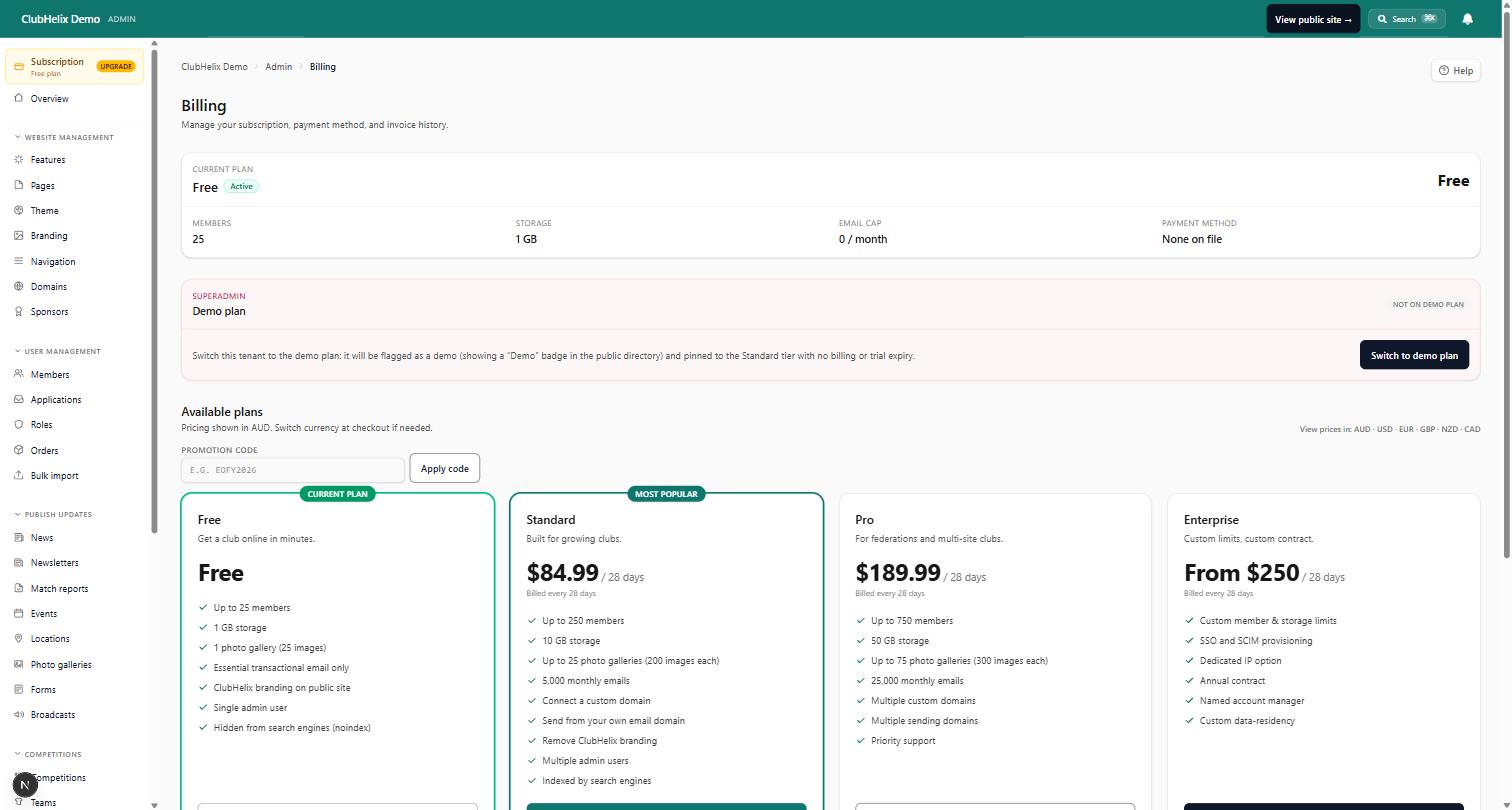
With billing and sponsorship tools doing the tracking, the treasurer's monthly job shrinks to: reconcile the bank account, categorise the handful of manual transactions, paste the budget-vs-actual table into the report. And if your club has graduated to proper accounting software, an accounting integration can carry transactions across automatically instead of via CSV and long evenings.

Controls that fit on an index card
Community clubs don't need a finance manual; they need five rules, applied without exception:
- Two people on the bank account. Dual authorisation for payments above a small threshold, and signatories reviewed at every AGM.
- No reimbursements without receipts. A photo of the receipt attached to the claim; approved by someone other than the claimant.
- Cash counted by two, banked fast. Any cash from canteen or events counted by two people who both initial the total. Better yet, go cashless and shrink the problem.
- The treasurer never approves their own spend. President or secretary signs off treasurer expenses.
- An annual look-over. Even where a formal audit isn't legally required, have someone independent review the books yearly. It protects the honest treasurer far more than it catches the rare dishonest one.
None of this is about distrust — it's the opposite. Good controls are what let a club hand its money to a volunteer without anyone losing sleep.
The handover kit
Treasurer turnover is where club finances go to die. Build the handover file now, while the current treasurer still remembers everything:
- Logins list (bank, payment platform, accounting/club system, grant portals) — stored in the club's password manager, not a personal notebook.
- This year's budget and last two years' actuals.
- The recurring-payments calendar: what big bills arrive when.
- Contacts: bank, association, insurer, auditor, key sponsors.
- The controls card and the report outline above.
A new treasurer with that folder is productive in a week. Without it, the club loses six months and usually some money.
Frequently asked questions
What should a sports club budget include?
Every expected income line (fees, sponsorship, fundraising net, canteen net, grants, events) and every expense line (affiliation and insurance, facilities, equipment, match-day costs, administration, events, contingency), each with a budget figure, a running actual, and the variance. Add a planned small surplus and a cash-reserve target. One page is the right size — a budget the whole committee can read is worth ten tabs of detail only the treasurer understands.
How much cash reserve should a club keep?
A common and sensible target is three to six months of fixed costs — enough to survive a washed-out season, a lost grant, or a facility surprise without an emergency levy. Build it deliberately: a small planned surplus each year, transferred to a separate reserve account so it isn't quietly absorbed by the operating account. A reserve isn't hoarding members' money; it's the difference between a setback and a crisis.
What does a treasurer report to the committee each month?
Eight short items: cash position, income and expenses for the month, budget-versus-actual year to date with variances explained, outstanding money owed to the club, upcoming large payments, any decisions needing a vote, and a recommendation to accept the report. From clean records it's a ten-minute job. The discipline that matters most is regularity — a two-minute report every month beats a perfect report quarterly.
Do we need accounting software or is a spreadsheet enough?
A well-kept spreadsheet is genuinely enough for many small clubs — the template above is designed for one. The upgrade trigger isn't club size so much as transaction volume and channels: once money arrives through registrations, a shop, raffles, events and sponsors, the win is collecting each stream through a system that records it automatically, so the spreadsheet (or accounting package) receives summaries rather than mysteries.
Move to proper accounting software when GST/HST registration, payroll, or an audit requirement enters the picture.
ClubHelix collects your fees at registration, tracks invoices and sponsor money with billing tools, and connects to your bookkeeping via integrations — so the treasurer's report writes itself from real records. See pricing to get started.


