
What this guide answers
- How many reminders should we send before a person gets involved?
Three or four automated ones — a notice ahead of the due date, a reminder close to it, one on the day, and a nudge a week after — then a single personal message from a named volunteer.
- Should unpaid members be allowed to play?
That is a committee decision that belongs in the policy, not a judgement call on a Saturday.
- How do we ask about money without embarrassing someone?
Make the club go first. Put one line offering help in every fee message, give it a private route to one named person, and keep the reply short and practical — an amount, a couple of options, a decision.
- What do we do about a member who simply refuses to pay?
Follow the ladder to its end, then apply the consequence you published.
- Can reminders be automated without feeling robotic?
Yes, and the wording is what decides it. Write reminders in the club's own voice, sign them from a person rather than a system, name the amount and the date plainly, and include the help sentence every time.
South Africa edition. This guide is written for volunteer-run clubs in South Africa. Where rules differ — grants, tax, incorporation, safeguarding — follow the South Africa-specific pointers below or check with your national body.
There is a moment every club treasurer knows. It is week six of the season, the unpaid list has nineteen names on it, and half of those names belong to people you will stand next to at the canteen on Saturday. So you say nothing, the list grows, and by mid-season the club is carrying a five-figure hole and one volunteer is carrying all of the awkwardness.
The way out is not a firmer personality. It is a policy — written once, agreed by the committee, applied the same way to everyone, and mostly executed by reminders rather than by a person. When the club has one, chasing stops being a favour someone does and becomes a process nobody has to feel bad about.
This guide is about that policy. If you want the message wording itself, our renewal reminder templates has the copy; if you want the underlying who-has-paid list, tracking who has paid covers the method. This one is the decisions you make before either of those matters.
Start by sorting the list into three piles
Almost every arrears list is three different problems wearing one label, and they need three different responses.
The forgetters. The overwhelming majority. They meant to pay, the email arrived during a work meeting, and it left their head entirely. They need a reminder and a link, not a conversation. Automation handles this pile completely, and it is usually 80% of the list.
The stuck. A smaller group for whom the money is genuinely hard right now — a job that ended, a relationship that ended, a bill that landed. They are often the most embarrassed and the most likely to simply disappear from the club rather than ask. They need a path that is private, quick and does not require them to explain themselves to a committee.
The avoiders. A very small number who have decided, consciously or otherwise, that the club is optional. They are the reason a policy exists at all, and they are the only pile that needs consequences. Treating the whole list like this pile is the single most common mistake, and it is how clubs lose good members over a single unpaid fee.
Write your policy so the first pile never reaches a human, the second pile reaches one trusted person, and the third pile reaches a documented process.
Decide what "unpaid" actually means
Vagueness here is what makes chasing feel personal. Pin down four things at a committee meeting and minute them:
- The due date. Not "before the season starts" — a date. Registration day, the first game, the end of the month.
- The grace period. A published number of days after the due date during which nothing happens except reminders. Fourteen days suits most clubs. Its real function is to stop volunteers improvising leniency case by case.
- The point at which something changes. The date when a member stops being financial for the purposes of your rules, and what that changes.
- The end point. The date at the end of the season when the committee decides what to do with whatever is still outstanding.
Those four dates turn arrears from an ongoing emotional negotiation into a calendar.
The escalation ladder
Agree the sequence once and let it run. A version that works for most clubs:
| When | What goes out | Who sends it |
|---|---|---|
| 30 days before due | Fee notice with the amount, the date and a payment link | Automatic |
| 7 days before due | Short reminder, same link | Automatic |
| Due date | "Due today" note, same link | Automatic |
| +7 days | Friendly nudge naming the amount and the grace period end | Automatic |
| +14 days | A short personal message from a named person, offering a payment plan or a hardship conversation | One named volunteer |
| +30 days | The documented consequence applies, with notice given in writing first | Registrar or treasurer |
| Season end | Committee decides: pursue, plan, or write off — and minutes it | Committee |
Three rules make this ladder work:
- Every message contains the amount and a way to pay in the same breath. A reminder that makes someone go looking for bank details is a reminder that fails.
- Only one person does the human steps, and their name is in the policy. Arrears chased by four people is how a member gets three messages in a week and decides the club is chaotic.
- Nothing skips a rung. The consequence at +30 days is only fair because everything above it happened first, in writing, with the dates visible.
What consequences are you actually willing to apply?
This is the question committees avoid, and avoiding it is exactly why the ladder collapses at the last rung. Decide it in the quiet of a meeting rather than in the noise of a Saturday morning.
The options, roughly from mildest to firmest:
- Nothing formal, just reminders. Legitimate for a small social club, but be honest that it means some people never pay.
- Loss of member benefits — discounts, priority booking, the members' rate at the bar.
- Loss of voting rights at the annual meeting, if your rules define a financial member.
- Not selected to play, which needs care: it lands on a child in junior sport, and it lands publicly.
- Not registered or renewed for the following season until the balance is settled — the quietest and often the most effective, because it is a private conversation that happens once a year.
Check what your own rules and your governing body actually permit before you write any of these down, and check what your insurance and registration arrangements assume about who is a registered participant. Being unable to follow through on a stated consequence is worse than never stating one.
Whatever you pick: put it in writing, give notice before it applies, and apply it to everyone. A consequence applied to one family and waived for another is the fastest way to turn a money problem into a governance problem.
The hardship path, and why it has to be easy to find
Every club has families for whom the fee is the difference between playing and not playing, and almost none of them will raise it unprompted. So the club has to raise it first.
- Name it in every fee message. One sentence: "If paying this is difficult right now, reply to this message and we'll sort something out — it stays between you and the treasurer."
- Give it a single, private route to one named person, not the committee inbox.
- Have two ready answers so the conversation is short: a payment plan across the season, or a reduced or waived fee from a hardship allowance the committee sets each year.
- Decide who may approve what in advance — a plan by the treasurer alone, a waiver by two office-holders — so nobody has to take a family's circumstances to a full meeting.
- Keep the details out of the minutes. Record that a hardship arrangement was approved and by whom; do not record why.
- Check for external help. Many sports have voucher or subsidy schemes for junior participation, and plenty of families do not know they exist. Knowing which ones apply to your sport is a genuinely useful thing for a registrar to keep on file.
A club that handles this well keeps members it would otherwise lose silently — and those families are often the ones who volunteer hardest once things improve.
Automate the 80% so the humans handle the 20%
The forgetters should never reach a person. With ClubHelix, fees are attached to membership types and registrations, members pay online from the link in the message, and the payment lands against the member's record rather than as a line on a bank statement someone has to decode.
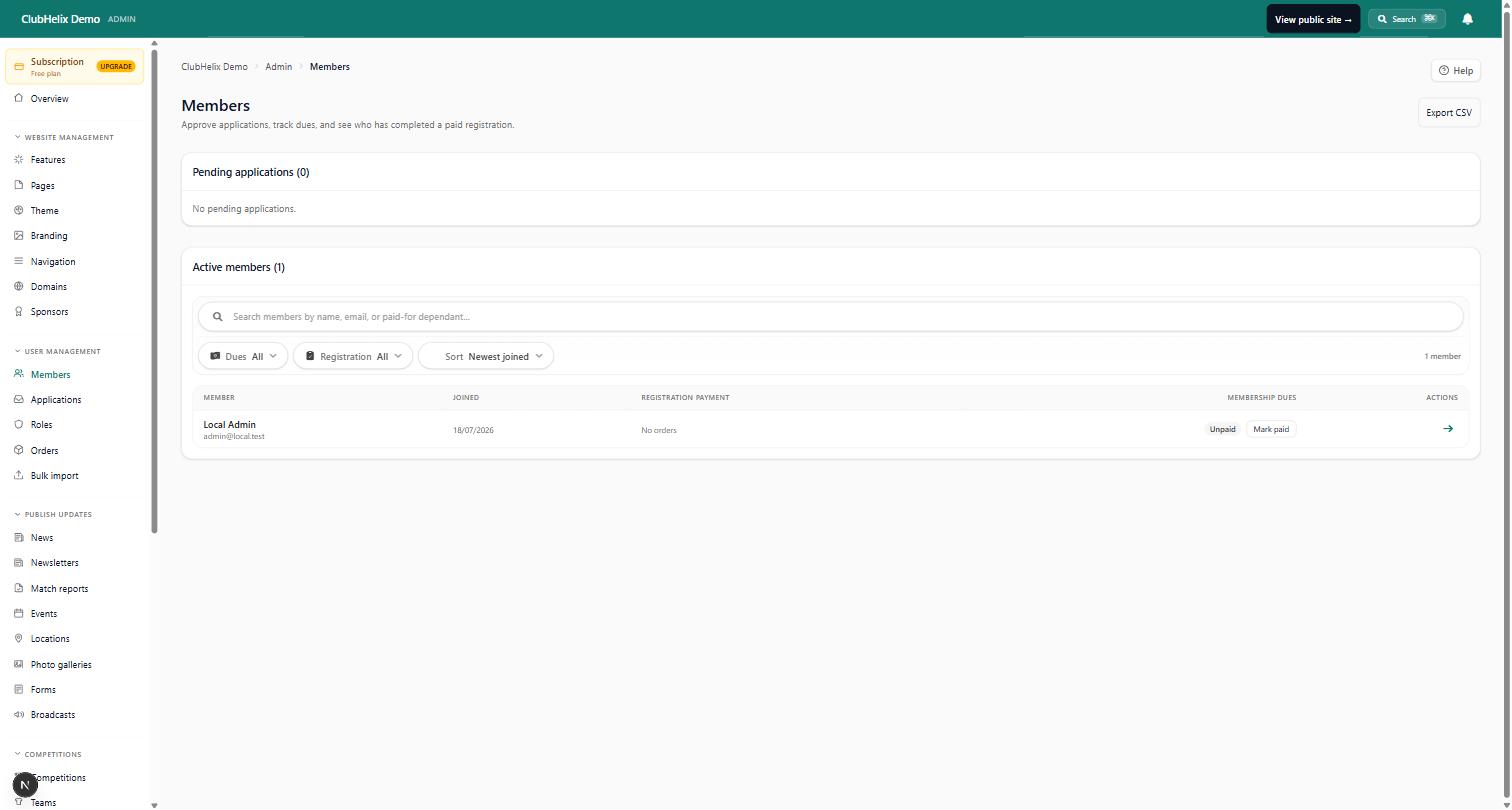
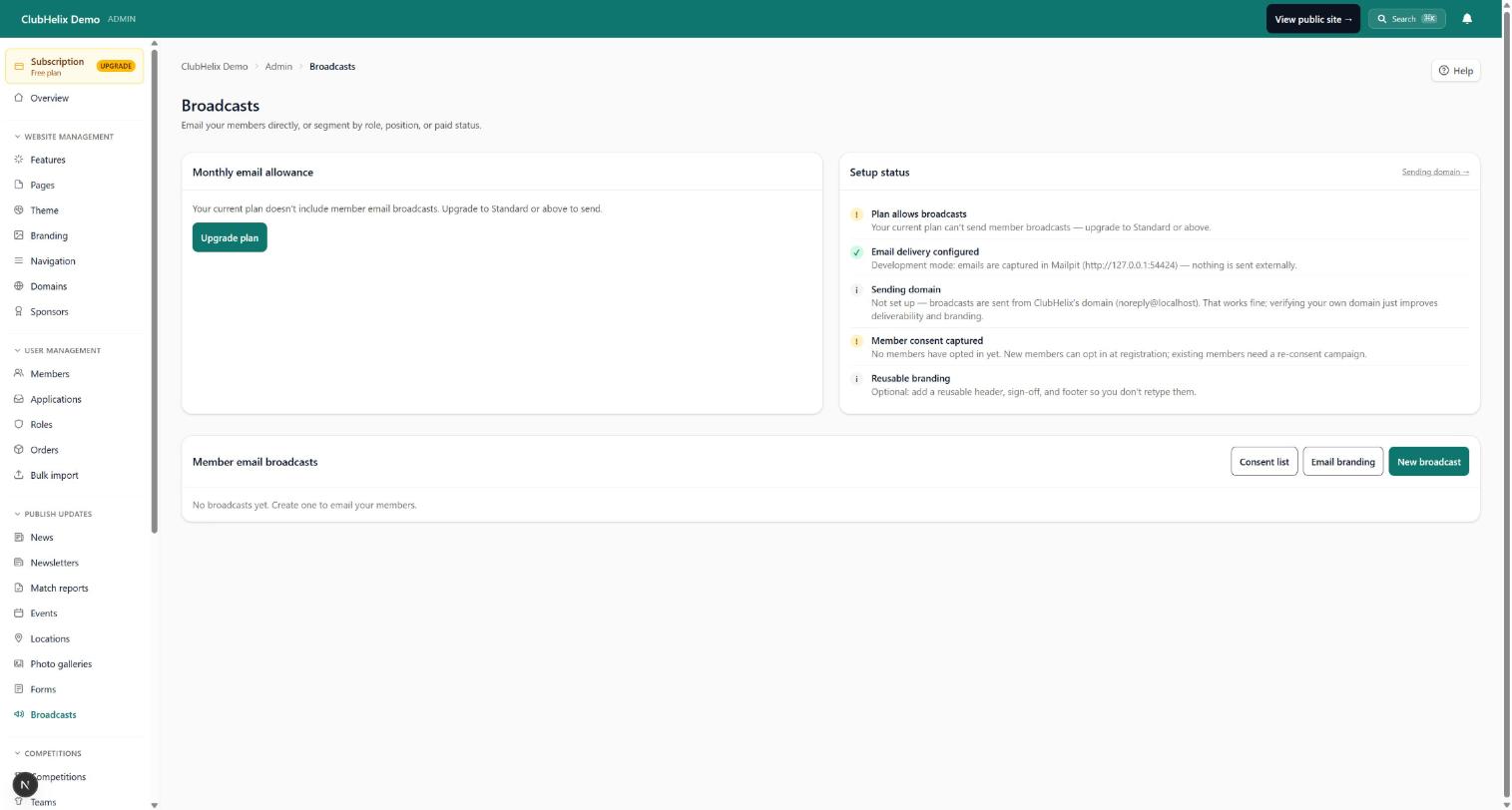
Renewal and lapse reminders run on a schedule the club controls — a set of days before the due date and a nudge after it, with your own subject line and wording, sent once per member per cycle so nobody is spammed. Paying moves the member's paid-until date, which quietly re-arms the next cycle. For anything beyond that sequence, broadcasts can reach exactly the segment you mean rather than the whole club.
What that leaves for a human is the short list of people who need a conversation — which is the list a volunteer can actually face.
Who gets to see the arrears list
Treat it as sensitive, because it is. A practical rule: the treasurer and the registrar see names and amounts; the committee sees totals and counts; team managers and coaches see nothing. If a coach needs to know whether a player is eligible, the answer they get is "eligible" or "not eligible", not the reason.
This matters beyond politeness. An arrears list circulated in a team chat is a privacy incident, and it is the kind of thing a family remembers for years. Keep it inside the systems the club controls, with access tied to roles rather than to who happens to have a copy of the spreadsheet.
Writing it off — and when that is the right call
At season end, some balances will still be there. The committee's job is to decide, once, in a meeting, with the list in front of it:
- Pursue — worth it only where the amount is genuinely material and the member is genuinely able.
- Plan — a written arrangement to clear the balance across the next season, often alongside a return to playing.
- Write off — record it, minute it, and let it go.
Writing off is not failure. Carrying an unresolved balance into a new season is: it distorts the accounts, it hangs over a family, and it guarantees the same conversation again in March. A club that clears the decks each year, and tightens the process that let the balance build, ends up chasing far less next time.
The prevention is upstream anyway. Fees collected at the moment of registration, with the payment attached to the sign-up rather than promised afterwards, remove most of the problem before it exists — which is the argument in collecting membership fees online.
Frequently asked questions
How many reminders should we send before a person gets involved?
Three or four automated ones — a notice ahead of the due date, a reminder close to it, one on the day, and a nudge a week after — then a single personal message from a named volunteer. Beyond that, more reminders stop working: someone who has ignored five emails is not going to respond to a sixth, and the person you need to reach is usually avoiding the subject rather than missing the message.
Should unpaid members be allowed to play?
That is a committee decision that belongs in the policy, not a judgement call on a Saturday. Whatever you choose, give written notice before it applies, apply it consistently, and think hard about junior sport, where the consequence lands on a child who has no control over the payment. Many clubs find that declining to register for the next season is a firmer lever and a far kinder one.
How do we ask about money without embarrassing someone?
Make the club go first. Put one line offering help in every fee message, give it a private route to one named person, and keep the reply short and practical — an amount, a couple of options, a decision. The families who need it are usually more worried about being seen to ask than about the money itself, so the club's job is to make asking feel routine.
What do we do about a member who simply refuses to pay?
Follow the ladder to its end, then apply the consequence you published. Do not improvise a harsher one, do not discuss it outside the people who need to know, and do not let it become a personal contest between a volunteer and a member. Record the decision in the minutes with the amount and the date, and if the balance is small, write it off and move on — a season of committee energy is worth more than the fee.
Can reminders be automated without feeling robotic?
Yes, and the wording is what decides it. Write reminders in the club's own voice, sign them from a person rather than a system, name the amount and the date plainly, and include the help sentence every time. An automated message that sounds like a neighbour works; one that sounds like a collections agency makes the next conversation harder for everyone.
Collect fees on your own club site, and let reminders do the routine chasing, with ClubHelix. Next: renewal reminder templates and tracking who has paid.


