
What this guide answers
- How does a 100 club fundraiser work?
The club sells 100 numbered subscriptions at a fixed price (say $5 a week), draws one paid-up number each week or month, pays the winner a published share of the pot (classically 50%), and keeps the rest.
- Do we need a permit to run a 100 club or club lotto?
Quite possibly — these games are regulated gambling, and the class your draw falls into depends mainly on turnover and prize values.
- What's the best prize split for a 100 club?
50/50 is the classic and the easiest to sell — "half the pot back in prizes" is instantly understood and feels generous.
- What if we can't sell all 100 numbers?
Start anyway. Either run the game with the numbers you've sold (a "60 club" is still excellent money), or have the club hold unsold numbers with a published rule that a drawn unsold number rolls the prize into the next…
New Zealand edition. This guide is written for volunteer-run clubs in New Zealand. Where rules differ — grants, tax, incorporation, safeguarding — follow the New Zealand-specific pointers below or check with your national body.
Ask a long-serving treasurer to name the most reliable fundraiser they've ever run and there's a decent chance they'll say "the 100 club." It's the quiet achiever of club fundraising: members buy a numbered ticket, a number is drawn each week or month, the winner takes a share of the pot, and the club keeps the rest. No gazebos, no catering, no working bee — just a recurring, predictable income stream that practically runs itself once it's set up.
This guide explains exactly how a 100 club works, the maths behind it, the popular variations (weekly draws, snowballs, sweeps and "lotto"-style formats), how to run one cleanly — and the part you must not skip: checking your local gaming rules first, because a 100 club is legally a lottery in most places.
General information only. This article is general information for community clubs, not legal or financial advice. 100 clubs, sweeps and club "lotto" games are forms of gambling, and the rules — whether the game can run without a licence, prize limits, who may enter, how proceeds must be used, and record-keeping — depend on the size and format of the game. The Department of Internal Affairs regulates gaming and lotteries; check its current guidance at dia.govt.nz before starting.
How a 100 club works
The mechanics are beautifully simple:
- The club sells 100 numbered memberships (numbers 1–100) — to members, families, sponsors and friends of the club. Each number costs a fixed subscription: commonly the price of a coffee each week, or a modest monthly amount, often collected as an upfront season payment or a recurring payment.
- A draw happens on a fixed schedule — weekly at training, monthly at the committee meeting, or timed with home games. One number (or several) is drawn randomly from the numbers that are paid up.
- The winner gets a fixed prize or a percentage of the pot, and the club keeps the remainder.
The classic split is 50/50: half of each period's takings to prizes, half to the club. Some clubs run 40% prizes / 60% club, or fixed prizes (a published first and second prize funded from the month's takings). Whatever you choose, publish it before you sell — participants should know exactly what share funds the club.
The maths at a glance. 100 numbers × $5/week = $500/week collected. With a 50/50 split, that's a $250 weekly prize and $250/week to the club — about $12,000 to $13,000 over a full year for essentially zero ongoing effort. Even a modest $2/week version banks the club around $5,000 a year.
This is why treasurers love it: it's the closest thing to fundraising annuity income a club can build, and it stacks neatly alongside event-based earners like a trivia or quiz night and the season's big raffle.
Two design decisions to make up front:
- Only paid-up numbers win. If a subscriber lapses, their number sits out the draw until they're current. This is the incentive that keeps collections easy — and it must be stated in the rules.
- What happens to unsold numbers? Either the club "holds" them (and a drawn unsold number rolls the prize over — which builds excitement), or you simply run a "60 club" until demand grows. Don't quietly pocket wins on club-held numbers without disclosing that rule; transparency is the whole game.
Popular variations
The weekly 50/50. As above — the default format. Draw at training or in the clubhouse, announce on the club's socials and website. Momentum comes from the ritual.
The snowball / jackpot. A slice of each pot (say 10%) feeds a jackpot that's only won when a special condition hits — the drawn number's owner is present at the draw, or a second "jackpot number" matches. Rollovers grow, interest compounds, and sales spike as the jackpot climbs. Cap it (e.g. must be won at the season's final draw) so it always pays out.
The 200/400 club. Same format, more numbers, bigger pots — for larger clubs or leagues. Nothing changes except the printing and the prize scale (and possibly your permit threshold — check).
Club "lotto" / pick-the-numbers. Members pick a small combination (say 3 numbers from 20); a weekly draw pays a jackpot if anyone matches, rolling over otherwise. Popular in many countries — but note this format looks even more like a lottery to regulators, so treat the compliance check as mandatory rather than cautious.
Sweeps and one-off number boards. The 100-square board for a big race or the season's showpiece final — buy a square, names drawn against outcomes. Technically a sweep, usually with its own (often lighter) rules for small prize pools, but again: jurisdiction-dependent.
The reverse draw. Numbers are drawn out until one remains, which takes the major prize — usually run as a one-night event with dinner, with minor prizes at milestones. Great as the season-launch event that sells the year's 100 club subscriptions on the spot.

The rules to check before you start (sports club lotto rules)
Games where people pay to enter a draw for a prize are regulated gambling, and the size of the game decides how much regulation applies. The smallest club draws sit in the lowest class and can run without a licence provided turnover and prize values stay under the published limits; go past them and a licence is required. Community clubs are accommodated, not exempt. The questions to answer against the Department of Internal Affairs' current guidance:
- Do we need a permit or licence? Often driven by total prize value and ticket revenue. Many jurisdictions allow small society lotteries with no permit under a threshold, then require a (usually cheap and simple) permit above it. A weekly 50/50 across a season can add up to a "declared lottery" even when each draw is small — ask the regulator how recurring draws are counted.
- Who can run it and where can proceeds go? Rules typically require a not-for-profit purpose and that net proceeds go to the club's objects. Keep the split documented.
- Who may enter? Age restrictions apply (minors and gambling don't mix), and some jurisdictions restrict sales to members and their guests versus the general public — which matters if you plan to sell numbers on the open internet.
- Record-keeping and draw integrity. Some permits prescribe how draws are conducted and what records you keep. Even where they don't: keep them anyway (see below).
- Prize rules. Cash vs non-cash, maximum prize values, and whether rollovers/jackpots are allowed all vary.
The good news: for a typical club-sized 100 club, compliance usually amounts to reading one government web page, possibly filing a simple form and small fee, and keeping tidy records. It's an evening of admin protecting years of income — and the same homework covers your raffles and sweeps too.
Running it cleanly: the operating checklist
Trust is the product. People subscribe to a 100 club because they trust the draw is fair and the money goes where the club says. Protect that:
- Write one page of rules and publish it on your club website: cost, schedule, prize split, paid-up rule, unsold-number rule, jackpot conditions, how winners are paid, and the permit number if you hold one.
- Keep a register — every number, its owner, contact details and payment status. This is the document the whole game runs on; keep it in club systems, not a personal spreadsheet on a retiring treasurer's laptop.
- Separate the money. A dedicated ledger line (or sub-account) for subscriptions in and prizes out. The treasurer reports the 100 club line at each committee meeting like any other program.
- Draw in public, announce everywhere. Draw at training or a home game, ideally with a junior pulling the number. Publish every result — winner (with their consent), number, prize, and the running "raised for the club" tally — on the club news page. The public tally is also your best sales tool.
- Pay winners fast and visibly. Same week, every time.
- Two people touch the money. The same basic control as every club cash activity.
- Renew deliberately. Run it season-aligned with a proper renewal push, rather than letting it decay one lapsed subscriber at a time.
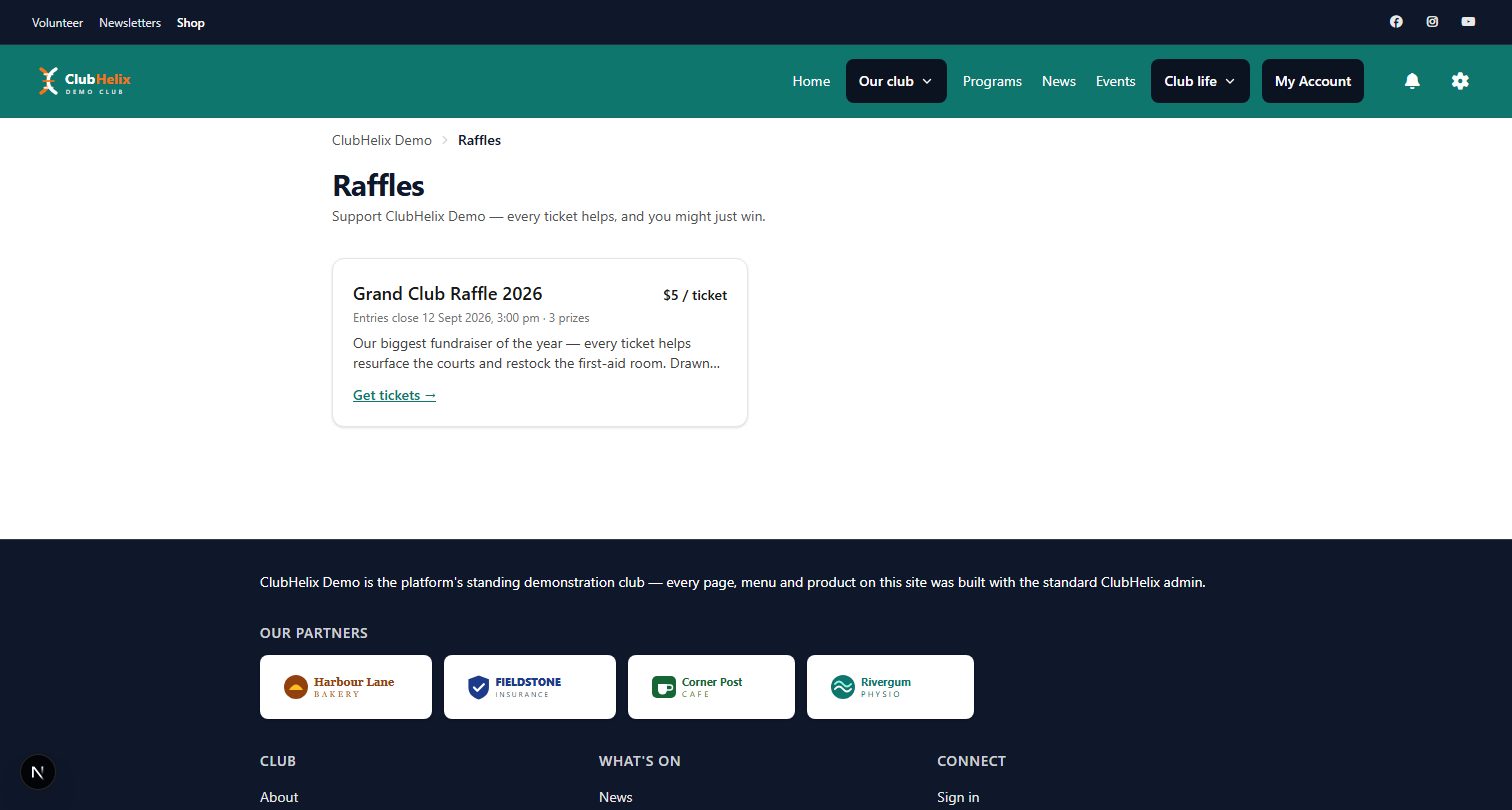
Digital tooling takes most of the friction out: with ClubHelix raffles, clubs sell numbered tickets online with payment collected on the spot, entries recorded automatically against real member accounts, and draws run and published without a shoebox of stubs. Your register, payment status and results trail exist as a by-product of selling.
Is a 100 club right for your club?
Strong fit if you have: a stable membership of 150+, a treasurer who'll keep the register honest, a weekly gathering point for draws, and a specific goal to fund ("the new mower fund" outsells "general revenue" every time).
Weak fit if: your community would rather give outright donations, your state's rules make the recurring format burdensome at your scale, or nobody owns it — a 100 club with a sloppy register dies within a season, and takes trust with it.
Many clubs run the hybrid: a 100 club as the baseline annuity, one big social fundraiser a year for the community moment, and grant applications for the capital projects — with the 100 club's documented income conveniently doubling as the co-contribution evidence grants love.
Frequently asked questions
How does a 100 club fundraiser work?
The club sells 100 numbered subscriptions at a fixed price (say $5 a week), draws one paid-up number each week or month, pays the winner a published share of the pot (classically 50%), and keeps the rest. At $5/week with a 50/50 split, that's about $250 a week to the club — roughly $12,000–$13,000 a year — from a game that takes minutes a week to run once the register is set up.
Do we need a permit to run a 100 club or club lotto?
Quite possibly — these games are regulated gambling, and the class your draw falls into depends mainly on turnover and prize values. The smallest club draws can run licence-free, but a weekly game across a full season adds up faster than committees expect, and that's what pushes clubs into licensed territory. Check the Department of Internal Affairs' current thresholds before selling numbers — it's typically one web page and, at most, a simple form.
What's the best prize split for a 100 club?
50/50 is the classic and the easiest to sell — "half the pot back in prizes" is instantly understood and feels generous. Clubs that want a faster fundraising rate run 40/60 or fixed prizes, and many carve 10% into a jackpot that rolls over to keep interest high late in the season. Whatever you pick, publish it in the rules before you sell, and never change it mid-season.
What if we can't sell all 100 numbers?
Start anyway. Either run the game with the numbers you've sold (a "60 club" is still excellent money), or have the club hold unsold numbers with a published rule that a drawn unsold number rolls the prize into the next draw — rollovers create exactly the buzz that sells the remaining numbers. What you must not do is leave the treatment of unsold numbers undocumented; ambiguity is what kills trust in games of chance.
Run the whole thing digitally: ClubHelix raffles sells the numbers, collects the money and keeps the register and results trail for you. Then build out the rest of the fundraising calendar with our guides to trivia nights and sausage sizzles.

