
What this guide answers
- Do club apps really show gambling advertisements to children?
Reviews of one widely used club app describe exactly that: gambling and scam creative shown to teenagers whose clubs require them to install the app to participate.
- Isn't advertising a fair trade for free software?
It is a trade, and each club can weigh it. What clubs should not do is make it accidentally.
- What is the difference between club sponsors and advertising in an app?
Control, money and relationship. Your club picks its sponsors and can decline one that does not fit; the sponsorship revenue funds the club; and the sponsor is usually part of your community.
- Does paying for a premium tier remove the ads?
Ask specifically, and ask for it in writing, because reviews of at least one product report advertisements continuing to appear on a paid tier that was sold as advertisement-free.
- How do we raise this with our committee without starting a fight?
Do not argue from principle; argue from evidence. Open the app store listing for the product your club uses, read the most recent hundred reviews, and take the count of how many mention advertising to the next meeting…
Here is a transaction your committee probably never discussed.
The club picks a system. The system has an app. To get fixtures, team news and availability, every family has to install it — so the club tells them to, in a newsletter, at registration, from the coach's group chat. Three hundred people install an app because their club asked them to.
That is an audience. It took the club decades to build, one volunteer and one season at a time. And in a great many products, the first thing that audience is shown is an advertisement the club never saw, sold by a company the club has never heard of, to a member who thinks they are looking at something their club made.
Nobody voted for that. It arrived as a side effect of a decision about fixtures.
What the reviews actually say
We read the public reviews of one widely used club app — five hundred written reviews, published between February 2024 and September 2026 — because we wanted to know whether advertising was a minor irritation people mention in passing or something else.
It is something else.
- 208 of the 500 reviews mention advertising. That is 42%, and it appears in every single month of the period, rising to between 52% and 73% in some months of 2026.
- Reviews that mention advertising average 1.52 stars. Reviews that do not average 2.32. Ads are not a footnote in an otherwise happy review; they are the thing people are angry about.
- Thirty reviews describe hostile delivery specifically — close buttons that are hard to find, full-screen ads that cannot be dismissed, and sound playing while the phone is on silent.
- Seven reviews report that the paid, advertisement-free tier still showed advertisements. They use the word "bait-and-switch".
- Seven reviews describe gambling and scam creative shown to teenagers whose clubs require them to install the app to play.
A second, different club app drew the same complaint at a similar rate in a smaller sample. This is not one company having a bad year. It is what the model produces.
Those numbers are our own reading of published reviews, not a study, and you can repeat it in an afternoon: open the app store listing for whatever your club uses, sort by most recent, and read a hundred. What people complain about is what your members are experiencing.
Why it happens, in one paragraph
Software costs money to build and run. If the club is not paying, somebody else is, and in consumer software that somebody is almost always an advertiser. At that point the product's incentives quietly invert: the more time your members spend in the app, the more advertisements can be shown, and the more precisely their behaviour can be profiled the more each one is worth. The company is not villainous. It is responding to the only revenue it has. But the club has stopped being the customer and started being the distribution channel.
The tell is the ad inventory itself. A club with a sponsor knows exactly who that sponsor is. Programmatic advertising works the other way — the slot is sold to whoever bids highest for that viewer at that moment, which is precisely why gambling creative can end up in front of a fifteen-year-old on the way to look up Saturday's team.
The three costs a committee should weigh
Your name is on it. The club sent the message that said "install this". When the app serves a betting advertisement to a junior player, the parent does not compose an email to an ad network. They raise it with the club, at training, on a Saturday, and the volunteer standing there has no answer.
The creative is not yours to control. Even where a vendor blocks certain categories, the club has no visibility of what a specific member is shown and no mechanism to object. That is an uncomfortable position for an organisation that has spent years writing child-safety policies about what happens inside its own four walls.
The attention is finite and you need it. Your members will read a limited number of club messages a season. Every advertisement between them spends a little of that patience, and the club is the one that pays when the AGM notice goes unread.
There is a governance point underneath all three: the club made a decision about member communications without ever putting the advertising question to the committee, because nobody mentioned it. That is worth fixing whatever you conclude.
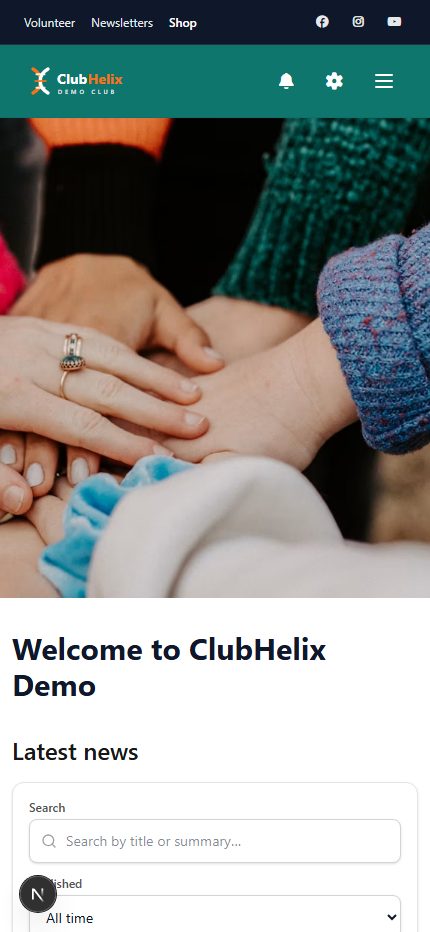
Your own sponsors are a completely different thing
To be clear, because this argument gets flattened: a club selling its own sponsorship is not the same as software selling your members' attention.
When your club puts a local business on the home page, three things are true that are not true of programmatic advertising:
- The club chose them. A committee decided this business is one the club is happy to be associated with, and can decline one it is not.
- The money comes to the club. Every cent funds the thing the members are there for.
- The relationship is real. The sponsor is usually a member's employer, a local trade, or the family business that has backed the under-12s for a decade, and they get something more valuable than an impression: standing in the community.
That is why our sponsorship tools exist — packages, agreements, placement and renewal reminders for the club's own sponsors — and why there is no advertising inventory anywhere in the product. The distinction is not advertising versus purity. It is whose audience it is and who gets paid.
Seven questions to ask any vendor
Ask these before you choose, and ask them again at renewal. Ask for the answers in writing.
- Is there advertising on any tier of your product, including the free one?
- If we pay for the ad-free tier, is every surface ad-free — the app, the notifications, the emails and the public site — or only some of them?
- Who decides what advertisements are shown? Is it you, or an advertising network bidding in real time?
- Which categories are excluded, and can we see the exclusion list? Gambling, alcohol, betting-adjacent games and weight-loss products are the ones a club should ask about by name.
- Is member data used for advertising targeting, shared with advertisers, or sold? Including to "partners".
- What trackers are in the app, and what do they collect about a member who has not consented to anything beyond playing sport?
- Where does your revenue come from? If the product is free and there is no advertising, that question still has an answer — and you want to know it before it turns out to be data.
The reaction tells you as much as the answer. A vendor whose business model is the subscription will answer all seven flatly and quickly.
"Free" is a price, not a gift
Be honest with your committee about the trade rather than pretending there is no cost either way. Ad-supported software is genuinely free in cash terms, and for a small club with no budget that is a real consideration — many reviewers say exactly that: the ads are annoying, but it is a free app.
What the club is paying instead is:
- its members' attention and patience;
- its control over what those members are shown in its name;
- whatever member behaviour is collected to make the advertising worth more;
- and the goodwill it spends when a parent complains and the club can only shrug.
Set that against a subscription, split across the membership, and the number is usually small. A club that can fund a set of match balls can fund software where it is the customer — and being the customer is what buys the right to complain and be listened to.
Where ClubHelix stands
No advertising. Not on the free tier, not in the app, not in the emails, not on your public site. Nobody buys space in front of your members, because there is no space to buy — our revenue is the club's subscription, which keeps the incentives pointed at the club rather than at time-on-screen.
What that means day to day is that the club's own app experience shows fixtures, results, news and availability and then gets out of the way, and the pages your members read carry your club's identity and your club's sponsors. What we collect and how we protect it is documented on the security page rather than left to a privacy policy nobody reads.
If you are weighing up an app-first product against a website-first one, our comparison of a club app versus a club website is a good next read — the advertising question is one input into that decision, and the ownership question underneath it is the same one.
Frequently asked questions
Do club apps really show gambling advertisements to children?
Reviews of one widely used club app describe exactly that: gambling and scam creative shown to teenagers whose clubs require them to install the app to participate. That is a small number of reviews out of five hundred, but it is the failure mode the advertising model makes possible, because the slot is sold to whoever bids for that viewer rather than chosen by the club or the vendor. Any club considering an ad-supported product should ask, in writing, which categories are excluded.
Isn't advertising a fair trade for free software?
It is a trade, and each club can weigh it. What clubs should not do is make it accidentally. The people seeing the advertisements installed the app because their club told them to, so the club has taken a position on their behalf without discussing it. Put it on a committee agenda, decide deliberately, and tell your members what you chose — that is a completely different thing from finding out through a complaint.
What is the difference between club sponsors and advertising in an app?
Control, money and relationship. Your club picks its sponsors and can decline one that does not fit; the sponsorship revenue funds the club; and the sponsor is usually part of your community. Advertising inside a club app is chosen by an ad network, paid to the software vendor, and shown to your members in your club's name. Selling your own sponsorship is a club running its own business. The other is a club being someone else's inventory.
Does paying for a premium tier remove the ads?
Ask specifically, and ask for it in writing, because reviews of at least one product report advertisements continuing to appear on a paid tier that was sold as advertisement-free. Ask whether every surface is covered — app, notifications, emails and the public website — or only the app, and what happens to a member who has not personally upgraded.
How do we raise this with our committee without starting a fight?
Do not argue from principle; argue from evidence. Open the app store listing for the product your club uses, read the most recent hundred reviews, and take the count of how many mention advertising to the next meeting alongside the seven questions in this guide. Then ask the vendor. A committee that has read its own members' words tends to reach a decision quickly, and the conversation stays about the club rather than about anyone's taste.
Run your club's site, app and messages with no advertising anywhere and your own sponsors front and centre — see the member app and sponsorship tools. Next: club app versus club website.


