
What this guide answers
- Does the sponsor get access to our member list?
No — and it should never be part of the deal. A funded website buys the sponsor placement: their logo on your pages, a spot on your sponsor page, a mention in your launch announcement.
- Is sponsoring a club website tax-deductible for the business?
Sponsorship is ordinarily treated as a business marketing expense — the sponsor is buying promotion, not making a gift.
- What does a club website actually cost to run after the funded year?
Far less than the build. The heavy lift — design, content migration, registration set-up — happens once.
- What if the funder pulls out after year one?
Plan for it at signing rather than discovering it in month eleven.
Most committees treat the club website as a cost the club has to bear — which is why it sits on the "one day" list next to the new canteen fridge. But a website is one of the few club expenses that someone else has a genuine reason to pay for. A local business gets year-round visibility. A council gets a stronger, better-run local club. A community funder gets an acquittable, photographable outcome.
This guide walks through the four funders Australian clubs can realistically ask, what each one gets out of it, and how to make the ask without it feeling like charity. It's written for volunteer committees with no budget and no appetite for grant paperwork — and it's honest about the one thing most funding pages aren't: what grants will not pay for.
The reframe: stop asking "can we afford it?"
The better question is: who benefits from this club being properly online? A 200-member club might run on a few thousand dollars a year of subs and canteen takings — but the businesses, banks and councils around it hold real budgets, and each has its own reason to want your club visible, taking registrations online, and easy to join. Your job isn't to find money in the club's budget. It's to connect one of those budgets to a concrete, one-off project with a visible result.
One-off is the key word. Funders of every kind prefer a project with a start, an end and something to show — "build the club a website and cover its first year" — over an open-ended subscription commitment. Structure every ask that way.
Option 1: your existing sponsor (the easiest yes)
Start with whoever already sponsors your club. They've already decided your club is worth backing — the only question is whether their money buys something anyone actually sees.
A season of ground signage is visible to whoever attends. A club website is visible to every member, every parent checking fixtures on a Thursday night, and everyone who Googles the club — all year. That's the pitch, and it's a genuinely better product for the same kind of spend:
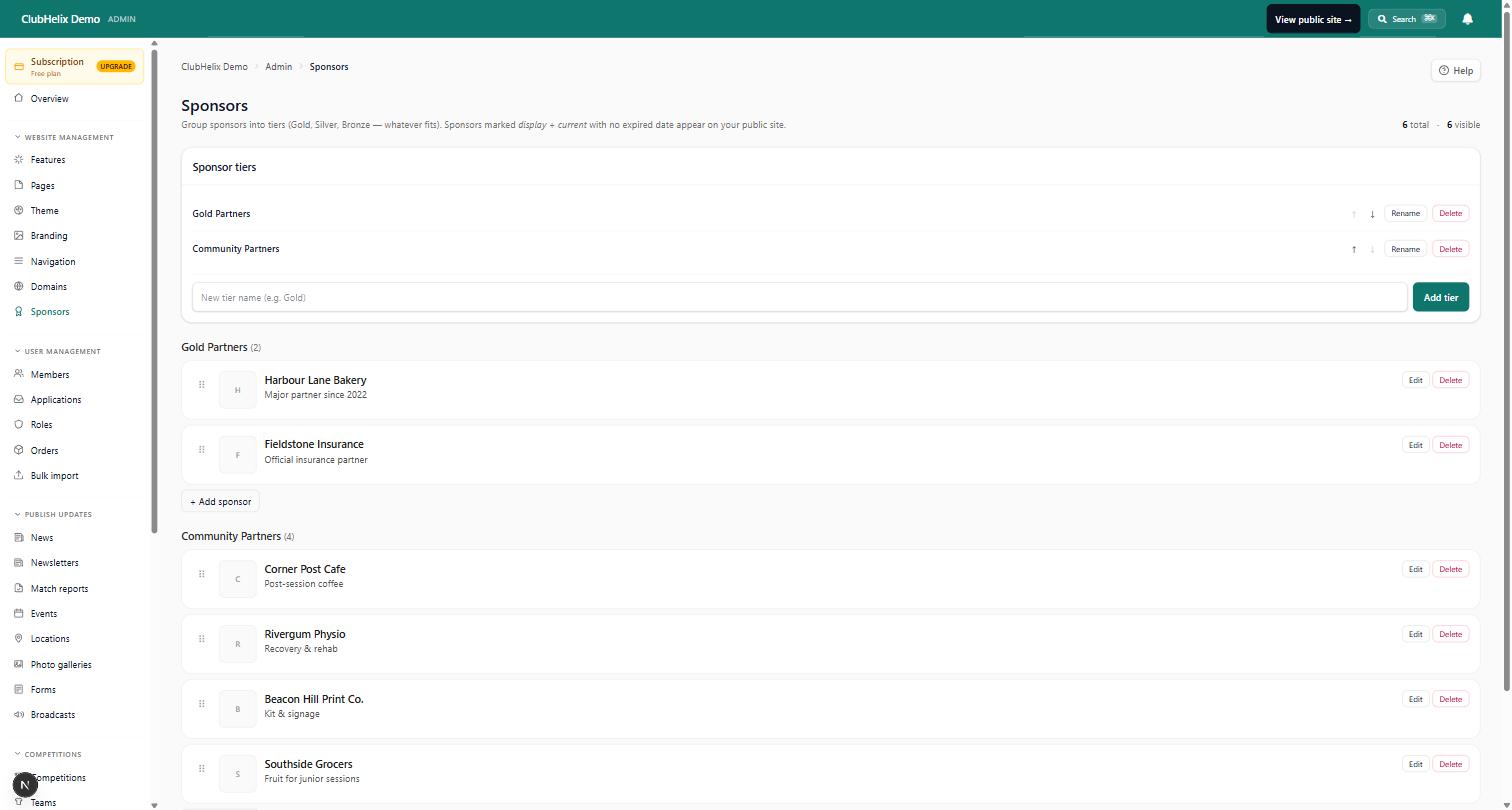
- Their logo in the site footer, on every page, for 12 months
- A sponsor page with their story and a link to their business
- Banner placement on the fixtures and results pages — the most-visited pages a club has
- A named thank-you in the launch announcement that goes to every member
The ask (from your president or sponsorship officer, to the business owner): "We're rebuilding the club's website this season. Rather than the usual signage package, would you fund the build? You'd be on every page of the site all year, and we'd announce it to every member." Then have the platform or builder invoice the sponsor directly for a fixed amount — the club never handles the money and never takes on a budget line. If you'd rather the whole thing were done for you, a done-for-you build bundles the site build and the first year into exactly that kind of single, sponsor-friendly figure.
If you haven't run a sponsorship program before, our guide on how to get sponsors for a sports club covers building your asset list and pricing packages — the website simply becomes your best asset.
Two honesty notes. First, sponsorship is a business marketing expense, not a donation — don't promise anyone a tax-deductible gift, and leave deductibility questions to the sponsor's accountant. Second, agree up front what happens next year: either the sponsor renews, or the club takes over the (much smaller) ongoing subscription. No surprises at month twelve.
Option 2: a Community Bank branch
If your town has a Community Bank branch, it exists to return profits to local organisations — and community sport is one of the biggest categories of that funding. Decisions are made by a local volunteer board, applications are a short form (branches typically have a simple form for smaller requests and a standard one above a few thousand dollars), and outcomes come back in writing.
Here's the part committees miss: Community Bank sponsorships come with reciprocal obligations, and the standard one is displaying the bank's logo on the club's website and promotional material. A club with no real website struggles to hold up its end. A sponsorship that funds the website makes the branch's recognition — and its acquittal evidence — the very thing being built. That symmetry makes this one of the cleanest asks in club funding.
Practical notes: the club is the applicant, so this is your committee's application with the builder's itemised quote attached; funds usually need to be spent within about six months (a two-week build clears that easily); and boards meet monthly-ish, so allow four to eight weeks for a decision. If the answer is "not this round", ask when the next budget cycle opens and come back.
Option 3: your council
Councils hold sport and community development budgets, and many employ club development officers whose whole job is building club capability. They can't easily fund one club's website (that looks like favouritism) — but they can absolutely run a program: a handful of local clubs, selected by the council, each getting a professional website and online registration, delivered in a school term, with a "supported by council" credit on every site.
For the council, this is a grant-round-shaped outcome with receipts: five live websites, five before-and-after screenshots for the newsletter, five clubs that are easier to join. And because a batch program lands in the thousands rather than the tens of thousands, it typically sits within the council's simple-quote purchasing range — no tender required.
How to raise it: don't cold-call the council switchboard. Go through your state sporting body or the council's sport/community development officer, and lead with a local example if any nearby club is already online. If your council runs an annual community grants round instead, apply through that with the build quoted as a one-off project. There's a page you can send your council directly — council programs — with the program shape and the figure on it.
Option 4: ClubGRANTS and community funding (NSW and beyond)
In NSW, registered clubs (leagues, RSL and community clubs) distribute significant community funding every year through the ClubGRANTS scheme, and its Category 2 stream covers general community development — including grassroots sport. Applications run through the ClubGRANTS Online portal, and your local registered club's window is usually early in the calendar year.
The same rules of thumb apply as with any grant: apply before the project happens (retrospective funding is almost universally excluded), frame the build as a one-off community project with a clear outcome, and attach an itemised quote.
The honest section: what grants won't pay for
Read this before your secretary spends a weekend on an application. Most Australian sport grant programs — state and local — explicitly exclude ongoing operational costs, and many name "yearly subscriptions" in the exclusion list. Equipment-and-kit programs fund equipment and kit. Infrastructure streams fund concrete and lights.
What that means in practice:
- Don't apply for a grant to cover a software subscription. It's the most commonly excluded item there is, and a rejected application costs your committee a volunteer weekend.
- A one-off website build is a much stronger fit — it's a project, not an operating cost. It's still worth one email to the program team to confirm before you write anything.
- Sponsors, banks and councils publish no such exclusion lists. That's exactly why the first three options in this guide come before the grants one.
For the full picture of what the major Australian programs do fund — and how to get your club grant-ready before a round opens — see our grants for sports clubs guide and the state-by-state grant guides linked from it.

Making the ask: a 30-day plan
- Week 1: list every current sponsor, the nearest Community Bank branch, and your council's sport or community development contact. Three lists, one page.
- Week 2: make the sponsor ask first — it's the shortest path from conversation to yes. One conversation, one forwarded one-pager, one decision-maker.
- Week 3: if there's a Community Bank branch in town, ring it and ask two questions: would the board consider funding a club website build, and when does it next meet?
- Week 4: raise the council program via your state body or development officer — or diarise the council's next community grant round with the build quote ready.
Whichever path lands, insist on the same deal shape: a fixed, one-off amount, invoiced to the funder, covering the build and the first year — with the club owning its content, domain, member data and payment account from day one, and a clear, unhurried plan for year two.
Frequently asked questions
Does the sponsor get access to our member list?
No — and it should never be part of the deal. A funded website buys the sponsor placement: their logo on your pages, a spot on your sponsor page, a mention in your launch announcement. Member contact details stay with the club, full stop. If a prospective funder asks for your member list as a condition, walk away — no legitimate community sponsor needs it, and handing it over would breach the trust (and in many cases the privacy obligations) your club owes its members.
Is sponsoring a club website tax-deductible for the business?
Sponsorship is ordinarily treated as a business marketing expense — the sponsor is buying promotion, not making a gift. But every business's situation is different, so leave that question to the sponsor's accountant and never present sponsorship as a donation. Unless your club is formally endorsed as a deductible gift recipient (most community sports clubs are not), don't put "tax-deductible" anywhere near the ask.
What does a club website actually cost to run after the funded year?
Far less than the build. The heavy lift — design, content migration, registration set-up — happens once. After the funded first year, the club carries a normal subscription sized to its member count, which for most community clubs is a line item in the hundreds per year, not the thousands. You can see exactly what that looks like on the pricing page before you ever make the ask, so year two is never a surprise to your committee or your funder.
What if the funder pulls out after year one?
Plan for it at signing rather than discovering it in month eleven. The three usual outcomes, in order of frequency: the sponsor renews (a working, visible placement is an easy re-sell); the club takes over the subscription itself; or a different local business takes the placement — a live site with real traffic numbers is a much easier sponsorship product to sell than a promise. Whichever way it goes, the site, the domain and the data are the club's, so nothing about a funder's decision can take your website away.

