
What this guide answers
- When should a club move from a sign-up sheet to rostering software?
As a rule of thumb, when you pass around thirty shifts in a season, when more than one person is coordinating, or when any shift carries a qualification or screening requirement.
- What is wrong with a shared spreadsheet for volunteer rosters?
Nothing, until it gets long. Then it fails quietly rather than loudly — simultaneous edits overwrite each other, empty cells hide in the middle, people who have left are still listed, swaps happen in private messages…
- How do we stop volunteers dropping out of shifts?
Send a reminder the night before that names the time, the place and who else is on the shift, make swaps public rather than private, and hold the rule that a shift is yours until somebody else has confirmed.
- Can we track volunteer hours for grant applications?
Yes, and it is far easier when the roster records who actually turned up rather than who signed up.
- Do all our volunteers need to use an app?
No. A good rostering setup lets a coordinator place someone on a shift manually and send them a text reminder, which covers volunteers who do not want another login.
New Zealand edition. This guide is written for volunteer-run clubs in New Zealand. Where rules differ — grants, tax, incorporation, safeguarding — follow the New Zealand-specific pointers below or check with your national body.
Let us begin by defending the sign-up sheet, because it deserves it. A single shared document with dates down the side and jobs across the top is free, universally understood, editable by anyone with a phone, and requires no training, no logins and no committee decision. For a great many clubs it is the correct answer and will remain so. Anybody who tells you that a spreadsheet is beneath a serious club has not run a season on volunteer time.
What sheets are not is durable under load. They do not degrade loudly — a sheet never throws an error, never sends an alert, never refuses to save. It simply drifts away from reality. Two names for one job because the sheet was open in two browsers. A row deleted by accident three weeks ago that nobody has noticed. A person who quietly stopped coming in June and is still down for four shifts in August. And the Friday-night discovery that tomorrow's second afternoon shift has been blank since the day it was created, because nothing in the world was ever going to tell you otherwise.
This guide is about the crossover point rather than about which tool is better. It covers how to count your club's real shift load, the specific ways a shared sheet fails once that load rises, what changes when reminders and swaps become the system's job rather than a person's, and what a proper roster record gives you at grant and awards time that a retrospective estimate never can. It is written for whoever currently owns the sheet, which in most clubs is one very patient person.
Count your shifts first
Almost every argument about rostering tools is really an argument about scale, held by two people who have never counted. Do the count. It takes ten minutes and usually surprises the committee.
Use this shape and fill in your own numbers.
| Job | People per occasion | Occasions per season | Shifts |
|---|---|---|---|
| Food outlet, morning shift | 2 | 18 home days | 36 |
| Food outlet, afternoon shift | 2 | 18 | 36 |
| Barbecue | 2 | 8 | 16 |
| Ground or venue set-up | 2 | 18 | 36 |
| Pack-down and clean | 2 | 18 | 36 |
| Scoring and timing | 1 per team | 18 × 6 teams | 108 |
| First aid or duty officer | 1 | 18 | 18 |
| Gate or entry desk | 2 | 18 | 36 |
| Working bees | 12 | 3 | 36 |
| Major events | 15 | 2 | 30 |
| Total | 388 |
Those are illustrative figures for a mid-sized community club, not a survey result — put your own in. The point is the order of magnitude. Committees habitually picture "the canteen roster" and think in dozens, when the true number across every job is in the hundreds.
Here is the rule of thumb we would offer, based on what breaks and when rather than on any study: a shared sheet holds up to around thirty shifts a season. Below that, one organised person can hold the whole thing in their head, spot a gap by looking, and fix it with two text messages. Above it, the sheet is still perfectly readable and has quietly stopped being true, because no human can eyeball three hundred cells weekly and no sheet will ever tell you which one is empty.
Two other thresholds matter as much as the raw count:
- More than one coordinator. The moment two people are both editing and both messaging, you need a system rather than an agreement.
- Shifts that carry a requirement — a screening check, a food handling certificate, an accreditation. A sheet cannot refuse an unqualified name, and it will not tell you the certificate expired in May.
Where a shared sheet actually breaks
Not "it is old-fashioned". These are the specific, repeatable failures, and you will recognise most of them.
| Failure | What is really happening | What it costs |
|---|---|---|
| Silent overwrite | Two people editing at once; the last save wins | A name vanishes and nobody knows until the shift is empty |
| The phantom volunteer | Someone signed up in February and left the club in May | You believe you are covered when you are not |
| The invisible gap | An empty cell in row 42 of a long sheet | Discovered on the night, filled by whoever is standing there |
| The link nobody has | The sheet lives in one person's account and was shared by message | Half the club cannot see the roster at all |
| Accidental destruction | A row deleted, a column sorted, a paste over the top | The roster is now wrong in a way nobody can date |
| No record of who actually turned up | The sheet records intention, not attendance | Your hours figures are guesses |
| Reminders as a personal job | One volunteer sends every reminder by hand | That volunteer burns out — reliably, within two seasons |
| Swaps by side channel | "Can you cover me?" happens in a private message | The sheet is now out of date and only two people know |
| No requirement checking | Anyone can put their name against any job | An unqualified or unscreened person is rostered |
| Fairness disputes | Nobody can see who has done how many shifts | The same twelve people carry the club and resent it |
The last three are the ones that turn an administrative annoyance into a genuine club problem. Fairness in particular is corrosive — the reason people stop volunteering is rarely the work itself, it is the growing sense that they are doing more than their share and that nobody has noticed. A sheet cannot count, so it cannot notice.

Vocabulary varies by club, but in New Zealand these shifts usually sit under the duty roster and the canteen roster, with the sausage sizzle and the gate added for bigger fixtures. Where a club shares a ground with a school or another code, add key-holding and ground preparation to the list — those jobs land on a smaller group of people and are the ones most likely to be missing from the sheet entirely.
The three jobs a sheet cannot do
A rostering system is not a prettier spreadsheet. It does three things a document structurally cannot, and those three things are the whole value.
1. Remind people without a human doing it
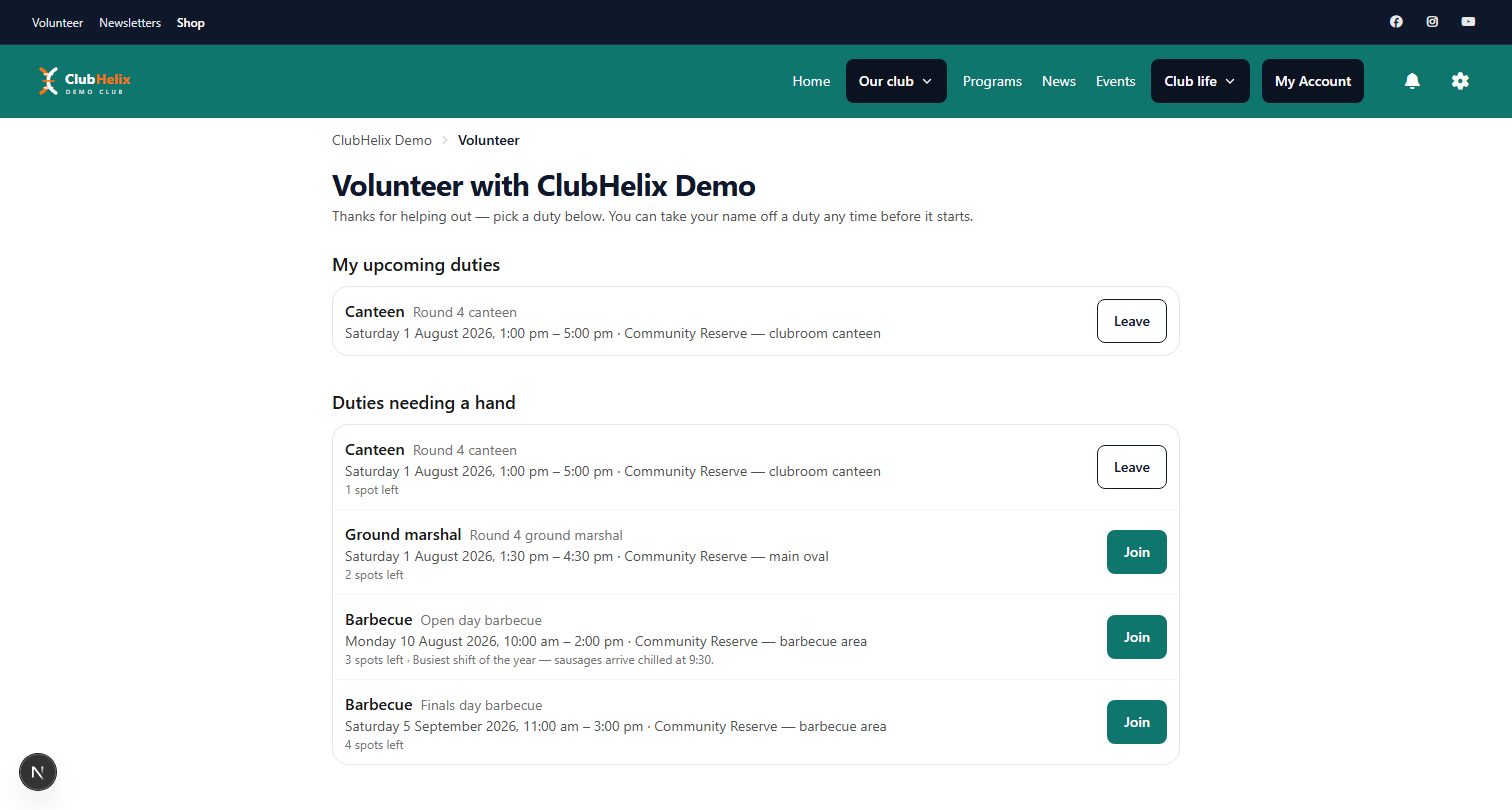
The reminder is the difference between a roster and a wish. On a sheet, reminders are somebody's personal Thursday-night task, and that person eventually stops — either because they got tired or because they left. A rostering system sends them on a schedule: a confirmation when you sign up, a nudge a week out, a reminder the night before with the time, the place and who else is on with you.
That last detail matters more than it sounds. "You are on the 9am shift with Priya and Tom, meet at the side door" produces a far higher turn-up rate than "don't forget your shift", because it removes the two things people are actually anxious about — arriving alone and not knowing where to go.
2. Let people swap without breaking the roster
Every roster has swaps. On a sheet, a swap happens in a private message and the sheet is immediately wrong. Worse, the coordinator finds out only if somebody thinks to tell them.
Write a swap protocol regardless of your tool, and put it at the top of the roster:
- You are responsible for your shift until someone else is confirmed on it.
- Post the swap where everyone can see it, not in a private message.
- The roster is only changed when the replacement has confirmed — a "maybe" is not cover.
- If nobody takes it 48 hours out, tell the coordinator. Do not go quiet.
A rostering system enforces steps two and three by design, which is why swaps stop being a source of no-shows. If you stay on a sheet, this protocol is the single highest-value thing you can add to it.
3. Show coverage, not signatures
A sheet shows you names. What you need is the inverse — the empty cells, ranked by how soon they matter. A coverage view answers one question at a glance: what is not filled in the next three weeks. That is the question the coordinator actually has, and it is the one a long spreadsheet is worst at answering.
Set a rule for what counts as covered and hold to it. A useful one: a shift is covered when the minimum number of people have confirmed, and any shift still short seven days out gets a targeted message to people who have not done a shift this month — not another all-club broadcast, which everyone has learned to ignore.
What a roster record gives you that a guess cannot
Every club eventually needs to state its volunteer hours — for a grant application, an annual report, a council lease review, an award nomination or a governing-body return. The honest position for most clubs is that they estimate, and the estimate is low, because nobody counts the hour before and the hour after.
A roster that records who was actually rostered and who actually turned up gives you three things an estimate never will:
- A defensible number, built from shifts times hours rather than from memory in the week the application is due.
- A distribution, which is far more persuasive than a total. "Ninety-four people contributed at least one shift" says something about community depth that "4,000 hours" does not.
- A trend across seasons, which is what a funder assessing sustainability is really looking for.
Record the hours as you go, not at the end. The mechanics of turning that into a grant-ready figure — what to count, what to value it at, how to present it — are covered properly in tracking volunteer hours for grants, which is a better read than anything we could compress into this section.
The same record does double duty for recognition. Life membership arguments, service awards and the presentation-night thank-you list all go better when they are based on a record rather than on who the committee happens to remember. Our guide on volunteer appreciation ideas has the rest.
In New Zealand, volunteer hours are commonly requested by council community funding, regional trusts and gaming trusts, and by regional sports trusts assessing capability funding. A figure with a stated method behind it carries far more weight than a round number. Check each funder's definition before you build the report — some count committee time, some explicitly do not.
When some jobs need more than a name
Not every shift is interchangeable, and a sheet treats them as though they are.
In New Zealand, people in specified child-related roles are covered by the safety checking regime, food handling at club level sits under food safety rules, and a licensed bar requires certified duty managers on shift. Treat this as general information, keep certificate expiry dates visible to more than one person, and confirm what applies to your club with your national body and the relevant authority.
Whatever your regime, the practical point is the same — a shift with a requirement attached should not be fillable by someone who does not meet it, and a certificate that expires mid-season should surface before the shift, not after it. That is a job for a system that holds accreditations against people, not for a column on a sheet that nobody re-reads.
When to keep the sheet
A rostering tool is not automatically the right answer, and moving too early costs you goodwill. Stay on the sheet when:
- You are genuinely under about thirty shifts a season and one person can see the whole thing.
- All your volunteers are already comfortable with one shared document and nobody is excluded by it.
- No shift carries a qualification requirement.
- Nobody outside the club needs a report on your hours.
- The coordinator is not the bottleneck — they can send the reminders in ten minutes a week and are happy to.
If that is you, the best investment is not software. It is a better sheet — one owner, one link, a locked structure, a swap protocol at the top and a standing five-minute item at every committee meeting. Our volunteer roster template is built for exactly that, and our guide on recruiting club volunteers covers the harder problem of having anyone to roster at all.
Moving across without losing anyone
The migration is where clubs stumble, usually by switching everything at once in the second week of the season. Do it like this instead.
- Pick one roster to move first — the one with the most shifts and the most pain, usually the food outlet or match day. Leave everything else on the sheet.
- Move it in the off-season or a break, never mid-season.
- Pre-fill the people you already know. Nobody should have to re-sign-up for a shift they already agreed to. Import the existing roster before you announce anything.
- Announce it as less work, not new work — "you will get a reminder the night before with who you are on with, and swaps happen in one place".
- Run the sheet in parallel for exactly two weeks, then close it and delete the link. A parallel system left running is a second source of truth forever.
- Move the next roster once the first has run for a month without the coordinator touching it.
Expect one or two people to resist, and expect them to be among your most reliable volunteers. Give them the option of being added manually by the coordinator — a good rostering system should let a coordinator place someone on a shift without that person doing anything, which covers the volunteer who does not use a phone at all.
Handing the roster to something that never forgets
The job you are really trying to get rid of is not the roster. It is being the person who remembers — the one who chases on Thursday, notices the gap in row 42, and takes the "can anyone cover Saturday" message at nine at night. ClubHelix does that part: volunteer rostering with shifts, sign-ups, swaps and a coverage view, SMS and push reminders that go out on schedule without anyone sending them, attendance recording so your hours figure comes from what happened rather than what was planned, and reports that turn the season into a number you can put in an application.
It sits alongside the rest of your club — the same member list that runs registrations, teams and events, so a new volunteer is not a new record to create. Start free, look at the published pricing only when you outgrow it, and have the first roster loaded before the pre-season working bee. Set your club up and give your coordinator their Thursday nights back.
Frequently asked questions
When should a club move from a sign-up sheet to rostering software?
As a rule of thumb, when you pass around thirty shifts in a season, when more than one person is coordinating, or when any shift carries a qualification or screening requirement. Below that a well-run shared sheet with a single owner and a written swap protocol is genuinely fine and cheaper in every sense.
What is wrong with a shared spreadsheet for volunteer rosters?
Nothing, until it gets long. Then it fails quietly rather than loudly — simultaneous edits overwrite each other, empty cells hide in the middle, people who have left are still listed, swaps happen in private messages the sheet never learns about, and nobody can see who has done how many shifts. A sheet records intentions; it cannot chase, verify or count.
How do we stop volunteers dropping out of shifts?
Send a reminder the night before that names the time, the place and who else is on the shift, make swaps public rather than private, and hold the rule that a shift is yours until somebody else has confirmed. Most no-shows are not defections — they are people who forgot, or who arranged cover in a message the coordinator never saw.
Can we track volunteer hours for grant applications?
Yes, and it is far easier when the roster records who actually turned up rather than who signed up. Record it shift by shift as the season runs, keep the number of distinct volunteers as well as the total hours, and check what your specific funder counts before you build the report — definitions vary, particularly around committee and coaching time.
Do all our volunteers need to use an app?
No. A good rostering setup lets a coordinator place someone on a shift manually and send them a text reminder, which covers volunteers who do not want another login. The goal is that the roster is accurate in one place, not that every person interacts with it the same way.
Keep reading — volunteer roster template gives you a working sheet to start from, and how to recruit club volunteers tackles the harder half of the problem.


