
What this guide answers
- How often should a club recognise volunteers?
Little and often beats big and rare. Aim for something small every week (a named thank-you, a social post), something structured every month or two (volunteer of the month, the president's calls), and one major moment…
- What's a reasonable budget for volunteer appreciation?
Most clubs do it well on a few hundred dollars a year, because the highest-impact ideas — specific public thanks, handwritten cards, named awards — are nearly free.
- Should volunteers be paid or given honorariums instead?
Paying some volunteers and not others is one of the fastest ways to poison a volunteer culture, so most community clubs avoid honorariums except for genuinely skilled, time-heavy roles (like a qualified coach), and…
- How do we recognise volunteers who hate public attention?
Ask people how they like to be thanked — it's one question at sign-up or in your welcome pack.
Canada edition. This guide is written for volunteer-run clubs in Canada. Where rules differ — grants, tax, incorporation, safeguarding — follow the Canada-specific pointers below or check with your national body.
Every community club runs on the same fuel: a small group of people who give up their evenings and weekends because they love the place. The uncomfortable truth is that most clubs are far better at using volunteers than thanking them — and the clubs that burn through volunteers fastest are almost never the ones with the hardest jobs. They're the ones where nobody says thank you.
Volunteer appreciation isn't a party once a year. It's a habit, backed up by a couple of structured moments each season where the club says, publicly and specifically, "we saw what you did, and it mattered." This guide gives you 25+ appreciation ideas sorted by cost and effort, then a complete outline for a club volunteer awards program you can put to your committee this month.
Why appreciation beats recruitment
Committees spend hours agonising over how to recruit new volunteers, and almost none on keeping the ones they have. Yet the maths is lopsided: replacing an experienced canteen coordinator or team manager costs you a season of mistakes, a recruitment scramble, and usually a second volunteer's time spent training the replacement. Keeping them costs a thank-you.
Research on volunteering consistently finds the same drivers of retention: feeling effective, feeling connected, and feeling recognised. Two of those three are entirely within your committee's control this week. And there's a compounding effect — a club with a visible culture of appreciation finds recruitment easier too, because prospective volunteers can see that the work is noticed.
Three principles before the list:
- Specific beats generic. "Thanks for everything" washes over people. "Thanks for staying back to pack up the nets in the rain on Saturday" lands, because it proves someone actually noticed.
- Public and private both matter — but ask first. Some volunteers glow when thanked in front of the club; others would rather disappear into the floor. Learn which is which.
- Proportionate and consistent. If one volunteer gets a hamper for running a single event and another gets nothing for a decade of Saturdays, your appreciation program is doing damage. Set tiers and apply them evenly.
Free and nearly-free ideas (1–10)
-
The named thank-you at the barbecue. At any club gathering, the president spends sixty seconds naming three volunteers and the specific thing each did. Costs nothing, takes preparation of exactly one text message to yourself.
-
A handwritten card. In an era of group chats, a physical card signed by the committee is startlingly powerful. Keep a box of blank cards in the clubroom.
-
Thank-you posts on the club website and socials. A short "volunteer of the week" style post with a photo, published to your club news page and shared to social channels. It also quietly shows prospective members what kind of club you are.
-
A thank-you from the players. A junior team signing a card for their team manager, or seniors giving the canteen crew a guard of honour after the last home game, beats anything the committee can buy.
-
First pick of the good jobs. Long-serving volunteers get first refusal on the pleasant shifts — the sunny Saturday morning gate, not the wet Tuesday-night pack-up.
-
Name them in the annual report. Every volunteer, by name, every year. People keep these documents. Omissions get noticed, so work from your roster records rather than memory.
-
A reserved car park for the month. A laminated sign and a spot near the clubroom. Slightly silly, weirdly beloved.
-
The president's phone call. Once a season, the president calls five volunteers just to say thanks — no agenda, no ask. Rotate through the list so everyone gets one within a couple of seasons.
-
Public tally of hours. "Our volunteers gave 2,340 hours this season" on the website and at the end-of-year banquet. It reframes the club as something the community built, and every volunteer sees themselves in the number — and it is the number grant applications and corporate sponsors ask for most often, so track it whether or not you publish it.
-
Ask their opinion. Genuinely consulting volunteers on decisions that touch their patch — canteen layout, training schedules — signals respect more loudly than any gift.
Low-cost ideas with outsized impact (11–18)
- Volunteer-only morning tea or breakfast. One morning a season, the committee cooks and the volunteers sit down. Reversing the roles is the whole point.
- Free canteen coffee for rostered volunteers. A simple standing rule: if you're on the roster that day, coffee and a snack are on the club.
- A club polo with "Volunteer" embroidered on it. Identifies your crew on game day and doubles as a keepsake. Present it after a volunteer's first full season, not their first shift, so it means something.
- Movie or meal vouchers for the "invisible" jobs. The people who do the work nobody sees — bookkeeping, uniform washing, line marking — should be first in line, precisely because they never get the sideline thank-yous.
- Family membership discount. Many clubs waive or discount fees for the children of regular volunteers. Set a clear, published threshold (say, ten rostered shifts a season) so it's a program, not a favour.
- Sponsor-donated rewards. Ask your sponsors for vouchers to give volunteers. Sponsors usually say yes — it's cheap exposure to exactly the community they sponsored you to reach.
- Professional development. Pay for the coaching course, the food-safety certificate, the first-aid refresher. The volunteer gets a qualification they keep; the club gets the capability. Everyone wins.
- End-of-season volunteer raffle. Every rostered shift during the season earns a ticket in a draw at presentation night. It gently rewards frequency without turning volunteering into a transaction.
Public recognition ideas (19–25)
- Volunteer of the Month. A named award, a photo on the website, and a small voucher. Keep the cadence honest — skip a month rather than manufacture a winner.
- A perpetual volunteer trophy. A named honour board or shield for the club's premier volunteer award, with every past winner engraved. History gives an award weight that money can't.
- Name something after them. The "Joan Mitchell Canteen" or an annual match named for a legendary volunteer. Reserve this for genuinely exceptional, long-term service.
- Life membership. The highest honour most clubs can give. It deserves clear criteria and a proper nomination process — we've written a full guide to life membership criteria and nominations.
- Nominate them for external awards. Councils, state sport departments and national sporting bodies all run volunteer awards. A nomination is itself a compliment, and a win brings the club publicity.
- A "decade of service" milestone. Track service years and mark 5, 10 and 20-year milestones at presentation night with a badge or gift. This only works if your records are good — start keeping them now.
- The honour wall. A clubroom wall (or a page on your website) listing every award winner and life member. New members should be able to see, on day one, that this club remembers its people.

And a bonus one that costs the most discipline and the least money: 26. End every season with individual thank-you emails that name the volunteer's actual contribution — shifts worked, events run, problems solved. If your rostering lives in a proper system rather than a paper clipboard, this takes minutes because the record already exists.
A club volunteer awards program you can adopt
One-off thank-yous keep the week-to-week culture healthy. A structured awards program is what makes recognition fair, visible and durable across committee changeovers. Here's an outline you can adapt and adopt in a single committee meeting.
Award categories. Keep it to four or five so each one stays meaningful:
| Award | Who it's for | Selected by |
|---|---|---|
| Volunteer of the Year | The standout contribution across the whole club | Committee vote from nominations |
| Rising Star | Best first- or second-year volunteer | Committee vote |
| Behind the Scenes | The invisible jobs — admin, grounds, finance | Committee vote |
| Team Contribution | Best team manager, coach support or age-group parent crew | Nominated by coaches |
| Service Milestones | 5 / 10 / 20 years of recorded service | Automatic, from records |
Nomination process. Open nominations to the whole club for a fortnight late in the season — a simple form asking who, which award, and one paragraph of why. You'll learn about contributions the committee never sees. Publish the call for nominations on your website and email it to all members.
Judging. A small panel (president, one committee member, one past winner) shortlists and decides. Two rules keep it clean: panel members can't be nominated, and the "why" paragraph — not popularity — is the judging basis.
Presentation. Award at presentation night, with the nomination paragraph read aloud. That sixty seconds of specific, public praise is the real prize; the trophy is a souvenir of it.
Record-keeping. Keep a running register of winners and service years in the club's systems — not in a retiring secretary's spreadsheet. Future committees will thank you at every milestone award.
Make appreciation automatic with good records
Almost every idea above gets ten times easier when the club actually knows who volunteered, for what, and how often. If your volunteer coordination happens through a group chat and memory, your appreciation will be patchy — and patchy recognition is worse than none, because the missed people notice.
This is where a proper volunteer rostering system quietly earns its keep. When shifts are defined, offered and filled in one place, you get a season-long record per person for free: who covered the canteen, who did gate duty, who filled the last-minute gaps. That record drives your milestone awards, your end-of-season thank-you emails, your raffle entries and your family-discount eligibility — with no extra admin.
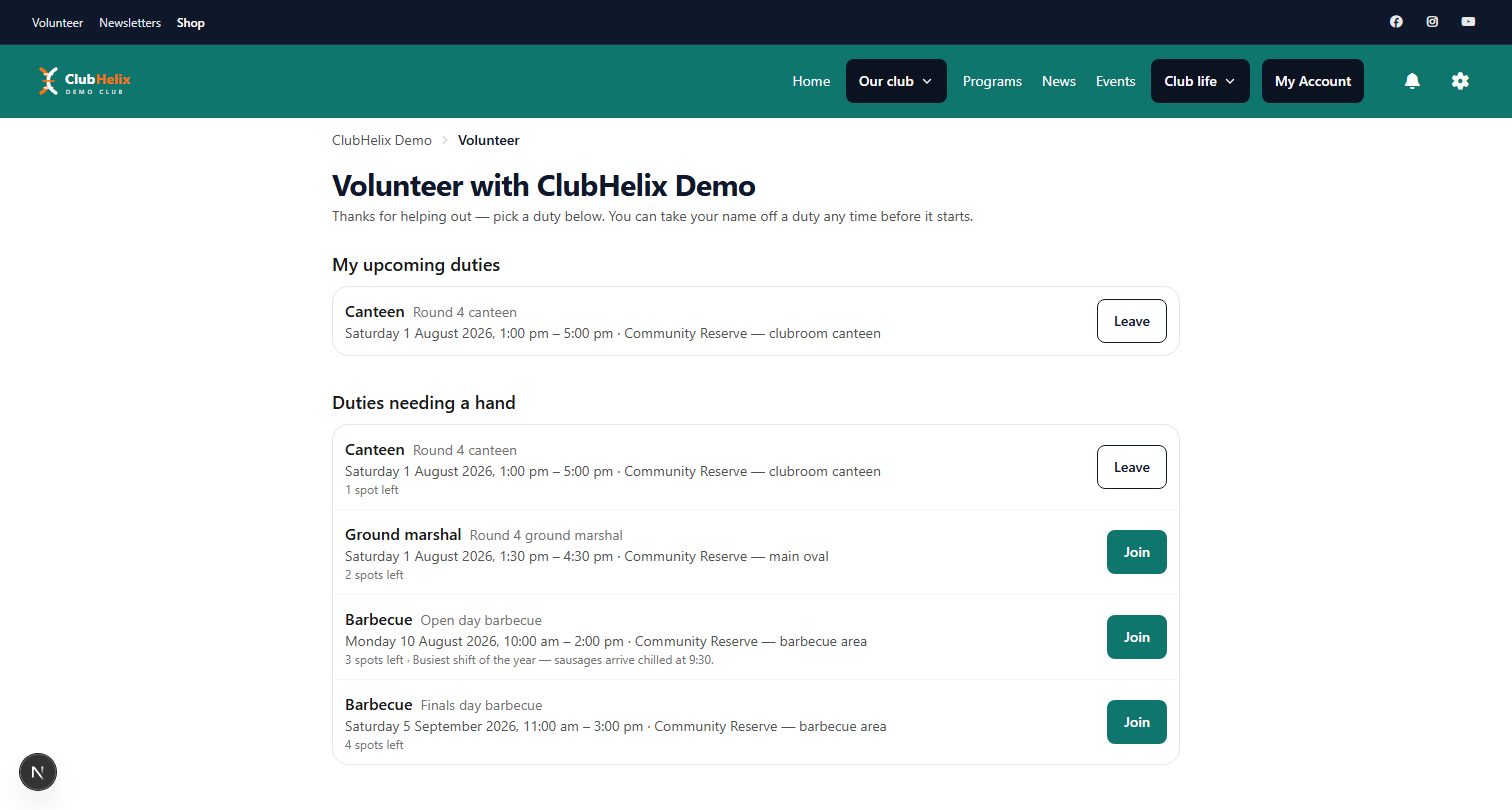
Pair it with your club news page for the public side — volunteer-of-the-month posts, award announcements, the annual hours tally — and appreciation stops being a thing the club means to do and becomes a thing the club visibly does.
Frequently asked questions
How often should a club recognise volunteers?
Little and often beats big and rare. Aim for something small every week (a named thank-you, a social post), something structured every month or two (volunteer of the month, the president's calls), and one major moment a season (awards at presentation night). The weekly habit is what shapes culture; the annual awards are what make it fair and visible.
What's a reasonable budget for volunteer appreciation?
Most clubs do it well on a few hundred dollars a year, because the highest-impact ideas — specific public thanks, handwritten cards, named awards — are nearly free. A common approach is to budget a small fixed amount per active volunteer per season for vouchers and the volunteer breakfast, and ask sponsors to donate the rest. If money is tight, cut gifts before you cut recognition.
Should volunteers be paid or given honorariums instead?
Paying some volunteers and not others is one of the fastest ways to poison a volunteer culture, so most community clubs avoid honorariums except for genuinely skilled, time-heavy roles (like a qualified coach), and they make those arrangements explicit and public. Reimbursing out-of-pocket expenses, on the other hand, should be automatic — volunteers should never be quietly subsidising the club.
How do we recognise volunteers who hate public attention?
Ask people how they like to be thanked — it's one question at sign-up or in your welcome pack. For the spotlight-averse, use the private channel versions: the handwritten card, the phone call, the quiet voucher, first pick of shifts. You can still count them in aggregate public recognition (the hours tally, the annual report list) without putting them on stage.
ClubHelix gives your club volunteer rostering with a season-long record of every shift, plus a news page for the public thank-yous — so recognition runs on records, not memory. New to the club-website side? Start with our guide to building a club website.

