
What this guide answers
- How long should a training session be?
Around 60 minutes for juniors and 75–90 minutes for seniors is typical.
- What is the basic structure of a training session?
Four parts: a warm-up (10–15% of the time), a skill block (30–40%), a game phase (30–40%), and a cool-down with a brief wrap-up.
- How far in advance should coaches plan sessions?
Sketch one-line weekly themes for the whole term, then spend about ten minutes the night before turning each theme into a full session plan.
- Should volunteer coaches track training attendance?
Yes — it takes thirty seconds a session and pays for itself many times over.
Ireland edition. This guide is written for volunteer-run clubs in Ireland. Where rules differ — grants, tax, incorporation, safeguarding — follow the Ireland-specific pointers below or check with your national body.
Most volunteer coaches plan training in the car park, five minutes before the players arrive. It works — sort of — but it produces the same session every week, long queues at drills, and that dead ten minutes where nobody's sure what's next and the group dissolves into chaos.
A written coaching session plan fixes all of that, and it doesn't need to be a coaching-degree document. Ten minutes with the template below gives you a session that runs itself, players who are moving instead of waiting, and a record you can build the next session on. Here's the structure, a copyable training session plan template, and how to plan a whole term without burning your evenings.
The four-part session structure
Nearly every good training session, in any sport and at any age, follows the same shape:
1. Warm-up (10–15% of the session)
Get bodies moving and heart rates up — light running, dynamic stretching, and ideally something with a ball or equipment from the first minute. For juniors, make the warm-up a game (tag, relays, mirror drills); nothing empties young players' enthusiasm faster than laps. The warm-up is also your settling period: it absorbs latecomers without derailing the plan.
2. Skill block (30–40%)
The teaching heart of the session — one or two focus skills, not five. Structure each drill as demonstrate briefly, do lots, correct individually: thirty seconds of showing, minutes of doing. The most common volunteer-coach mistake is queues — one ball and twelve waiting players. Split into small groups, use every ball you own, and aim for each player touching the ball (or equivalent) every 20–30 seconds.

3. Game phase (30–40%)
Apply the skill under pressure — small-sided games, modified rules that reward tonight's focus skill (for example, a goal only counts after a completed pass sequence, if passing was the skill block). Small-sided beats full-sided at training: 4v4 gives every player ten times the involvements of a full-field scrimmage. This is also the phase players would vote for, so never let running the clock down squeeze it out.
4. Cool-down and wrap (5–10%)
Lower the tempo, stretch, and — most valuable of all — talk for two minutes: one thing the group did well, one thing you'll work on next week, and any notices (match details, fees, the sausage sizzle roster). Juniors get collected on time; seniors know exactly when they can leave. Ending on schedule is a promise that keeps volunteers and families on side.
The copyable session plan template
Copy this table into a note, doc or print-out, and fill it in — ten minutes, the night before:
| Section | Time | Activity | Equipment | Coaching points |
|---|---|---|---|---|
| Warm-up | 10 min | e.g. relay races with ball carry | 8 balls, 12 cones | Fun first; absorb latecomers |
| Skill 1 | 15 min | e.g. passing in pairs → triangles | 1 ball per pair | Weight of pass; call the name |
| Skill 2 | 10 min | e.g. receiving under pressure | Cones for grids | First touch away from defender |
| Game | 20 min | 4v4, goal counts after 3 passes | Bibs, small goals | Praise the skill, not just goals |
| Cool-down | 5 min | Jog, stretch, huddle | — | One highlight, one focus, notices |
Header details to add at the top: date, team/age group, session goal in one sentence ("improve passing under pressure"), expected numbers, and a wet-weather variant. That last one matters — a plan for 14 players collapses when 7 turn up, so jot a fallback ("if under 10: skip grids, straight to 3v3 round-robin").
A few rules that make any plan better:
- One goal per session. "Get better at passing" produces a better hour than "work on everything".
- Plan transitions, not just drills. The gaps between activities are where sessions die. Set up the next drill's cones during the current one, and move groups with a countdown, not a speech.
- Maximum touches, minimum talking. If you speak for more than a minute, players stop listening. Coach individuals while the group keeps playing.
- Keep every plan. A season of dated session plans is a coaching diary — and a gift to whoever coaches this team next year.
Planning a term, not just a Tuesday
The real time-saver isn't planning one session faster — it's planning eight at once. At the start of each block, sketch a one-line theme per week.
Plan around school terms and mid-terms: a session plan that ignores the mid-term break will lose most of its attendance in the middle of the sequence. Build in a weather contingency for every outdoor block too — over a winter you should expect to lose two or three sessions.
| Week | Theme | Notes |
|---|---|---|
| 1 | Ball control basics | High fun factor, re-set standards |
| 2 | Passing | — |
| 3 | Passing under pressure | Builds on week 2 |
| 4 | Defending 1v1 | — |
| 5 | Defending as a pair | Match Saturday: expect tired legs |
| 6 | Attacking movement | — |
| 7 | Set pieces | Photos night for club socials |
| 8 | Games night + review | Reward week; parents invited |
Now each weekly plan is just "fill in the template for this week's theme", and skills build on each other instead of resetting every Tuesday. Themes should follow what matches reveal — if Saturday exposed defending, that's next week's theme. Slot this planning into your pre-season checklist and the term runs itself.
Term planning is also how a club lifts every team at once: if all junior coaches share the same themed spine, a player who moves up an age group isn't starting from scratch. If you're building a junior setup from the ground up, our guides on starting a junior program and increasing junior participation pick up that thread.
Know who's coming (before you plan for 14 and get 7)
Half the value of a session plan evaporates when you've planned drills for numbers that don't show. The fix is knowing attendance before the session, not discovering it in the car park:
- Ask for RSVPs. A simple tap-yes/tap-no against each session tells you by lunchtime whether tonight is a 12-player plan or a 7-player plan.
- Record who actually attended. Thirty seconds at the session — tick names off — builds the record that matters over a season.
- Watch the pattern, not the night. One missed Tuesday means nothing; three in a row is a player drifting, and a friendly "we've missed you" message from the coach at that moment is the cheapest retention tool in sport.
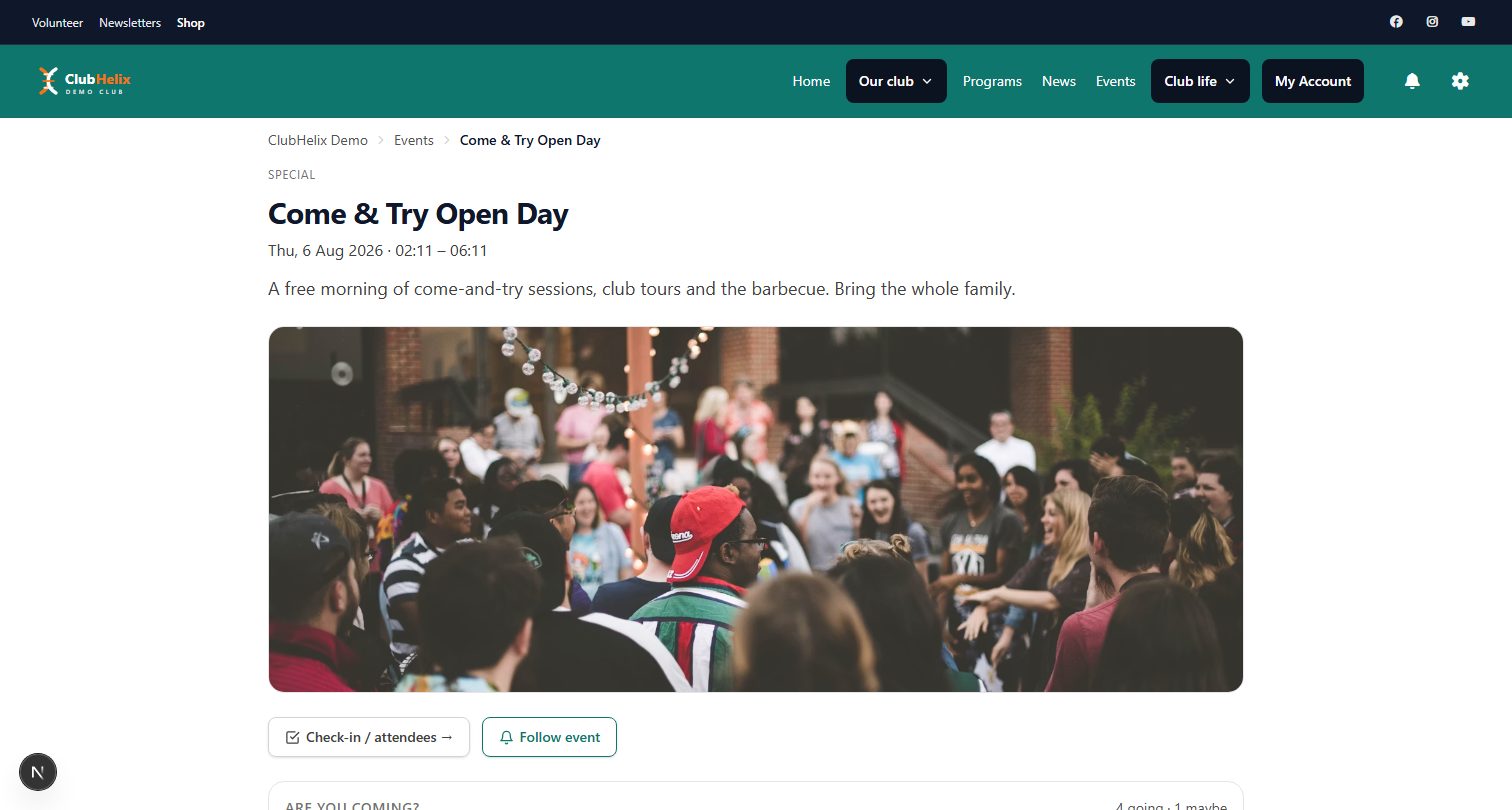
Doing this on paper works; doing it in your club's system works better, because the record survives coach handovers. With RSVPs and attendance attached to each scheduled session, players (or parents) tap their response from the fixture list, coaches see expected numbers at a glance, and team management keeps the squad list, contact details and session schedule in the same place — so "message everyone who missed tonight" is one tap, not a scroll through your phone.
Tips for the time-poor volunteer coach
- Steal shamelessly. Your sport's governing body almost certainly publishes free drill libraries and sample coaching session plans — start there and adapt, don't invent.
- Build a bank of eight. After one season of keeping plans, you own a rotation you can reuse and refine every year. Session planning drops from ten minutes to two.
- Delegate the warm-up. Senior players or a parent helper can run a standard warm-up from a card while you set up the skill block.
- Debrief in one line. After each session, write one sentence on the plan: "grids too big, 3-pass rule worked". Next year's you will be grateful.
- Protect the fun. Especially for juniors, the session structure serves one master: players who want to come back next week. If a drill is dying, kill it early and go to the game.
If your club wants training organised properly across every team — schedules on the club website, RSVPs before each session, attendance history that survives coach changes — ClubHelix handles it alongside teams, fixtures and comms, and there's a free tier to try it on before you commit. See what's included or set up your club.
Frequently asked questions
How long should a training session be?
Around 60 minutes for juniors and 75–90 minutes for seniors is typical. Attention and quality fall off a cliff past those marks — a sharp hour beats a baggy ninety minutes at any age.
What is the basic structure of a training session?
Four parts: a warm-up (10–15% of the time), a skill block (30–40%), a game phase (30–40%), and a cool-down with a brief wrap-up. The proportions flex by sport and age, but the shape holds almost universally.
How far in advance should coaches plan sessions?
Sketch one-line weekly themes for the whole term, then spend about ten minutes the night before turning each theme into a full session plan. Planning the term first means each weekly plan builds on the last instead of starting from scratch.
Should volunteer coaches track training attendance?
Yes — it takes thirty seconds a session and pays for itself many times over. Attendance patterns reveal drifting players while there's still time for a friendly check-in, and expected numbers let you plan drills that actually fit the group that turns up.
