
What this guide answers
- Can we take bookings without a payment processor or a card reader?
Yes — a resource set to be paid at the venue confirms bookings without any payment provider connected, and the club collects the money however it likes: a QR code, a bank transfer, cash or a terminal it already owns.
- How do we know who has paid when the money comes in by QR code?
Ask every booker to quote the booking reference from the pay page in the payment reference — or their surname and the booking date if they have not scanned — then mark each booking paid as the money lands and export…
- What happens if someone cancels a booking they were going to pay for at the venue?
Nothing is owed and nothing needs refunding — the booking is cancelled, the slot returns to the grid, and the cancellation email tells the booker they owe nothing.
- When does a venue-paid booking show up as income?
On the day the club records the payment, not the day the slot was booked.
- Should the club stop taking card payments at booking altogether?
Not necessarily — the payment method is set per resource, so many clubs take the card up front for one-off hirers and high-value slots and let members pay at the venue for the rest.
Ireland edition. This guide is written for volunteer-run clubs in Ireland. Where rules differ — grants, tax, incorporation, safeguarding — follow the Ireland-specific pointers below or check with your national body.
Every online booking system would like you to take the card at the moment of booking, and for a lot of clubs that is exactly right. The court is paid for before it is used, nobody chases anyone, and the treasurer's job is to read a report. But walk into most clubs on a Saturday and the money is moving a different way: a QR code taped to the bar, a card terminal at the canteen, a cash tin with a float, a bank-transfer reference scribbled on the sign-in sheet. Members pay when they turn up, the way they pay for a drink.
Neither way is wrong. The mistake is running venue payment without a record, or running card payment for a crowd that cancels every other week. This guide is about doing venue payment well: when to choose it, what the booking still has to do for you, how to handle QR codes, terminals and cash without burning out a volunteer, how to reconcile what is owed against what came in, and how the money should appear in the club's books. The final section shows how it works in ClubHelix, but the thinking applies whatever you use.
When venue payment beats card at booking — and when it doesn't
Start by being honest about who your bookers are and what they do when plans change.
| Situation | Card at booking | Pay at the venue |
|---|---|---|
| Bookers cancel often (weather, lame horses, shift work) | Every cancellation is a refund to process | Nothing to refund — an unpaid cancellation owes nothing |
| Members already pay at the bar or canteen | A second way to pay, and a second reconciliation | One counter, one float, one habit |
| One-off hirers the club does not know | The money is in before the door opens | Somebody has to chase a stranger |
| The club has no payment processor yet | Cannot take a paid booking at all | Bookings from day one |
| No-shows hurt (a prime evening court) | A no-show has already paid | A no-show costs the club the slot and the fee |
| Volunteers are stretched | Nothing to count at the end of the night | Someone owns the owed list and the tin |
The pattern is clear enough. Venue payment suits members, regulars and anything with a high cancellation rate — the equestrian club whose riders cancel when a horse is off, the tennis club whose social players pay at the bar, the pool that lets swimmers pay for a lane at the desk. Card at booking suits strangers, high-value slots and clubs with no volunteer to chase. Plenty of clubs run both, on different resources: the clubrooms for a stranger's 40th are paid by card up front; the members' court on a Tuesday is paid at the bar.
One thing the table cannot show: for a club that does not yet have a payment processor connected, venue payment is not a compromise. It is the difference between taking bookings this week and taking them after the committee has finished the paperwork.
The three things a venue-paid booking must still do
Taking the money later does not mean doing less. It means the booking has to carry more information, because the money is no longer proof that it exists.
It confirms straight away. A booker who pays at the venue must still know, the moment they book, that the slot is theirs. "Pending until you pay" is how you get two families on one court and both of them right.
It tells the booker exactly what they owe and how to pay it. Not "fees apply" — the amount, and the method: "Pay [amount] at the venue. Cash or card to the duty member in the tack room before you ride." That sentence belongs on the booking screen, in the confirmation email and in the booker's own list of bookings, because the person who booked on Monday will not remember on Saturday.
It gives the club a list of what is owed, by booking. This is the one most clubs skip and the one that matters most. Without it, the QR-code takings are a lump sum that nobody can match to anything, the volunteer at the desk is asking "have you paid?" and taking the answer on trust, and the treasurer's booked income and collected income drift apart until nobody knows which is right.
Get those three right and venue payment is calmer than card. Miss the third and you have built a very polite way of not being paid.
QR codes, card terminals and cash: a volunteer's guide
The method is less important than the routine around it. Here is what works for each.
A QR code. The cheapest and, for members, the most convenient. Print a code that opens a payment page or a bank-transfer with the club's details pre-filled, laminate it, and put it where the payment happens — the tack-room door, the bar, the pool desk. Ask bookers to put the booking reference from the pay page in the transfer reference if your booking system prints one, and their name and the date if it does not, because a transfer with no reference is the single biggest cause of reconciliation misery. Check the code still works every month; a code that points at an old account is worse than no code.
An instant bank transfer to the club's IBAN, printed on a laminated card or a QR code, works well; ask for the booking reference from the pay page, or "surname + date" if they have not scanned, so the statement matches the owed list.
A card terminal (EFTPOS, if that is what yours is called). If the canteen already has one, use it for bookings too — one terminal, one end-of-day report. Train volunteers to type the booking amount, not to round it, and to give the receipt to the booker. The terminal's daily settlement report is your reconciliation partner for card-at-the-venue payments.
Cash. Still the fastest method at a busy counter, and the one that needs the most routine. A counted float at the start, two people counting at the end, a signed sheet, and the takings banked within a couple of days. Keep bookings cash separate from canteen cash if you can — a second tin costs nothing and saves an argument. Give a receipt for anything more than pocket change.
Bank transfer after the fact. The method of last resort, because it happens off-site and out of sight. Accept it, but insist on a reference and mark the booking paid only when the money is on the statement, not when the booker says it has been sent.
Whichever method, one rule: the person taking the money must be able to see the list of what is owed. A volunteer with a terminal and no list is guessing.
Reconciliation: the owed list, marking paid, the CSV against the takings
Reconciliation sounds like a treasurer's word, but for venue payment it is a five-minute job that keeps the club honest, and it goes like this.
- Start with the list of what is owed. Every confirmed booking to be paid at the venue, with the booker, the resource, the date and the amount, that has not yet been marked paid. The list does not expire: money owed from three weeks ago is still owed.
- As money arrives, mark each booking paid. Record the method (cash, card at the venue, bank transfer, other), the amount actually taken if it differs, and a reference — the receipt number, the transfer description. Send the booker a receipt if they want one.
- At the end of the day or the week, compare. Export the bookings marked paid by card at the venue and set them against the terminal's settlement report; export the bank-transfer ones and set them against the statement; count the cash against the bookings marked cash. The three totals should match the three sources. When they do not, the difference is usually one booking marked with the wrong method or one transfer with no reference.
- Chase what is left. The owed list is now short and specific: two names, two amounts, two dates. A friendly message beats a general appeal in the newsletter every time.

Two things make this fast. The first is that the owed list and the marking-paid happen in the same place, so nothing is copied between a booking system and a spreadsheet. The second is a CSV export of exactly the rows on screen — this week's bookings on one court, or everything still owed — with the method and the reference in the columns, so the comparison is a sort, not a search.
No-shows and the cancellation policy
The honest weakness of venue payment is the no-show. A booker who has paid by card and does not turn up has cost the club nothing but a slot; one who was going to pay at the venue has cost the club the slot and the fee. You cannot remove that risk, but you can shrink it.
- Make cancelling easy. A booker who can cancel their own upcoming booking in two taps, and who owes nothing when they do, will cancel rather than simply not come. That returns the slot to the grid for someone else.
- Write the policy down. "A booking that is not cancelled before it starts is payable in full" is fair, common, and only enforceable if it is in your hire terms and on the booking page. Our facility hire terms template has the wording.
- Chase the same day. A no-show that is chased on Monday with "you still owe [amount] for Saturday's court" is usually paid; one chased at the end of the season is usually forgotten.
- Move the repeat offenders. Two no-shows and the person books by card next time. Because the payment method is set per resource, the practical version of this is a members-only, pay-at-the-venue resource and an everyone-welcome, card-at-booking one.
- Keep the highest-value slots on card. If the Friday-night floodlit court is the one that hurts when it goes empty, take the card for that one and let the rest be paid at the bar.
How it shows in the club's books
Venue payment changes when the money is recorded, and the treasurer needs to understand that before the first report is read.
A booking paid by card at booking is income on the day it was booked. A booking paid at the venue is income on the day the club records it — which is when the money actually arrived, not when the slot was booked and not when it was played. That is the correct treatment, and it means two numbers that used to be the same are now different: booked value (the price of every booking taken) and collected (the money actually recorded). The gap between them is your owed list, and watching it is how the treasurer knows whether the volunteer at the desk is keeping up.
Feed the collected figure, not the booked figure, into the club budget. Booked income that was never collected is the classic way a facility looks profitable on paper and short in the bank.
The worked example in ClubHelix
Here is how the whole routine looks on the ClubHelix Demo club, where the arena is set to be paid at the venue.
The resource. In facility booking, each court, arena, lane or room decides for itself how it is paid — "Card at the time of booking" or "At the venue" — and the venue option comes with a box for your own payment instructions, which is where you tell the booker what to do when they get there ("pay the duty member in the clubhouse", "EFTPOS at the bar"). A venue-paid resource needs no payment processor connected, so the club takes bookings from the day it signs up, and money the club records itself with Mark paid carries no platform commission, because none of it crosses our rails.
The booking. A venue-paid booking is confirmed straight away. The booker sees "Pay [amount] at the venue" with your instructions on the booking screen, in the confirmation email and in their own bookings list. Guests book with a name and an email; members sign in, get the member rate automatically while they are financial, and can cancel their own upcoming bookings — an unpaid venue booking that is cancelled owes nothing, and the cancellation email says so.
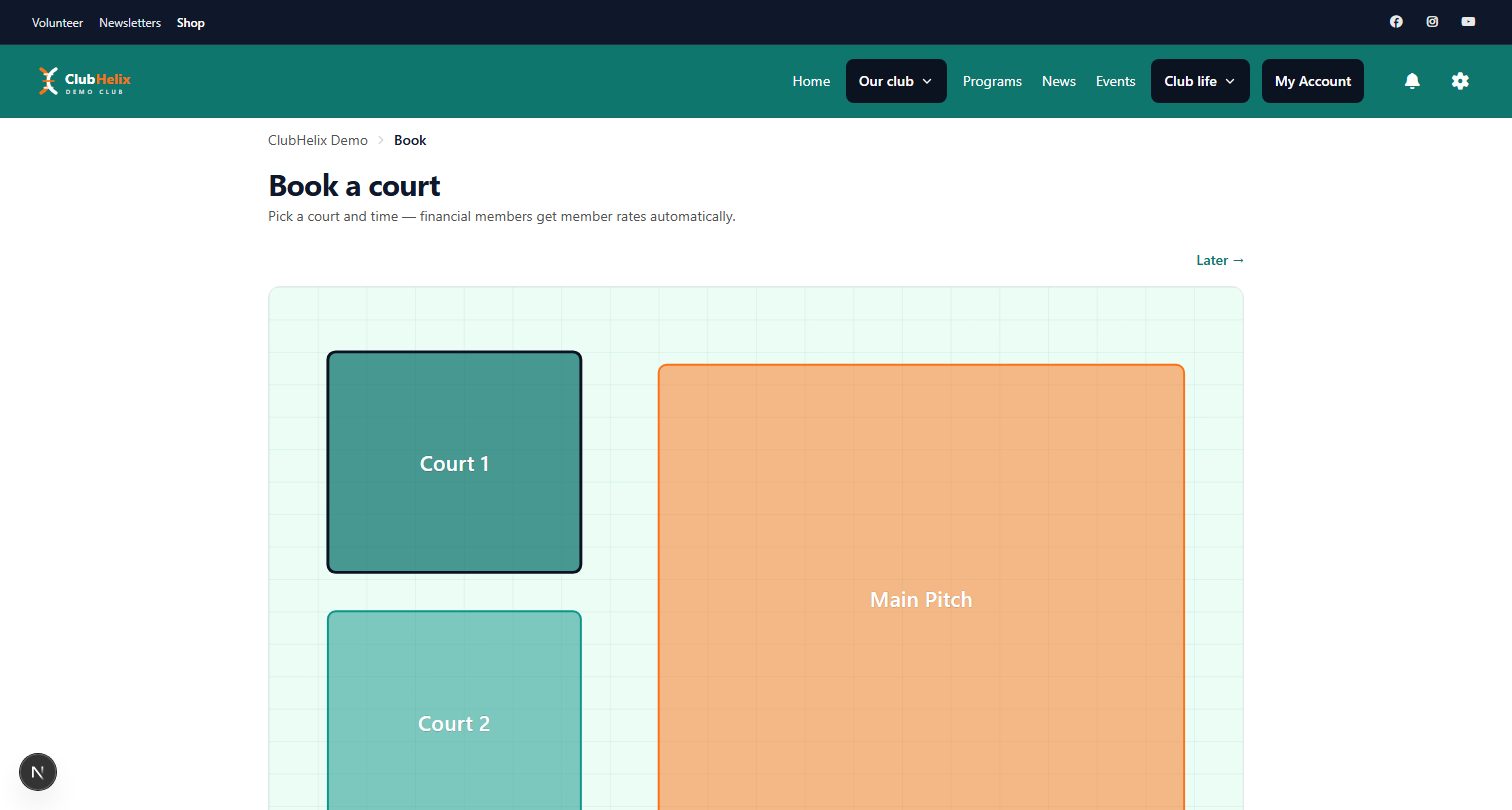
The poster. Facilities prints a QR poster for each resource and one for the whole venue. Laminate it and put it where the money changes hands — the tack-room door, the bar, the pool desk. The code on the poster is ours, not one you make yourself: scanning it opens a pay page that already knows which booking the person is standing there to settle — their own bookings when they are signed in, the ones made on that device when they booked as a guest, or the link in their confirmation email. Your typed instructions print on that resource's own poster, so "pay the duty member in the clubhouse" is still the first thing anyone reads. The venue poster leaves them off — a venue holds several resources whose instructions may disagree — and the pay page shows each booking's own instructions instead, once the scanner is looking at their booking.
The pay page. It shows what is owed and a booking reference to quote on a transfer, and then offers two ways to settle up. Pay by card runs through the club's own payment provider — an ordinary online payment, so the club's usual card fees apply. Or the page shows the club's own payment details: your payment QR image, a payment link, or your account details, whichever you use. Those are set once for the whole organisation on the Paying at the venue card in Facilities, and they appear on every poster and every pay page. Change the account and one edit updates every pay page at once; the posters carry the same details, so those still have to be reprinted. Somebody who pays the club that way can press I've paid to tell you. That raises a Rider says paid flag on the booking, with a filter of its own, and the booking stays owed until somebody confirms it with Mark paid — a claim is never money.
The owed list. The Bookings page carries an "Owed at the venue" tile — the total and how many bookings are still to settle — and an "Owed at the venue" filter that lists them all, whenever they were made. Each row shows the booker, the resource, the slot, how many horses or players they brought, any comment they left, and the amount.
Marking paid. On any booking still owed, Mark paid opens a small form with the amount pre-filled to what is owed: pick cash, card at the venue, bank transfer or other, add a reference such as the receipt or transaction number, and tick "Email the booker a receipt". Saving writes a payment to the club's ledger dated that day, so the booking appears in the payments export and the finance reports as collected, and the audit log records who marked it and when.
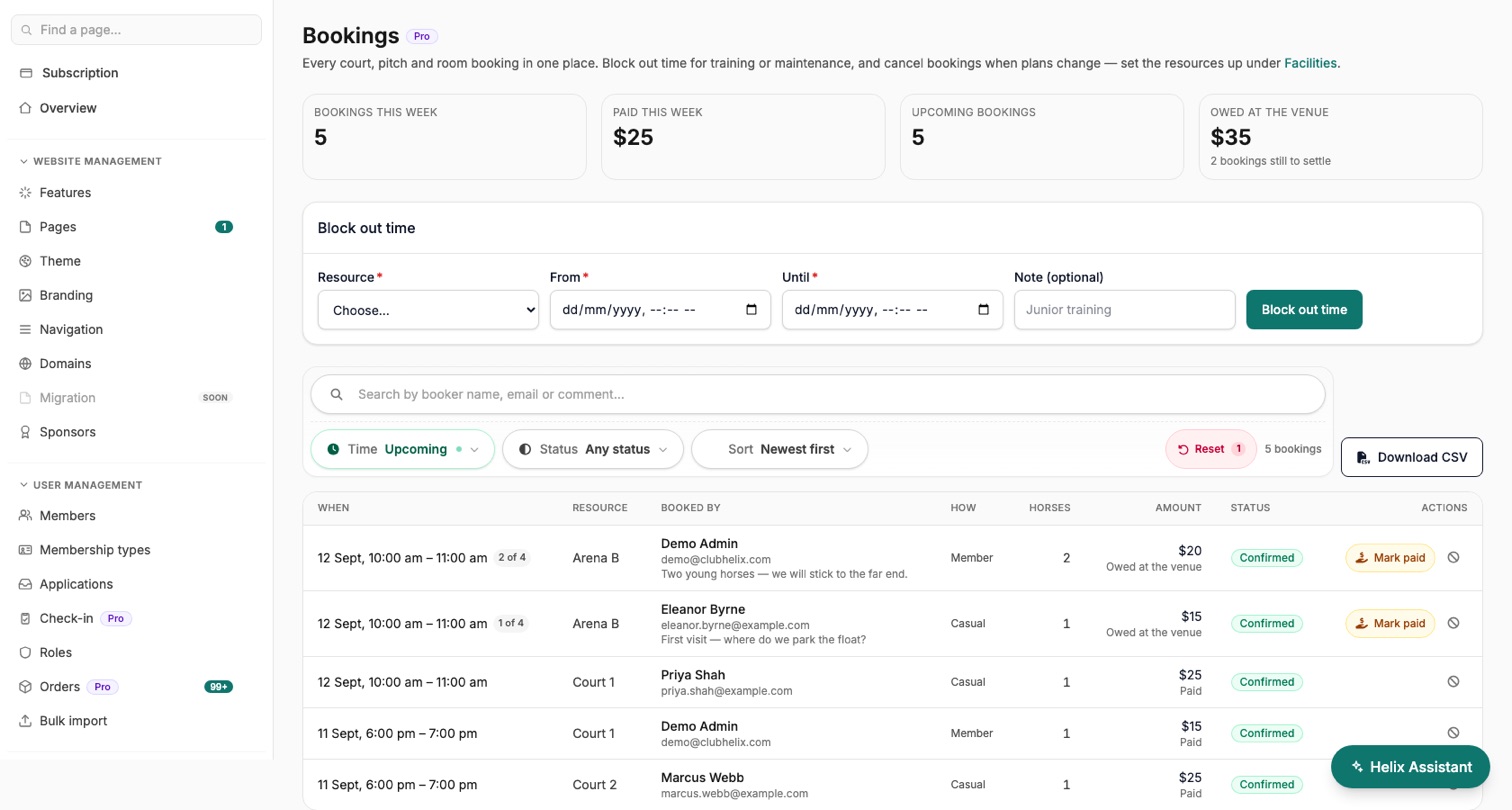
Reconciling. Download CSV exports whatever the list is currently showing, filters included — resource, when, who, units, comment, amount, what is owed and the payment method — ready to set against the terminal's settlement report or the bank statement. The Booking revenue report separates booked value from collected, so the treasurer can see the owed gap without opening the bookings list at all.
Refunds. A payment taken at the venue is refunded the way it was taken — hand back the cash, reverse the terminal transaction, make a transfer — and nothing needs recording in the booking. A card payment is refunded through your payment provider's dashboard and reconciles back on its own.
The rest of the money side — collecting membership fees online into the club's own account, with instalment plans and reminders, and the club's own ClubHelix plan — is covered on the billing and sponsors page; pricing is per club, with no per-booking fee on money the club records itself.
Frequently asked questions
Can we take bookings without a payment processor or a card reader?
Yes — a resource set to be paid at the venue confirms bookings without any payment provider connected, and the club collects the money however it likes: a QR code, a bank transfer, cash or a terminal it already owns. Record each payment with Mark paid so the list of what is owed stays accurate. Card payment needs a processor either way — at the time of booking, or from the pay page behind a QR poster.
How do we know who has paid when the money comes in by QR code?
Ask every booker to quote the booking reference from the pay page in the payment reference — or their surname and the booking date if they have not scanned — then mark each booking paid as the money lands and export the paid rows against the bank statement. Somebody who has paid the club direct can also press I've paid on the pay page, which flags the booking as Rider says paid: a claim rather than money, but it tells you which line on the statement to go looking for. The owed list shrinks to the handful of names still outstanding, which is who you chase.
What happens if someone cancels a booking they were going to pay for at the venue?
Nothing is owed and nothing needs refunding — the booking is cancelled, the slot returns to the grid, and the cancellation email tells the booker they owe nothing. If they had already paid at the venue, refund them the way you took the money.
When does a venue-paid booking show up as income?
On the day the club records the payment, not the day the slot was booked. Reports show booked value and collected separately, and the gap between them is your list of what is still owed at the venue.
Should the club stop taking card payments at booking altogether?
Not necessarily — the payment method is set per resource, so many clubs take the card up front for one-off hirers and high-value slots and let members pay at the venue for the rest. Choose by who books each resource and how often they cancel.


