
What this guide answers
- Can I run a club competition on a spreadsheet?
Yes, and plenty of clubs do it well for small, short competitions.
- What is the best draw generator for clubs?
The useful question is not which tool generates the draw, but which one maintains it.
- How should a forfeit be scored?
However your by-laws say, consistently and in advance. Most competitions award the win and a nominal score to the non-forfeiting side, count the match as played by both, and decide separately whether the forfeiting…
- Do byes count as matches played?
That is a by-law decision, and it changes your rankings, so make it deliberately.
- What is the fastest way to publish results so people see them?
Enter them from the sideline as matches finish, into a system that updates your public page immediately, then push the changes that matter — a venue move, a cancellation — rather than assuming people will re-check.
Ireland edition. This guide is written for volunteer-run clubs in Ireland. Where rules differ — grants, tax, incorporation, safeguarding — follow the Ireland-specific pointers below or check with your national body.
Round three, Sunday night. The competition workbook has six tabs — Draw, Results, Ladder, Venues, Contacts and one called Working — and until Saturday morning it was accurate. Then the rain closed two venues, a team folded after losing four players in a fortnight, and a coach emailed to say his side had turned up against the wrong opposition because he was still working from the file you attached in February.
None of that is a spreadsheet's fault. Spreadsheets are superb at holding a plan. What they are not built for is a plan that changes underneath you, where one edit has eleven consequences and nine of them are invisible until somebody complains. That is the honest shape of this comparison. It is not that manual fixtures are amateurish; it is that running a live competition is a recalculation problem, and recalculation is precisely the kind of work you want a machine to own.
This guide is for whoever holds the draw — the fixture secretary, the competition manager, or the committee member who inherited the file with the merged cells. It covers where a manual draw breaks and roughly when, how ladder points, byes and forfeits should be handled so nobody is arguing about percentages the week before finals, and where results have to end up if players are actually going to see them. If you are still building your first draw rather than maintaining one, read how to make a fixture draw first and come back here.
What a spreadsheet genuinely does well
Any argument that starts by pretending the spreadsheet was a mistake will lose the committee in about ninety seconds, because the spreadsheet has been working. Be fair to it.
- It costs nothing and everyone has one. No procurement, no approval, no card details.
- It is completely flexible. Odd formats — three-round pools, a split season, a two-division crossover — can be modelled in an afternoon without asking anyone's permission.
- You can see everything at once. A whole season on one screen is genuinely useful when you are checking that no team has four away matches in a row.
- It is brilliant for the draft. Sketching the shape of a season, testing whether 11 teams fit into 15 weeks, working out how many byes you are forced into — a spreadsheet is the right tool for all of it.
- It works offline, in a car park, with no signal.
Keep it for that. The question is not whether to use a spreadsheet to design a draw; it is whether the spreadsheet should still be the source of truth once the first ball is bowled, served or bounced.
How much of the competition you actually control is the other half of the question, and that depends on where your club sits in the structure above it.
Most clubs in Ireland play in competitions run by a county board, provincial branch or regional league, which sets the fixture list and the rules. Your club handles nominations, availability, re-fixtures and results submission, plus the internal competitions you run yourselves. The published version members rely on is the one on your own site, whoever generated the draw.
The failure timeline — when a manual draw actually breaks
Manual fixtures do not fail on day one. They fail predictably, at points where the season stops matching the plan. If you have run a competition before, you will recognise most of this.
| When | What happens | What it costs a spreadsheet |
|---|---|---|
| Two weeks before round 1 | A team nominates late, another pulls out | The whole draw is regenerated and every previously circulated copy is now wrong |
| Round 1 | A venue double-books | One fixture moves, and the venue tab, the draw tab and the emailed PDF disagree |
| Round 3 | A round is abandoned mid-way | Some results stand, some do not; the ladder needs a manual, defensible adjustment |
| Round 4 | A team withdraws for the season | Every past result against them may need voiding and every future match becomes a bye |
| Round 6 | A forfeit | Points, matches played and the for-and-against columns all move by hand |
| Round 9 | An ineligible player is discovered | A retrospective points adjustment that must survive being questioned |
| Round 12 | Two teams finish level | The tie-break rule gets read closely for the first time all season |
| Finals week | The draw is re-seeded | A new bracket built from scratch, usually at night, usually in a hurry |
| The following January | A new fixture secretary takes over | A copy of last year's file, with last year's errors, and nobody who remembers why |
Two patterns run through the whole table. The first is that every change is a fan-out: one real-world event (rain, a withdrawal, a forfeit) requires edits in several places, and there is nothing checking that you made all of them. The second is that the errors are silent. A broken formula does not raise its hand. It quietly serves a wrong ladder to 200 people for a fortnight until a coach with a notebook works out that his side's percentage is wrong.

The three-copies problem
The deeper issue is not the file. It is that a season generates copies, and copies drift.
There is the master workbook on the fixture secretary's laptop, the PDF exported in February and attached to an email, and the screenshot somebody posted into a team chat, which is now the version four coaches are using. There may also be a printed sheet on a noticeboard and a page on the club website last edited by a committee member who has since moved away.
When round 6 moves, you have to fix all of them, and you will not. The published copy is the one people act on, so the practical test of any fixture system is not "can it hold a draw" but "when the draw changes, how many places do I have to change it?" A spreadsheet's honest answer is: as many as you have ever sent it to. Competition software's answer should be: one, and everything downstream follows.
Weather sharpens this. A frozen or waterlogged surface at eight on a Saturday morning, a heat policy in high summer, or an early-season pitch inspection all end the same way — a call that has to reach several hundred people in under an hour, then a re-fixture that has to be found by everyone weeks later. A draw that lives in one place, with notifications attached to it, earns its keep in that hour alone. Our wet-weather communication plan sets out the escalation order.
Ladder maths, byes and forfeits
This is where the two approaches genuinely diverge, because a competition table is not a list — it is a calculation with rules, and the rules have edge cases that only appear when something goes wrong.
The standings table itself is easy: four points for a win, two for a draw, nothing for a loss, ordered by points then by a differential. The hard part is everything that is not a normal completed match.
Whatever your competition calls the standings table — most commonly the league table — the same principles apply.
Byes
A bye is not a win, but it has to be recorded, because a team with a bye has played fewer matches than everyone else and half your tie-break rules divide by matches played.
Decide before round 1 and write it into the by-laws:
- Does a bye award points? Many competitions award the equivalent of a win to keep the table comparable; others award nothing and rank on average points instead.
- Does a bye count as a match played? If it does, percentage and average calculations shift for that team.
- Does a bye affect the for-and-against columns? Usually not, but if you award points you must say what happens to the score columns.
The reason to settle it early is that byes multiply. An odd number of teams gives every side a bye; a withdrawal creates one every round for whoever was drawn against the departed team; a split-round finals structure adds more. If your rule is written down once and applied by the system, the table stays comparable. If it is applied by hand every fortnight, one distracted evening puts a team into finals that should not be there.
Forfeits, walkovers and abandoned rounds
The single most common source of a disputed table is inconsistent forfeit treatment. Write the answers down, then let the system apply them.
| Scenario | What has to be decided in advance |
|---|---|
| Team forfeits before match day | Score awarded to the opposition, and whether the forfeiting team is penalised |
| Team forfeits on the day | Same, plus who wears the venue or official costs |
| Both teams unable to field a side | Whether it is a draw, a double loss, or a void fixture |
| Match abandoned after it starts | Score at abandonment, replay, or split points |
| Whole round abandoned for weather | Reschedule, void the round, or award shared points |
| Team withdraws mid-season | Whether past results stand or are struck out, and how the differential is treated |
| Ineligible player used | Points adjustment, and whether it applies retrospectively |
Here is the worked example that shows why manual recalculation is risky. Take a six-team competition, four points a win, ranked on points then goal difference. After round 5:
| Team | P | W | L | D | For | Against | Diff | Pts |
|---|---|---|---|---|---|---|---|---|
| Harbour | 5 | 4 | 1 | 0 | 61 | 44 | +17 | 16 |
| Ridge | 5 | 4 | 1 | 0 | 58 | 45 | +13 | 16 |
| Vale | 5 | 3 | 2 | 0 | 52 | 48 | +4 | 12 |
| Quarry | 5 | 2 | 3 | 0 | 47 | 51 | -4 | 8 |
| Mill | 5 | 1 | 4 | 0 | 43 | 57 | -14 | 4 |
| Pier | 5 | 1 | 4 | 0 | 41 | 57 | -16 | 4 |
Now Pier withdraws, and the by-law says their results are struck out. Every team's played count drops by one. Harbour and Ridge both lose a win, but the goal columns move by different amounts because they beat Pier by different margins, so the order at the top can flip. Vale, who happened to lose to Pier, gets a loss removed and may jump. Two teams still on the same points now separate on a differential that has changed twice. Doing that by hand across four tabs, at 10pm, with a coach messaging you, is how a season ends in a protest.
A competition system recalculates the whole table from the underlying results the moment you mark a fixture as void or forfeited, and it applies the same rule to every team, every time. If you take one thing from this comparison, take that. Competition tools that own fixtures, results and standings together do this because they hold the results, not a picture of the results — and a finals series built from that table inherits the corrections automatically instead of being re-typed.
The four numbers that should always agree
A quick integrity check you can run in any system. At any point in the season, these four should reconcile: fixtures scheduled to date, results entered to date, total matches played across the standings table (each match counts twice), and total points awarded against the maximum available for those matches.
If they do not reconcile, something has been missed — a result never entered, a forfeit applied to one team but not the other, a fixture deleted rather than voided. In a spreadsheet this is a manual audit somebody has to remember to do. In a competition system the numbers derive from one another, so they cannot disagree.
Publishing results where players actually look
A draw nobody can find is not a draw. This is the part most comparisons skip, and it is where the practical difference is largest, because the spreadsheet's natural output — a file — is the worst possible format for the way people actually check.
| Who | What they want to know | When | What a file or PDF does to them |
|---|---|---|---|
| A player | Where and what time, this week | Thursday night, phone | Pinch-zooming a 12-column grid on a small screen |
| A parent | Which venue, which grade, is it still on | Saturday morning | Opening an attachment from a February email |
| A coach | Who is available, who we play next | Mid-week | Cross-referencing two files |
| A visiting club | Directions and the correct start time | The day before | Emailing your secretary |
| A prospective member | Does this club have a team at my level | Any time | Never sees it at all — files are not findable |
Three rules make publishing work, whatever tool you use:
- One canonical location. A page on your own club site that is always current. Everything else — posts, chats, printed sheets — links to it rather than copying it.
- Push the change, do not just publish it. People do not re-check a page they have already read. A venue change or a wash-out needs to arrive: a notification to the affected teams, a message for the truly urgent, and the page updated so anyone who checks later gets the same answer.
- Results the same day. Standings that update on Sunday morning get looked at. Standings that update on Wednesday do not, and by then the arguments have already happened in a group chat.
This is the real payoff of a system that holds fixtures and results together. Results entered on the sideline appear on the public page immediately, the table recalculates itself, and a live match centre gives the people who could not be there something to follow. If your club also writes up the weekend, how to write a match report covers the format that gets read.
The Saturday-to-Monday rhythm
A workable weekly cycle for a club competition manager:
- Wednesday — availability closes, teams are selected and published. A written team selection policy removes most of the arguments before they start.
- Thursday — fixtures confirmed, venue changes pushed to the affected teams only.
- Saturday — the weather call by the fastest channel you have, then scores entered as matches finish, from a phone, by whoever is there.
- Sunday — the table is already correct; you write the summary rather than the maths.
- Monday — nothing. That is the point.
The real cost of a free spreadsheet
The spreadsheet is free. The hours are not. Rough out your own version of this table with real numbers from your last season — the ratios matter more than the absolutes.
| Task | Manual, per week | With a competition system |
|---|---|---|
| Entering results | 30-45 min | Entered once, by whoever is at the match |
| Recalculating the table | 15-30 min | Automatic |
| Publishing the update in every place | 20-30 min | One save |
| Answering "where are we playing?" | 20-40 min | Mostly self-served |
| Fixing a change from mid-week | 30-60 min, ad hoc | One edit, pushed |
Even at the low end that is around two hours a week of one person's life, for maybe 20 weeks, plus the pre-season build and the finals scramble. That is a substantial volunteer role that exists only because the tool cannot recalculate.
Two hours a week for 20 weeks is 40 hours. Costed at even €18 an hour as an illustration, that is over €700 of donated time spent on arithmetic. In Ireland, where the same handful of people typically run fixtures, the pitch roster and the underage grades, the argument for automating the calculation is less about money than about whether those people are still standing in September.
When a spreadsheet is still the right tool
Not everything needs a system, and pretending otherwise is how software gets bought and abandoned.
- A one-weekend carnival with a fixed bracket, no interruptions, and results going straight onto a whiteboard.
- Designing the season before it starts — scenario testing, counting rounds, checking travel balance.
- A four-team social competition where everyone is in one chat and the table fits in a message.
- A genuinely bespoke format your governing body has invented and nothing supports yet.
The line is roughly this: if the competition runs more than about six weeks, involves more than about six teams, or has results that matter to people who are not in the room, the recalculation load will exceed what a manual file can carry safely.
Switching mid-season without losing a round
Most clubs move at the worst possible time, because they only feel the pain in season. It is survivable if you sequence it.
- Freeze the table. Export the current standings and file it. That is your reconciliation reference.
- Load teams and remaining fixtures first, not history, so members immediately have one place to look.
- Back-load results round by round, checking against your frozen copy after each one. Discrepancies are almost always a forfeit or a bye applied differently — useful, because it tells you your by-law was ambiguous.
- Publish the new location once, loudly, and put a pointer on the old one. Two sources of truth is worse than either.
- Retire the file. Next year's fixture secretary should inherit a system, not a workbook with your initials in the filename.
Running the draw, the ladder and the match centre in one place
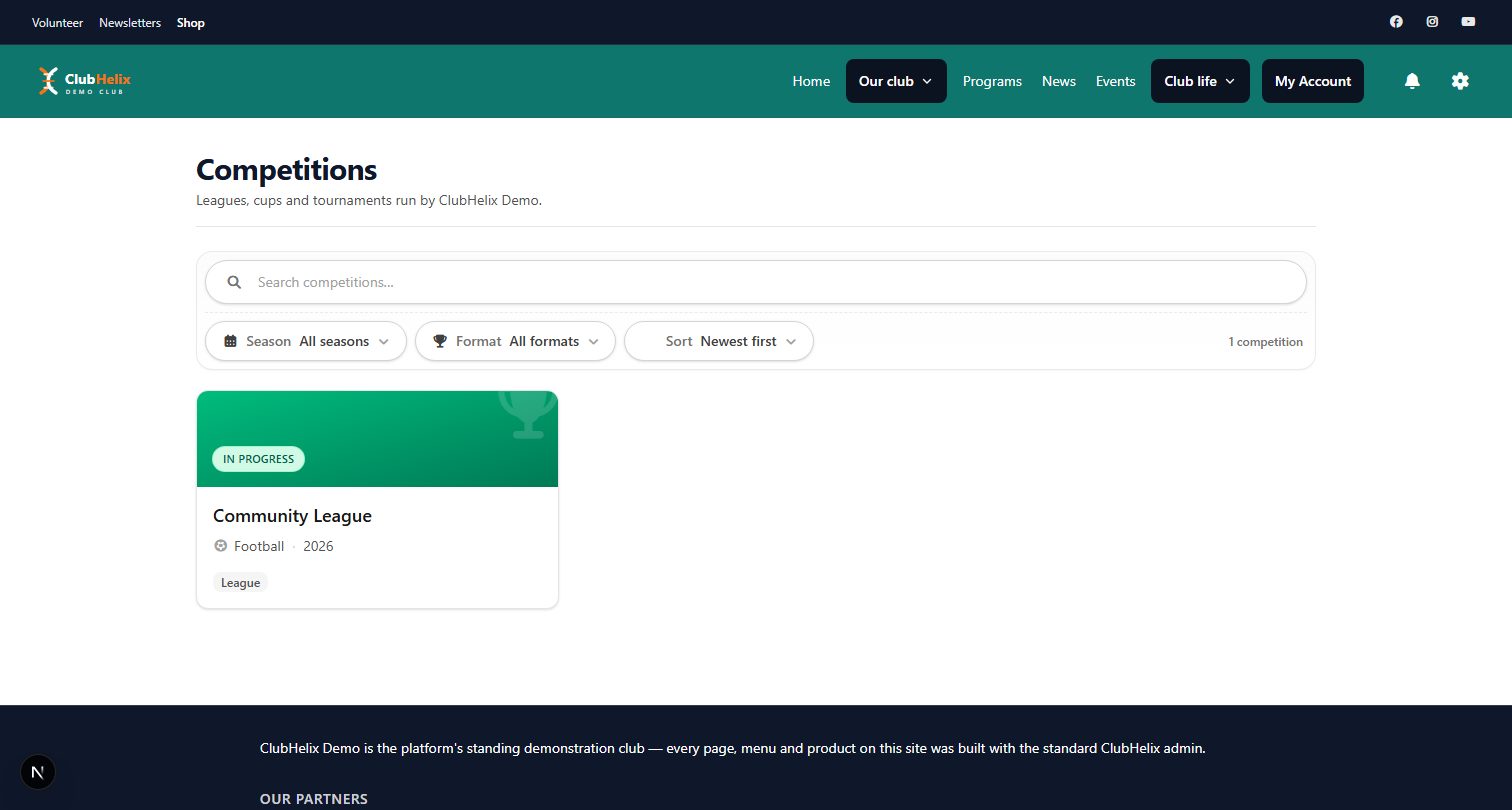
The admin that eats a competition manager's season — re-entering results, recalculating a table, republishing a changed fixture in four places, answering the same venue question thirty times — is exactly the work a club platform should absorb. ClubHelix builds competitions into your club website, so fixtures, results, standings and a finals series all derive from the same data, and the public fixture page updates the moment a score goes in. Team management handles availability and selection alongside it, so the people picking sides and the people publishing the draw are working from one list rather than two.
You can try that on the free tier, and see the pricing only when your competition has outgrown it. It is designed for volunteer committees rather than full-time administrators, and most clubs get their first competition loaded and published in an evening — start your club site and put this season's draw somewhere it can finally look after itself.
If the spreadsheet is running more than the draw — the member list, the payments, the rosters — the spreadsheet to club software comparison shows what a club gains, and what it gives up, by moving all of it.
Frequently asked questions
Can I run a club competition on a spreadsheet?
Yes, and plenty of clubs do it well for small, short competitions. The limits show up when the season changes shape — a washed-out round, a withdrawal, a forfeit — because each of those requires several coordinated edits and there is nothing checking that you made them all. If your competition runs more than about six weeks with more than about six teams, the recalculation load starts to outgrow a manual file.
What is the best draw generator for clubs?
The useful question is not which tool generates the draw, but which one maintains it. Generating a round robin is a solved problem that takes minutes. Keeping the draw, the results, the standings and the published version in agreement for four months is the actual job, so choose based on what happens after a fixture changes rather than on how quickly the first draw appears.
How should a forfeit be scored?
However your by-laws say, consistently and in advance. Most competitions award the win and a nominal score to the non-forfeiting side, count the match as played by both, and decide separately whether the forfeiting team is penalised. What matters far more than the specific rule is that it is written down before round 1 and applied identically every time, because inconsistent forfeit treatment is the most common source of a disputed table.
Do byes count as matches played?
That is a by-law decision, and it changes your rankings, so make it deliberately. If byes count as played and award points, the table stays directly comparable between teams. If they count for nothing, you generally need to rank on average points instead, or teams with more byes are unfairly punished. Write the answer into your competition rules and make sure whatever holds your standings applies it automatically.
What is the fastest way to publish results so people see them?
Enter them from the sideline as matches finish, into a system that updates your public page immediately, then push the changes that matter — a venue move, a cancellation — rather than assuming people will re-check. One canonical page everyone links to beats five copies in chats and emails, because copies drift and the copy someone acted on is the one that was wrong.
Keep reading — how to make a fixture draw covers building the season in the first place, and wet-weather communication plan covers the Saturday morning that breaks it.


