
What this guide answers
- How many junior teams should we nominate?
Nominate on commitments rather than hopes: run a one-question intention check with last season's families, apply your own recent return rate to the newcomers, and nominate the sides you can genuinely fill.
- What happens if a child turns the next age up mid-season?
Nothing, in almost every competition: age groups are set by your association's cut-off date or birth year and hold for the whole season, so a child who has a birthday in round eight finishes the season in the team she…
- Can a junior play up in an older age group?
Usually yes, but only with your association's written approval, and some sports add a size or safety assessment for contact grades.
- Does a child need their own email address to register?
No, and inventing one for them is a mistake that compounds. The child is the member and the parent or guardian is the contact of record, so the child's record should be complete — name, date of birth, team, medical…
- When should we start coaches' and managers' clearances?
The week you recruit them, which in practice is about eight weeks before round one.
USA edition. This guide is written for volunteer-run clubs in the United States. Where rules differ — grants, tax, incorporation, safeguarding — follow the USA-specific pointers below or check with your national body.
Every junior club runs the same few weeks, every season, in the same order of panic. Nominations close before you know how many children are coming back. Grading happens before half the registrations have landed. The team lists are due to your association in the week two coaches are still "pretty sure, just checking with work". And underneath all of it, every child has to be eligible and every adult has to be cleared before the first whistle of round one.
None of that is really a paperwork problem. It is a sequencing problem — a set of tasks that only work in one order, run by a coordinator who is also somebody's parent with a day job. Get the order right and junior team registration becomes four calm evenings. Get it wrong and you spend round one on the phone. This guide sets out that order, working backwards from round one, then goes through the decisions that go wrong inside it: how many teams to nominate before you know your numbers, who is eligible for which age group, and what to collect at registration. ClubHelix turns up in the last third as the worked example.
Work backwards from round one
There is only one fixed date in a junior season: round one. Everything else is a deadline derived from it, and the reason clubs feel ambushed is that they plan forwards from "registrations are open" instead of backwards from the only date that cannot move.
Write the countdown out once, in weeks, and reuse it every season. The exact spacing depends on your association's calendar — some want nominations a full term ahead, some want them a month out — but the order almost never changes.
| Weeks before round one | What has to happen | Who owns it | What breaks if it slips |
|---|---|---|---|
| 14 | Intention check with last season's families, age group by age group | Junior coordinator | You nominate blind |
| 12 | Team nomination lodged with your association | Junior coordinator | Late nomination fees, or no grade available |
| 10 | Registration opens — fees, questions, consents and waivers all live | Registrar | Families register into a form you are still editing |
| 8 | Coaches and managers confirmed; their clearances started | Committee | An uncleared adult at the first training |
| 6 | On-time registration cut-off; grading information to the association | Registrar | Grading a squad you cannot name |
| 4 | Grading or squad assessment held | Coaches | Teams picked on last season's memory |
| 3 | Team lists finalised and lodged; player eligibility and clearances clear | Junior coordinator | An ineligible player, and a forfeited result weeks later |
| 2 | Uniforms sized and ordered; team lists sent to families | Team managers | Children in round one wearing whatever they had |
| 1 | First training; parent briefing; wet-weather contacts confirmed | Team managers | Round one is the first time a coach meets a parent |
| 0 | Round one | Everyone | Nothing, if the nine rows above happened in the weeks above |
Two rows deserve most of your attention, because they are the two that other people's deadlines control: the nomination at week twelve, and the team lists at week three. Both ask you to commit to numbers you do not have yet.
How many teams to nominate when you don't know your numbers
This is the decision every junior coordinator dreads, and it has exactly two failure modes. They are not symmetrical, which is the useful part.
Nominating a team you cannot fill. You put in four under-12 sides, three fill, and the fourth limps through two rounds with six players borrowed from the age group below before you withdraw it. The costs are real: a withdrawal fee or fine from your association, a rewritten draw that annoys every other club, coaches who did the pre-season for nothing, and — worst — nine or ten children whose first experience of your club was a team that fell over. Those families rarely come back, and they tell other families.
Nominating too few. Registrations close and you have nine children with nowhere to go. You have a waiting list, which for a nine-year-old means "no". Some associations will accept a late addition; many will not once the draw is published, and none of them will do it twice. This failure mode looks tidier on the night and costs you more over three seasons, because those nine families go and find a club that had room.
The practical way through is to nominate on commitments rather than sentiment:
- Count who has said yes, not who is interested. An intention check at week fourteen — one question, one click, one reminder — converts a guess into a list of names. "Are you playing with us again this season? Yes / No / Not sure yet" is the whole survey.
- Apply your own return rate, not a hopeful one. Most junior clubs return 65–85% of a given age group year on year, and you know your own number from the last three seasons. Returning players plus (last season's new signings x your recent trend) is a better estimate than any committee's optimism.
- Nominate the teams you can fill, and ask about the marginal one. Ring your association before nominations close and ask two questions: how late can we add a side, and will you accept a combined team with a neighbouring club? A five-minute call at week twelve is worth more than any amount of guessing at week three.
- Remember which way the sport skews. Older junior age groups drop players to other commitments; the youngest groups grow through the season as friends join friends. Nominate the bottom of your club generously and the top of it honestly.

The age-group rules that actually bite
Age group registration looks simple until the first awkward case, and every club gets the same handful. The rule that matters is never "how old is this child" — it is "how does our association define this age group", and that definition is either an age at a fixed cut-off date or a birth year. Find out which, in writing, before you sort a single child.
| The question you'll be asked | Where the answer comes from | What goes wrong when you guess |
|---|---|---|
| "Which age group is my child in?" | Your association's definition: age at a cut-off date, or birth year | Two children the same age in different grades, and no reason why |
| "She turns the next age up mid-season — does she move?" | The cut-off, not the birthday. The group is fixed for the whole season | A child moved out of her team in round eight, for nothing |
| "Can he play up an age group?" | A written dispensation from your association, sometimes with a safety review | An ineligible player and a result reversed weeks later |
| "She played at another club last season." | A clearance or transfer, processed before she takes the field | A forfeit that is discovered after the ladder is published |
| "Can the twins be in the same team?" | Your coordinator's discretion, inside the age rules — never outside them | A precedent you will be held to by every family next season |
| "He's registered but the fee hasn't gone through — can he train?" | Your own written rule, decided once and applied to everyone | A conversation you have to have forty times instead of once |
Three of those are worth spelling out. The mid-season birthday is the question you will answer most often and the easiest to get right: age groups are set at the cut-off and hold for the season, so a child who turns twelve in the middle of it finishes the season in the under-12s. Say so in the welcome note and you will never discuss it again.
Playing up is a genuine judgement call, and it is not yours alone. Most associations require written approval, and some add a size or safety assessment for contact sports. The answer is more often yes for a physically mature child with a friendship group a year ahead and more often no for a talented but small one — and either way, get the approval on file before the first game, not after somebody protests.
The child who played elsewhere last season is the one that quietly costs you competition points. Clearances take time and they usually need the other club to act, so ask the question on your registration form ("Which club were you registered with last season?") and start the clearance the day the answer says somebody else. A player who has not been cleared is not registered, whatever your own records say.
What to collect at registration — and what to leave alone
The temptation is to ask everything while you have a parent's attention. Resist it. Every field you collect is a field you have to store, protect, keep accurate and eventually delete, and a junior registration form holds data about children. The test for each field is simple: name the person who will read this, and the week they will read it in. If you cannot, it does not go on the form.
| Field | Collect? | Why, or why not |
|---|---|---|
| Child's full name and date of birth | Yes | The whole basis of age-group eligibility and association registration |
| Parent or guardian name and mobile | Yes | The person you will actually be contacting all season |
| Second emergency contact | Yes | The first one is at work when a child turns an ankle |
| Medical conditions, allergies, medicine | Yes, restricted | Coaches and managers need it at training; nobody else does |
| Photo and publication consent | Yes, as a consent question | Answered once, honoured all season, and recorded against the child |
| Uniform size | Yes, each season | Children grow; last season's answer is wrong |
| Previous club | Yes | Triggers the clearance before it becomes a forfeit |
| Gender | Optional | Age-group eligibility in some sports, and funding returns |
| Home address | Only if your association needs it | Otherwise a postcode does everything a catchment map needs |
| School attended | Only if you run school programs | Otherwise it is a field nobody opens |
| Health-fund or insurance numbers | No | You will never use it, and it is the most sensitive thing on the page |
| Parent's occupation or employer | No | Sponsorship prospecting is a different conversation, asked separately |
Two habits make the difference. First, restrict the medical answers to the handful of adults who need them — a coach and a team manager, not the whole committee and not a shared spreadsheet. Second, collect consents as answers, not as assumptions: a parent who did not tick the photo box has said no, and that no needs to be visible to the person about to post the team photo. Our guide to running a club registration day covers the face-to-face half of this, for the families who will always turn up with a pen.
The nine-year-old who doesn't have an email address
Here is the thing most systems get wrong, and it is worth understanding before you pick one. A child is a member of your club. A child is not an account holder. Almost every membership system assumes those are the same thing — one member, one login, one email address — and so clubs do one of two workarounds, both of which bite later.
The first is inventing an address: jack.smith@ the parent's domain, or the parent's own address typed into the child's record. Now your notices are addressed to a nine-year-old at an inbox he has never seen, your records claim a child has an email address he does not have, and when his sister registers the same address belongs to two people. The second workaround is worse: creating a real login for the child, which hands account recovery, consent and communication to someone who is, by every measure that matters, a child.
The rule that avoids both: the child is the member, and the parent or guardian is the contact of record. The child's record should be complete — name, date of birth, team, uniform size, medical notes, consents — and every notice about that child should go to a named adult who has agreed to receive it. Ask for the relationship, not just the address, and take two contacts where a family can give them, because separated households are common and "we only ever emailed Mum" is a conversation nobody enjoys. Then, when that child is sixteen and genuinely wants their own account, there is somewhere sensible to put it.
Team lists, coaches and managers
A team is not nominated, it is staffed. Before you lodge a list, each team needs a coach, a manager, and a plan for the week both of them are away. The manager role is the one clubs under-fill and most regret: our guide to what a team manager does is worth handing to every parent you are about to ask.
Clearances are the part of this that cannot be hurried at the end, because they depend on other people's processing times.
Adults in child-related roles at your club — coaches, team managers, and in many cases committee members — need whatever safeguarding check your jurisdiction requires for adults working with children, plus anything your national or state body adds on top. Names, processing times, renewal cycles and exemptions for parent helpers all differ, so confirm the scheme where your club operates and treat the governing body's minimum as a floor rather than a target. The slow part is almost never the application; it is the fortnight between a volunteer saying yes and that volunteer getting around to applying. Start it the week you recruit them, and record every clearance and its expiry date centrally instead of in one person's inbox — an expired check nobody noticed is a genuine risk, not a filing error.
Whatever the scheme, the club-side discipline is identical: nobody starts on the promise that the paperwork is coming, every clearance has a recorded expiry date, and somebody other than the person holding the check knows where the register is. Set the rule once, in writing, and it stops being awkward.
Telling families the team list
Grading is the only genuinely unpleasant part of registering junior teams, and almost all of the unpleasantness is avoidable by doing one thing in the right order: publish how teams will be decided before you decide them. A two-paragraph selection statement — what is assessed, who assesses it, whether friendship requests are considered, how a family raises a concern — turns "why is my daughter in the twos" from an accusation into a question with an answer. Our team selection policy template is written for exactly this.
Then, when you send the lists:
- Send every list at the same time, so no family learns their child's grade from another family's group chat.
- Send them to the parents, not to a public page, and name the coach and manager in the same message.
- Say what happens next, including the first training time and venue, before anyone has to ask.
- Name one person for concerns and one week to raise them in. An open-ended invitation to complain runs all season.
Expect two or three difficult replies per age group and answer them in the same calm sentences you wrote before grading. The families who accept a decision are the ones who can see it was made a particular way rather than made up.
The late joiner in round three
Somebody's cousin turns up to training in round three and wants to play. This is a good problem, and the reason it feels like a bad one is that clubs treat it as an exception each time instead of a process once. Decide, in the pre-season, the four things a late joiner needs: an association registration that is still open, a place in a team that is not already at its maximum, a pro-rata fee or your standard full fee (pick one and write it down), and the same consents and medical answers as everyone else. If a clearance is involved, it is the same clearance as always.
Then keep a real waiting list rather than a mental one. A named list, in age-group order, means the next phone call is obvious the day a place appears — and it is also your evidence next season that the age group you nominated too thinly should have had another side.
The wash-up meeting that makes next season easier
Two weeks after the last round, while everybody still remembers, sit the junior coordinator, the registrar and the coaches down for forty minutes and write down five numbers: registrations by age group, teams nominated versus teams filled, how many children joined after round one, how many families did not return, and the date each deadline actually hit rather than the date it was supposed to. That last one is the whole point — it becomes next season's countdown table, tuned to your association instead of to a guide on the internet.
Ask two questions as well: which deadline hurt most, and which conversation did we have more than five times? The first tells you where to move a week. The second tells you what to put in the welcome note so you never have that conversation again. Our guide on increasing junior participation picks up where this leaves off, and starting a junior program is the one to read if you are building an age group from nothing rather than renewing one.
Doing it in ClubHelix
Everything above is process, and it works on paper. What junior sports club management software removes is the transcription — the same child's details typed into a form, a spreadsheet, a team list and a group chat, differently each time. That is the whole promise of decent youth sports club software, and it is worth being specific about which bits of it exist.
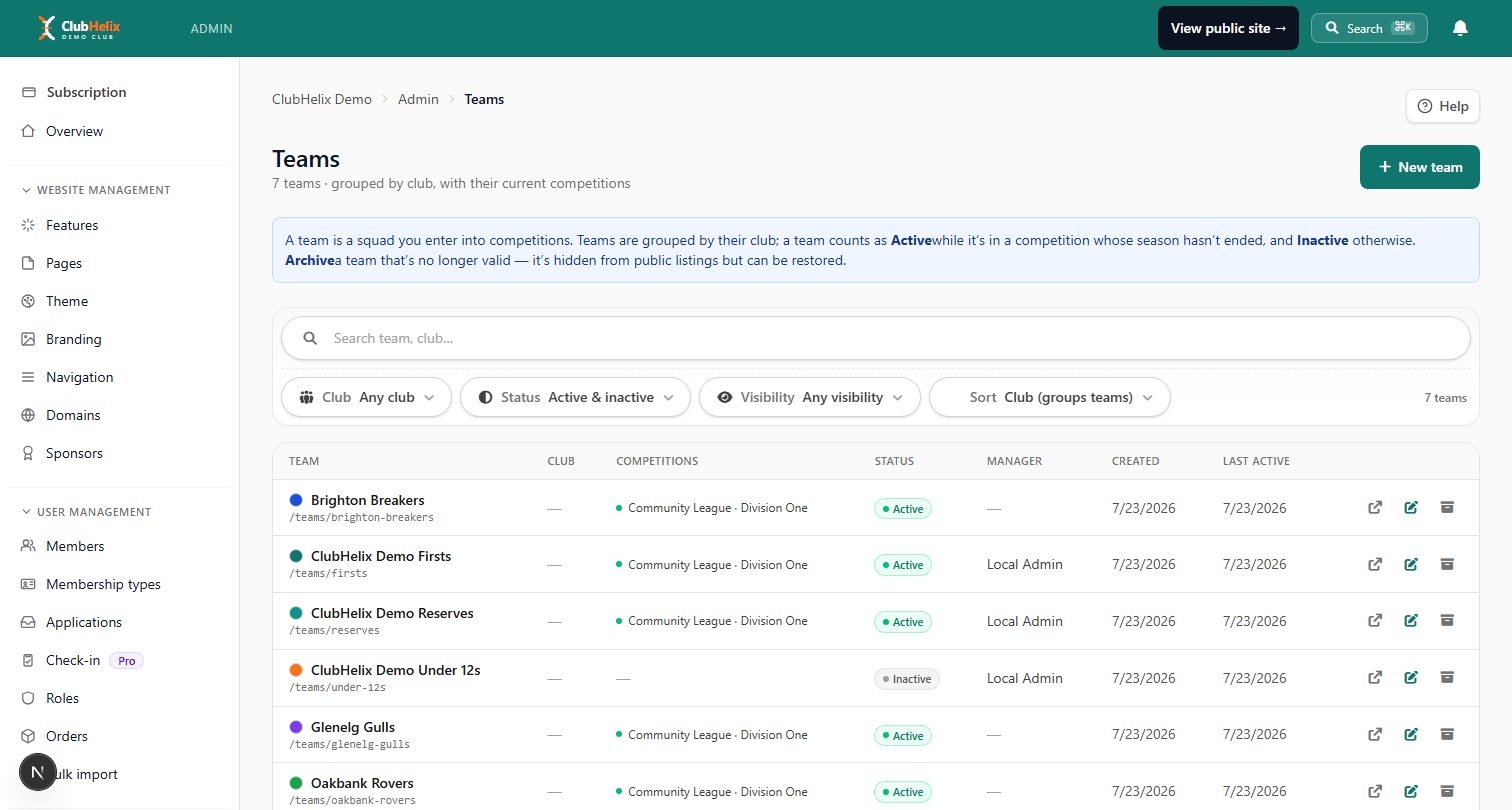
- Teams holds your club's age-group sections with their members, coaches and contact details, so the under-12s list is a thing in your club's records rather than a document somebody owns.
- Online registration lets families join on your own branded site, answering your questions and agreeing to your terms. A member record carries an optional date of birth and gender, used for age-group eligibility and for funding returns.
- Registration forms collect your own questions — uniform size, previous club, medical notes, "which club were you registered with last season" — with consent questions and digital waivers alongside them, so a photo consent is an answer on the record instead of a memory.
- A child can be on the roster without an account of their own, with a parent or guardian linked to the record, so notices about their team reach the adult rather than a nine-year-old's inbox.
- Credentials and checks are tracked against member records with their expiry dates, which is the register the clearance discipline above assumes you have.
Nominations themselves stay between you and your association, through whatever portal it runs — although if your association is itself on ClubHelix, affiliated clubs can nominate teams through their own login. And if you charge junior fees, sibling and family rates apply automatically at checkout — second child, third child and onwards, or a family maximum — with no code to type, and promo codes stack on top.
Write the five wash-up numbers down where next season's coordinator will find them: the counts your club already keeps live in your own reports, and the rest belong in the minutes. Plans are on the pricing page, and you can start a club on the free tier and have registration open before the intention check goes out.
Frequently asked questions
How many junior teams should we nominate?
Nominate on commitments rather than hopes: run a one-question intention check with last season's families, apply your own recent return rate to the newcomers, and nominate the sides you can genuinely fill. Then ring your association and ask how late an extra team can be added and whether a combined team with a neighbouring club is acceptable — that answer is what lets you nominate honestly instead of optimistically.
What happens if a child turns the next age up mid-season?
Nothing, in almost every competition: age groups are set by your association's cut-off date or birth year and hold for the whole season, so a child who has a birthday in round eight finishes the season in the team she started it in. Put that sentence in your welcome note and you will spend the season not explaining it.
Can a junior play up in an older age group?
Usually yes, but only with your association's written approval, and some sports add a size or safety assessment for contact grades. Get the approval on file before the first game rather than after somebody protests, because a player used without it is an ineligible player and the result can be reversed.
Does a child need their own email address to register?
No, and inventing one for them is a mistake that compounds. The child is the member and the parent or guardian is the contact of record, so the child's record should be complete — name, date of birth, team, medical notes, consents — while every notice about that child goes to a named adult who has agreed to receive it.
When should we start coaches' and managers' clearances?
The week you recruit them, which in practice is about eight weeks before round one. Whatever the check is called where your club operates, the delay is rarely the processing — it is the fortnight between a volunteer agreeing and that volunteer filling in the form, and nobody starts on the promise that the paperwork is coming.

