
What this guide answers
- How many renewal reminders should a club send?
Three to five touches over about six weeks: an opening email, one or two reminders, an SMS near the deadline, and a personal follow-up afterwards.
- When should membership renewal reminders start?
Open renewals four to six weeks before your deadline — ideally right after the season ends, while enthusiasm is highest.
- How do you chase unpaid club fees without being awkward?
Assume forgetfulness, keep every message warm, and make paying take under two minutes.
- Should renewal reminders go by email or SMS?
Use email for the main sequence, because it carries detail and links well, and add SMS in the last few days before the deadline when immediacy matters most.
UK edition. This guide is written for volunteer-run clubs in the UK. Where rules differ — grants, tax, incorporation, safeguarding — follow the UK-specific pointers below or check with your national body.
Almost nobody who fails to renew their club membership has actually decided to leave. They meant to do it, the email arrived during school pickup, and three weeks later it's buried under 200 others. That's the real enemy of renewals: not disloyalty, but friction and forgetting.
Which is good news, because friction and forgetting are fixable. A short, well-timed membership renewal reminder sequence — with a payment link that works in under two minutes — routinely recovers most "lapsed" members without a single awkward conversation. Here's the sequence, the tone rules, and copy-ready email and SMS templates you can use this season.
Why renewal reminders fail
Before the templates, it's worth knowing the four mistakes that sink most clubs' renewal campaigns:
- One email, sent once. A single reminder catches maybe half your members at a moment they can act. The rest need a nudge — plan for three to five touches from the start, so the follow-ups don't feel like escalation.
- No link, or a hard link. "Fees are due, see the treasurer at training" adds a week of delay per member. Every reminder needs one tap-to-pay link. If members must download a form or do a bank transfer with a reference number, expect drop-off — our guide to collecting club membership fees online covers fixing this properly.
- Guilt-tripping. "It's disappointing that some members still haven't paid" punishes the 80% who did and hardens the 20% who haven't. Assume forgetfulness, never freeloading.
- Chasing people who already paid. Nothing torches goodwill faster. Your reminder list must exclude paid members automatically, which means your payment records and your email list have to be the same system (more below).
The renewal reminder sequence
Here's a sequence that works for a typical club season. Adjust the dates to your own renewal deadline.
One timing note: avoid landing your main renewal push in the middle of the summer holidays, when a large share of your list is away. If your club collects by Direct Debit rather than a single annual payment, the sequence below still applies but the trigger changes — you're chasing failed and cancelled mandates month by month rather than running one annual campaign, and a failed mandate deserves a friendlier first message than a genuine non-renewal, because it is usually just an expired bank card.
| Timing | Channel | Message |
|---|---|---|
| 4–6 weeks before deadline | Renewal open — warm, benefits-led, early-bird price if you offer one | |
| 2 weeks before | Friendly reminder — deadline, price, one link | |
| A few days before | SMS | Short nudge — "closes Friday", link |
| Deadline day | Last call — what happens after today | |
| 1–2 weeks after | Email or personal call | "We miss you" — personal, door left open |
Two principles hold the sequence together. First, each touch only goes to people who haven't paid yet — the list shrinks every round. Second, the tone stays warm the whole way; only the urgency changes. You're reminding a friend about something they wanted to do anyway.
Timing notes
- Open renewals before the break, not after. Members are most attached to the club in the glow of the season just played. A renewal email the week after presentation night, with next season's dates, converts far better than a cold email in the pre-season.
- Early-bird pricing works. Even a modest discount for renewing by a date gives your first email a genuine reason to act now, and pulls most of your cash flow forward. Our guide on how much club membership should cost covers structuring fees.
- SMS is your deadline weapon. Emails get read eventually; texts get read now. Save SMS for the final days when "eventually" is too late.
The email templates
Copy, replace the square brackets, send. Each one is deliberately short — renewal emails are read on phones, mid-life.
Template 1 — renewal open (4–6 weeks out)
Subject: [Year] renewals are open — you're 2 minutes from done
Hi [First name],
It's renewal time at [Club Name]. Lock in your spot for [year] here: [link] — it takes about two minutes and payment is online.
Fees this year: [amount] ([what's included]). Renew by [early-bird date] and pay [discounted amount].
The season starts [date], and after a year like the last one — [one genuine highlight] — we can't wait to see you back.
[Name], [Role]
Template 2 — friendly reminder (2 weeks out)
Subject: Reminder: [Club Name] renewal closes [date]
Hi [First name],
Just a quick reminder that renewals close on [date]. If you meant to do it and life got in the way (it happens to all of us), here's the link: [link].
Two minutes, all online. If anything about the fee is a stretch right now, reply to this email and we'll work something out — no fuss, no drama.
[Name], [Role]
That second paragraph is the most important in the whole sequence. Cost is the silent reason behind many lapses, and a genuine, low-key offer of instalments or a payment plan keeps families at the club who would otherwise quietly drift away.
Template 3 — deadline day
Subject: Last call — renewals close today
Hi [First name],
Today's the day: renewals for [year] close tonight. Here's the link one more time: [link].
After today, [what happens — e.g. you'll drop out of team allocations for round one / the fee goes to the standard rate].
If something's holding you up, reply and tell me — there's almost always a way through.
[Name], [Role]
Note what this email doesn't do: it doesn't scold, and the consequence is a fact, not a threat.
Template 4 — the "we miss you" (1–2 weeks after)
Subject: We'd love to have you back at [Club Name]
Hi [First name],
I noticed you haven't renewed for [year] and wanted to check in personally. If you're moving on — no hard feelings at all, and thank you for everything you've given the club.
But if it just slipped by, the door's open: [link].
And if something about the club, the fees or the season put you off, I'd honestly love to hear it — reply and tell me straight.
[Name], President

For long-standing members, replace this email with a phone call. Five minutes of a committee member's voice recovers members no template can — and when someone really is leaving, the feedback question turns a loss into your best retention intelligence.
The SMS templates
Keep texts under 160 characters, always with the link:
- Pre-deadline nudge: "Hi [name], [Club] renewals close Fri! 2 mins online: [link] — see you out there. [Your name]"
- Deadline day: "Last day to renew for [Club]! [link] Reply if you need a hand. [Your name]"
- Payment plan follow-up: "Hi [name], no stress on the fees — reply YES and I'll set up instalments. [Your name], [Club]"
Make renewing take two minutes
The sequence above only works if the link at the end of it is genuinely easy. The gold standard is online self-service registration: the member taps the link, their details are pre-filled from last season, they confirm, pay by card, and get a receipt — done before the kettle boils. Every extra step (printing a form, finding BSB details, inventing a payment reference) costs you real renewals.
Just as important is what happens on your side. When payments and your member list live in one system, every renewal automatically updates the member's paid-up status — so your next reminder round excludes them without anyone maintaining a spreadsheet.
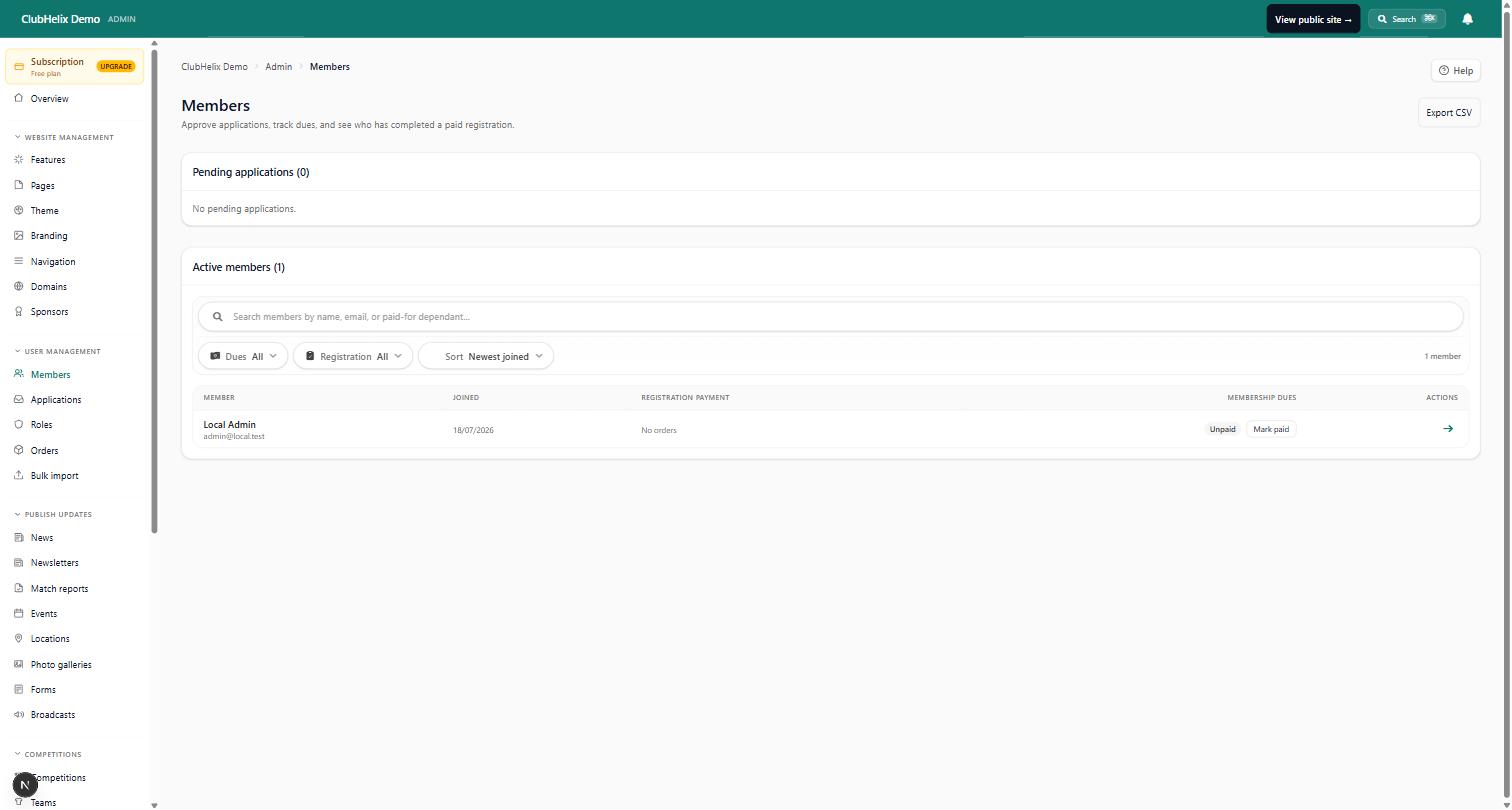
That one screen answers the question every treasurer dreads at committee meetings: who actually hasn't paid? Filter to unpaid members, select all, send the reminder — thirty seconds instead of a Sunday afternoon of cross-checking bank statements.
Chasing genuinely unpaid fees
A handful of members will still be unpaid after the full sequence. Three rules for that last mile:
- Go personal, not broadcast. From here it's one-to-one messages or calls from someone who knows them — ideally their team manager or coach, not "the club".
- Have a policy and apply it evenly. Agree in committee what unpaid means in practice (for example: not selected for competitive fixtures after round two) — enforcing it ad hoc against one family is how clubs end up in fights.
- Always leave the payment-plan door open. The goal is a paid-up member next month, not a point proven this week. Instalments recover far more fees than ultimatums.
If you'd like the whole pipeline in one place — pre-filled online renewals, card payments, automatic paid-up tracking, and reminder broadcasts and SMS that only ever reach unpaid members — that's exactly what ClubHelix does, with a free tier to start on. Have a look at pricing or create your club and set up your first renewal campaign this week.
Frequently asked questions
How many renewal reminders should a club send?
Three to five touches over about six weeks: an opening email, one or two reminders, an SMS near the deadline, and a personal follow-up afterwards. Each round should only go to members who haven't yet paid.
When should membership renewal reminders start?
Open renewals four to six weeks before your deadline — ideally right after the season ends, while enthusiasm is highest. Starting earlier than that tends to produce "I'll do it later", which is the exact problem you're solving.
How do you chase unpaid club fees without being awkward?
Assume forgetfulness, keep every message warm, and make paying take under two minutes. For the final few, switch to personal one-to-one contact and offer a payment plan — instalments recover more fees than pressure ever does.
Should renewal reminders go by email or SMS?
Use email for the main sequence, because it carries detail and links well, and add SMS in the last few days before the deadline when immediacy matters most. Texts get read within minutes, which makes them ideal for "closes Friday" nudges.

