
What this guide answers
- A member insists they paid cash months ago and we have no record. What now?
Treat the first instance as the club's failure, not the member's — because it probably was.
- Should unpaid members be allowed to train and play?
During the grace period, yes — the first weeks of a season are chaotic and plenty of good-faith members are a fortnight behind.
- How do we handle families who genuinely cannot afford the fees?
Have the path built before it is needed: a payment plan or fee relief that one or two named officers can approve privately, plus knowledge of any fee-assistance schemes in your area (many exist for junior sport — your…
- What should we do about long-term non-payers at season's end?
Follow your constitution — most provide that unfinancial members lapse after a defined period, which cleanly resets the register for next season.
Canada edition. This guide is written for volunteer-run clubs in Canada. Where rules differ — grants, tax, incorporation, safeguarding — follow the Canada-specific pointers below or check with your national body.
Round 6, committee meeting, general business. The treasurer mentions — carefully, because half the room is friends with the people involved — that eleven players are on the park unpaid. The registrar has a different number, because their list counts two who "definitely paid cash at the sausage sizzle". The coach has selected all of them, because nobody told the coach anything. Every club treasurer reading this has lived some version of the scene.
The problem is almost never that members refuse to pay. Community club members are, on the whole, honest people who forgot, or thought their partner paid, or genuinely believe the canteen cash they handed someone in March counted. The problem is that the club cannot answer the question — who has paid, right now, according to one list everyone trusts — and in the absence of a trusted answer, chasing feels like accusing. This guide is about building that answer, not about the chasing itself (we cover the reminder messages in membership renewal reminder templates and the payment mechanics in how to collect club fees online).
What "financial member" actually means — and why it matters
Most club constitutions hang real consequences off a single definition: a financial member is one whose fees are paid (or formally excused), and only financial members may vote at general meetings, be selected, hold committee positions, or be covered by certain club arrangements. Check your own constitution's wording — the phrase is standard in incorporated associations, and it quietly makes your who-has-paid list a governance document, not just a treasurer's convenience.
That is worth saying out loud at the start of each season, because it reframes the whole exercise. Chasing fees is not the club being petty about money; it is the club maintaining the register that determines who can vote at the AGM and who is inside the club's arrangements when something goes wrong. When the committee treats the list that way — a register with rules, not a nagging campaign — both the tracking and the conversations get easier.
Decide, and minute, three policies before the season starts:
- The grace period. How long after registration may someone train or play unpaid? Two weeks is common; whatever you choose, it applies to everyone, including the president's kids.
- The consequence. What happens at the deadline — ineligible for selection is the usual and fairest lever, because it is automatic rather than personal.
- The hardship path. Who can quietly approve a payment plan or a waiver, so that a family doing it tough has a dignified route that never appears on a public list. Usually the treasurer plus one other officer.
The one-list method
Everything that goes wrong in fee tracking comes from having more than one list. The registrar's spreadsheet, the treasurer's bank statement, the coach's memory and the paper forms in someone's car boot each hold a piece of the truth, and reconciling them is the volunteer-hour black hole. The fix is structural, not disciplinary:
Rule 1: payment status lives on the member record. One system holds the member list, and each member's paid/unpaid state is a field on their record — not a separate document. When someone asks "has Priya paid?", there is exactly one place to look. This is how online registration platforms work by design: the member registers, pays in the same flow, and the record marks itself paid the moment the money arrives. Nobody transcribes anything, which means nobody mistranscribes anything.
Rule 2: money only arrives through doors that update the list. Online payment at registration is the front door and updates the record automatically. Every other door — the cash at training, the bank transfer with the mystery reference — is only acceptable if a named person records it against the member the same week. Most clubs are better served by closing the side doors: "all fees online, please" is a one-line policy that eliminates the entire category of cash-that-never-got-recorded, and our guide to collecting fees online covers how to make that painless.
Rule 3: the unpaid list is a filter, not a project. If rules 1 and 2 hold, "who hasn't paid" stops being something anyone compiles. It is the member list, filtered to unpaid — live, correct, and available to the registrar at training on a phone.
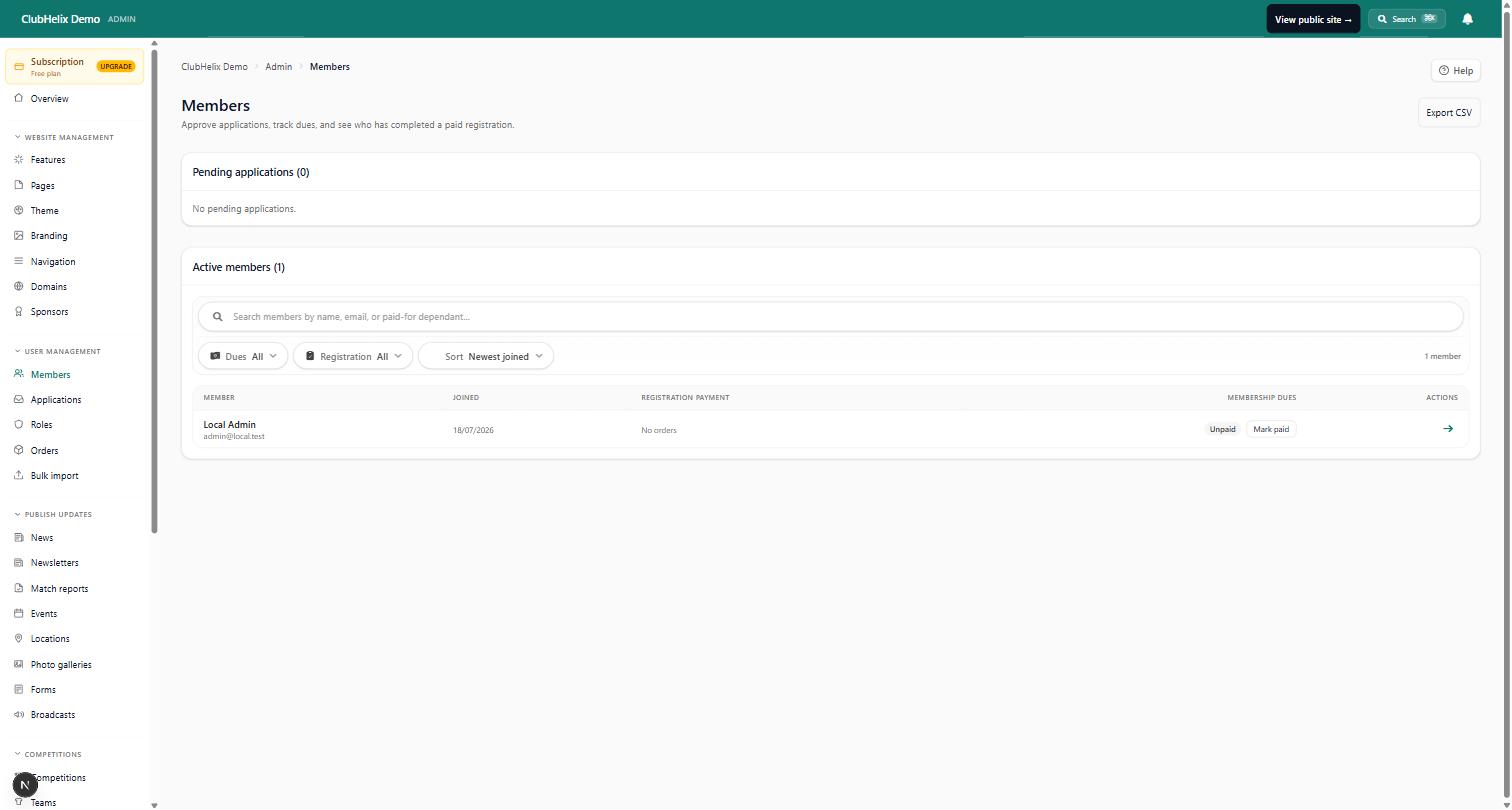
Rule 4: instalments count as a status, not a mystery. Plenty of families pay a season in parts — a deposit at sign-on and the balance across the term. Whatever arrangement you offer (registration forms on ClubHelix can take a fee in instalments), the member record should show the arrangement and where it is up to, so a part-paid family is never on anyone's "hasn't paid" list. Nothing sours goodwill faster than chasing someone who is exactly on schedule.
The treasurer's half: reconciliation and reporting
The registrar's question is who; the treasurer's question is how much, and whether the platform's number matches the bank's. A workable monthly rhythm:
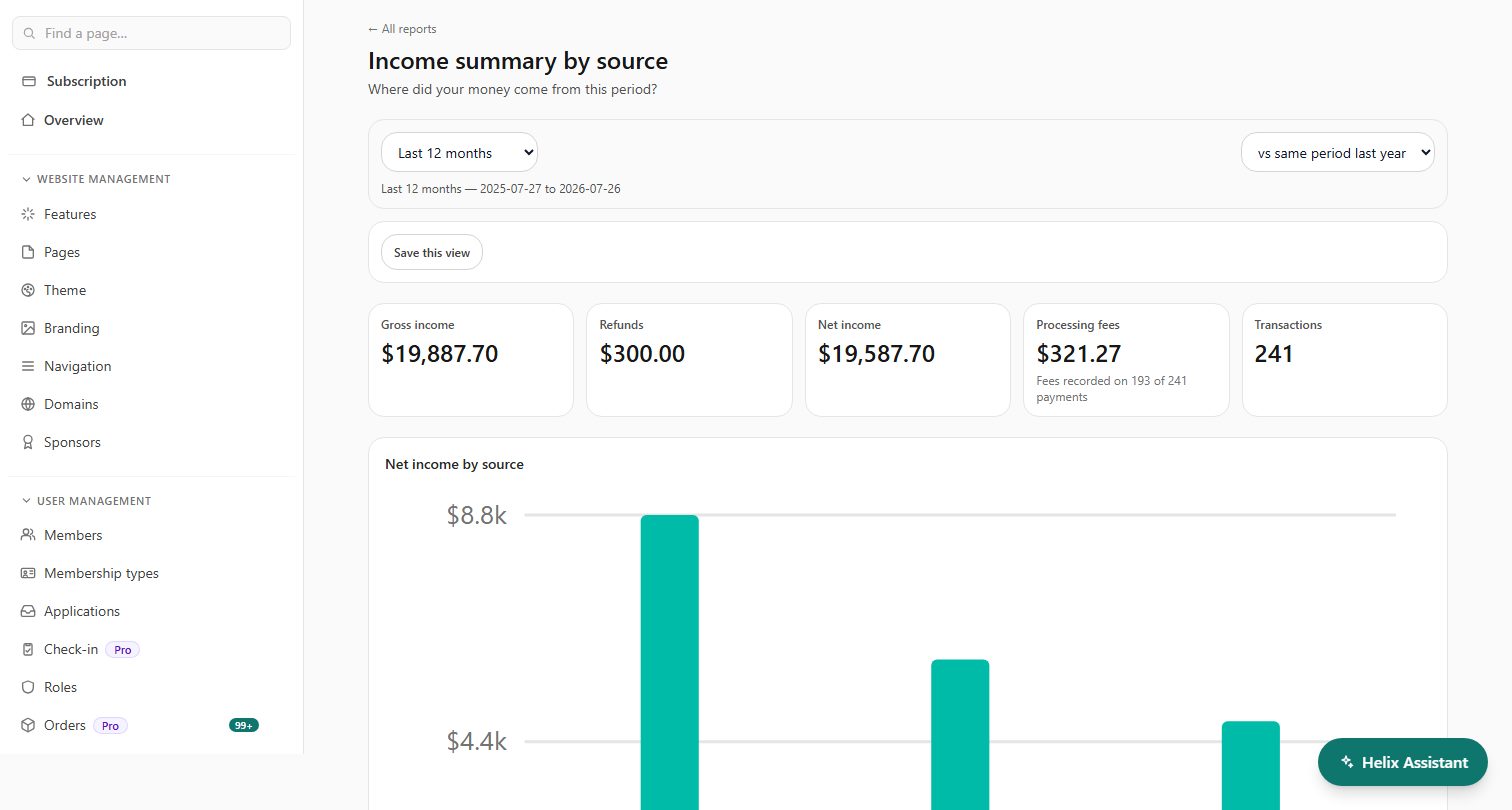
- Reconcile monthly, not in a June panic. Once a month, the fees recorded in the system are compared against the bank account. Online payments make this nearly automatic — each payout is itemised — while every cash side-door you allowed in rule 2 becomes a line to explain.
- Report the picture, not the names. The committee needs "fees: $14,200 of an expected $17,000, 31 members unpaid, 9 on payment plans" — numbers straight from the income reports. Individual unpaid names go to the registrar for follow-up and stay off the minutes; a name in committee minutes is a small-town embarrassment that outlasts the debt.
- Track expected, not just received. The powerful number is the gap: registered members × their fee, versus collected. A club that only watches the money arriving never notices the money that silently didn't.
Chasing without cringing
Even with a perfect list, someone has to press send. Three principles keep it civil:
- Let the system send the first two nudges. An automated reminder reads as process; a personal message reads as pursuit. Save the human touch for the third contact, when it carries actual warmth — "just checking everything's okay" — rather than the awkwardness of a friend asking a friend for money. Templates for the whole sequence are in our renewal reminders guide.
- Make paying instantly possible. Every reminder carries the payment link; the distance between "oh no, I forgot" and paid should be under a minute, on a phone.
- Apply the policy, not a judgement. When the grace period ends, the consequence you minuted happens — to everyone. The registrar never has to decide anything about any individual, which is precisely what makes the role survivable.
Frequently asked questions
A member insists they paid cash months ago and we have no record. What now?
Treat the first instance as the club's failure, not the member's — because it probably was. Accept their word, mark it paid with a note, and use the story (nameless) at the next committee meeting as the argument for closing the cash side-door: every unrecorded payment is a future dispute the club has already lost. If a pattern emerges around one member, that becomes a quiet conversation for the treasurer — but design the system so the situation cannot recur, rather than litigating each recurrence.
Should unpaid members be allowed to train and play?
During the grace period, yes — the first weeks of a season are chaotic and plenty of good-faith members are a fortnight behind. After it, the fairest widely-used consequence is selection ineligibility, because it is automatic, visible in advance and applies identically to everyone. What you should avoid is the discretionary version, where enforcement depends on who is asking — that is how committees end up accused of playing favourites. Check your constitution and your insurer's expectations for anything stricter your club is bound to.
How do we handle families who genuinely cannot afford the fees?
Have the path built before it is needed: a payment plan or fee relief that one or two named officers can approve privately, plus knowledge of any fee-assistance schemes in your area (many exist for junior sport — your governing body will know). The design goal is dignity — a family on an approved plan is a financial member in good standing, indistinguishable on every list from anyone else. What breaks clubs is having no path, so hardship cases either quietly leave or sit on the unpaid list all season being nagged.
What should we do about long-term non-payers at season's end?
Follow your constitution — most provide that unfinancial members lapse after a defined period, which cleanly resets the register for next season. Before anyone lapses, do one honest human check: a phone call, not another email, because a season of silence sometimes turns out to be an injury, a family crisis or an email address that died in March. Clubs that end the season with a clean register — everyone paid, on a plan, formally excused or lapsed — start the next one with a membership renewal that takes days instead of months.


