
What this guide answers
- How many periods should our competition use?
Use whatever your sport's sanctioned format for that age group and grade specifies, and only make your own choice where no format is prescribed.
- Should the score we record be the running total or the score in that period alone?
Either works, as long as every scorer in the competition does the same one and the published result says which it is.
- What do we do about extra time, golden point or a shootout?
Decide in advance whether it is recorded as extra periods on the match card or folded into the final score, and write that decision into the competition rules before round one.
- What if a match is abandoned halfway through?
Record the periods that were actually played and leave the rest blank rather than entering zeros, then apply whatever your competition rules say about an abandoned match — most commonly the result stands after a…
- Do sets and innings work the same way as quarters?
They are the same idea with a different trigger. A quarter ends when the clock does; a set ends when someone reaches a points target; an innings ends on wickets, outs or a ball limit.
South Africa edition. This guide is written for volunteer-run clubs in South Africa. Where rules differ — grants, tax, incorporation, safeguarding — follow the South Africa-specific pointers below or check with your national body.
Ask three volunteers at your club how long a junior game goes for and you will often get three answers. One says four twelves. One says four tens with a short break at the change of ends. The third says nobody told them, so they just watched what the other team's coach did and copied it.
That is not a coaching problem. It is a paperwork problem, and it has a fix that takes about twenty minutes before round one: decide how a match is divided, write it down in one place, and make sure the scorers and the website both use the same shape. This guide walks through the vocabulary sport by sport, how to choose period lengths for juniors, and what you gain once the score is recorded period by period rather than as a single number at the end.
Why the way you divide a match matters
The division of a match is not a cosmetic detail. Four practical things hang off it.
- Scoring. A scorer needs to know where one period stops and the next begins, because that is when they rule a line, total the column and start again. Get it wrong and the totals still add up, but you have lost the shape of the game.
- Substitutions and rotations. Most junior participation rules are written in period language: everyone on the court for at least two quarters, no player in the same position for more than two consecutive periods, rolling substitutions only at the break. If the periods are ambiguous, the rule is unenforceable.
- Timing and the clock. Period count multiplied by period length, plus breaks, is the block of time you have booked the court or ground for. It is also what tells the next team when to warm up.
- What spectators see. A scoreboard, a live score page and a match report all read better when they show the run of the game. Twenty-eight to twenty-four is a result. Seven-all, then a nine-point third quarter, is a story.
There is a fifth reason that only shows up later in the season: reviews and disputes. When a coach queries a result three weeks after the game, a final score gives you nothing to check against. A score recorded by period can be laid beside the scorer's sheet line by line, and the discrepancy is usually obvious in under a minute.
The vocabulary, sport by sport
Every sport divides a match, and almost every sport has its own word for the division. There is nothing clever going on — they are all the same idea with different names and different rules about what ends one.
| Sport | What a period is called | Usual count | What ends a period |
|---|---|---|---|
| Football (soccer) | Half | 2 | The clock |
| Hockey | Half or quarter | 2 or 4 | The clock |
| Rugby codes | Half | 2 | The clock |
| Netball | Quarter | 4 | The clock |
| Australian rules football | Quarter | 4 | The clock, plus time on |
| Basketball | Quarter | 4 | The clock |
| Ice hockey | Period | 3 | The clock |
| Tennis, volleyball, badminton, squash | Set or game | Best of 3 or 5 | A points target, won by a margin |
| Cricket, softball, baseball | Innings | 1, 2 or a fixed number | Wickets, outs or a ball limit |
| Lawn bowls, archery, curling | End | Varies by format | Every bowl, arrow or stone delivered |
| Polo | Chukka | 4 to 8 | The clock (plus the bell) |
| Roller derby, some indoor formats | Period or jam | 2 periods of timed jams | The clock or the jam |
Three things are worth pulling out of that table.
Timed periods versus target periods. A half or a quarter ends when the clock says so. A set or an end does not — it ends when somebody reaches a number, or when everyone has had a turn. That difference decides whether your match card needs a duration at all, and whether "period 3" is guaranteed to happen. In a best-of-five set match, period four and period five may never be played, and a blank is the correct record rather than a zero.
Some sports move. Hockey has been played as halves and as quarters at different levels in the same season. Junior formats routinely split a senior half into quarters so more children get a rest and a rotation. Do not assume this year matches last year — check the current rules from whoever sanctions your competition before you set it up.
The count is the part people get wrong. Almost nobody misnames a quarter. Plenty of people set up a four-quarter sport with two periods because the software defaulted that way and nobody looked.
Halves
Two periods, a break in the middle, ends swapped. It is the simplest shape and the reason so many systems default to it.
The thing to decide with halves is what happens when a match is drawn and the competition needs a winner. Extra time is usually two shorter halves of its own, which means your record of the match can end up with four periods rather than two. Decide in advance whether extra time is recorded as additional periods or folded into the final score, and tell the scorers which one you want. Either answer works. Two different answers on the same weekend do not.
Quarters
Four periods, with a short break at each change and a longer one at half time. Quarters exist mostly for participation and recovery: they create three natural moments to rotate players rather than one.
If your competition has a court-time or field-time rule, quarters are where it is enforced, so the quarter-by-quarter record is the evidence. A team manager who logs which children played which quarters has an answer ready when a parent asks why their child sat out. A team manager who wrote down only the final score does not.
Sets
A set ends at a points target, usually with a two-point margin and sometimes with a cap. The match ends when one side has won a majority of the sets, which is why sets are recorded as a sequence rather than a total.
This is the format where the period-by-period record is genuinely the result. "Three sets to one" means nothing without the set scores beside it, and the set scores are what a selector, a grader or a governing body will ask for. Record each set as its own line. Leave unplayed sets blank.

Innings
An innings ends on a condition rather than a clock: all out, a ball limit reached, a declaration, or a set number of outs. Junior formats often add their own conditions, such as a batting side retiring a player at a score or rotating every set number of balls.
Two practical notes. First, a limited-over match has two innings and a one-day two-innings format has four — the count is a decision about the competition, not about the sport, so check your own playing conditions. Second, the innings score is rarely just runs: wickets, overs faced and extras all matter to the people who read the result later. If your scoring sheet captures them, make sure your published result has somewhere sensible to put them, even if that is the match report rather than the score line.
Periods, thirds, ends and chukkas
The remaining names are the same idea again.
- Periods are what ice hockey calls its three divisions, and a useful generic word when your sport's own term is contested or varies by grade.
- Thirds turn up in some indoor and modified formats, and in training-style competitions where a third is a block rather than a timed period.
- Ends are the unit in bowls, curling and archery. A match is a count of ends, and the score is cumulative across them, so the end-by-end record doubles as the running score.
- Chukkas in polo are timed, short, and numerous — four to eight depending on the level — which makes the running record more important than it looks, because nobody remembers what happened in the third of eight.
Choosing period length for juniors
Where a governing body publishes a modified-rules format for an age group, use it. That is the short answer, and it is the right one, because the format is usually tied to ball size, field size, team size and the rules the coaches have been trained on. Deviating locally makes your players' experience inconsistent with every other competition they enter.
Where you genuinely have a choice — a social grade, an internal competition, a come-and-try series — these are the trade-offs to weigh.
- Total playing time first, then divide. Decide the block of time you have (a court booking, a ground slot, how long the youngest players can concentrate), subtract warm-up and breaks, then split the remainder. Working the other way round produces a session that will not fit.
- More periods for younger players. Shorter periods with more breaks suit shorter attention spans and hotter days, and they create more rotation points so more children get a turn in each position.
- Leave room for the changeover. A four-quarter junior game needs three breaks, and a break with coaching in it is never as short as the rule book says. Add it up honestly or the last quarter gets cut every week.
- Match the venue, not the ideal. If you have four teams sharing a court for two hours, the format has to fit two hours with a changeover, not the format you would run with unlimited court time.
- Write the heat and wet-weather variation in now. Decide in advance what a shortened match looks like — fewer periods, or shorter ones — and record which one was played. A guide to wet-weather communication is useful here, because the announcement and the scoring rule have to agree.
Whatever you settle on, publish it where coaches and parents will see it before the first match, not in the minutes of a committee meeting.
Write the scoring note before round one
The single highest-value thing you can do is a one-page note that every scorer, team manager and duty volunteer can read in two minutes. It does not need to be formal. It needs to be specific.
Cover these, in this order:
- How many periods, and what we call them. "Four quarters", not "the usual".
- How long each period runs, and whether the clock stops.
- How long the breaks are, including the longer one.
- What you write down at the end of each period. The running total, or the score in that period alone? Pick one and say which. This is the most common source of disagreement between two scorers at the same game.
- What happens if a period is not played. Leave it blank, do not enter a zero.
- What happens in extra time, a shortened match or an abandonment.
- Who gets the sheet at the end, and by when.
- Who to call when something is not covered by the note.
Print it, laminate it, and put a copy in every scorebox and score bench. Hand a copy to every new team manager in their induction pack. Volunteers are not inconsistent because they are careless; they are inconsistent because nobody ever told them what consistent looks like.
What period-by-period scores give you back
Once the score is recorded period by period, three things get better without any extra work.
Match reports write themselves. A writer with quarter scores has a structure handed to them: the tight first half, the goal burst after the main break, the defensive last quarter. A writer with one final score has to invent a narrative or write four bland sentences. If your club is building a reporting habit, our guide on how to write a match report works far better when the numbers are already broken up.
Reviews get faster. Selectors, coaches and graders look for patterns — the side that starts slowly, the team that fades late, the grade that is really two grades pretending to be one. None of that is visible in final scores alone.
Live updates get more interesting. A live score that moves at the end of each period gives the parent who could not get there something to follow, and gives the people at the ground a reason to check the page.
Setting the periods up in your competition
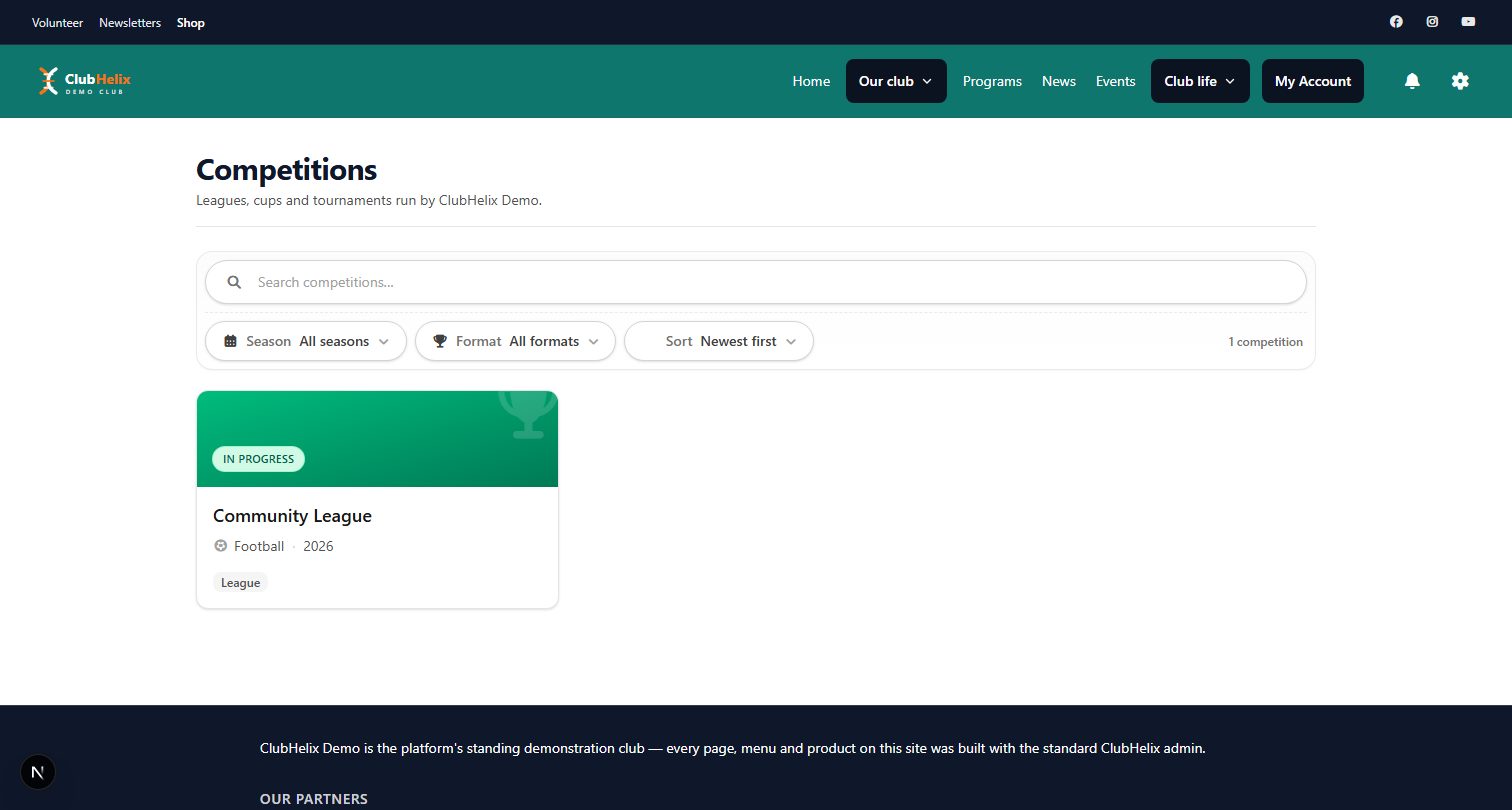
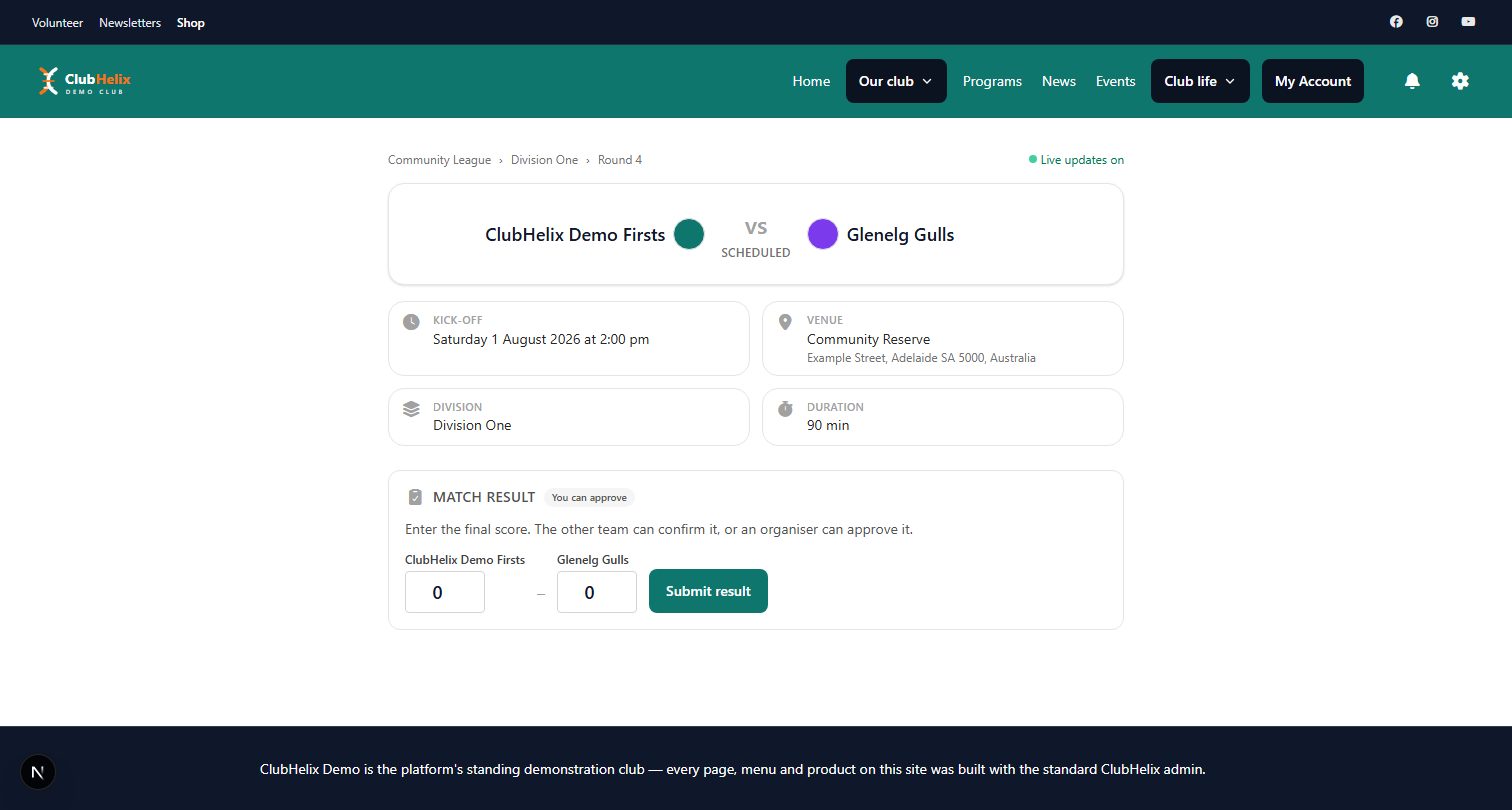
In ClubHelix, competitions are leagues and divisions with published fixtures and game schedules, entered-once results, and ladders that compute themselves. The part that matters for this guide is the match card: it records a score period by period, not just a final score, so the shape of the game survives into the published result.
That flows straight through to the live match centre, which carries live scores, lineups published once locked, allowlisted stream embeds and match reports on every fixture page. Because the periods are part of the record, the running score on a fixture page is the same record the scorer produced, rather than a second version of it typed somewhere else.
A few habits make it work smoothly:
- Decide the period shape when the competition is set up, before fixtures are published, so the first round's scorers never see a mismatch between the sheet and the screen.
- Use the same shape across a whole grade. A division where three teams record quarters and two record halves is a division whose results cannot be compared.
- If a governing body changes the format mid-season, change it once, centrally, and tell the scorers the same day. Read our guide on reporting to your governing body before you change anything that has already been submitted.
- Pair it with a sensible draw. Our guide on how to make a fixture draw covers the round-robin maths that decides how many matches your format has to fit into the season.
Frequently asked questions
How many periods should our competition use?
Use whatever your sport's sanctioned format for that age group and grade specifies, and only make your own choice where no format is prescribed. If you do get to choose, work backwards from the time you have booked, allow honestly for breaks, and lean towards more and shorter periods for younger players so there are more rotation points and more rest.
Should the score we record be the running total or the score in that period alone?
Either works, as long as every scorer in the competition does the same one and the published result says which it is. Period-only scores are easier to read as a story of the game and easier to check against a scorer's sheet. Running totals are easier for a scoreboard operator. Pick one, put it in the scoring note, and do not change it mid-season.
What do we do about extra time, golden point or a shootout?
Decide in advance whether it is recorded as extra periods on the match card or folded into the final score, and write that decision into the competition rules before round one. The important thing is not which answer you choose but that every match in the competition uses the same one, because a finals dispute is the worst possible time to be working it out.
What if a match is abandoned halfway through?
Record the periods that were actually played and leave the rest blank rather than entering zeros, then apply whatever your competition rules say about an abandoned match — most commonly the result stands after a nominated point, or the match is replayed, or points are shared. A blank period says "not played". A zero says "played and nobody scored", which is a different and usually untrue claim.
Do sets and innings work the same way as quarters?
They are the same idea with a different trigger. A quarter ends when the clock does; a set ends when someone reaches a points target; an innings ends on wickets, outs or a ball limit. The practical difference is that a later set or innings may never be played at all, so your record needs to distinguish a period that was not reached from a period that finished scoreless.
Where should we publish the format so people actually see it?
Put it on the competition page on your website, in the pre-season pack that goes to coaches and team managers, and on a printed card in the scorebox. Three places sounds like overkill until the first Saturday of the season, when the person doing the scoring is a parent who volunteered nine minutes ago and has never seen your website.
The format you choose matters less than writing it down once and using it everywhere. Fix it before round one and the rest of the season is just filling in the boxes.

